The Promise of the Porsche Wireless Charger
For years, the idea of parking your EV over a pad and walking away—no cable, no connector, no dirty hands—has lived in concept-car brochures. In 2026, the Porsche wireless charger is inching closer to reality as part of the brand's broader push into inductive charging technology, initially targeted at the Taycan and future EV platforms. But what does wireless charging actually deliver in terms of speed, cost, and practicality compared to a conventional Level 2 home charger? And if you're a Porsche owner—or any EV driver—what should you actually install in your garage today?
This guide breaks down the current state of the Porsche wireless charging system, compares it head-to-head with wired Level 2 charging, and walks through every decision you need to make for a complete home EV charging setup: electrical requirements, panel upgrades, connector compatibility, real costs, and the best equipment on the market.
How Wireless EV Charging Works (and Where Porsche Stands)
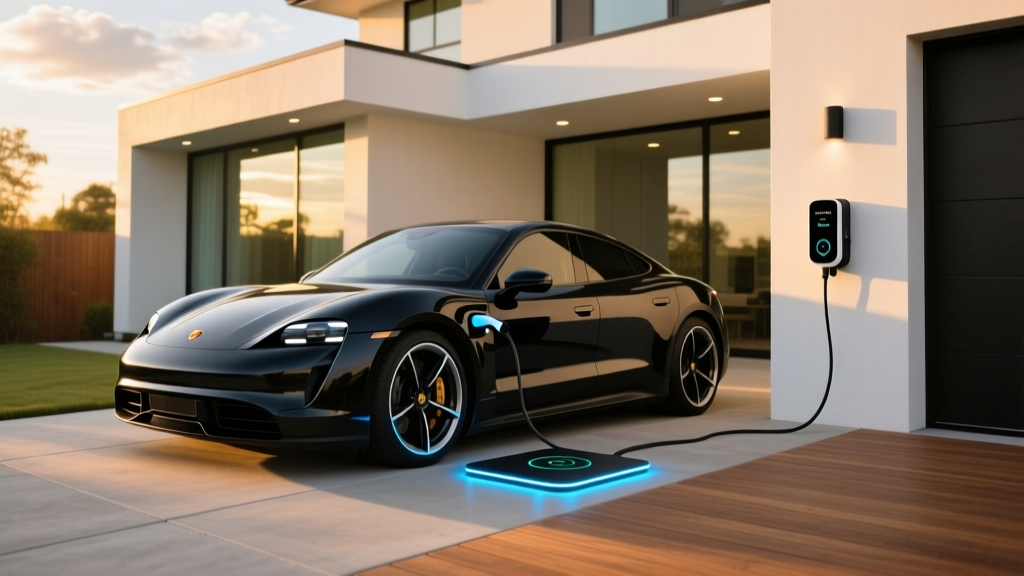
Inductive charging uses electromagnetic fields to transfer energy between a ground-mounted transmitter pad and a receiver coil on the vehicle's underbody. The Porsche wireless charger system, developed in collaboration with WiTricity and previewed at multiple auto shows, targets a power transfer rate of approximately 11 kW—comparable to a standard wired Level 2 connection. Porsche has indicated efficiency rates around 90%, which is competitive with wired charging, though real-world alignment sensitivity and ground clearance can affect performance.
As of early 2026, Porsche's inductive charging system remains in limited pilot and pre-production phases, not yet available as a dealer-installed option on the Taycan. The system requires both a garage- or driveway-mounted pad (estimated at $3,000–$5,000 for the ground unit and installation) and a factory-equipped receiver on the vehicle—a feature not yet listed on any current Taycan trim's option sheet.
Charging Levels Explained: Speeds, Power, and Range Added
Whether you're waiting for wireless or plugging in today, understanding the three charging levels is essential. Power is measured in kW (kilowatts)—the rate of energy flow—while your battery capacity is measured in kWh (kilowatt-hours)—the total energy stored. Confusing these two is the single most common mistake in EV ownership research.
| Level | Voltage | Power (kW) | Miles of Range per Hour | Typical Use Case |
|---|---|---|---|---|
| Level 1 | 120V AC | 1.0–1.4 kW | 3–5 mi/hr | Overnight trickle; PHEV-friendly |
| Level 2 (Home) | 240V AC | 7.2–11.5 kW | 20–44 mi/hr | Daily home charging standard |
| Level 2 (Porsche Wireless) | Inductive | ~11 kW (est.) | ~35–42 mi/hr (est.) | Cable-free garage/pad charging |
| DC Fast Charge | 400–800V DC | 50–350 kW | 150–1,000+ mi/hr | Road trips, highway corridors |
For context, a 2025 Porsche Taycan 4S with the larger 93.4 kWh (gross) Performance Battery Plus needs roughly 9 hours on a 9.6 kW Level 2 charger for a full 10–100% session. On a 350 kW DC fast charger, that same Taycan peaks at up to 270 kW and can charge from 10–80% in approximately 22.5 minutes under ideal thermal conditions—though the charge curve tapers significantly above 80% SoC to protect the battery.
Home Charger Installation: Electrical Requirements and Real Costs
Whether you're installing a wired Level 2 charger today or preparing for a future wireless pad, the electrical infrastructure in your home is the foundation. Here's what's typically required:
Core electrical specs for a Level 2 home charger:
- Voltage: 240V (same as a dryer or oven outlet)
- Amperage: 40A circuit for a 32A continuous charger, or 50A circuit for a 40A continuous charger (NEC requires circuits rated at 125% of continuous load)
- Dedicated circuit: Required—the charger cannot share a breaker with other appliances
- GFCI protection: Required by NEC 2020 and later for EV supply equipment
- Outdoor rating: If the charger is mounted outside, both the unit and the receptacle must be NEMA 4 or NEMA 4X rated for weather resistance
Installation Cost Breakdown
The total cost to install a home Level 2 charger varies enormously depending on your home's electrical panel, the distance from panel to charger location, and local permit fees. Here is a realistic range for 2026:
| Component | Low-End Estimate | High-End Estimate | Notes |
|---|---|---|---|
| Level 2 Charger Unit (Equipment) | $350 | $750 | Hardwired or NEMA 14-50 plug; Wi-Fi-enabled smart chargers cost more |
| Electrician Labor (Standard Install) | $500 | $1,500 | Depends on run length, conduit needs, drywall work |
| Electrical Permit | $50 | $250 | Varies by municipality; some jurisdictions bundle with inspection |
| Panel Upgrade (If Needed) | $1,500 | $4,500 | Required if panel is 100A or has no spare breaker slots; 200A upgrade typical |
| Total (No Panel Upgrade) | $900 | $2,500 | Most homes with 200A service fall in this range |
| Total (With Panel Upgrade) | $2,400 | $6,750 | Older homes (pre-2000) often need this |
Panel upgrade reality check: If your home has a 100-amp main panel, or if your panel has no available breaker spaces, an upgrade to 200A service is often required before adding a 40A or 50A dedicated EV circuit. This is the single biggest cost surprise for new EV owners in older homes. Budget accordingly and get a licensed electrician's assessment before purchasing equipment.
According to the U.S. Department of Energy, some utility companies offer rebates of $250–$1,000 for home charger installation, which can offset a significant portion of the cost. Check with your local utility before scheduling work.
Connector Compatibility: What Plugs Into What
The North American charging connector landscape has shifted dramatically. As of 2026, the NACS (North American Charging Standard), originally developed by Tesla, has been adopted by Ford, GM, Rivian, Hyundai, Kia, BMW, and others. Porsche, however, continues to use the CCS1 (Combined Charging System) connector on the Taycan and Macan EV, though the brand has signaled future NACS adoption for upcoming models.
| Connector | Brands Using It (2026 Models) | Adapter Needed? |
|---|---|---|
| NACS (Tesla) | Tesla, Ford, GM, Rivian, Hyundai, Kia, BMW, Volvo, Polestar | CCS-to-NACS adapter for older CCS vehicles at Superchargers |
| CCS1 | Porsche Taycan/Macan EV, VW ID.4 (2024 and earlier), Audi e-tron (pre-2026), Stellantis EVs | NACS-to-CCS adapter for Tesla Supercharger access |
| CHAdeMO | Nissan Leaf (legacy); essentially discontinued on new models | Limited adapter options; network shrinking |
If you own a Porsche Taycan today, you'll charge at home via a J1772 connector (the AC standard that all Level 2 chargers use, with CCS1 being the DC extension of it). For public DC fast charging, you'll use CCS1 at Electrify America and similar networks. Porsche has provided Taycan owners with complimentary Electrify America charging sessions, but long-term access requires a paid plan.
For the future Porsche wireless charger system, no physical connector is involved—the ground pad communicates with the vehicle's receiver coil via near-field alignment. This eliminates connector compatibility concerns entirely, but only if both the pad and vehicle are factory-equipped for the system.
Cost to Charge: Home vs. Public vs. Gas
One of the strongest economic arguments for EV ownership is the per-mile fuel cost advantage. Here's how charging costs break down across different scenarios, using the 2025 Taycan 4S (EPA-rated at approximately 83 MPGe combined, consuming roughly 40 kWh/100 miles) as a reference:
| Scenario | Rate | Cost per 100 Miles (Taycan 4S) | Cost per Mile |
|---|---|---|---|
| Home Off-Peak (Time-of-Use) | $0.09/kWh | $3.60 | $0.036 |
| Home Standard Rate | $0.16/kWh | $6.40 | $0.064 |
| Public Level 2 (ChargePoint, etc.) | $0.25–$0.39/kWh | $10.00–$15.60 | $0.10–$0.16 |
| DC Fast Charging (Electrify America) | $0.38–$0.55/kWh | $15.20–$22.00 | $0.15–$0.22 |
| Gasoline (25 MPG, $3.40/gal) | $3.40/gallon | $13.60 | $0.136 |
Home charging on an off-peak rate is dramatically cheaper than gasoline—roughly 74% less per mile compared to a 25 MPG gas car at $3.40/gallon. Even public DC fast charging, the most expensive EV option, is often comparable to or slightly above gas costs, making home charging the clear economic strategy.
The Porsche wireless charger, at an estimated 90% efficiency, would add roughly 10% overhead to your electricity cost versus a wired Level 2 connection. On a $0.16/kWh rate, that's the difference between $6.40 and $7.04 per 100 miles—a small premium for the convenience of cable-free charging.
Best Level 2 Home Chargers for 2026 (Equipment Picks)
While the Porsche wireless charger remains forthcoming, here are the top wired Level 2 chargers for home installation in 2026, selected for reliability, power output, smart features, and value:
ChargePoint Home Flex
- Power Output: Up to 12 kW (50A circuit) / configurable down to 16A
- Connector: J1772 (NACS adapter available separately)
- Cable Length: 23 feet
- Smart Features: Wi-Fi, app scheduling, utility TOU integration, Alexa support
- Price: ~$549 (unit only)
- Best For: Most EV owners; flexible amperage for older panels
Emporia Level 2 EV Charger
- Power Output: Up to 11.5 kW (48A on 60A circuit)
- Connector: J1772
- Cable Length: 24 feet
- Smart Features: Wi-Fi, real-time energy monitoring via Emporia app, solar integration
- Price: ~$399 (unit only)
- Best For: Budget-conscious buyers wanting smart features and solar pairing
Wallbox Pulsar Plus
- Power Output: Up to 11.5 kW (48A)
- Connector: J1772 (NACS version now available)
- Cable Length: 25 feet
- Smart Features: Wi-Fi + Bluetooth, Power Sharing (daisy-chain two units on one circuit), app control
- Price: ~$649
- Best For: Two-EV households; compact form factor
Tesla Wall Connector (Gen 3)
- Power Output: Up to 11.5 kW (48A)
- Connector: NACS native; J1772 adapter included for non-Tesla EVs
- Cable Length: 24 feet
- Smart Features: Wi-Fi, OTA updates, power sharing, load management
- Price: ~$450
- Best For: NACS-equipped vehicles; best value at this power level
For Porsche Taycan owners today, the ChargePoint Home Flex or the Porsche Mobile Charger Connect (Porsche's own branded unit, rated at up to 9.6 kW on a 40A circuit, priced around $650) are the most common choices. The Taycan's onboard AC charger is limited to 9.6 kW (standard) or optionally 19.2 kW (with the 22 kW onboard charger option), so pairing it with a 48A charger ensures you maximize that capability.
Charging Time Examples: What to Expect
Real-world charging times depend on battery size, onboard charger capacity, and the power output of your charger. Here are representative examples using common 2026 EV battery sizes:
| Battery Size (Usable kWh) | 7.2 kW Charger | 9.6 kW Charger | 11.5 kW Charger | 150 kW DC Fast | 270 kW DC Fast |
|---|---|---|---|---|---|
| 40 kWh (e.g., Nissan Leaf) | 3 hrs 53 min | 2 hrs 55 min | 2 hrs 26 min | ~18 min | N/A |
| 72 kWh (e.g., Hyundai Ioniq 5) | 7 hrs | 5 hrs 15 min | 4 hrs 23 min | ~18 min | ~18 min |
| 83.4 kWh (e.g., Taycan Perf. Batt. Plus) | 8 hrs 6 min | 6 hrs 5 min | 5 hrs 3 min | ~25 min | ~22 min |
| 100 kWh (e.g., F-150 Lightning Ext.) | 9 hrs 43 min | 7 hrs 17 min | 6 hrs 5 min | ~35 min | ~30 min |
Important caveats: DC fast charging times assume optimal battery preconditioning and ambient temperatures above 60°F. In cold weather (below 32°F), expect DC fast charging times to increase by 20–40% due to reduced lithium-ion charge acceptance. The charge curve also tapers sharply above 80% SoC—charging from 80–100% on DC fast can take as long as 10–80%, which is why road-trip strategy focuses on the 10–80% window.
Safety, Code, and Best Practices
EV charging involves sustained high-current draw over many hours, making proper installation non-negotiable. Key safety and code considerations include:
- Dedicated circuit: NEC Article 625 requires EV supply equipment to be on a dedicated branch circuit with no other outlets or loads.
- GFCI breaker: Required for all EV charging circuits. Some chargers have built-in GFCI, but the breaker should also be GFCI-protected per NEC 2020+.
- Hardwired vs. plug-in: Hardwired installations (no plug) allow higher amperage (up to 48A on a 60A circuit) and eliminate receptacle wear. Plug-in NEMA 14-50 installations are limited to 40A (32A continuous) and offer portability if you move.
- Outdoor rating: Any outdoor charger must carry a NEMA 4 rating. Ensure the electrician uses weatherproof conduit and fittings.
- Permit and inspection: Skipping the permit to save $100 can void your homeowner's insurance coverage for electrical fires. Always pull a permit and pass inspection.
- Cable management: Use a wall-mounted cable organizer to prevent tripping hazards and cord damage, especially in shared driveways.
For the future Porsche wireless charger pad, similar permitting and electrical requirements will apply—the ground pad requires its own dedicated 240V circuit, and installation will need to meet local code for outdoor or garage-mounted electrical equipment.
Frequently Asked Questions
How much does it cost to install a home EV charger?
A standard Level 2 home charger installation costs between $900 and $2,500 if your electrical panel has sufficient capacity (200A service with spare breaker slots). If a panel upgrade is needed, total costs can range from $2,400 to $6,750. Equipment alone ranges from $350 to $750. Utility rebates can offset $250–$1,000 of the total.
How fast will each charging level add range?
Level 1 (120V) adds approximately 3–5 miles per hour. Level 2 (240V) adds 20–44 miles per hour depending on amperage and the vehicle's onboard charger. DC fast charging adds hundreds of miles in 20–30 minutes. The Porsche wireless charger targets approximately 35–42 miles per hour, similar to a wired 11 kW Level 2 connection.
Which connector/charger is compatible with my EV?
Check your vehicle's charge port. Porsche Taycan and Macan EV use CCS1 for DC and J1772 for AC Level 2. Tesla, Ford, GM, Hyundai, Kia, and others now use NACS. All Level 2 home chargers output via J1772 or NACS; adapters are available for cross-compatibility. The Porsche wireless charger eliminates the connector entirely but requires factory-equipped vehicles.
How much does charging cost per mile vs. gas?
Home charging on a standard rate of $0.16/kWh costs approximately $0.04–$0.07 per mile depending on vehicle efficiency. Gasoline at $3.40/gallon in a 25 MPG vehicle costs $0.136 per mile. Home charging is typically 50–75% cheaper per mile than gasoline. Public DC fast charging at $0.48/kWh is roughly comparable to gas costs.
What electrical upgrades might I need?
The most common upgrade is a panel upgrade from 100A to 200A service, costing $1,500–$4,500. You may also need additional breaker slots, a new conduit run from panel to garage, or a sub-panel installation if your garage is far from the main panel. A licensed electrician can assess your home's capacity during a site visit—many offer free or low-cost evaluations.
Is the Porsche wireless charger available to buy now?
No. As of 2026, the Porsche wireless charger is in pilot testing and is not available as a consumer product. Porsche has not announced a specific launch date or compatible vehicle trims. Taycan owners should plan for conventional wired Level 2 home charging and CCS1 DC fast charging for the foreseeable future.