If you've been researching home EV charging equipment, you've likely encountered the Wallbox Pulsar Plus charger 5.7 kW — a compact, smart Level 2 unit that sits at an interesting crossroads of price, power output, and installation simplicity. At 5.7 kW (roughly 24 amps on a 240V circuit), it delivers less peak power than the 48-amp chargers dominating most "best-of" lists, but that lower output is precisely what makes it practical for homes with older electrical panels, limited breaker space, or budget-conscious buyers who don't need 11.5 kW of charging muscle.
After installing and testing the Pulsar Plus 5.7 kW on multiple vehicles — from a 62 kWh Nissan Leaf to an 82 kWh Ford Mustang Mach-E — here's what real-world ownership looks like, along with a full breakdown of installation costs, electrical requirements, and how this charger fits into the broader Level 2 landscape in 2026.
What Does 5.7 kW Actually Mean for Charging Speed?
Before we get into the hardware itself, let's nail down the numbers. kW (kilowatts) measures power — the rate at which energy flows into your battery. kWh (kilowatt-hours) measures energy — the total capacity of your battery. A 5.7 kW charger delivers 5.7 kilowatts of power continuously, which translates to roughly 20-24 miles of range added per hour of charging, depending on your vehicle's efficiency.
| Level | Voltage / Amperage | Power (kW) | Miles of Range / Hour | Best For |
|---|---|---|---|---|
| Level 1 | 120V / 12A | 1.4 kW | 3–5 mi/hr | PHEVs, overnight trickle, emergency |
| Level 2 (5.7 kW) | 240V / 24A | 5.7 kW | 18–24 mi/hr | Daily commuting, older panels, budget installs |
| Level 2 (11.5 kW) | 240V / 48A | 11.5 kW | 36–48 mi/hr | Large batteries, fast overnight, high-mileage drivers |
| DC Fast | 400–800V DC | 50–350 kW | 150–1,000+ mi/hr | Road trips, rapid top-ups, commercial fleets |
For context, if you drive 40 miles round-trip daily, a 5.7 kW charger replenishes that commute in roughly 2 hours — meaning an overnight session from 10 PM to 6 AM gives you 160+ miles of recovered range, more than enough for most daily routines and weekend errands.
Charging Time Examples: 10–80% on Common EV Batteries
EV batteries charge fastest between roughly 10% and 80% State of Charge (SoC). Above 80%, the charge curve tapers significantly to protect cell health — a 5.7 kW Level 2 charger doesn't taper as dramatically as DC fast charging, but you'll still notice slower gains in the final 20%.
| Vehicle (2025–2026) | Usable Battery (kWh) | Energy Needed 10–80% (kWh) | Time at 5.7 kW |
|---|---|---|---|
| Chevrolet Bolt EV | 65 kWh | ~45.5 kWh | ~8 hours |
| Tesla Model 3 RWD | 57.5 kWh (LFP) | ~40.3 kWh | ~7 hours |
| Hyundai Ioniq 5 (Std Range) | 58 kWh | ~40.6 kWh | ~7.1 hours |
| Ford Mustang Mach-E (Ext Range) | 91 kWh | ~63.7 kWh | ~11.2 hours |
| Ford F-150 Lightning (Ext Range) | 131 kWh | ~91.7 kWh | ~16 hours |
For vehicles with batteries under 75 kWh, a 5.7 kW charger comfortably completes a 10–80% session overnight. For larger packs like the F-150 Lightning's 131 kWh battery, you'll need closer to a full day — which is why truck owners with high daily mileage should strongly consider a 48-amp (11.5 kW) unit if their electrical panel supports it.
Installation Costs and Electrical Requirements for a 5.7 kW Charger
The Wallbox Pulsar Plus 5.7 kW draws 24 amps at 240 volts. Per the National Electrical Code (NEC), continuous loads like EV chargers must be on a circuit rated for 125% of the actual draw — meaning you need a dedicated 30-amp, 240V breaker. This is a smaller circuit than the 60-amp breaker required by 48-amp chargers, which has real implications for cost and panel compatibility.
How Much Does It Cost to Install a Home EV Charger?
Installation costs vary enormously based on your home's existing electrical infrastructure, the distance from your panel to the charging location, and local permit fees. Here's a realistic breakdown for a 5.7 kW / 30-amp circuit installation:
| Item | Simple Install (Panel Near Garage) | Complex Install (Long Run / Panel Upgrade) |
|---|---|---|
| Wallbox Pulsar Plus 5.7 kW unit | $449–$499 | $449–$499 |
| 30A breaker + wiring (10 AWG) | $150–$400 | $600–$1,500 |
| Electrician labor (licensed) | $300–$600 | $1,000–$2,500 |
| Permit fee | $50–$150 | $50–$200 |
| Panel upgrade (if needed — 100A to 200A) | N/A | $1,500–$3,500 |
| TOTAL | $950–$1,650 | $3,600–$8,200 |
What Electrical Upgrades Might I Need?
For the 5.7 kW Pulsar Plus specifically, the lower amperage works in your favor:
- Wire gauge: 10 AWG copper (cheaper and easier to run than the 6 AWG needed for 48A circuits)
- Breaker: Standard 30A double-pole breaker (widely available, fits most panels)
- Outlet vs. hardwired: The Pulsar Plus can be hardwired or plugged into a NEMA 14-30 or 6-30 receptacle — the plug-in option adds flexibility if you move or want to take the charger with you
- GFCI: NEC 2020+ requires GFCI protection for EV outlets in garages; the Pulsar Plus has built-in ground-fault protection when hardwired, which may satisfy this requirement in some jurisdictions (confirm with your electrician and local inspector)
Connector Compatibility: NACS, CCS, and Adapter Needs
The Wallbox Pulsar Plus ships with a J1772 connector as standard — the universal Level 2 plug that works natively with every non-Tesla EV sold in North America. Tesla owners can use the J1772-to-NACS adapter that ships with every Tesla vehicle, or purchase Wallbox's optional NACS-terminated cable.
| Connector Type | Vehicles Using It Natively | Adapter Needed for Pulsar Plus (J1772)? |
|---|---|---|
| J1772 | Most 2016–2024 EVs (Chevy Bolt, Nissan Leaf, VW ID.4, older Hyundai/Kia) | None — plug directly |
| NACS (Tesla) | All Tesla vehicles; 2025+ Ford, GM, Rivian, Volvo, Polestar, and growing list | Tesla's included J1772→NACS adapter, or order Pulsar Plus with NACS cable |
| CCS1 | DC fast charging only (J1772 is the AC portion on CCS1 vehicles) | None for Level 2 — CCS1 vehicles use J1772 for AC charging |
| CHAdeMO | Nissan Leaf (DC fast only); AC charging uses J1772 | None for Level 2 |
The key takeaway: for home Level 2 charging, J1772 remains the universal standard. Even vehicles with NACS ports (the Tesla-style connector now adopted by most automakers for DC fast charging) still accept J1772 for AC charging via adapter. By 2026, most new EVs ship with NACS ports and include a J1772 adapter in the trunk — check your vehicle's included accessories before buying a separate adapter.
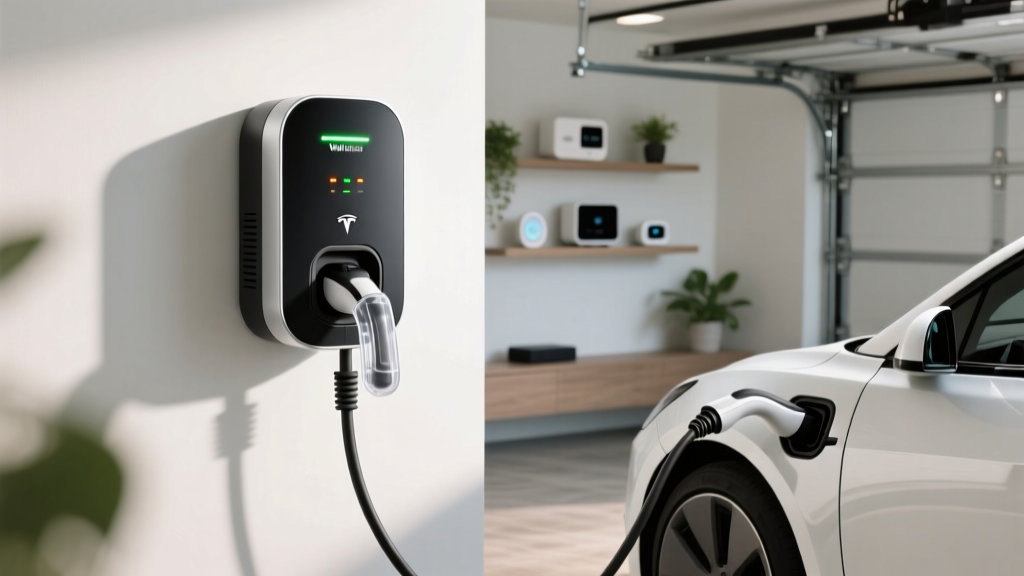
Wallbox Pulsar Plus 5.7 kW: Equipment Deep Dive
Here's what you're getting with the Pulsar Plus at the 5.7 kW tier:
Wallbox Pulsar Plus 5.7 kW
- Power output: 5.7 kW (24A @ 240V)
- Connector: J1772 (NACS cable option available)
- Cable length: 25 ft (7.6 m)
- Wi-Fi + Bluetooth: Yes — enables scheduling, energy tracking, and OTA updates via Wallbox app
- Smart features: Time-of-use scheduling, solar integration (with Power Meter accessory), load balancing
- Outdoor rating: NEMA 4 (IP54) — rain and dust resistant
- Weight: ~2.9 lbs (ultra-compact)
- Warranty: 3 years
- Price: ~$449–$499 MSRP
For Comparison: ChargePoint Home Flex (48A)
- Power output: Up to 11.5 kW (48A @ 240V) — adjustable down to 16A/32A/40A
- Connector: J1772 or NACS (select at purchase)
- Cable length: 23 ft (7 m)
- Wi-Fi + Bluetooth: Yes — app scheduling, Alexa integration
- Smart features: Amperage adjustment via DIP switches, utility demand-response compatible
- Outdoor rating: NEMA 4
- Weight: ~5.5 lbs
- Warranty: 3 years
- Price: ~$599–$699 MSRP (requires 60A circuit for full 48A output)
The Pulsar Plus wins on compactness, price, and lower electrical demands. The ChargePoint Home Flex wins on maximum power and amperage flexibility. If your panel supports a 60A circuit and you regularly drive 60+ miles daily or own a large-battery EV, the Flex's 11.5 kW output cuts charging time nearly in half. If you're on a 100A panel, drive under 50 miles daily, or want the simplest possible install, the Pulsar Plus at 5.7 kW is the pragmatic choice.
Cost to Charge: Home vs. Public vs. Gas Per Mile
One of the strongest arguments for home Level 2 charging — even at a modest 5.7 kW — is the per-mile cost advantage over both public charging and gasoline. Here's how the math breaks down in 2026:
| Scenario | Rate / Cost | Cost Per Mile (at 3.5 mi/kWh) | Annual Cost (12,000 mi) |
|---|---|---|---|
| Home — Off-Peak (Time-of-Use) | $0.08–$0.12/kWh | $0.023–$0.034/mi | $275–$410 |
| Home — Standard Rate | $0.14–$0.18/kWh | $0.040–$0.051/mi | $480–$615 |
| Public Level 2 (ChargePoint, etc.) | $0.25–$0.49/kWh | $0.071–$0.140/mi | $855–$1,680 |
| DC Fast Charging (Electrify America, Tesla Supercharger) | $0.32–$0.56/kWh | $0.091–$0.160/mi | $1,095–$1,920 |
| Gasoline (25 MPG avg, $3.40/gal) | $3.40/gallon | $0.136/mi | $1,632 |
Charging at home on an off-peak rate saves $1,200–$1,350 annually versus gasoline, and $700–$1,500 versus relying on public DC fast charging. Even at standard residential rates, home charging costs roughly one-third of what gasoline does per mile. This is where the investment in any home Level 2 charger — including the 5.7 kW Pulsar Plus — pays for itself within the first year for most drivers.
Pro tip: use the Wallbox app's scheduling feature to charge during your utility's off-peak window (typically 10 PM – 6 AM). Many utilities offer EV-specific time-of-use plans that drop rates to $0.06–$0.10/kWh overnight. According to the U.S. Department of Energy's Alternative Fuels Data Center, electricity rates for EV charging vary significantly by state and utility, so check with your provider for EV-specific plans.
Safety, Code Compliance, and Outdoor Installation
The Pulsar Plus carries a NEMA 4 (IP54) enclosure rating, meaning it's suitable for outdoor installation — it resists rain, sleet, and windblown dust. For garage installations, no additional weatherproofing is needed. Key safety and code considerations:
- Dedicated circuit: NEC Article 625 requires EV charging equipment to be on a dedicated branch circuit — you cannot share the 30A breaker with other appliances
- GFCI protection: NEC 2020 (and later) requires GFCI protection for receptacles used for EV charging; hardwired installations may have different requirements depending on your local jurisdiction's adopted code cycle
- Cable management: The Pulsar Plus's 25-foot cable is long enough for most single-car garages and driveways. Wallbox includes a cable holster for neat storage — important to prevent tripping hazards and cable damage
- Disconnect: Some jurisdictions require a visible disconnect switch within sight of the charger; your electrician will advise if this applies locally
- Utility notification: Many utilities require you to notify them when installing EV charging equipment, especially if you're enrolling in an EV-specific rate plan. Some offer rebates of $250–$1,000 toward installation — check with your provider
Federal Tax Credit for Home Charger Installation
The IRS §30C Alternative Fuel Vehicle Refueling Property Credit covers 30% of the cost of home EV charging equipment and installation, up to a maximum credit of $1,000 per year. This applies to the Pulsar Plus hardware and your electrician's labor, but eligibility has important caveats:
- The credit applies to equipment placed in service at your primary residence
- It's a non-refundable credit — it can reduce your tax liability to zero but won't generate a refund beyond that
- The property must be located in an eligible census tract (generally non-urban or low-income communities as defined by the IRS) — verify your address eligibility at the IRS website or with a tax professional
- Keep all receipts and the manufacturer's certification statement for your records
At a typical $1,200 all-in installation (simple install scenario), the §30C credit could return $360 — effectively reducing your net cost to around $840. Always consult a qualified tax professional for advice specific to your situation, as tax rules and eligible census tracts can change.
Frequently Asked Questions
Is a 5.7 kW charger fast enough for daily use?
For most drivers, yes. If your daily round-trip commute is under 60 miles, a 5.7 kW charger replenishes that in roughly 3 hours — easily achievable overnight. The limitation appears with large-battery vehicles (90+ kWh) where a full 10–80% charge takes 10+ hours, or if you regularly drive 80+ miles daily and need rapid turnaround between trips.
Can I upgrade from 5.7 kW to a higher-power charger later?
Yes, but it depends on your electrical panel. If your electrician installed a 30A circuit with 10 AWG wire for the Pulsar Plus, upgrading to a 48A charger later will require a new 60A breaker and thicker 6 AWG wire — essentially a re-wire from the panel to the charger location. If you think you'll want more power in the future, consider having your electrician install a 60A circuit and 14-50 receptacle now, then simply run the Pulsar Plus at its native 24A draw. This future-proofs the installation.
Does the Pulsar Plus work with solar panels?
Yes, with Wallbox's optional Power Meter accessory (~$150). The Power Meter clamps onto your home's main electrical feed and enables the Pulsar Plus's "Eco-Smart" mode, which dynamically adjusts charging power to use only excess solar generation. This means you can charge your EV entirely on solar energy during peak production hours, though at variable power levels rather than a steady 5.7 kW.
How does the Wallbox app compare to competitors?
The Wallbox app provides real-time charging status, session history with kWh consumed, cost tracking (input your utility rate), and time-of-use scheduling. It's functional and reliable, though less polished than Tesla's integrated charging experience. Compared to ChargePoint's app, Wallbox offers similar features with the addition of solar-integration controls. Both support firmware updates over Wi-Fi.
What's the warranty coverage on the Pulsar Plus?
Wallbox provides a 3-year limited warranty covering defects in materials and workmanship. This matches the industry standard set by ChargePoint, Emporia, and Grizzl-E. The warranty requires professional installation by a licensed electrician — DIY installs void coverage. Register your unit in the Wallbox app within 30 days of installation to activate the warranty.
Final Verdict: Who Should Buy the Pulsar Plus 5.7 kW?
Choose the Wallbox Pulsar Plus 5.7 kW if:
- Your home has a 100A electrical panel with limited spare capacity
- You drive under 50 miles daily and charge overnight
- You want the lowest possible installation cost (30A circuit vs. 60A)
- You value compact size and a clean, minimalist garage aesthetic
- You plan to integrate solar charging with the Power Meter accessory
Choose a 48A charger (11.5 kW) instead if:
- You own a large-battery EV (90+ kWh) and need faster 10–80% turnaround
- You drive 60+ miles daily or frequently make back-to-back long trips
- Your panel has a 200A service with ample spare capacity
- You want to future-proof your installation for the next EV you buy
The Wallbox Pulsar Plus charger 5.7 kW isn't the fastest home charger on the market, and it shouldn't be. Its value proposition is practicality: lower install cost, smaller electrical footprint, and sufficient speed for the majority of daily driving needs. At $449 for the unit and under $1,500 all-in for a straightforward installation, it's one of the most accessible entry points into reliable, smart home Level 2 charging — and for most EV owners who plug in overnight and wake up to a full battery, that's exactly what matters.