If you're shopping for a Level 2 home charger, the Autel MaxiCharger 40A smart EV charger occupies a compelling middle ground: it delivers 9.6 kW of power on a 240-volt / 50-amp circuit, includes Wi-Fi–connected scheduling and energy monitoring, and undercuts premium competitors like ChargePoint and Tesla on price. But specs on paper don't tell you how it performs in a cold garage at 5 AM or whether your electrical panel can handle it. This guide covers the MaxiCharger's real-world output, full installation economics, connector fitment for every major EV platform, and what you'll actually pay per mile compared to gasoline.
What the Autel MaxiCharger 40A Actually Delivers
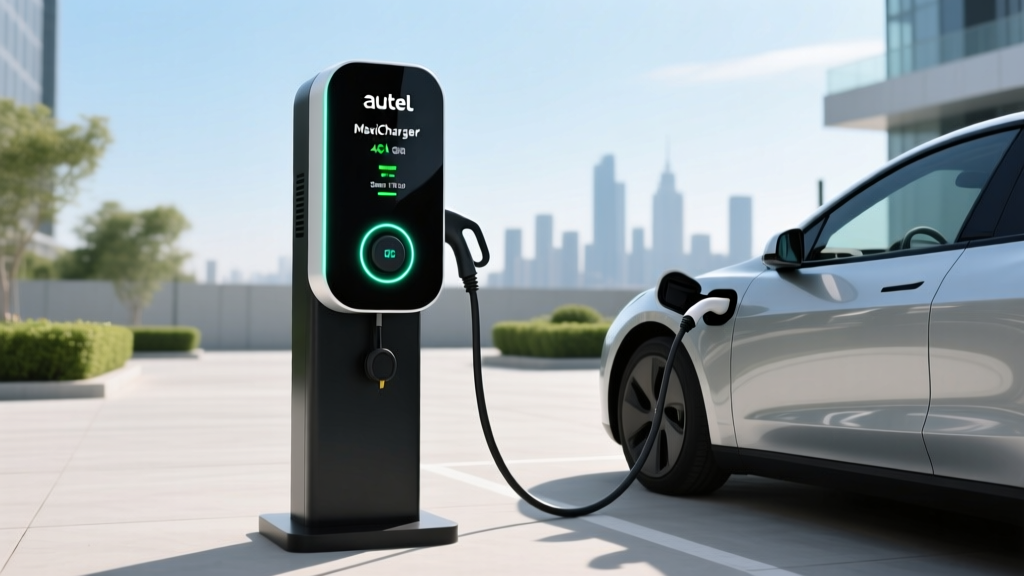
The Autel MaxiCharger AC wallbox is rated for a maximum continuous output of 40 amps, which on a North American 240V split-phase circuit translates to 9.6 kW of power. (Remember: kW is the rate of energy flow — like water pressure — while kWh is the total energy stored in your battery, like gallons in a tank.) At 9.6 kW, the charger adds roughly 30–38 miles of range per hour of charging, depending on your vehicle's efficiency.
Autel ships the MaxiCharger with a 25-foot cable, a NEMA 14-50 plug (for outlets), or a hardwired option for permanent installation. The unit's smart features include Wi-Fi connectivity, an Autel companion app for scheduling and energy tracking, RFID-based access control (useful for shared driveways or multi-unit buildings), and load-balancing capability when paired with Autel's optional energy meter.
For context, here's how 9.6 kW stacks up against other common home and public charging scenarios:
| Level | Voltage | Max Power (kW) | Miles of Range Added/Hour | Typical Use |
|---|---|---|---|---|
| Level 1 | 120V | 1.2–1.9 kW | 3–5 mi/hr | Emergency / overnight trickle |
| Level 2 (standard outlet) | 240V | 3.8–7.2 kW | 12–25 mi/hr | Apartment / older homes |
| Level 2 (Autel MaxiCharger 40A) | 240V | 9.6 kW | 30–38 mi/hr | Dedicated home install |
| Level 2 (48A units) | 240V | 11.5 kW | 36–46 mi/hr | High-capacity homes |
| DC Fast Charging | 400–800V | 50–350 kW | 150–1,000+ mi/hr | Road trips / public stations |
Installation Cost: What You'll Actually Pay
The Autel MaxiCharger 40A hardware typically retails between $450 and $550, but the total cost to get it running depends heavily on your home's electrical infrastructure. Here's a realistic breakdown based on 2026 electrician rates and permitting fees:
| Component | Low Estimate | High Estimate | Notes |
|---|---|---|---|
| Autel MaxiCharger 40A unit | $450 | $550 | Hardwired or NEMA 14-50 plug version |
| Electrician labor (run 50A circuit) | $400 | $1,200 | Depends on distance from panel to garage |
| Permit & inspection | $50 | $250 | Varies by municipality |
| NEMA 14-50 outlet (if plug-in) | $75 | $150 | Industrial-grade receptacle recommended |
| Panel upgrade (100A → 200A) | $1,500 | $3,500 | Only if existing panel lacks capacity |
| Total (no panel upgrade) | $975 | $2,150 | Most homes with 200A service |
| Total (with panel upgrade) | $2,475 | $5,650 | Older homes with 100A service |
The panel upgrade is the variable that catches buyers off guard. Homes built before 1990 often have 100-amp main service panels that are already near capacity with HVAC, electric range, and dryer loads. Adding a continuous 40A EV load can push total demand past the panel's rating, triggering a mandatory upgrade. A licensed electrician will perform a load calculation (NEC Article 220) to determine whether your panel has headroom. Some utilities and states offer rebates of $200–$500 toward panel upgrades for EV adoption — check afdc.energy.gov for current programs in your area.
Connector Compatibility: Will It Fit Your EV?
The Autel MaxiCharger ships with a J1772 connector, which is the standard Level 2 plug for every non-Tesla EV sold in North America. Tesla vehicles require an adapter — either the J1772-to-Tesla adapter that ships with every Tesla (included in the glovebox) or a third-party option like the Lectron or Tesla Wall Connector with integrated NACS.
As of 2026, the North American Charging Standard (NACS) is becoming the dominant connector, with Ford, GM, Rivian, Volvo, and others shipping NACS-equipped vehicles. However, Level 2 home charging still broadly relies on J1772 for non-Tesla brands, and the Autel unit remains fully compatible. Here's the connector landscape:
| Connector | Brands Using It (2026) | Autel MaxiCharger Compatible? |
|---|---|---|
| J1772 | Hyundai, Kia, VW, BMW, Mercedes, Toyota, Subaru, Nissan (Leaf) | Yes — native |
| NACS (Tesla) | Tesla, Ford, GM, Rivian, Volvo, Polestar | Yes — via J1772-to-NACS adapter |
| CHAdeMO | Nissan Leaf (older), Mitsubishi (legacy) | Level 2 uses J1772 regardless — yes |
One practical note: if you drive a NACS-equipped Ford F-150 Lightning or Chevy Equinox EV and plan to use public Tesla Superchargers, that's a DC fast-charging scenario with a completely different connector. Your home Level 2 Autel charger will still work fine with the J1772-to-NACS adapter for overnight charging.
Charging Time: What to Expect for Common Battery Sizes
At a sustained 9.6 kW, the Autel MaxiCharger can fully replenish most EV batteries overnight. Here's how long a 10% to 80% charge takes for popular 2026 EVs (accounting for ~10% charging inefficiency, which is standard for Level 2 AC-to-DC conversion):
| Vehicle | Usable Battery (kWh) | Energy Needed (10–80%) | Estimated Time |
|---|---|---|---|
| Tesla Model Y (Long Range) | 75 kWh | 52.5 kWh | ~6 hours |
| Hyundai Ioniq 5 (Standard Range) | 58 kWh | 40.6 kWh | ~4.5 hours |
| Ford F-150 Lightning (Extended) | 131 kWh | 91.7 kWh | ~10.5 hours |
| Chevy Equinox EV | 85 kWh | 59.5 kWh | ~7 hours |
| Toyota bZ4X | 64 kWh | 44.8 kWh | ~5 hours |
For most daily driving — 30 to 60 miles of commuting — you'll only need 1 to 2 hours of charging to replenish what you used. The full overnight window is most valuable for road-trip preparation or for drivers with long commutes exceeding 100 miles round-trip.
Cost Per Mile: Home Charging vs. Public vs. Gasoline
One of the strongest economic arguments for home Level 2 charging is the cost-per-mile advantage over both public charging and gasoline. Here's a realistic comparison using 2026 average rates:
| Scenario | Rate | Cost per kWh | Cost per Mile (at 3 mi/kWh) |
|---|---|---|---|
| Home off-peak (utility TOU plan) | $0.08–$0.12/kWh | $0.10 avg | $0.033 |
| Home standard rate | $0.14–$0.18/kWh | $0.16 avg | $0.053 |
| Public Level 2 (ChargePoint, EVgo) | $0.25–$0.49/kWh | $0.35 avg | $0.117 |
| DC Fast Charging (Electrify America) | $0.35–$0.55/kWh | $0.45 avg | $0.150 |
| Gasoline (28 MPG avg, $3.40/gal) | $3.40/gallon | — | $0.121 |
At home off-peak rates, the Autel MaxiCharger delivers fueling at roughly $0.03 per mile — about one-quarter the cost of gasoline and one-fifth the cost of DC fast charging. Even at standard residential rates, home charging undercuts gas by more than half. The EPA's fueleconomy.gov database lets you look up your specific vehicle's kWh/100mi rating to calculate personalized costs.
Many utilities offer time-of-use (TOU) plans that discount electricity during overnight hours (typically 10 PM – 6 AM). The Autel app's scheduling feature lets you set charging windows to align with these off-peak rates automatically, maximizing savings without manual intervention.
Equipment Comparison: Autel MaxiCharger vs. Alternatives
The 40A smart charger segment is competitive. Here's how the Autel MaxiCharger stacks up against three widely available alternatives in 2026:
Autel MaxiCharger AC 40A
- Power: 9.6 kW (40A)
- Connector: J1772 (25 ft cable)
- Smart features: Wi-Fi, app scheduling, RFID access, load balancing
- Installation: NEMA 14-50 or hardwired
- Price: ~$450–$550
- Best for: Budget-conscious buyers wanting smart features
ChargePoint Home Flex (up to 50A)
- Power: Up to 12 kW (50A, adjustable)
- Connector: J1772 or NACS (23 ft cable)
- Smart features: Wi-Fi, Alexa integration, detailed energy reports
- Installation: NEMA 14-50 or hardwired
- Price: ~$650–$750
- Best for: Users wanting NACS native + ecosystem integration
Tesla Wall Connector (48A)
- Power: 11.5 kW (48A)
- Connector: NACS native (24 ft cable)
- Smart features: Wi-Fi, OTA updates, power sharing between units
- Installation: Hardwired only
- Price: ~$475
- Best for: Tesla-only households
Emporia Vue Level 2 (48A)
- Power: 11.5 kW (48A)
- Connector: J1772 (24 ft cable)
- Smart features: Whole-home energy monitoring, solar integration
- Installation: Hardwired
- Price: ~$550–$650
- Best for: Solar owners wanting unified energy dashboard
The Autel MaxiCharger's primary advantage is price-to-feature ratio: you get Wi-Fi smart scheduling, RFID security, and load balancing at a lower price point than the ChargePoint Home Flex. Its limitation is the 40A cap — if your panel supports a 60A circuit (allowing a 48A charger), you'd gain roughly 15–20% faster charging with the Tesla Wall Connector or Emporia Vue.
Safety, Code Compliance, and Electrical Requirements
Installing a 40A continuous-load EV charger is not a DIY project. The NEC (National Electrical Code) classifies EV charging as a continuous load, meaning the circuit must be rated at 125% of the charger's maximum draw. For the Autel MaxiCharger at 40A, that means a 50-amp breaker with 6 AWG copper wire (or 4 AWG aluminum).
Key safety and code requirements to discuss with your electrician:
- Dedicated circuit: The 50A circuit must serve only the EV charger — no shared loads.
- GFCI protection: NEC 2020 and later require GFCI protection for outdoor receptacles; some jurisdictions extend this to indoor garage outlets. Hardwired installations may be exempt.
- Outdoor rating: If mounting outdoors, the Autel MaxiCharger carries a NEMA 4 rating (splash-resistant), but the electrical junction box and conduit must also be rated for wet locations.
- Permit and inspection: Nearly all jurisdictions require an electrical permit for new 240V circuits. The inspection ensures proper wire gauge, breaker sizing, grounding, and bonding. Skipping this step can void homeowner's insurance coverage for electrical fires.
- Load management: If your panel is near capacity but a full upgrade is cost-prohibitive, Autel's optional energy meter enables dynamic load balancing — the charger automatically reduces output when other household loads spike, staying within your panel's total capacity.
The Autel MaxiCharger is UL-listed (Underwriters Laboratories), which is essential for both safety and insurance purposes. Non-UL-listed chargers — often found at deep discounts on marketplace sites — may not pass inspection and can create liability issues in the event of an electrical fault.
Frequently Asked Questions
How much does it cost to install the Autel MaxiCharger 40A at home?
Expect $975–$2,150 total (equipment + electrician + permit) if your electrical panel has sufficient capacity. If a panel upgrade from 100A to 200A is needed, add $1,500–$3,500. Always get a load calculation from a licensed electrician before purchasing.
How fast will the Autel MaxiCharger add range compared to a standard outlet?
At 9.6 kW, the MaxiCharger adds 30–38 miles of range per hour. A standard 120V outlet (Level 1) adds only 3–5 miles per hour. For a 300-mile-range EV depleted to 20%, Level 1 would take over 48 hours to fully recharge; the Autel MaxiCharger does it in about 8 hours.
Is the Autel MaxiCharger compatible with Tesla vehicles?
Yes, using the J1772-to-Tesla adapter included with every Tesla vehicle. The adapter snaps onto the Autel's J1772 connector and plugs into the Tesla charge port. Charging speed remains the same — 9.6 kW / 40A.
Does the Autel MaxiCharger qualify for any tax credits or rebates?
The federal Alternative Fuel Vehicle Refueling Property Credit (IRC §30C) covers up to 30% of home charger equipment and installation costs, capped at $1,000, for installations in eligible census tracts. Many utilities also offer $200–$500 rebates for smart Level 2 chargers — check with your local provider. Eligibility rules change; consult a tax professional for your specific situation.
Can I install the Autel MaxiCharger myself?
Physically mounting the unit is straightforward, but the 240V / 50A electrical circuit must be installed by a licensed electrician and permitted through your local building department. Improper wiring at this amperage creates serious fire risk and will fail inspection, potentially voiding insurance coverage.
What happens if my EV can only accept 32A or 7.7 kW on Level 2?
The Autel MaxiCharger will simply deliver what the vehicle's onboard charger can accept. If your EV maxes out at 7.7 kW (32A), the charger will operate at that rate automatically. You won't damage the vehicle — EVs control the draw, not the charger. However, you'd be paying for 9.6 kW capacity you can't use, so consider whether a 32A charger (on a 40A circuit) would save money without sacrificing speed.