The VW ID.4 Range Reality: What the EPA Says vs. What You'll Actually Get
If you own or are shopping for a Volkswagen ID.4, the first thing to understand is that the EPA-estimated range is a starting point — not a guarantee. The 2026 VW ID.4 Pro (RWD, 82 kWh usable battery, NMC chemistry) carries an EPA rating of approximately 291 miles. The Pro S and AWD variants sit between 263 and 275 miles depending on wheel size and drivetrain. But real-world conditions shift those numbers considerably.
EPA Sticker: 275–291 mi (depending on trim/drivetrain)
Highway (70+ mph, moderate temps): ~235–255 mi
Cold Weather (below 30°F, cabin heat on): ~195–220 mi
Optimal City/Mixed (mild temps, moderate speeds): ~270–290 mi
Source: fueleconomy.gov — verify your exact trim and model year.
Why the gap? EV batteries are chemical systems sensitive to temperature, speed, and driving style. At 75 mph on the interstate, aerodynamic drag consumes disproportionately more energy than at 55 mph. In freezing temperatures, the battery's internal resistance increases and cabin heating draws from the traction pack, cutting range by 20–30%. Understanding this is essential because it directly dictates your charging strategy — and how much range you need to recapture each night at home.
Charging Levels Explained: How Fast Each Adds Range to Your ID.4
Before choosing equipment, you need to understand the three charging tiers. The critical distinction: kW (kilowatts) measures power — how fast energy flows into the battery. kWh (kilowatt-hours) measures energy — the total capacity of the battery. Think of kW as the width of a hose and kWh as the size of the bucket. A wider hose (higher kW) fills the bucket faster.
| Level | Voltage / Amps | Max Power (kW) | Miles of Range Added per Hour | 10–80% Time (82 kWh pack) |
|---|---|---|---|---|
| Level 1 (120V household) | 120V / 12A | 1.4 kW | ~3–4 mi/hr | ~40+ hours (impractical) |
| Level 2 (240V home/public) | 240V / 32–48A | 7.7–11.5 kW | ~22–33 mi/hr | ~7.5–10 hours |
| DC Fast Charging (public) | 400V+ DC | Up to 175 kW (peak) | ~150–220 mi in 30 min | ~28–34 min (10–80%) |
The VW ID.4's onboard AC charger accepts up to 11 kW on Level 2, meaning a 48-amp, 240V circuit will fully utilize that capability. On DC fast charging, the ID.4 peaks at approximately 175 kW (2024+ models with the software update; earlier 2021–2023 models peak at ~125 kW). However, that peak rate only holds between roughly 5–30% state of charge. The charge curve tapers significantly above 50%, and drops sharply past 80% — which is why manufacturers quote 10–80% times rather than 0–100%. Charging from 80–100% on DC fast charging can take nearly as long as the 10–80% session, and generates excess heat that accelerates long-term battery degradation.
Home Charger Installation: Electrical Requirements, Costs & Panel Upgrades
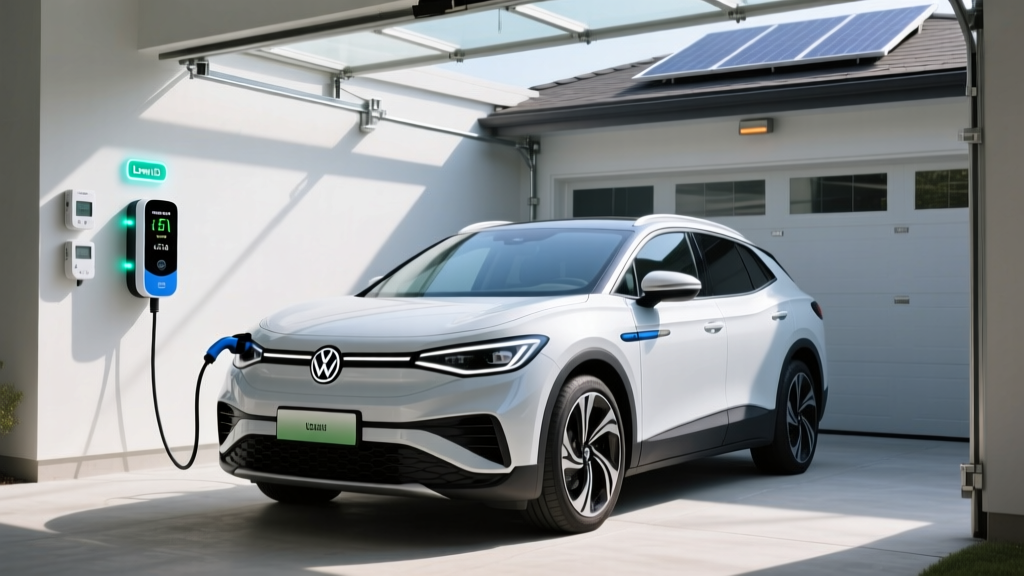
Installing a Level 2 home charger is where most ID.4 owners will do 80–90% of their charging. But the installation isn't as simple as plugging in a dryer. Here's what's involved electrically and financially.
Electrical Requirements for the VW ID.4
To get the full 11 kW AC charging rate, you need a 240V / 48-amp dedicated circuit with a 60-amp breaker (NEC code requires the breaker to be rated at 125% of the continuous load — 48A × 1.25 = 60A). If your charger is hardwired, a 60-amp breaker is mandatory. If you use a NEMA 14-50 outlet, the circuit is typically 50 amps, delivering up to 40A continuous (9.6 kW) — still excellent for overnight charging, adding roughly 28 miles of range per hour.
Do You Need a Panel Upgrade?
This is the hidden cost that catches many homeowners off guard. Most modern homes have a 200-amp electrical panel. If your panel is already near capacity (running electric heat, an electric oven, dryer, and water heater), adding a 60-amp EV circuit may push you over. A licensed electrician will perform a load calculation per NEC Article 220 to determine if your panel can handle the additional draw. If not, a panel upgrade from 100A to 200A, or from 200A to 400A, can add $1,500–$4,000 to your project.
| Component | Typical Cost Range | Notes |
|---|---|---|
| Level 2 Charger (Equipment) | $300–$700 | Smart Wi-Fi models at upper end |
| Electrician Labor (standard install) | $400–$1,200 | Depends on run length from panel to garage |
| Permit & Inspection | $50–$250 | Required by most jurisdictions; varies by city |
| Panel Upgrade (if needed) | $1,500–$4,000 | 100A→200A or 200A→400A; older homes most affected |
| Total (no panel upgrade) | $750–$2,150 | Most common scenario |
| Total (with panel upgrade) | $2,250–$6,150 | Older homes or high-load panels |
Always hire a licensed electrician. The federal Residential Clean Energy Credit (IRC §25C) may cover up to 30% of charger equipment and installation costs, capped at $1,000 annually. Confirm current eligibility with a tax professional.
Permits, Code & Safety Considerations
Most municipalities require a permit for any new 240V circuit. The inspection verifies proper wire gauge (6 AWG copper for a 60A circuit), correct breaker sizing, and proper grounding. For outdoor installations, your charger must carry a NEMA 4 or NEMA 4X rating (weatherproof enclosure). A GFCI breaker is required for outdoor receptacles per NEC 2023 and later. Hardwired installations avoid the GFCI nuisance-trip issue that some EV owners experience with NEMA 14-50 outlets — a consideration worth discussing with your electrician.
Connector Compatibility: NACS, CCS & What Your VW ID.4 Uses
The connector landscape has shifted dramatically. Here's where the VW ID.4 stands in 2026:
| Connector | Type | Used By | VW ID.4 Status (2026) |
|---|---|---|---|
| CCS1 | AC + DC combo | VW, Hyundai, BMW, most legacy non-Tesla | Native port on 2021–2024 models |
| NACS (Tesla/J3400) | AC + DC combo | Tesla, Ford, GM, Rivian; expanding to most OEMs | Native on 2025+ ID.4; CCS-to-NACS adapter for older models |
| CHAdeMO | DC only | Nissan Leaf (legacy); phasing out | Not compatible; no adapter needed |
| J1772 | AC only (Level 1/2) | All non-Tesla EVs (pre-2025) | Native AC port; Tesla J1772 adapter works |
If you own a 2021–2024 ID.4 with a CCS1 port, you'll need a CCS-to-NACS adapter (approximately $150–$250) to access Tesla Supercharger stalls, which now welcome non-Tesla vehicles at many locations. Volkswagen has offered adapter programs for existing owners — check with your dealer. For home Level 2 charging, any J1772 or NACS-equipped wall unit will work; the ID.4's AC inlet accepts J1772 natively on older models and NACS on 2025+ trims.
Level 2 Home Charger Recommendations for the VW ID.4
Below are three proven chargers matched to the ID.4's 11 kW AC charging capability. Each recommendation includes power output, connector type, cable length, smart features, and approximate retail price.
Best Overall for ID.4
- Power: Up to 11.5 kW (48A, 240V)
- Connector: J1772 (NACS version available)
- Cable: 23 ft
- Smart: Wi-Fi, app scheduling, Alexa, load sharing
- Price: ~$550–$650
Fully utilizes the ID.4's 11 kW onboard charger. UL-listed, NEMA 4 rated for outdoor use.
Best Budget Smart Charger
- Power: Up to 11.5 kW (48A, 240V)
- Connector: J1772
- Cable: 24 ft
- Smart: Wi-Fi, energy monitoring, solar integration
- Price: ~$350–$400
Strong value. Energy monitoring pairs well with solar panels. Hardwire or NEMA 14-50.
Best for NACS-Equipped 2025+ ID.4
- Power: Up to 11.5 kW (48A, 240V)
- Connector: NACS (with J1772 adapter in box)
- Cable: 24 ft
- Smart: Wi-Fi, OTA updates, Power-Share for 2 units
- Price: ~$450–$500
Sleek design. The universal version includes a J1772 adapter for older ID.4 models.
Key buying tip: Don't overspend on a charger rated beyond 48A / 11.5 kW for the ID.4. The vehicle's onboard AC charger caps at 11 kW, so a $1,200 charger pushing 19.2 kW won't charge your ID.4 any faster. Save that budget for a quality installation instead.
Charging Cost Per Mile: VW ID.4 vs. Gasoline SUV
One of the strongest ownership arguments for the ID.4 is fuel cost. Here's how charging costs compare across scenarios, benchmarked against a comparable gas SUV averaging 25 MPG combined.
| Scenario | Rate | ID.4 Cost/Mile | Gas SUV Cost/Mile (25 MPG) |
|---|---|---|---|
| Home (off-peak utility rate) | $0.09/kWh | $0.027 | $0.132 ($3.30/gal) |
| Home (national avg. residential) | $0.16/kWh | $0.048 | $0.132 ($3.30/gal) |
| Public Level 2 (network pricing) | $0.30/kWh | $0.090 | $0.132 ($3.30/gal) |
| DC Fast Charging (Electrify America, etc.) | $0.48/kWh | $0.144 | $0.132 ($3.30/gal) |
ID.4 efficiency calculated at ~3.0 mi/kWh (EPA combined). Gas cost assumes $3.30/gallon national average. Your local utility rates and gas prices will vary. Source: EIA electricity pricing.
The takeaway: home charging is dramatically cheaper than gas, saving roughly $1,000–$1,300 per year for a driver covering 12,000 miles. Public DC fast charging, however, can actually exceed gasoline cost per mile — which is why minimizing DCFC reliance and maximizing home Level 2 charging is the smartest economic strategy for ID.4 owners.
DC Fast Charging the ID.4 on Road Trips: What to Expect
When you leave your home charging zone, the ID.4's DC fast charging capability determines how practical it is for road trips. Here's the realistic picture:
The 2025–2026 ID.4 (with the updated MEB software) peaks at ~175 kW at DC fast chargers, but that peak is sustained only briefly between roughly 5–30% state of charge. By 50% SoC, power drops to approximately 100–120 kW. By 80%, it's down to 50–60 kW. A typical 10–80% session on a 175+ kW charger takes approximately 28–34 minutes, depending on battery temperature and starting SoC.
Preconditioning matters. If you navigate to a DC fast charger using the ID.4's built-in navigation, the vehicle will begin warming the battery to the optimal temperature range (~25–35°C) before you arrive. In cold weather, preconditioning can shave 5–10 minutes off your charging session and increase peak power acceptance by 20–30 kW. Always route through the car's nav when heading to a fast charger in winter.
For road-trip planning, tools like A Better Route Planner (ABRP) let you model ID.4-specific charging curves, accounting for terrain, temperature, and speed — far more accurate than generic range calculators.
Frequently Asked Questions
How much does it cost to install a home EV charger for my VW ID.4?
A standard Level 2 home charger installation — including a quality 48A smart charger, electrician labor, wire run, and permit — typically costs $750–$2,150 if your electrical panel has sufficient capacity. If a panel upgrade is required (common in homes with 100A service or high existing loads), add $1,500–$4,000. The federal Residential Clean Energy Credit (IRC §25C) may offset up to 30% of equipment and installation, capped at $1,000 per year. Confirm eligibility with a tax professional and check IRS guidelines.
How fast will each charging level add range to my ID.4?
Level 1 (120V standard outlet) adds about 3–4 miles per hour — essentially a trickle. Level 2 (240V, 48A) adds approximately 28–33 miles per hour, fully replenishing the 82 kWh battery overnight in 7.5–10 hours. DC fast charging at a 175 kW station can add ~70 miles in 10 minutes or complete a 10–80% session in roughly 30 minutes.
Which connector and charger is compatible with my VW ID.4?
For 2021–2024 models, the ID.4 uses a CCS1 connector for DC fast charging and J1772 for AC Level 2. The 2025+ ID.4 has adopted the NACS (J3400) connector natively. If you have a CCS1 model, you can purchase a CCS-to-NACS adapter (~$150–$250) to access Tesla Supercharger stations. For home Level 2 charging, any J1772 or NACS wall connector rated at 48A / 240V will work.
How much does charging the ID.4 cost per mile vs. gas?
At the national average residential electricity rate of ~$0.16/kWh, the ID.4 costs approximately $0.048/mile to fuel. A comparable gas SUV at 25 MPG and $3.30/gallon costs about $0.132/mile. That's a savings of roughly $0.084 per mile, or about $1,008 per year at 12,000 miles. However, DC fast charging at $0.48/kWh pushes the ID.4 to $0.144/mile — slightly more than gas — so home charging is key to realizing savings.
What electrical upgrades might I need for a Level 2 charger?
The most common upgrade is a panel capacity increase. If your home has a 100-amp panel or a 200-amp panel already near its load limit, you may need an upgrade to 200A or 400A service. Other potential costs include running new conduit (especially for detached garages or long wire runs exceeding 50 feet), upgrading from a fuse box to a breaker panel, or installing a sub-panel. Your electrician's load calculation will determine exactly what's needed — always get this assessment before purchasing equipment.
Does frequent DC fast charging degrade the ID.4 battery?
DC fast charging generates more heat than Level 2 charging, and heat is the primary driver of lithium-ion battery degradation. However, VW's battery management system (BMS) actively manages thermal limits, and occasional DCFC use on road trips has minimal impact. The concern is exclusive reliance on DCFC. Studies from NREL and real-world fleet data suggest that vehicles charged primarily on Level 2 with occasional DCFC see degradation rates of roughly 1.5–2.5% per year, while DCFC-only charging can push that to 3–4% annually. The ID.4's battery warranty covers 8 years / 100,000 miles with a minimum 70% capacity retention threshold.