Vermont EV Charger Rebate: Your Path to Affordable Home Charging
Vermont consistently ranks among the most EV-friendly states, and a big reason is the financial support available for home charging infrastructure. If you're shopping for a Vermont EV charger rebate, you're likely weighing the upfront cost of a Level 2 home station against the convenience of waking up to a full battery every morning. This guide breaks down the rebate landscape, real installation costs, electrical requirements, equipment recommendations, and the per-mile economics of charging at home versus fueling a gas car.
Whether you drive a Tesla Model Y, a Hyundai Ioniq 5, a Ford F-150 Lightning, or a Chevrolet Equinox EV, the fundamentals of home charging remain the same — but the details matter. A 240-volt Level 2 charger can add 25 to 44 miles of range per hour of charging, turning an overnight session into a full battery. Let's walk through exactly what's involved.
Understanding Charging Levels: Speeds in kW and Miles Per Hour
Before evaluating rebates or calling an electrician, you need to understand the three charging levels available to EV owners. The critical distinction: kW (kilowatts) measures power — how fast energy flows into your battery — while kWh (kilowatt-hours) measures energy — the total capacity of your battery, like gallons in a fuel tank.
| Level | Voltage | Power (kW) | Miles of Range Added Per Hour | Typical Use Case |
|---|---|---|---|---|
| Level 1 | 120V AC | 1.0–1.4 kW | 3–5 mi/hr | Overnight top-ups, PHEVs, low-mileage drivers |
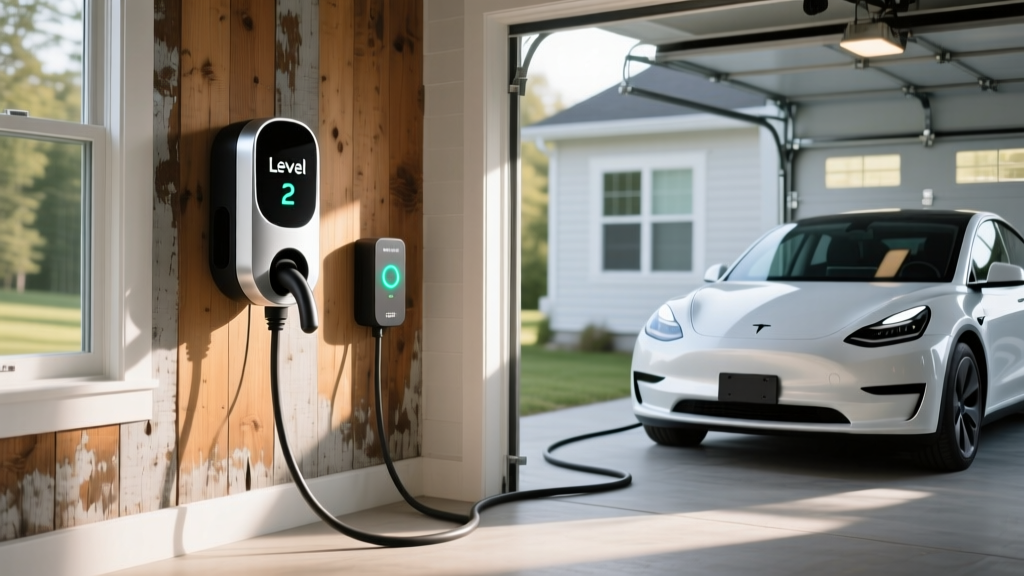
| Level 2 | 240V AC | 3.3–19.2 kW | 12–44 mi/hr (varies by vehicle acceptance rate) | Primary home and workplace charging |
| DC Fast Charging | 400–800V DC | 50–350 kW | 150–1,000+ mi/hr (first 20 min, then tapers) | Road trips, highway corridors |
Most EV owners install a Level 2 charger at home because it delivers a practical overnight charge. A typical EV with a 75 kWh battery (like a Tesla Model Y Long Range) charging at 11.5 kW will go from 10% to 80% state of charge in roughly 5 hours — easily done while you sleep. DC fast chargers, found along interstate corridors like I-89 and I-91 in Vermont, are designed for road trips, not daily use; frequent DC fast charging can accelerate battery degradation over time.
How Much Does It Cost to Install a Home EV Charger in Vermont?
The total cost to install a Level 2 home EV charger in Vermont typically ranges from $800 to $3,500+, depending on your electrical panel capacity, the distance from your panel to the charger location, and whether you need a panel upgrade. Here's a detailed breakdown:
| Cost Component | Low Estimate | High Estimate | Notes |
|---|---|---|---|
| Level 2 Charger Equipment | $350 | $750 | Hardwired or NEMA 14-50 plug; smart vs. basic models |
| Electrician Labor | $300 | $1,500 | Depends on run length, wall type, and conduit needs |
| Electrical Permit | $50 | $200 | Varies by municipality; Burlington vs. rural areas |
| Panel Upgrade (if needed) | $1,500 | $3,500 | Upgrading from 100A to 200A service; older homes common in VT |
| Total (no panel upgrade) | $700 | $2,450 | Most homes with 200A service fall in this range |
| Total (with panel upgrade) | $2,200 | $5,950 | Common in pre-1990 homes with 100A panels |
Vermont EV Charger Rebate Programs
Vermont offers several incentive pathways to offset these costs. The state's Drive Electric Vermont program and participating utilities like Green Mountain Power (GMP) and Burlington Electric Department have historically offered rebates on Level 2 charging equipment and installation. Utility rebates often cover $200 to $500 toward equipment or installation, and some programs offer off-peak charging incentives that reduce your ongoing electricity costs.
At the federal level, the Alternative Fuel Vehicle Refueling Property Credit (IRS Form 8911) may cover up to 30% of home charger equipment and installation costs, capped at $1,000. However, this credit is subject to census-tract eligibility requirements — it applies only in non-urban or low-income census tracts. Many rural Vermont areas qualify, but you should verify your address against the IRS eligibility tool and consult a tax professional before claiming.
Always check current program availability with Efficiency Vermont and your local utility, as rebate amounts and eligibility rules update periodically.
Electrical Requirements: What Your Home Needs for Level 2 Charging
A Level 2 EV charger requires a dedicated 240-volt circuit, similar to what powers an electric dryer or oven. The most common residential setups are:
- NEMA 14-50 outlet: A 50-amp receptacle that supports chargers drawing up to 40 amps (9.6 kW). This is the most popular option because it allows you to unplug and take the charger if you move.
- Hardwired connection: Directly wired to your panel, supporting up to 48 amps (11.5 kW) or even 80 amps (19.2 kW) on premium chargers. Hardwired installations are required for circuits above 50 amps per NEC code and eliminate the GFCI nuisance-tripping issue some owners experience with plug-in setups.
Do You Need a Panel Upgrade?
Vermont has some of the oldest housing stock in the country. Many homes built before 1990 have 100-amp electrical service, which may not support a 40- or 50-amp EV charger circuit alongside existing loads (electric heat, water heater, dryer, stove). An electrician will perform a load calculation per NEC Article 220 to determine if your panel has headroom.
If you need a panel upgrade to 200 amps, expect to pay $1,500–$3,500. Some Vermont utilities offer financing or rebates for panel upgrades when paired with EV charger installation — another reason to call your utility before scheduling an electrician.
Safety and Code Requirements
- Dedicated circuit: Your EV charger must be on its own dedicated breaker — never shared with other appliances.
- GFCI protection: NEC 2020 and later require GFCI protection for outdoor receptacles; hardwired chargers may not require a separate GFCI breaker depending on local code interpretation.
- Outdoor rating: If your charger is mounted outside (common in Vermont where garages are limited), ensure the unit carries a NEMA 4 or NEMA 4X rating for weather resistance. Vermont winters demand equipment rated for temperatures down to -22°F (-30°C).
- Permit and inspection: Most Vermont municipalities require an electrical permit and post-installation inspection. Your electrician typically handles this, and the cost is included in the estimates above.
Which Connector and Charger Is Compatible with My EV?
The connector landscape has shifted dramatically. As of 2026, the North American Charging Standard (NACS) — originally Tesla's proprietary connector — has been adopted by Ford, GM, Rivian, Volvo, Hyundai/Kia, and most other major automakers. The legacy CCS1 (Combined Charging System) connector is still found on vehicles sold through 2024–2025, and CHAdeMO is essentially limited to older Nissan Leaf models.
| Connector | Automakers Using It (2026) | Adapter Needed? |
|---|---|---|
| NACS (Tesla-style) | Tesla, Ford, GM, Rivian, Hyundai, Kia, Volvo, Polestar, Mercedes-Benz (new models) | No — native on 2025+ models from these brands |
| CCS1 | Older models still on the road (2024 and earlier VW ID.4, BMW i4, etc.) | NACS-to-CCS adapter available from Tesla and third parties (~$200–$250) |
| CHAdeMO | Nissan Leaf (discontinued), Mitsubishi Outlander PHEV (older) | Limited adapter options; CHAdeMO infrastructure declining |
If you're buying a new EV in 2026, you'll almost certainly get a NACS port. If you own a CCS1-equipped EV from the 2022–2024 model years, you can purchase a NACS-to-CCS adapter to access the Tesla Supercharger network, which now welcomes non-Tesla vehicles at many locations.
For home Level 2 charging, the connector matters less because most home chargers are available with either a NACS or J1772 plug (J1772 is the legacy standard that works with all CCS1 vehicles via the top portion of the CCS connector). Tesla Wall Connectors come with NACS; most third-party chargers ship with J1772 or NACS options.
Charging Time Examples: 10% to 80% for Common EV Batteries
Charging time depends on your battery's usable capacity (measured in kWh) and the power delivery of your charger (measured in kW). Most EVs accept between 7.2 kW and 11.5 kW on Level 2 — the vehicle's onboard charger determines the maximum acceptance rate, not just the charger's output.
| Vehicle | Battery (usable kWh) | Max L2 Acceptance (kW) | 10–80% at 11.5 kW | 10–80% at 7.7 kW |
|---|---|---|---|---|
| Tesla Model Y Long Range | 75 kWh | 11.5 kW | ~4.5 hours | ~6.7 hours |
| Hyundai Ioniq 5 (Long Range) | 77.4 kWh | 10.9 kW | ~4.7 hours | ~7.0 hours |
| Ford F-150 Lightning (Extended) | 131 kWh | 19.2 kW | ~4.8 hours | ~7.1 hours (at 11.5 kW, not 7.7) |
| Chevrolet Equinox EV | 85 kWh | 11.5 kW | ~5.2 hours | ~7.7 hours |
| Toyota RAV4 Prime (PHEV) | 14.9 kWh | 3.3 kW (6.6 kW optional) | N/A | ~2.5 hours (at 6.6 kW) |
Note: Charging slows significantly above 80% state of charge to protect battery health. This is why most EV owners set their daily charge limit to 80% (or 90% for LFP batteries, like those in Tesla Model Y Standard Range and rear-wheel-drive variants). The final 20% can take as long as the first 80%.
Cost to Charge per Mile vs. Gasoline in Vermont
Vermont's residential electricity rates average around $0.20–$0.22 per kWh as of early 2026, though utility-specific rates and time-of-use plans can shift this. Here's how charging costs compare to gasoline on a per-mile basis:
| Scenario | Rate | Vehicle Efficiency | Cost Per Mile |
|---|---|---|---|
| Home charging (standard rate) | $0.21/kWh | 3.5 mi/kWh (typical EV, ~115 MPGe) | $0.06/mi |
| Home charging (off-peak TOU) | $0.14/kWh | 3.5 mi/kWh | $0.04/mi |
| Public Level 2 (ChargePoint, etc.) | $0.30/kWh | 3.5 mi/kWh | $0.09/mi |
| DC Fast Charging (Electrify America) | $0.45/kWh | 3.5 mi/kWh | $0.13/mi |
| Gasoline (25 MPG combined) | $3.40/gal | 25 mi/gal | $0.14/mi |
| Gasoline (30 MPG combined) | $3.40/gal | 30 mi/gal | $0.11/mi |
At Vermont's average gas price of roughly $3.40/gallon and electricity at $0.21/kWh, home EV charging delivers fuel savings of 55–70% per mile compared to a typical gas vehicle. Over 12,000 miles per year, that translates to $600–$900 in annual fuel savings. Off-peak time-of-use rates from your utility can push savings even higher. According to fueleconomy.gov, EVs like the Hyundai Ioniq 5 achieve 114–132 MPGe combined, making them among the most efficient vehicles on the road.
Recommended Level 2 Home Chargers for Vermont EV Owners
Based on reliability, cold-weather performance, smart features, and value, here are our top picks for Vermont installations. All units below are rated for outdoor use and cold temperatures.
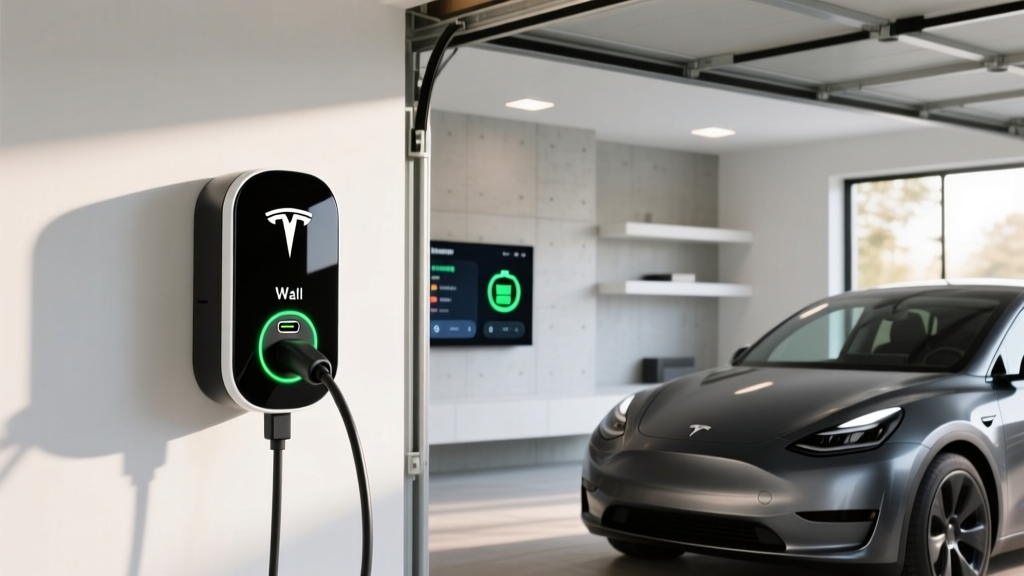
1. Tesla Wall Connector (Gen 3) — Best Overall Value
- Power Output: Up to 11.5 kW (48 amps hardwired)
- Connector: NACS native; J1772 adapter included for non-Tesla EVs
- Cable Length: 24 feet
- Smart Features: Wi-Fi, OTA updates, load sharing (pair two units on one circuit), access control
- Price: ~$475
- Best For: Tesla owners and anyone with a NACS-equipped 2025+ EV. The 24-foot cable is among the longest available.
2. ChargePoint Home Flex — Most Flexible
- Power Output: Up to 12 kW (50 amps) — configurable via DIP switches for lower-amp circuits
- Connector: J1772 standard; NACS adapter available
- Cable Length: 23 feet
- Smart Features: Wi-Fi, Alexa integration, detailed energy tracking app, scheduled charging
- Price: ~$550–$650
- Best For: CCS1-equipped EVs and owners who want granular app-based energy monitoring. The adjustable amperage means it works on 20A through 60A circuits.
3. Emporia Vue EV Charger — Budget Smart Pick
- Power Output: Up to 11.5 kW (48 amps hardwired) or 9.6 kW (40A NEMA 14-50)
- Connector: J1772 (NACS version now available)
- Cable Length: 24 feet
- Smart Features: Wi-Fi, solar integration (pairs with Emporia Vue energy monitor), V2H-ready with compatible vehicles
- Price: ~$350–$400
- Best For: Budget-conscious buyers who still want smart features. The solar integration is ideal for Vermont homes with rooftop panels.
4. Grizzl-E Smart — Cold-Weather Workhorse
- Power Output: Up to 10 kW (40 amps)
- Connector: J1772 or NACS (select at purchase)
- Cable Length: 24 feet
- Smart Features: Wi-Fi, OCPP-compatible, adjustable amperage
- Price: ~$450–$500
- Best For: Vermont's harsh winters. Built in Canada, tested to -40°F, with a rugged aluminum case. The best cold-weather track record in the industry.
Real-World Vermont Charging Considerations
Vermont's climate and infrastructure present specific challenges that out-of-state guides often miss:
- Cold-weather range loss: Expect 20–35% range reduction in Vermont's winter (December–February) due to battery chemistry and cabin heating demands. A vehicle rated at 300 miles EPA may deliver 200–240 miles in sub-freezing highway driving. This makes home Level 2 charging essential — you'll want to start each morning at 80–100% during winter.
- Preconditioning: Most modern EVs can precondition (warm) the battery before charging, which dramatically improves charge speed in cold weather. If your charger and vehicle support scheduled departure times, use them — a preconditioned battery charges up to 2x faster at a DC fast charger in winter.
- Public charging gaps: While I-89 and I-91 have decent DC fast charger coverage (Tesla Superchargers, Electrify America, and EVgo stations), rural routes in the Northeast Kingdom and central Vermont have fewer options. Home charging is not a luxury here — it's a necessity.
- Utility time-of-use rates: Green Mountain Power offers TOU rates that can reduce your charging cost to $0.14/kWh or less during overnight hours. Enrolling in a TOU plan and scheduling your charger to operate between 11 PM and 6 AM maximizes savings.
Frequently Asked Questions
How much does it cost to install a home EV charger?
In Vermont, expect $700–$2,450 for a standard Level 2 installation (equipment + electrician + permit) if your panel has sufficient capacity. If you need a panel upgrade from 100A to 200A, add $1,500–$3,500. Vermont EV charger rebates from your utility or the state can offset $200–$500 of this cost, and the federal Alternative Fuel Refueling Property Credit may cover up to 30% (max $1,000) if you're in an eligible census tract.
How fast will each charging level add range?
Level 1 (120V) adds 3–5 miles per hour — suitable for plug-in hybrids with small batteries. Level 2 (240V) adds 12–44 miles per hour depending on your vehicle's onboard charger acceptance rate and the circuit amperage. DC fast charging adds 150–1,000+ miles per hour in the initial phase but tapers significantly above 80% state of charge to protect the battery.
Which connector/charger is compatible with my EV?
For 2025 and newer vehicles from Tesla, Ford, GM, Hyundai, Kia, Rivian, and most others: NACS. For 2024 and older CCS1 vehicles: J1772 for Level 2 (works with all CCS1 cars), or use a NACS-to-CCS adapter for DC fast charging on the Supercharger network. CHAdeMO is limited to older Nissan Leaf models and has declining public infrastructure support.
How much does charging cost per mile vs gas?
At Vermont's average residential rate of $0.21/kWh and typical EV efficiency of 3.5 miles per kWh, home charging costs approximately $0.06 per mile. Compare this to a 25 MPG gas vehicle at $3.40/gallon ($0.14/mile) — a 57% savings per mile. Off-peak TOU rates push EV fuel costs down to $0.04/mile.
What electrical upgrades might I need?
The most common upgrade is a panel replacement from 100-amp to 200-amp service, especially in Vermont's older housing stock. You'll also need a dedicated 240V circuit (40A or 50A breaker) run from the panel to your charger location. If the run exceeds 50 feet, your electrician may need thicker-gauge wire, adding $200–$500 to the project. Always get a load calculation before assuming your panel can handle a new 40-amp circuit.
Sources: fueleconomy.gov (EPA efficiency data), IRS.gov (refueling property credit rules), Efficiency Vermont (state rebate programs).