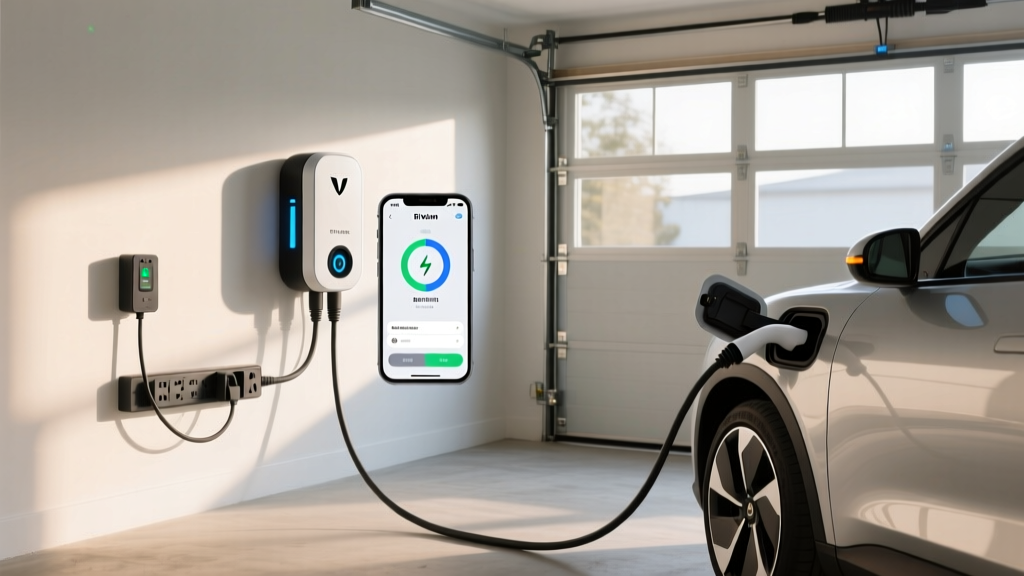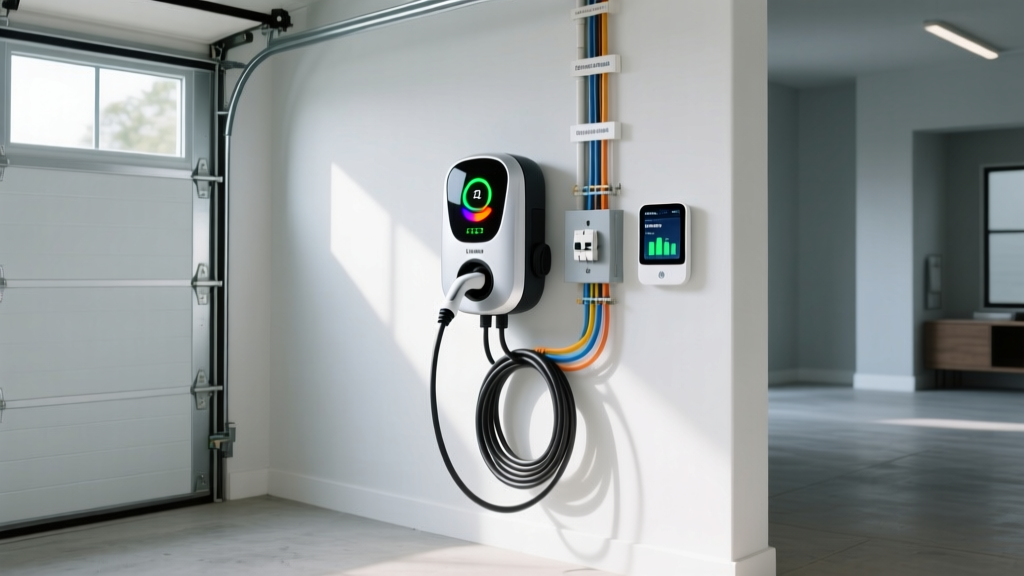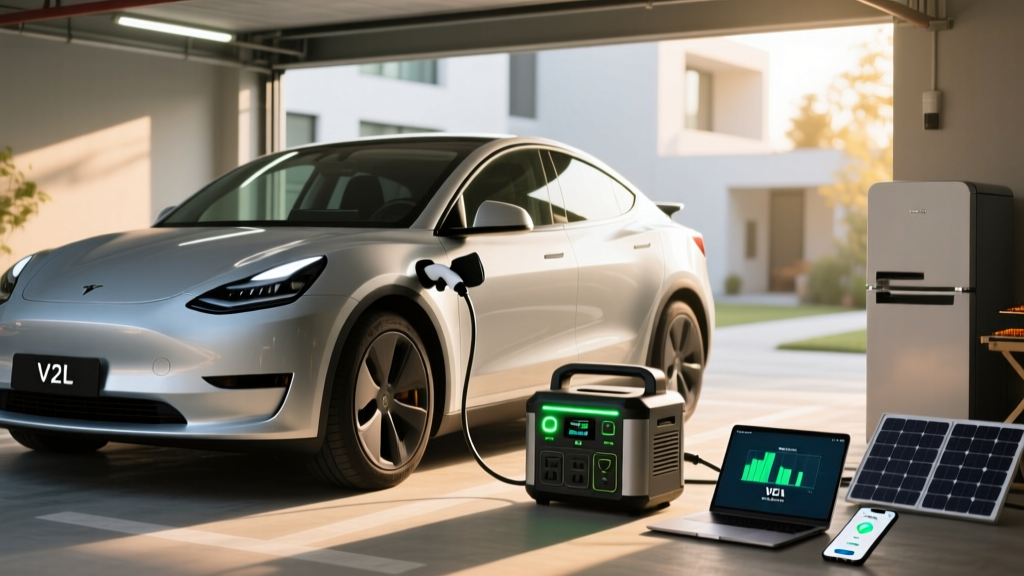
Electric vehicles are evolving from mere transportation into mobile power stations. Among the most practical emerging features is V2L charging — Vehicle-to-Load — which allows you to draw electricity directly from your EV's high-voltage traction battery to run external devices, appliances, and tools. Unlike bidirectional V2H (Vehicle-to-Home) or V2G (Vehicle-to-Grid) systems that require specialized electrical infrastructure, V2L is simple: plug into an outlet on the car and start drawing power.
But V2L doesn't exist in isolation. Understanding how it fits into your broader EV charging ecosystem — from Level 1 trickle charging to DC fast charging — is essential for any current or prospective EV owner. This guide covers V2L in depth, then maps the complete charging landscape so you know exactly what powers your car, what your car can power, and what it all costs.
What Is V2L Charging and How Does It Work?
V2L charging uses an onboard inverter to convert the DC electricity stored in your EV's high-voltage battery pack into standard AC household power (120V in North America). The vehicle essentially becomes a large, quiet, zero-emission generator. Most V2L-capable EVs provide one or more standard AC outlets — either built into the vehicle or via an adapter that plugs into the charge port.
V2L-Capable EVs: 2026 Models at a Glance
| Vehicle | V2L Output | Battery (usable kWh) | Outlet Location | Notes |
|---|---|---|---|---|
| Hyundai Ioniq 5 | 3.6 kW | 84.0 kWh (NMC) | Interior + charge-port adapter | Interior 120V outlet standard; external adapter available |
| Kia EV6 | 3.6 kW | 77.4 kWh (NMC) | Charge-port adapter | V2L adapter sold separately in some trims |
| Ford F-150 Lightning | 9.6 kW (Pro Power Onboard) | 131.0 kWh (NMC, Extended Range) | Bed outlets (120V/240V) | Highest output; 240V outlet enables welders, large compressors |
| Genesis GV60 | 3.6 kW | 77.4 kWh (NMC) | Charge-port adapter | Same E-GMP platform as Ioniq 5/EV6 |
| Chevrolet Silverado EV | 10.2 kW (Pro Power) | 200+ kWh (Ultium, NMC) | Bed outlets (120V/240V) | Massive battery enables days of backup use |
| Rivian R1S / R1T (Gen 2) | 6.6 kW (camp kitchen/outlets) | ~106 kWh (NMC, Max Pack) | Cargo area / bed outlets | Adventure-focused implementation |
What can you actually run? A 3.6 kW V2L system can comfortably power a microwave (~1,000W), a laptop charger (~65W), LED lighting (~20W), a mini-fridge (~80W), and a television (~150W) simultaneously. Ford's 9.6 kW system can run a circular saw (1,800W), an air compressor (1,600W), and a space heater (1,500W) all at once — making it a genuine job-site power source.
How long can you run devices? This depends on your battery capacity and load. Drawing a continuous 1,500W from an Ioniq 5's 84 kWh battery (assuming you use 80% of the pack, preserving a buffer) gives you roughly 44 hours of runtime. The F-150 Lightning Extended Range, at 131 kWh usable, could sustain that same 1,500W load for nearly 70 hours.
V2L vs. V2H vs. V2G: Understanding Bidirectional Charging
V2L is the simplest form of bidirectional energy flow. Here's how the three tiers differ:
- V2L (Vehicle-to-Load): Powers standalone devices via AC outlets on the vehicle. No home electrical integration required. Think of it as a built-in generator.
- V2H (Vehicle-to-Home): Feeds power back through a dedicated bidirectional charger and transfer switch to supply your home's electrical panel during outages. Requires a compatible charger (e.g., Ford Charge Station Pro, Wallbox Quasar) and professional installation with a transfer switch.
- V2G (Vehicle-to-Grid): Sends electricity back to the utility grid for demand-response programs or peak shaving. Requires utility cooperation, compatible hardware, and is still in limited deployment in 2026.
If you want emergency home backup without the complexity and cost of a full V2H setup, V2L combined with a heavy-duty extension cord to a critical appliance (refrigerator, CPAP machine, sump pump) is the practical middle ground. Just never backfeed into a wall outlet — that's a serious safety and code violation.
The Complete EV Charging Levels: Speeds Explained
Before exploring V2L's place in your charging life, you need clarity on how your EV gets charged in the first place. The three standard levels differ dramatically in power (kW) and time. Remember: kW (kilowatts) measures power — the rate of energy delivery, while kWh (kilowatt-hours) measures energy — the total capacity of your battery. A 10 kW charger fills a 100 kWh battery in 10 hours, theoretically.
EV Charging Levels: Speed and Range Added
| Level | Voltage | Power (kW) | Miles of Range/Hour | Typical Use |
|---|---|---|---|---|
| Level 1 | 120V AC | 1.0–1.4 kW | 3–5 mi/hr | Overnight top-up; low-mileage drivers |
| Level 2 | 240V AC | 3.3–19.2 kW | 12–75 mi/hr | Home daily charging; workplace; public AC |
| DC Fast Charge | 400–800V DC | 50–350+ kW | 150–1,200+ mi/hr (peak) | Road trips; rapid top-up |
Miles-per-hour figures vary by vehicle efficiency. A 250 mi/kWh-efficient sedan gains more miles per kW than a heavy truck at 2.0 mi/kWh.
DC Fast Charging: Charge Curve Reality
Peak kW ratings are marketing numbers. Real charging follows a charge curve — power starts high at low State of Charge (SoC) and tapers significantly above 80%. A Hyundai Ioniq 5 may peak at 240 kW on an 800V-compatible charger, but that peak lasts only minutes in the 10–40% SoC window. From 10–80%, the average sustained rate is closer to 150–170 kW, yielding a 10–80% time of approximately 18 minutes. From 80–100%, charging slows to roughly 30–50 kW — which is why road-trip strategy favors charging to 80% and moving on.
How Fast Will Each Level Charge Common EV Batteries?
Here's what charging times look like for three representative battery sizes across common charging scenarios:
| Scenario | 58 kWh Battery (e.g., VW ID.4 Std) |
84 kWh Battery (e.g., Ioniq 5) |
131 kWh Battery (e.g., F-150 Lightning ER) |
|---|---|---|---|
| Level 1 (1.4 kW): 0–100% | ~41 hours | ~60 hours | ~94 hours |
| Level 2 (11.5 kW / 48A): 0–100% | ~5 hours | ~7.3 hours | ~11.4 hours |
| Level 2 (7.7 kW / 32A): 0–100% | ~7.5 hours | ~10.9 hours | ~17 hours |
| DC Fast: 10–80% (typical peak) | ~25–30 min (135 kW avg) | ~18 min (170 kW avg) | ~40 min (150 kW avg) |
Home EV Charger Installation: Costs, Electrical Requirements, and Panel Upgrades
Most EV owners do the majority of their charging at home on Level 2. Here's what's involved in a professional installation.
Electrical Requirements
A Level 2 home charger requires a 240-volt dedicated circuit. Common configurations:
- 40-amp circuit (32A continuous charging, 7.7 kW): Adequate for most sedans and crossovers charging overnight. Requires 6-gauge copper wire (or 4-gauge aluminum).
- 50-amp circuit (40A continuous, 9.6 kW): Recommended for larger batteries (80+ kWh). Requires 6-gauge copper.
- 60-amp circuit (48A continuous, 11.5 kW): Maximizes charging speed for vehicles with large onboard chargers (e.g., F-150 Lightning, Lucid Air). Requires 4-gauge copper.
Critical safety note: Per the National Electrical Code (NEC), continuous loads (including EV charging) cannot exceed 80% of a circuit's rated amperage. A 50A breaker supports 40A continuous draw — not 50A. A licensed electrician will size wire and breaker accordingly.
Home Level 2 Charger Installation: Cost Breakdown
| Component | Simple Install (panel nearby) | Complex Install (long run / panel upgrade) |
|---|---|---|
| Level 2 EVSE unit (smart charger) | $350–$700 | $500–$1,200 |
| Electrician labor (2–6 hours) | $300–$600 | $800–$2,000 |
| Permit & inspection | $50–$200 | $100–$350 |
| Wire, conduit, connectors | $50–$150 | $200–$800 |
| Electrical panel upgrade (100A → 200A) | $0 (not needed) | $1,500–$3,500 |
| TOTAL ESTIMATED COST | $750–$1,650 | $3,100–$7,850 |
Source: Licensed electrician estimates, 2025–2026 national averages. Get at least two quotes. The IRS §30C Alternative Fuel Vehicle Refueling Property Credit may cover up to 30% of home charger installation costs (max $1,000), subject to census-tract eligibility.
Do You Need a Panel Upgrade?
Homes built before the 1990s often have 100-amp service panels. Adding a 50-amp EV circuit to an already-loaded 100A panel can exceed safe capacity — especially if you have electric heating, an electric dryer, and an electric range. Your electrician will perform a load calculation per NEC Article 220. If your calculated load exceeds 80% of panel capacity, a panel upgrade to 200A (or even 325A/400A for all-electric homes) is required. This is the single biggest cost variable in EV charger installation.
Connector Compatibility: NACS, CCS1, and CHAdeMO
The connector landscape has consolidated significantly. Tesla's North American Charging Standard (NACS) has been adopted by Ford, GM, Rivian, Hyundai, Kia, and most major automakers starting in the 2025–2026 model years. CCS1 remains on many existing vehicles, and CHAdeMO is effectively legacy (Nissan Leaf only).
Connector Types by Brand (2026 Models)
| Connector | Brands Using It (2026) | Adapter Notes |
|---|---|---|
| NACS | Tesla, Ford, GM, Rivian, Hyundai, Kia, Genesis, Volvo, Polestar, BMW, Mercedes, Lucid | CCS1→NACS adapters available ($150–$250) for older CCS vehicles |
| CCS1 | VW ID.4 (2024 and earlier), older Bolt EV/EUV, legacy models | NACS→CCS1 adapter needed for Tesla Supercharger access |
| CHAdeMO | Nissan Leaf (only remaining model) | CHAdeMO infrastructure declining; adapters limited |
For V2L: Hyundai/Kia/Genesis use a proprietary V2L adapter that plugs into the NACS (or CCS) charge port. Ford's Pro Power Onboard outlets are built into the vehicle body — no adapter needed.
Charging Cost Per Mile: EV vs. Gasoline
The economics of EV charging depend heavily on where and when you charge. Here's a realistic breakdown for a mid-size EV averaging 3.0 miles/kWh (roughly 112 MPGe):
Cost Per Mile: Charging Scenarios vs. Gas
| Scenario | $/kWh | ¢/mile | Annual cost (12,000 mi) |
|---|---|---|---|
| Home Level 2, off-peak utility rate | $0.09–$0.13 | 3.0–4.3¢ | $360–$520 |
| Home Level 2, standard rate | $0.14–$0.18 | 4.7–6.0¢ | $560–$720 |
| Public Level 2 (ChargePoint, EVgo) | $0.20–$0.35 | 6.7–11.7¢ | $800–$1,400 |
| DC Fast Charging (Electrify America, Tesla) | $0.30–$0.55 | 10.0–18.3¢ | $1,200–$2,200 |
| Gasoline vehicle (28 MPG avg, $3.40/gal) | — | 12.1¢ | $1,457 |
Home off-peak charging delivers the largest savings — typically 60–75% less per mile than gasoline. Exclusive DC fast charging can approach or exceed gas costs, which is why home Level 2 is the financial backbone of EV ownership. Source: fueleconomy.gov, AAA Your Driving Costs 2025.
Recommended Home Level 2 Chargers for 2026
Not all EVSE (Electric Vehicle Supply Equipment) units are equal. Here are top picks based on reliability, features, and value:
Emporia Level 2 Smart Charger
- Power: 11.5 kW (48A)
- Connector: NACS (J1772 adapter included)
- Cable length: 24 ft
- Smart features: Wi-Fi, scheduling, energy monitoring, solar integration, V2H-ready with Emporia V2H module
- Price: ~$399
- Best for: Budget-conscious buyers wanting full smart features
ChargePoint Home Flex
- Power: Up to 12 kW (50A, configurable)
- Connector: NACS or J1772
- Cable length: 23 ft
- Smart features: Wi-Fi, Alexa/Google integration, scheduling, amperage adjustment via app
- Price: ~$599
- Best for: Reliable name brand with flexible amperage
Tesla Wall Connector
- Power: 11.5 kW (48A)
- Connector: NACS (native Tesla)
- Cable length: 24 ft
- Smart features: Wi-Fi, power sharing (multiple units on one circuit), OTA updates
- Price: ~$450
- Best for: Tesla owners; excellent build quality
Grizzl-E Smart
- Power: 9.6 kW (40A)
- Connector: NACS (J1772 adapter available)
- Cable length: 24 ft
- Smart features: Wi-Fi, OCPP compatible, -40°F rated, IP67 outdoor
- Price: ~$499
- Best for: Cold climates, outdoor installs, ruggedness
Safety, Code, and Installation Best Practices
EV charging is a continuous high-amperage load — more demanding than most household circuits. Follow these non-negotiables:
- Dedicated circuit: Your EV charger must have its own breaker — never share a circuit with other outlets or appliances.
- GFCI protection: NEC 2020+ requires GFCI protection for all EVSE outlets (though hardwired units may not require a GFCI breaker, depending on jurisdiction). Your electrician will ensure compliance.
- Outdoor rating: If installing outdoors, choose an EVSE rated at least IP55 (splash-resistant). Look for NEMA 4 or IP67 for full weather resistance.
- Cable management: Use a holster or retractable system. A charging cable on the garage floor is a trip hazard and accelerates wear.
- Permit and inspection: Most jurisdictions require an electrical permit for a new 240V circuit. Skipping this voids homeowner's insurance coverage for related electrical fires.
- Hardwired vs. plug-in: Hardwired EVSE units (no plug) eliminate the NEMA 14-50 receptacle as a failure point and are preferred for 48A+ installations. A NEMA 14-50 plug is convenient for portability but is rated for limited insertion cycles.
Practical V2L Use Cases: When Your EV Becomes the Power Source
V2L isn't just a novelty — it solves real problems:
- Camping and overlanding: Power electric coolers, induction cooktops, CPAP machines, and lighting without a loud, smelly gas generator.
- Job-site power: The F-150 Lightning's 9.6 kW Pro Power Onboard runs miter saws, compressors, and battery chargers for a full workday.
- Emergency backup: During multi-day outages, run a refrigerator (150W avg), freezer, and medical devices. An 84 kWh battery at 1,000W continuous load provides 60+ hours of runtime.
- Tailgating and events: Electric grills, speakers, and displays — all from your car.
- Off-grid work: Laptop charging, power tools, and lighting at remote locations.
- V2L output (typically 3.6 kW) cannot run central air conditioning, electric heat strips, or electric ovens simultaneously.
- Using V2L depletes your driving range. Budget ~3 miles of range per kWh consumed.
- Most V2L systems shut off automatically if the vehicle's 12V battery drops below a threshold — keep your EV plugged in or monitor SoC during extended use.
- V2L adapters are brand-specific; a Hyundai V2L adapter won't work on a Ford, and vice versa.
Frequently Asked Questions
How much does it cost to install a home EV charger?
A straightforward Level 2 installation on an existing 200A panel typically costs $750–$1,650 total (EVSE unit + electrician + permit). If your home needs a panel upgrade from 100A to 200A, expect $3,100–$7,850 all-in. The IRS §30C credit may reimburse up to 30% of installation costs (max $1,000) if you live in an eligible census tract.
How fast will each charging level add range?
Level 1 (120V) adds 3–5 miles per hour — fine for drivers covering under 30 miles daily. Level 2 (240V, 48A) adds 25–40 miles per hour for most EVs, fully replenishing overnight. DC fast charging adds 150–300+ miles in a 20–30 minute session, depending on peak kW and vehicle acceptance rate.
Which connector or charger is compatible with my EV?
For 2026 models: Tesla, Ford, GM, Rivian, Hyundai, Kia, and most new EVs use NACS. Older VW, Bolt, and legacy models use CCS1. Only the Nissan Leaf still uses CHAdeMO. Adapters exist between NACS and CCS1 ($150–$250), but verify compatibility with your specific model year before purchasing.
How much does charging cost per mile vs. gas?
Home off-peak charging costs 3–4.3¢ per mile for a typical EV — roughly 65–75% less than a 28 MPG gas car at $3.40/gallon (12.1¢/mile). Public DC fast charging at $0.40/kWh costs about 13¢/mile, roughly equal to gas. Home charging is where the economics win decisively.
What electrical upgrades might I need?
If your home has a 100A panel, you'll likely need a 200A upgrade ($1,500–$3,500). If your panel is already 200A but heavily loaded (electric heat, dryer, range), your electrician will perform a load calculation. Solutions include a smart load-management device (e.g., Emporia Smart Load Manager) that throttles EV charging when other loads spike — potentially avoiding a panel upgrade entirely.
Can I use V2L while the vehicle is charging?
Generally, no. Most V2L systems disable output when the vehicle is plugged into a charger. Plan your V2L use for when the vehicle is parked and unplugged.
Does V2L degrade the battery faster?
V2L draws DC current at low rates (3.6 kW = roughly 0.04C for an 84 kWh battery). This is far gentler than DC fast charging and has negligible impact on battery degradation beyond normal cycle use. The battery doesn't distinguish between powering the motor at low speed and powering your TV.