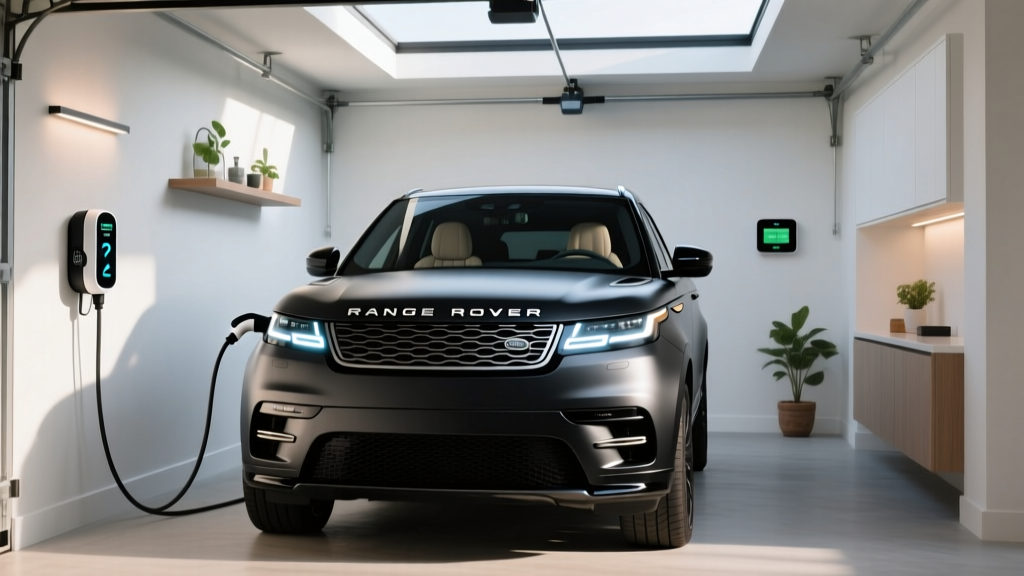
The 2025 Range Rover Sport PHEV (P550e) pairs a turbocharged inline-six with a 141-hp electric motor and a 38.2 kWh battery pack, delivering an EPA-estimated 48 miles of electric-only range. That is one of the largest batteries in the luxury PHEV segment, which means charging logistics matter more here than on a compact plug-in hybrid. If you are plugging into a standard 120V outlet, you could be waiting over 12 hours for a full charge. A proper Level 2 home setup transforms that experience entirely.
This guide covers everything you need to charge a Range Rover Sport PHEV at home and on the road: electrical requirements, installation costs, charge times at every level, connector compatibility, and specific equipment recommendations. Whether your Sport PHEV is parked in a suburban garage or you are planning a cross-country trip, the numbers below will tell you exactly what to expect.
2025 Range Rover Sport PHEV: Battery and Charging Specs at a Glance
Before we get into chargers and wiring, here are the vehicle-side numbers that drive every charging decision. The Sport PHEV uses a J1772 connector for AC charging and does not support DC fast charging — a common limitation among PHEVs that buyers should understand upfront.
| Specification | Value |
|---|---|
| Battery capacity (gross / usable) | 38.2 kWh / ~31.8 kWh usable |
| EPA electric-only range | 48 miles |
| Real-world electric range (highway/cold) | ~35–42 miles |
| EPA MPGe (combined, electric mode) | 51 MPGe |
| Gas-only fuel economy (combined) | 20 MPG |
| Max AC charge rate (onboard charger) | 7.2 kW |
| DC fast charging | Not supported |
| AC connector | J1772 |
| Combined system output | 542 hp / 553 lb-ft torque |
| 0–60 mph | 5.2 seconds |
| Base MSRP (P550e SE) | $83,600 |
| Battery warranty | 8 years / 100,000 miles |
Charging Levels Explained: How Fast Will Each Level Add Range?
Understanding the three charging levels is essential. The critical distinction: kW (kilowatts) measures power — how fast energy flows into your battery. kWh (kilowatt-hours) measures energy — the total capacity of your battery. Think of kW as the width of a pipe and kWh as the size of the tank you are filling.
| Level | Voltage / Amperage | Max Power (kW) | Miles of Range Per Hour | Full Charge Time (0–100%) |
|---|---|---|---|---|
| Level 1 (standard outlet) | 120V / 12A | 1.4 kW | ~3–4 mi/hr | ~10–12 hours |
| Level 2 (home/public AC) | 240V / 32A | 7.2 kW (vehicle max) | ~18–22 mi/hr | ~4.5–5.5 hours |
| DC Fast Charging | 400V+ / variable | N/A | N/A | Not supported on Sport PHEV |
The Sport PHEV's 7.2 kW onboard charger is the bottleneck for AC charging. Even if you install a 48-amp Level 2 charger capable of delivering 11.5 kW, the vehicle will only accept 7.2 kW. That said, installing a higher-capacity circuit is often smart for future-proofing if you plan to add a full BEV later.
For daily use, Level 2 is the practical choice. A 5-hour charge window easily covers an overnight session, meaning you start every morning with a full 48 miles of electric range — enough for most commutes without burning a drop of gas.
Home Charger Installation: Electrical Requirements and Costs
Installing a Level 2 charger for your Range Rover Sport PHEV requires a dedicated 240V circuit. Here is what that involves and what it typically costs.
Electrical Requirements
- Voltage: 240V (same as a dryer or oven outlet)
- Recommended circuit: 40-amp breaker minimum (for a 32-amp continuous charger); 50-amp or 60-amp recommended for future-proofing
- Wire gauge: 6 AWG copper for 50A circuits; 8 AWG for 40A
- Panel capacity: Most modern 200-amp panels can accommodate a 40–50A EV circuit. Older 100-amp panels often require an upgrade.
- GFCI protection: Required by NEC 2020 (Article 625) for all EV charging outlets — your electrician will include this
- Permit: Required in most jurisdictions; typically $50–$200
Installation Cost Breakdown
| Component | Low Estimate | High Estimate | Notes |
|---|---|---|---|
| Level 2 charger (hardware) | $350 | $750 | 32A–48A smart chargers |
| Electrician labor (2–6 hrs) | $300 | $900 | Varies by region and run length |
| Electrical materials (wire, conduit, breaker) | $100 | $400 | Longer wire runs cost more |
| Permit and inspection | $50 | $200 | Required in most municipalities |
| Total (no panel upgrade) | $800 | $2,250 | Typical suburban install |
| Panel upgrade (if needed) | $1,500 | $3,500 | 100A → 200A service upgrade |
| Total (with panel upgrade) | $2,300 | $5,750 | Older homes may require this |
For a Range Rover Sport PHEV owner with a modern 200-amp panel and a garage close to the electrical panel, expect to spend roughly $1,200–$1,800 total for a quality smart charger and professional installation. The investment pays for itself quickly given the fuel savings detailed below.
Connector Compatibility: What Fits the Range Rover Sport PHEV?
The 2025 Range Rover Sport PHEV uses the J1772 connector for all AC charging. This is the standard AC connector for every non-Tesla EV and PHEV sold in North America. Because the Sport PHEV does not support DC fast charging, you do not need to worry about CCS1, CHAdeMO, or NACS (Tesla's North American Charging Standard) compatibility for this vehicle.
| Connector Type | Used For | Sport PHEV Compatible? | Notes |
|---|---|---|---|
| J1772 | Level 1 & Level 2 AC charging | Yes (native) | Standard on all home chargers |
| NACS (Tesla) | Level 2 AC & DC fast charging | No (not needed) | Tesla Wall Connector includes J1772 adapter option |
| CCS1 | DC fast charging | No — PHEV has no DC port | Only relevant for full BEVs |
| CHAdeMO | DC fast charging (legacy) | No — PHEV has no DC port | Being phased out in the US |
Bottom line: Any Level 2 home charger with a J1772 plug will work with your Sport PHEV. If you also own or plan to buy a Tesla or NACS-equipped BEV, consider a charger that offers both J1772 and NACS, or use a J1772-to-NACS adapter. The Tesla Wall Connector now ships with a J1772 adapter option, making it a dual-vehicle solution.
Cost to Charge: Home vs. Public vs. Gas
One of the strongest arguments for plugging in your Sport PHEV nightly is the cost savings. Here is how charging costs compare across scenarios, based on the vehicle's ~31.8 kWh usable battery capacity and 48-mile EPA electric range.
| Scenario | Rate ($/kWh) | Cost for Full Charge | Cost Per Mile (electric) |
|---|---|---|---|
| Home (off-peak utility rate) | $0.10–$0.14 | $3.18–$4.45 | $0.07–$0.09 |
| Home (average US rate) | $0.16 | $5.09 | $0.11 |
| Public Level 2 (network pricing) | $0.25–$0.49 | $7.95–$15.58 | $0.17–$0.33 |
| Gas-only mode (20 MPG, $3.50/gal) | $3.50/gallon | — | $0.18 |
At home off-peak rates, driving on electricity costs roughly $0.07–$0.09 per mile — about half the cost of gas-only mode at $0.18/mile. Over a year of commuting 40 miles round-trip (roughly 10,000 miles), that translates to approximately $700–$1,100 in annual fuel savings if you maximize electric driving. The savings narrow if you rely heavily on public chargers, which can approach or exceed gas costs per mile.
Key insight for PHEV owners: The Range Rover Sport PHEV gets only 20 MPG in gas-only mode due to its weight and performance tuning. That makes electric driving significantly more valuable financially than on a more efficient PHEV like the Toyota RAV4 Prime (which gets 38 MPG on gas). Every mile you drive on electricity in the Sport PHEV saves more money.
Recommended Level 2 Chargers for the Range Rover Sport PHEV
Since the Sport PHEV's onboard charger maxes out at 7.2 kW (32 amps), any quality 32-amp charger will fully utilize its charging capability. We recommend 40–48 amp chargers for future-proofing, in case you add a BEV that can accept 11.5 kW. Below are three chargers we recommend based on reliability, smart features, and value.
ChargePoint Home Flex
- Power output: Up to 11.5 kW (48A) — adjustable via dip switches
- Connector: J1772 (native)
- Cable length: 23 feet
- Smart features: Wi-Fi, app scheduling, Alexa integration, energy tracking
- Price: ~$549
- Why it fits: Adjustable amperage lets you match your circuit exactly; excellent app for scheduling off-peak charging to minimize cost
Emporia Level 2 EV Charger
- Power output: Up to 11.5 kW (48A)
- Connector: J1772 (native)
- Cable length: 24 feet
- Smart features: Wi-Fi, app control, solar integration, TOU scheduling
- Price: ~$399
- Why it fits: Best value smart charger; pairs with Emporia Vue energy monitor for whole-home load management — ideal if your panel is tight on capacity
Tesla Wall Connector (J1772 version)
- Power output: Up to 11.5 kW (48A)
- Connector: J1772 (2025 J1772 model) or NACS with adapter
- Cable length: 24 feet
- Smart features: Wi-Fi, firmware updates, power sharing (two units on one circuit)
- Price: ~$450
- Why it fits: Sleek design matches luxury garage aesthetics; power-sharing feature lets you install two chargers on a single 60A circuit if you add a second EV
All three chargers are hardwired (no plug), which eliminates the need for a 240V receptacle and satisfies NEC requirements for continuous loads. If you prefer a plug-in setup using a NEMA 14-50 outlet, confirm your electrician installs a GFCI breaker — this is now required by code and adds roughly $80–$150 to the breaker cost.
Safety, Code Compliance, and Installation Best Practices
EV charging involves sustained high-current draw, which places more demand on your home's electrical system than typical appliances. Follow these guidelines to ensure a safe, code-compliant installation.
- Dedicated circuit: Your Level 2 charger must be on its own dedicated breaker — never share a circuit with other appliances. NEC Article 625 classifies EV charging as a continuous load, meaning the circuit must be rated at 125% of the charger's maximum amperage (e.g., a 32A charger needs a 40A breaker).
- GFCI protection: Required for all EV charging outlets since NEC 2020. Hardwired installations may have different requirements depending on your local jurisdiction — your electrician will know the local amendments.
- Outdoor rating: If your charger is mounted outside or in an exposed carport, ensure it carries a NEMA 4 or IP65 rating. All three chargers recommended above are rated for outdoor installation.
- Cable management: A 23–24 foot cable is long enough for most garage layouts, but plan your mounting location to avoid tripping hazards. Wall-mounted cable organizers ($20–$40) keep things tidy.
- Permit and inspection: Skipping the permit to save $100 is not worth the risk. An unpermitted install can void your homeowner's insurance coverage in the event of an electrical fire and may cause issues when you sell your home.
- Utility rebates: Many utilities offer $250–$500 rebates for installing a smart Level 2 charger, and some offer reduced time-of-use (TOU) rates for EV charging. Check with your local utility before purchasing — some require specific charger models to qualify.
For authoritative guidance on electrical codes related to EV charging, the NFPA's NEC Article 625 is the national standard, though local amendments vary. Always defer final specifications to a licensed electrician who can assess your home's specific wiring, panel capacity, and local code requirements.
Frequently Asked Questions
How much does it cost to install a home EV charger for the Range Rover Sport PHEV?
Expect $800–$2,250 for a typical installation including a smart Level 2 charger, electrician labor, materials, and permit — assuming your electrical panel has sufficient capacity. If a panel upgrade from 100A to 200A is needed, add $1,500–$3,500. Most Range Rover Sport PHEV owners with modern 200-amp panels spend around $1,200–$1,800 total.
How fast will each charging level add range to the Sport PHEV?
Level 1 (120V) adds roughly 3–4 miles per hour — about 10–12 hours for a full charge. Level 2 (240V, 32A) adds roughly 18–22 miles per hour, fully charging the 38.2 kWh battery in about 4.5–5.5 hours. The Sport PHEV does not support DC fast charging.
Which connector and charger is compatible with my Range Rover Sport PHEV?
The Sport PHEV uses a J1772 connector for all AC charging. Any Level 2 home charger with a J1772 plug is compatible. You do not need CCS1, CHAdeMO, or NACS because the vehicle has no DC fast-charge port. The ChargePoint Home Flex, Emporia Level 2, and Tesla Wall Connector (J1772 version) are all fully compatible.
How much does charging cost per mile versus gas?
At home off-peak rates ($0.10–$0.14/kWh), electric driving costs roughly $0.07–$0.09 per mile. Gas-only mode at 20 MPG and $3.50/gallon costs about $0.18 per mile. That is roughly a 50–60% savings per mile when driving on electricity. Public Level 2 chargers at $0.25–$0.49/kWh narrow or eliminate this advantage.
What electrical upgrades might I need for a home charger?
The most common upgrade is a panel capacity increase from 100A to 200A, needed in older homes with limited spare capacity. Other potential upgrades include running a new 240V circuit from the panel to your garage (especially if the panel is far from the parking spot, which increases wire cost), adding a GFCI breaker for outlet installations, and in rare cases, upgrading the utility service drop. A licensed electrician's load calculation will determine exactly what is needed.
Does the 2025 Range Rover Sport PHEV qualify for the federal tax credit?
The IRS §30D clean vehicle credit for PHEVs requires a minimum 7 kWh battery (the Sport PHEV's 38.2 kWh qualifies), but the credit also depends on MSRP caps ($80,000 for SUVs), buyer income limits ($300,000 joint / $150,000 single), and battery component and critical mineral sourcing requirements that change annually. Because the Sport PHEV's MSRP starts above $83,600 and the sourcing rules are strict, eligibility is uncertain for many buyers. Consult a tax professional and check the latest IRS guidance at irs.gov before relying on the credit in your purchase decision.
Can I use a Tesla Supercharger with my Range Rover Sport PHEV?
No. Tesla Superchargers provide DC fast charging, and the Sport PHEV does not have a DC fast-charge port. Even with an adapter, there is no way to DC-charge this vehicle. You can, however, use Tesla's Level 2 Wall Connector (J1772 version) at home, which is an excellent option.
Sources: EPA fuel economy data via fueleconomy.gov, Land Rover official specifications, IRS §30D guidance at irs.gov, NEC Article 625 via NFPA. Installation cost ranges based on national averages from licensed electrician surveys; your local costs may vary. Always consult a licensed electrician for your specific installation.