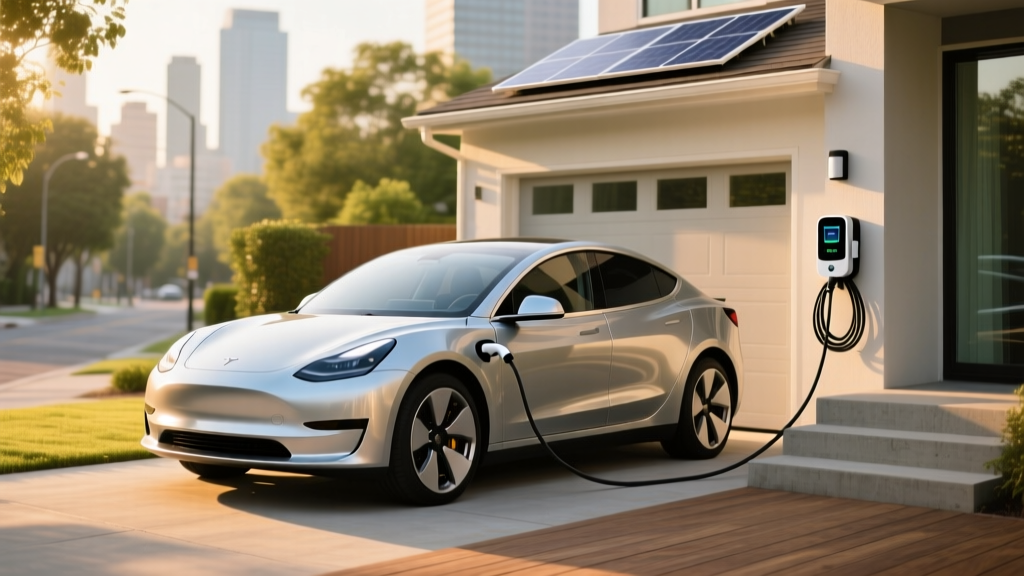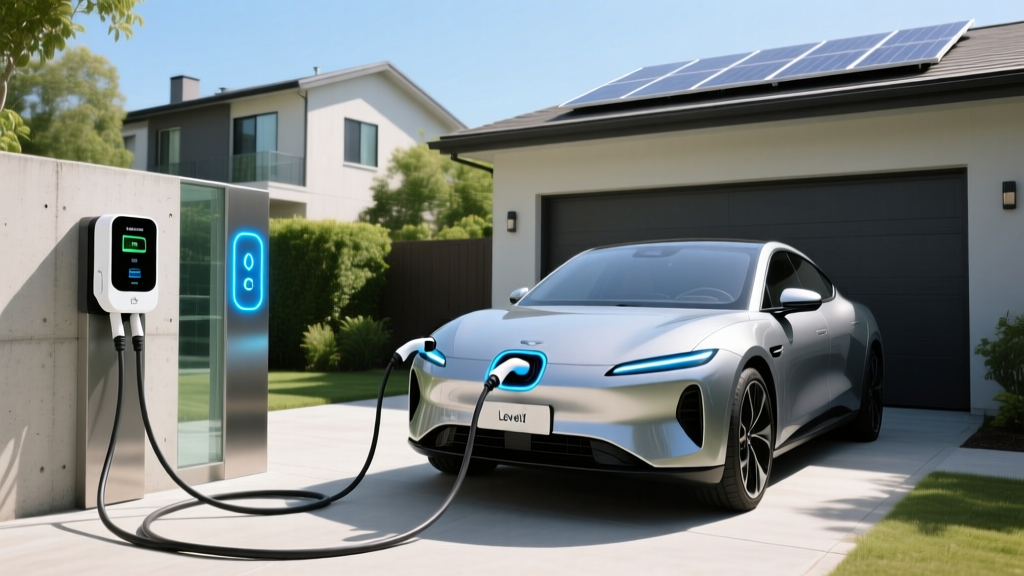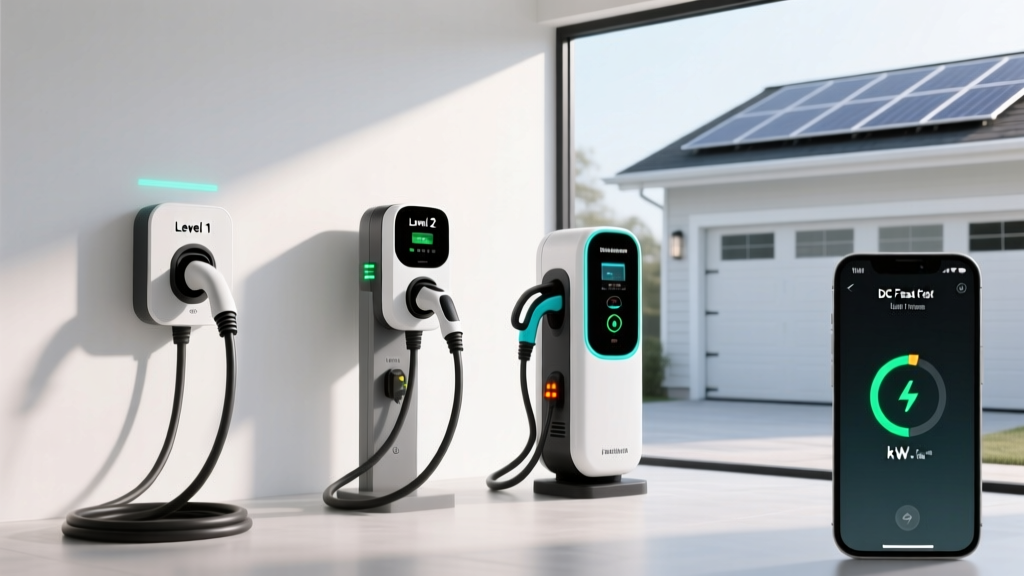
Choosing the right EV charger determines whether you wake up to a full battery every morning or spend your evenings hunting for public stations. The three types of electric car chargers—Level 1 (120V), Level 2 (240V), and DC Fast Charging (480V+)—differ radically in power output, measured in kilowatts (kW), which dictates how quickly they replenish your battery's energy capacity, measured in kilowatt-hours (kWh). Understanding that distinction is the foundation of practical EV ownership.
This guide breaks down every charger type with exact speeds, real installation costs, connector standards for 2026 models, and the per-mile economics that make home charging a fraction of the cost of gasoline.
Understanding kW vs kWh: The Metric That Matters
Before comparing charger types, lock in this distinction:
- kW (kilowatts) = power, or the rate at which electricity flows into your car. Think of it as the width of a hose. A 11.5 kW Level 2 charger delivers energy roughly 8× faster than a 1.4 kW Level 1 outlet.
- kWh (kilowatt-hours) = energy, or the total amount stored in your battery. A Tesla Model Y Long Range has an ~81 kWh battery pack; a Hyundai Ioniq 5 SE has a ~77.4 kWh pack.
Charging speed depends on both: a charger's kW output and your vehicle's onboard charger or DC acceptance rate. You can only charge as fast as the slower link in that chain.
The Three Types of Electric Car Chargers Explained
| Level | Voltage | Power (kW) | Miles of Range Per Hour | Typical Use | 10–80% Time (75 kWh battery) |
|---|---|---|---|---|---|
| Level 1 | 120V AC | 1.2–1.9 kW | 3–5 mi/hr | Overnight top-up, PHEVs, emergencies | ~31–47 hours |
| Level 2 | 240V AC | 3.3–19.2 kW | 12–75 mi/hr | Home daily charging, workplace, public destinations | ~3.5–8 hours (depends on kW) |
| DC Fast Charge | 400–800V DC | 50–350 kW | 150–1,200+ mi/hr | Road trips, highway corridors, rapid top-ups | ~18–45 minutes |
Level 1: The Emergency Backup
Every EV ships with a mobile charging cord that plugs into a standard 120V household outlet (NEMA 5-15). On a dedicated 15-amp circuit, expect roughly 1.4 kW and about 3–5 miles of range per hour of charging. For a plug-in hybrid like the Toyota RAV4 Prime (42 miles of electric range), Level 1 fully replenishes the 18.1 kWh battery in about 12 hours—perfectly adequate overnight. For a full-size BEV with a 75–100 kWh battery, Level 1 is impractical as a primary strategy but works as an emergency trickle or for very low-mileage drivers covering under 20 miles daily.
Level 2: The Home Charging Standard
A 240V Level 2 station—identical in voltage to an electric dryer or oven—is what the vast majority of EV owners rely on for daily charging. Residential units typically deliver 7.7 kW (32A), 9.6 kW (40A), 11.5 kW (48A), or up to 19.2 kW (80A) on hardwired circuits. At 11.5 kW, you add roughly 40–45 miles of range per hour, meaning an overnight session of 8 hours easily replaces 200+ miles of driving.
One important caveat: your car's onboard charger caps AC charging speed. The Ford F-150 Lightning Extended Range accepts 19.2 kW AC, but a Chevrolet Equinox EV accepts only 11.5 kW. Plugging the Chevy into a 19.2 kW station still charges at 11.5 kW.
DC Fast Charging: Road-Trip Power
DC fast chargers bypass your car's onboard AC-to-DC converter and feed direct current straight into the battery at far higher power levels. Modern public DCFC stations range from 50 kW (legacy) to 350 kW (Electrify America, EVgo, Tesla Supercharger V4). Vehicles built on 800V architectures—like the Hyundai Ioniq 5, Kia EV6, and Porsche Taycan—can accept peak rates of 235–350 kW, achieving 10–80% in as little as 18 minutes under ideal conditions.
Home Charger Installation: Electrical Requirements and Costs
Installing a Level 2 home charger is the single biggest infrastructure decision you'll make as an EV owner. Costs vary dramatically based on your electrical panel's capacity, the distance from panel to charger location, and local permit requirements.
| Component | Simple Install (Panel Adjacent) | Moderate Install (50–80 ft Run) | Complex Install (Panel Upgrade Needed) |
|---|---|---|---|
| Level 2 Charger Equipment | $350–$700 | $350–$700 | $350–$700 |
| Electrician Labor | $300–$600 | $600–$1,500 | $800–$2,000 |
| Electrical Permit | $50–$150 | $50–$200 | $100–$300 |
| Panel Upgrade (if needed) | Not required | Not required | $1,500–$4,000 |
| Conduit/Wiring Materials | $50–$150 | $200–$500 | $300–$800 |
| Total Estimated Cost | $750–$1,600 | $1,200–$2,900 | $3,050–$7,800 |
Electrical Panel Capacity: The Hidden Variable
Most modern homes have a 200-amp main panel, which generally supports a 40A or 50A dedicated circuit for EV charging alongside normal household loads. Older homes with 100-amp service may need a panel upgrade—a significant cost that many buyers overlook. A licensed electrician will perform a load calculation per NEC Article 220 to determine whether your panel has headroom.
If a full panel upgrade isn't feasible, consider a smart charger with load-management capability (such as the Enel X Way JuiceBox or Emporia Level 2). These devices dynamically reduce charging amperage when household demand spikes, allowing EV charging on smaller panels without tripping the main breaker.
Safety and Code Requirements
- Dedicated circuit: NEC 2023/2026 requires EV chargers to be on a dedicated branch circuit—not shared with other appliances.
- GFCI protection: Outdoor receptacles used for EV charging must have ground-fault circuit interrupter (GFCI) protection. Hardwired units with built-in GFCI are preferred for outdoor installs.
- NEMA 14-50 vs. hardwired: A NEMA 14-50 receptacle (50A, 240V) offers portability but requires a GFCI breaker (~$100–$150 extra). Hardwired installations (60A+) eliminate the receptacle, reduce points of failure, and may not require GFCI breakers in all jurisdictions—consult your local AHJ (Authority Having Jurisdiction).
- Outdoor rating: If mounting outdoors, ensure the charger carries a NEMA 4 or IP65 rating for weather resistance.
- Permit and inspection: Nearly all jurisdictions require an electrical permit and post-installation inspection. Skipping this voids homeowner's insurance coverage for electrical fires.
Connector Compatibility: NACS, CCS, and CHAdeMO in 2026
The connector landscape has consolidated dramatically. Following Ford, GM, Rivian, Volvo, and nearly every major automaker adopting the North American Charging Standard (NACS) for their vehicles starting in the 2025–2026 model years, the legacy CCS1 connector is being phased out on new vehicles. CHAdeMO remains only on the Nissan Leaf, which continues to use it through its final production runs.
| Connector | AC Charging (Level 1/2) | DC Fast Charging | Brands Using It (2026) |
|---|---|---|---|
| NACS (J3400) | Yes (native) | Yes (native) | Tesla, Ford, GM, Rivian, Volvo, Polestar, Mercedes, BMW, Hyundai, Kia, Lucid, Subaru, Toyota (bZ series) |
| CCS1 | Yes (via J1772 + DC pins) | Yes | Legacy models (pre-2025 VW ID.4, older BMW i4, Stellantis EVs); adapters available for NACS vehicles |
| CHAdeMO | No (uses J1772 for AC) | Yes | Nissan Leaf only |
Adapter reality: If you own a NACS-equipped vehicle and need to use a CCS1 public charger, Tesla, Ford, and others sell CCS-to-NACS adapters ($150–$250). Conversely, CCS-vehicle owners can purchase NACS-to-CCS adapters to access Tesla Superchargers that have opened to non-Tesla vehicles. Always verify adapter compatibility with both your vehicle and the specific charging network before purchasing.
Charging Cost Per Mile: EV vs. Gasoline
The economic case for home charging is overwhelming when you compare cost per mile against a gasoline vehicle. The variables are your local electricity rate ($/kWh), your vehicle's efficiency (kWh/100 mi), and whether you use time-of-use (TOU) rates for off-peak charging.
| Scenario | Rate ($/kWh) | Vehicle Efficiency | Cost Per Mile |
|---|---|---|---|
| Home, off-peak TOU rate | $0.08–$0.12 | 28 kWh/100 mi (e.g., Tesla Model 3) | $0.022–$0.034 |
| Home, standard residential rate | $0.14–$0.18 | 28 kWh/100 mi | $0.039–$0.050 |
| Public Level 2 (ChargePoint, etc.) | $0.20–$0.35 | 28 kWh/100 mi | $0.056–$0.098 |
| DC Fast Charging (Electrify America, EVgo) | $0.35–$0.55 | 28 kWh/100 mi | $0.098–$0.154 |
| Tesla Supercharger (member rate) | $0.25–$0.35 | 28 kWh/100 mi | $0.070–$0.098 |
| Gasoline Baseline: 28 MPG combined at $3.40/gallon = $0.121/mile | |||
Home off-peak charging delivers fuel costs roughly 75–80% lower than gasoline per mile. Even frequent DC fast charging roughly matches gasoline costs. The savings compound: a driver covering 12,000 miles/year at home TOU rates spends approximately $300–$400 annually on electricity versus $1,450 on gasoline for an equivalent 28 MPG vehicle.
For the latest average electricity rates by state, the U.S. Energy Information Administration (EIA) publishes monthly residential pricing data.
Recommended Level 2 Home Chargers (2026)
ChargePoint Home Flex
- Power Output: Up to 12 kW (50A) on a 60A circuit, adjustable down to 16A
- Connector: NACS (2026 model) or J1772; CCS adapter included
- Cable Length: 23 feet
- Smart Features: Wi-Fi, app scheduling, Alexa integration, energy tracking, TOU optimization
- Price: $599 (NACS model)
- Best For: Most homeowners wanting reliable, app-controlled charging with flexible amperage
Emporia Vue Level 2 Charger
- Power Output: Up to 11.5 kW (48A) on a 60A circuit
- Connector: NACS (J3400)
- Cable Length: 24 feet
- Smart Features: Integrated energy monitoring, solar-aware charging, circuit-sharing with Emporia Vue panel monitor, load management
- Price: $399
- Best For: Homes with solar panels or limited electrical capacity needing load management
Grizzl-E Smart
- Power Output: Up to 10 kW (40A) on a 50A circuit
- Connector: NACS or J1772
- Cable Length: 24 feet
- Smart Features: OCPP-compatible, app control, adjustable amperage, extreme cold rating (-40°C)
- Price: $449
- Best For: Cold-climate installations and outdoor mounting in harsh environments
Wall Connector (Tesla, Gen 4)
- Power Output: Up to 11.5 kW (48A) on a 60A circuit
- Connector: NACS native
- Cable Length: 24 feet
- Smart Features: Wi-Fi updates, power-sharing between multiple units, Tesla app integration, integrated cable management
- Price: $495
- Best For: Tesla owners and multi-EV households wanting power-sharing across two Wall Connectors on one circuit
DC Fast Charging Times for Common EV Batteries
DC fast charging times depend on battery size, vehicle acceptance rate, and charger capability. Below are representative 10–80% times under optimal thermal conditions:
| Vehicle | Battery (kWh) | Peak DC Acceptance | Charger Used | 10–80% Time |
|---|---|---|---|---|
| Hyundai Ioniq 5 (2026) | 77.4 (NMC) | 240 kW (800V) | 350 kW EA station | ~18 minutes |
| Tesla Model 3 Long Range | ~79 (NMC) | 250 kW | Tesla Supercharger V3 | ~25 minutes |
| Ford F-150 Lightning Ext. Range | 131 (NMC) | 150 kW | 150 kW DCFC | ~41 minutes |
| Chevrolet Equinox EV 3RS | 85 (NMC) | 150 kW | 150 kW DCFC | ~30 minutes |
| Nissan Leaf SV Plus | 62 (NMC) | 100 kW (CHAdeMO) | 100 kW CHAdeMO | ~40 minutes |
Remember: these times assume a preconditioned battery at moderate ambient temperature (60–80°F). In sub-freezing conditions without preconditioning, expect 10–80% times to increase by 30–50% due to reduced lithium-ion charge acceptance at low temperatures.
Frequently Asked Questions
How much does it cost to install a home EV charger?
A straightforward Level 2 installation on an existing 200A panel with a short wire run typically costs $750–$1,600 including equipment, electrician labor, and permit. Longer wire runs (50–80+ feet) push costs to $1,200–$2,900. If your home needs a panel upgrade from 100A to 200A, add $1,500–$4,000, bringing the total to $3,050–$7,800. Always get 2–3 quotes from licensed electricians and verify they pull permits. The IRS Alternative Fuel Vehicle Refueling Property Credit (§30C) may cover up to 30% of equipment and installation costs (capped at $1,000 for residential) if you live in an eligible census tract—check current-year IRS guidance for eligibility.
How fast will each charging level add range?
Level 1 (120V) adds 3–5 miles per hour. Level 2 (240V, 48A/11.5 kW) adds roughly 40–45 miles per hour for efficient sedans. DC fast charging at 150+ kW can add 150–300 miles in 20–30 minutes, depending on vehicle acceptance rate and battery size. Exact rates vary by vehicle efficiency (measured in kWh/100 mi or MPGe on fueleconomy.gov).
Which connector/charger is compatible with my EV?
For 2026 model-year vehicles, nearly all new EVs use NACS (J3400) for both AC and DC charging. Legacy CCS1 vehicles (pre-2025) can use NACS Superchargers with a CCS-to-NACS adapter. The Nissan Leaf remains the sole CHAdeMO vehicle. For home Level 2 charging, purchase a charger with the connector native to your vehicle—NACS for most new EVs, J1772 for older models.
How much does charging cost per mile vs gas?
Home charging at off-peak electricity rates ($0.08–$0.12/kWh) costs roughly $0.02–$0.03 per mile for an efficient EV. Gasoline at $3.40/gallon in a 28 MPG vehicle costs $0.12 per mile. That's a 75–80% per-mile savings. Public DC fast charging ($0.35–$0.55/kWh) costs roughly $0.10–$0.15 per mile—comparable to gasoline—so prioritize home and workplace charging for maximum savings.
What electrical upgrades might I need?
Homes with a 200-amp electrical panel typically support a 40–50A dedicated EV circuit without upgrades. Homes with 100-amp service, older wiring, or high existing loads (electric heat, pool, workshop) may require a panel upgrade to 200A or 400A, costing $1,500–$4,000. An alternative is installing a smart charger with load management that dynamically reduces charging current when household demand is high, avoiding a panel upgrade entirely. A licensed electrician's load calculation per NEC Article 220 is the definitive answer for your home.