Your electric vehicle's battery holds more than just driving range — it's a rolling power plant. Vehicle-to-Load (V2L) technology lets you tap that stored energy to run appliances, power tools, or keep your home's essentials alive during an outage, all through a V2L charger or adapter plugged into your EV's charge port. But V2L is just one slice of the broader EV energy ecosystem. This guide breaks down exactly what V2L can deliver, how it fits alongside standard Level 1, Level 2, and DC fast charging, and what equipment and electrical upgrades you'll need in 2026.
What Is a V2L Charger and What Can It Power?
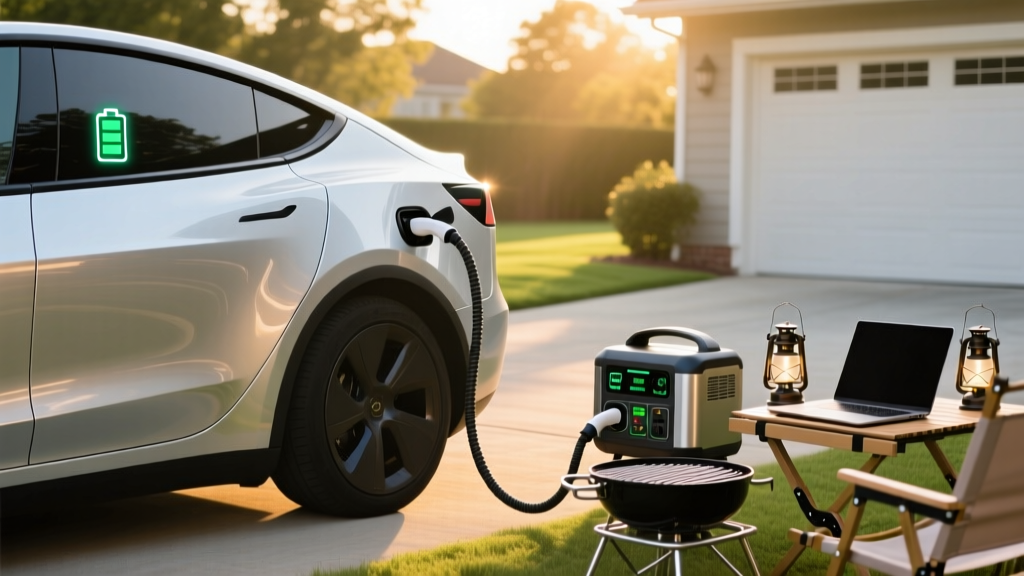
A V2L (Vehicle-to-Load) charger is an adapter or bidirectional charging unit that draws energy from your EV's high-voltage traction battery and converts it to standard 120V AC household power. Unlike a conventional EV charger that pushes electricity into your car, a V2L device pulls it out.
Most V2L systems in 2026 deliver between 1.5 kW and 3.6 kW of continuous output through one or two standard NEMA 5-15 outlets. That's enough to simultaneously run:
- A full-size refrigerator (800W)
- A microwave (1,000W)
- Several LED lights and a Wi-Fi router (100W combined)
- A laptop charger (65W)
With a 77.4 kWh battery (like the Hyundai Ioniq 5's usable capacity), a 3.6 kW V2L draw could sustain those essentials for well over 20 hours before depleting the pack to 20% State of Charge (SoC).
- V2L (Vehicle-to-Load): Powers standalone devices via an AC outlet adapter. No home electrical integration required.
- V2H (Vehicle-to-Home): Feeds power into your home's electrical panel via a bidirectional Level 2 charger and transfer switch. Can back up entire circuits during outages.
- V2G (Vehicle-to-Grid): Sends energy back to the utility grid for demand response and potential compensation. Still limited in availability in 2026.
Charging Levels Explained: Speeds, kW, and Range Per Hour
Before exploring V2L hardware, it's critical to understand how EVs charge. kW (kilowatts) measures the rate of power flow — how fast energy moves. kWh (kilowatt-hours) measures total energy stored — your battery's tank size. Never confuse the two.
| Level | Voltage / Amps | Max Power (kW) | Miles of Range Per Hour | 10–80% Time (77 kWh battery) |
|---|---|---|---|---|
| Level 1 (120V) | 120V / 12A | 1.4 kW | 3–5 mi/hr | ~32 hours |
| Level 2 (240V) | 240V / 32–48A | 7.7–11.5 kW | 20–40 mi/hr | 5–8 hours |
| DC Fast Charging | 400–800V DC | 50–350 kW | 150–1,200 mi/hr (peak) | 18–45 minutes |
| V2L Output | 120V AC out | 1.5–3.6 kW | N/A (discharges battery) | N/A |
Real-world caveat: DC fast charging speeds peak only between roughly 10–50% SoC and taper significantly above 80% to protect battery health. A vehicle rated for 240 kW peak might average only 120 kW across a full 10–80% session. Cold batteries below 50°F also charge noticeably slower unless preconditioned.
V2L-Compatible EVs in 2026: Which Models Support It?
Not every EV can export power. V2L requires both compatible onboard hardware (a bidirectional inverter) and, in most cases, a manufacturer-specific adapter that plugs into the charge port. Here's the 2026 landscape:
| Vehicle | V2L Output | Charge Port / Connector | Adapter Required | Battery (usable kWh) |
|---|---|---|---|---|
| Hyundai Ioniq 5 | 3.6 kW | NACS (2026+) | Hyundai V2L adapter | 77.4 kWh (NMC) |
| Hyundai Ioniq 6 | 3.6 kW | NACS (2026+) | Hyundai V2L adapter | 77.4 kWh (NMC) |
| Kia EV6 | 3.6 kW | NACS (2026+) | Kia V2L adapter | 77.4 kWh (NMC) |
| Kia EV9 | 3.6 kW | NACS | Kia V2L adapter | 100.0 kWh (NMC) |
| Ford F-150 Lightning | 2.4 kW (onboard) / 9.6 kW (V2H w/ Charge Station Pro) | CCS1 / NACS adapter | Ford Intelligent Backup Power system (V2H) | 98–131 kWh (NMC) |
| Ford E-Transit | 2.4 kW (Pro Power Onboard) | CCS1 | Built-in bed outlets | 68 kWh (NMC) |
| Genesis GV60 | 3.6 kW | NACS (2026+) | Genesis V2L adapter | 77.4 kWh (NMC) |
| Chevrolet Silverado EV | Up to 10.2 kW (V2H/V2L via Energy Transfer Pro) | NACS | GM Energy Transfer Pro accessory | 200 kWh (NMC, max pack) |
Notable exclusions: As of 2026, Tesla vehicles do not offer consumer V2L functionality despite having the largest battery packs on the market. Rivian's V2H feature (announced for the R1T and R1S) remains in limited rollout. Always verify V2L support for your specific model year and trim — it's sometimes limited to higher trims or requires a dealer-installed accessory.
How Much Does It Cost to Install a Home EV Charger?
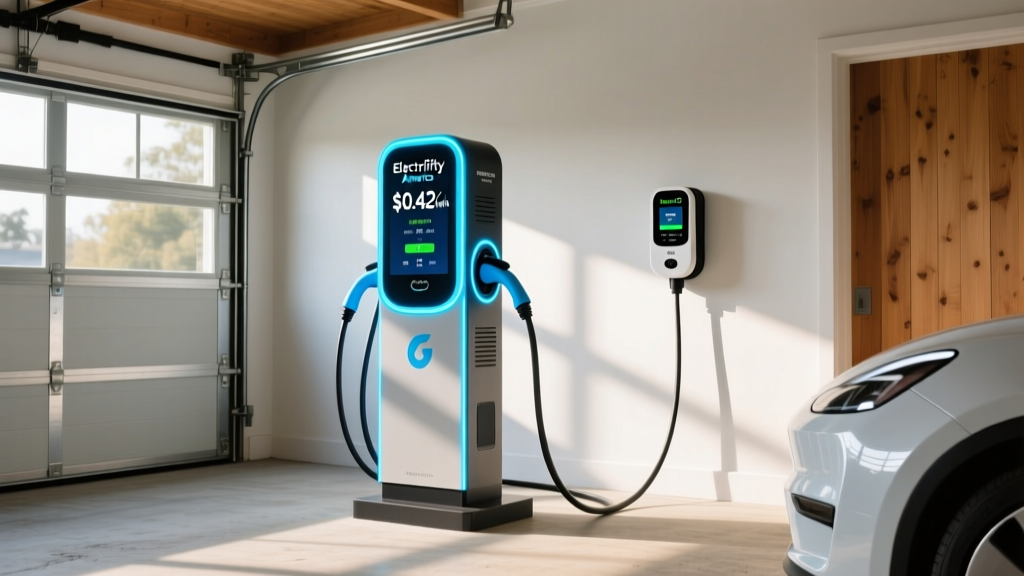
If you're pairing V2L capability with a proper home Level 2 charging setup, budget for both equipment and professional electrical work. Costs vary dramatically based on your home's existing electrical panel and the distance from the panel to your desired charger location.
| Component | Simple Install (panel nearby) | Complex Install (long run, panel upgrade) |
|---|---|---|
| Level 2 EVSE (32A–48A smart charger) | $350–$700 | $350–$700 |
| Electrician labor (240V circuit, 50A breaker) | $400–$800 | $1,200–$3,000 |
| Electrical permit | $50–$150 | $50–$200 |
| Panel upgrade (100A → 200A, if needed) | $0 | $1,500–$3,500 |
| Conduit, wiring, junction boxes | $50–$150 | $300–$800 |
| TOTAL RANGE | $850–$1,800 | $3,400–$8,200 |
Panel upgrade reality check: Homes built before 1990 often have 100-amp electrical service. Adding a 40A or 48A continuous-load EV circuit may require upgrading to 200A service. This isn't optional — the National Electrical Code (NEC) requires that continuous loads (including EV chargers) not exceed 80% of a circuit's rated capacity. A licensed electrician will perform a load calculation to determine if your panel can handle the additional draw.
Electrical Requirements: What Your V2L and Level 2 Setup Needs
Setting up EV charging and V2L capability safely means meeting code and planning for your home's specific infrastructure.
Level 2 Home Charger Requirements
- Dedicated 240V circuit: 50A breaker (for a 40A continuous charger) or 60A breaker (for 48A continuous)
- Wire gauge: 6 AWG copper for 50A circuits; 4 AWG for 60A circuits (runs over 50 feet may require upsizing)
- NEMA 14-50 outlet (for plug-in chargers) or hardwired connection (required for circuits above 50A per NEC)
- GFCI protection: NEC 2023 and later requires GFCI breakers for all EV receptacles — expect to pay $50–$120 for a GFCI breaker
- Outdoor rating: If your charger is outdoors, the EVSE must carry a NEMA 4 or NEMA 4X weatherproof rating
V2L Setup Considerations
V2L adapters plug directly into your vehicle's charge port and require no home electrical modifications. However, if you're pursuing V2H (Vehicle-to-Home) capability — like Ford's Intelligent Backup Power or GM's Energy Transfer Pro — you'll need:
- A bidirectional Level 2 wall unit (e.g., Ford Charge Station Pro, ~$1,300)
- A home energy management system or automatic transfer switch ($500–$2,000)
- Professional installation by a certified electrician ($1,000–$2,500 additional)
- Utility interconnection approval in some jurisdictions
Recommended V2L Adapters and Level 2 Chargers for 2026
Here's equipment that delivers proven performance and matches current connector standards.
Hyundai/Kia/Genesis V2L Adapter
- Power output: 3.6 kW (120V, 30A max)
- Connector: NACS (2026 models) or CCS1 (2024–2025 models)
- Outlets: 2× NEMA 5-15R (standard 120V)
- Price: $350–$450 (dealer or OEM parts site)
- Smart features: SoC limit setting via vehicle infotainment (stop discharge at 20%, 30%, etc.)
ChargePoint Home Flex (Level 2)
- Power output: Up to 11.5 kW (240V/48A) — configurable down to 16A
- Connector: NACS or J1772 (CCS1 with adapter)
- Cable length: 23 feet
- Price: $549–$649
- Smart features: Wi-Fi, scheduled charging, energy tracking, Alexa integration
Tesla Wall Connector (Level 2)
- Power output: Up to 11.5 kW (240V/48A)
- Connector: NACS native
- Cable length: 24 feet
- Price: $475
- Smart features: Wi-Fi updates, load sharing (multiple units on one circuit), power sharing
Emporia Vue Level 2 Charger
- Power output: Up to 11.5 kW (240V/48A)
- Connector: J1772 (NACS adapter included)
- Cable length: 24 feet
- Price: $399
- Smart features: Whole-home energy monitoring integration, solar-aware charging, V2H-ready firmware (upcoming)
Connector compatibility note: As of 2026, nearly all new EVs sold in North America use the NACS (North American Charging Standard) connector, originally developed by Tesla and now adopted by Ford, GM, Hyundai, Kia, Rivian, Volvo, and others. If you own a 2024 or earlier EV with a CCS1 port, you'll need a CCS1-to-NACS adapter ($150–$250) for Tesla Supercharger access. CHAdeMO remains only on the Nissan Leaf (discontinued after 2025) and a handful of older models — adapters are limited and not recommended for daily use.
How Much Does Charging Cost Per Mile vs. Gas?
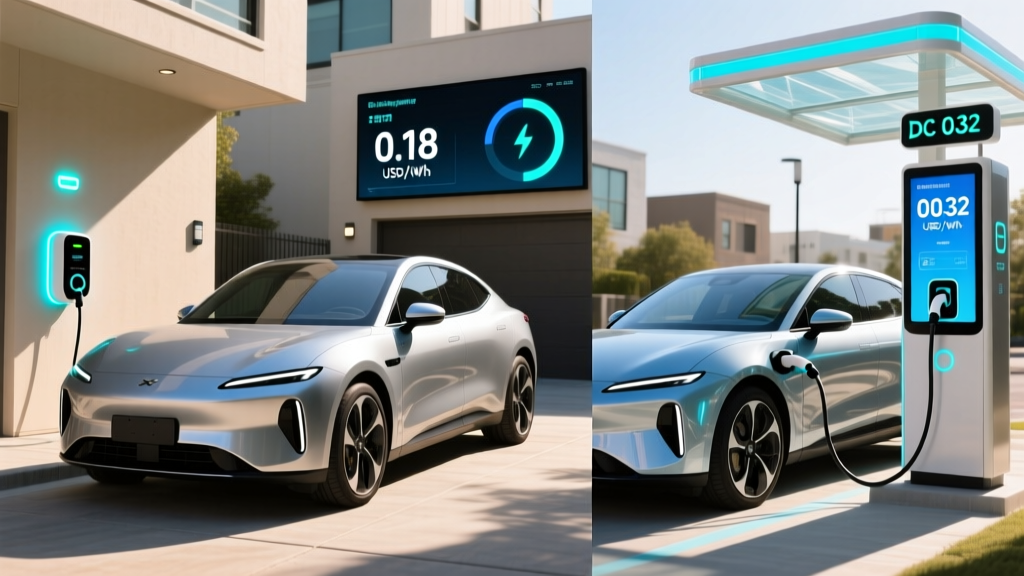
The economics of EV charging depend heavily on where and when you charge. Here's a realistic 2026 breakdown for an average EV achieving 3.5 miles per kWh (roughly 28.5 kWh/100 miles — typical for a midsize crossover like the Ioniq 5 or Model Y).
| Scenario | Rate ($/kWh) | Cost Per Mile | Equivalent Gas MPG at $3.40/gal |
|---|---|---|---|
| Home (off-peak utility rate) | $0.09–$0.13 | $0.026–$0.037 | 92–131 MPGe |
| Home (standard residential rate) | $0.14–$0.18 | $0.040–$0.051 | 67–85 MPGe |
| Public Level 2 (ChargePoint, etc.) | $0.20–$0.35 | $0.057–$0.100 | 34–60 MPGe |
| DC Fast (Electrify America, EVgo) | $0.35–$0.55 | $0.100–$0.157 | 22–34 MPGe |
| Gasoline (28 MPG avg sedan) | $3.40/gallon | $0.121 | 28 MPG |
Bottom line: Home off-peak charging delivers fuel costs at roughly one-quarter to one-third the price of gasoline. Even public DC fast charging at peak rates roughly matches gas costs per mile — and you're paying for speed, not economy. For V2L use, you're essentially discharging energy you already paid for at your home charging rate, making it one of the cheapest backup power sources available.
Safety, Code, and Smart Charging Practices
Whether you're installing a Level 2 charger or using V2L regularly, follow these safety principles:
- Never use extension cords with EV chargers or V2L adapters — voltage drop over distance creates fire risk
- Set a discharge limit when using V2L — most vehicles let you set a minimum SoC (e.g., 20%) so you don't strand yourself with a dead battery
- Inspect connectors for corrosion or damage, especially on outdoor units exposed to weather
- Verify your EVSE's UL listing — only use chargers certified by UL, ETL, or equivalent NRTL (Nationally Recognized Testing Laboratory)
- Monitor battery temperature: Sustained V2L discharge in extreme heat (>100°F ambient) can stress thermal management — park in shade when possible
V2L provides 120V AC only — it cannot directly power 240V appliances like electric dryers, central AC, or electric ranges. For whole-home backup including 240V circuits, you need a V2H system with a bidirectional charger and transfer switch. V2L is ideal for portable power, camping, job sites, and emergency essentials — not full-home backup.
Frequently Asked Questions
Can I use any V2L adapter with any EV?
No. V2L requires vehicle-specific hardware and software support. The adapter must match your EV's charge port connector (NACS for 2026+ models, CCS1 for older models), and your vehicle must have a bidirectional inverter built in. Check your owner's manual or manufacturer website for V2L compatibility before purchasing any adapter.
How long can V2L power my devices before the battery runs out?
Divide your battery's usable capacity (kWh) by your total load (kW). For example, a Kia EV9 with 100 kWh usable and a 2 kW total load (fridge + lights + router) could run for approximately 50 hours from 100% to 0%. In practice, set a 20% discharge floor to protect the battery, yielding roughly 40 hours — more than enough for most multi-day outages.
Does using V2L degrade my EV battery?
Minimally. Battery degradation is driven primarily by charge cycles, heat, and high SoC storage. Occasional V2L use is equivalent to driving the same energy out — the battery doesn't distinguish between discharge to wheels vs. discharge to outlets. According to U.S. Department of Energy data via fueleconomy.gov, modern NMC and LFP batteries retain 90%+ capacity after 150,000 miles of normal use including bidirectional cycling.
Do I need a permit to install a home Level 2 charger?
Yes, in virtually all U.S. jurisdictions. A licensed electrician will pull the permit, which typically costs $50–$200 depending on your municipality. The permit ensures the installation meets NEC requirements and is inspected for safety. Unpermitted work can void home insurance coverage and create problems during a home sale.
What's the difference between a V2L adapter and a V2L charger?
In common usage, the terms are interchangeable, but technically: a V2L adapter is a simple dongle that plugs into your EV's charge port and exposes AC outlets (like Hyundai's $400 unit). A V2L charger can also refer to a bidirectional wall-mounted unit (like the Ford Charge Station Pro) that enables V2H functionality — both charging the car and sending power back to the home through a single wall-mounted device.
Is V2L eligible for any tax credits or incentives?
The federal §30D Clean Vehicle Credit applies to the vehicle itself (up to $7,500, subject to MSRP caps, buyer income limits, and battery sourcing requirements), not to standalone V2L adapters. However, the Alternative Fuel Vehicle Refueling Property Credit (§30C) may cover bidirectional chargers (V2H equipment) installed at your home — up to 30% of the cost, capped at $1,000. Consult a tax professional to confirm eligibility based on your specific equipment and installation.