The Toyota RAV4 Prime (PHEV) has long been one of the most sought-after plug-in hybrids on the market. With growing interest in the next-generation model and search queries surging for a Toyota RAV4 PHEV 150 km range, buyers want to know: can you really squeeze 150 kilometers (roughly 93 miles) of electric-only driving out of a RAV4 plug-in hybrid, and what does it take to charge one at home?
As of the 2025 model year, the EPA rates the RAV4 Prime at 42 miles (68 km) of electric-only range from its 18.1 kWh usable lithium-ion battery. Toyota has signaled that its next-generation RAV4 PHEV — expected for the 2026 or 2027 model year on the new TNGA-P platform — will carry a significantly larger battery pack, potentially pushing EV range toward the 100–150 km mark. Until those final specs are confirmed and vehicles reach dealerships, however, the 150 km figure remains an aspirational target based on international testing cycles and early reports, not an EPA-verified number you can buy today.
Whether you're charging the current RAV4 Prime or preparing your home for a future long-range PHEV, the charging infrastructure you install now will serve you well. This guide covers exactly what's required — from electrical panel capacity to Level 2 equipment selection — with hard numbers at every step.
Understanding EV Charging Levels: kW, kWh, and Miles Per Hour
Before selecting equipment, you need clarity on the single most common point of confusion in EV ownership: kW (kilowatts) measures power — how fast energy flows into the battery. kWh (kilowatt-hours) measures energy — the total capacity of the battery itself. Think of kW as the width of a hose and kWh as the size of the bucket you're filling.
The current RAV4 Prime has an 18.1 kWh usable battery and a 6.6 kW onboard charger for Level 2 AC charging. A future 150 km-range PHEV would likely carry a 30–40 kWh pack, making charging infrastructure even more important.
| Level | Voltage | Power (kW) | Miles of EV Range Added Per Hour | Best For |
|---|---|---|---|---|
| Level 1 (Standard Outlet) | 120V AC | 1.0–1.4 kW | 3–5 miles/hr | Overnight top-ups, low daily mileage |
| Level 2 (Home / Public AC) | 240V AC | 3.3–19.2 kW | 12–75 miles/hr | Daily home charging, workplace |
| DC Fast Charging | 200–900V DC | 50–350 kW | 150–1,000+ miles/hr | Road trips, rapid top-ups |
For the current RAV4 Prime, a full Level 1 charge from empty takes roughly 12–14 hours. A Level 2 connection at 6.6 kW cuts that to approximately 2.5 hours. DC fast charging is not supported on the RAV4 Prime — Toyota omitted CCS DC capability on the current generation. A future long-range PHEV with a 35+ kWh battery would benefit enormously from DC fast charging capability, and industry signals suggest Toyota may add CCS or NACS DC support on upcoming models.
How Much Does It Cost to Install a Home EV Charger?
Home Level 2 installation costs vary widely depending on your electrical panel's existing capacity, the distance from panel to charger location, and local permit fees. Here's a realistic breakdown for a typical 240V / 40-amp (9.6 kW) home charging station:
| Component | Typical Cost Range | Notes |
|---|---|---|
| Level 2 Charger (Hardware) | $350–$750 | Smart Wi-Fi chargers, 25-ft cable, 32A–48A |
| Electrician Labor | $500–$2,000 | Depends on run length, wall type, conduit needs |
| Electrical Permit | $50–$250 | Varies by municipality; required by code |
| Panel Upgrade (if needed) | $1,500–$4,000 | Older 100A panels may need upgrade to 200A |
| Total (no panel upgrade) | $900–$3,000 | Most common scenario for modern homes |
| Total (with panel upgrade) | $2,400–$7,000 | Common in homes built before 2000 |
Which Connector Is Compatible with the RAV4 PHEV?
The current-generation RAV4 Prime uses a J1772 connector for Level 1 and Level 2 AC charging. It does not support DC fast charging natively. Here's how the connector landscape maps to Toyota's PHEV lineup and the broader market:
| Connector Type | Use Case | RAV4 Prime (Current) | Future Toyota PHEV (Expected) |
|---|---|---|---|
| J1772 | Level 1 & Level 2 AC | ✅ Native | ✅ Likely (or NACS with adapter) |
| NACS (Tesla / SAE J3400) | Level 2 AC + DC Fast | ❌ (adapter needed for Tesla destinations) | ✅ Toyota has committed to NACS adoption |
| CCS1 | DC Fast Charging | ❌ Not supported | ⚠️ Possible on select models |
| CHAdeMO | DC Fast (legacy) | ❌ Not supported | ❌ Discontinued standard |
Toyota announced in late 2023 that it will adopt the NACS (North American Charging Standard) connector on its North American EVs and electrified vehicles beginning with 2025–2026 model-year launches. For current RAV4 Prime owners, this means a J1772-to-NACS adapter (roughly $150–$250) will eventually grant access to Tesla Supercharger V2/V3 stations equipped with Magic Dock or NACS-native connectors. For home charging, any J1772 Level 2 station works natively today.
Charging Time: What to Expect from Empty to Full
Charging time depends on battery size (kWh) and charger power output (kW). Here are realistic charge times for the current RAV4 Prime and projected times for a future 150 km-range PHEV with a larger battery:
| Scenario | Battery (kWh Usable) | Charger Power | 0–100% Time | 10–80% Time |
|---|---|---|---|---|
| Current RAV4 Prime — Level 1 | 18.1 kWh | 1.4 kW (120V) | ~13 hours | ~9.5 hours |
| Current RAV4 Prime — Level 2 | 18.1 kWh | 6.6 kW (240V/28A) | ~2.75 hours | ~1.9 hours |
| Future PHEV (est.) — Level 2 | 35 kWh (est.) | 7.7 kW (240V/32A) | ~4.5 hours | ~3.2 hours |
| Future PHEV (est.) — Level 2 | 35 kWh (est.) | 11.5 kW (240V/48A) | ~3.0 hours | ~2.1 hours |
| Future PHEV (est.) — DC Fast | 35 kWh (est.) | 50 kW DC | N/A | ~25–30 min |
A few important caveats: PHEV batteries typically charge at a relatively constant rate from 10–80% because they lack the aggressive taper curves seen in large BEV packs. However, above 80% State of Charge (SoC), charging slows significantly to protect battery health. For daily driving, charging to 80–90% is practical and preserves long-term battery State of Health (SoH). Toyota's PHEV battery warranty covers 10 years / 150,000 miles with a capacity retention threshold — among the strongest in the segment.
Cost Per Mile: Charging vs. Gasoline for the RAV4 PHEV
One of the strongest arguments for a PHEV is the cost advantage of electric miles over gasoline. Here's how the numbers break down for the current RAV4 Prime and a comparable gas-only RAV4:
| Scenario | Energy Cost | Efficiency | Cost Per Mile |
|---|---|---|---|
| Home charging (off-peak, $0.12/kWh) | $0.12/kWh | 2.8 miles/kWh (94 MPGe) | $0.043/mile |
| Home charging (peak, $0.22/kWh) | $0.22/kWh | 2.8 miles/kWh | $0.079/mile |
| Public Level 2 ($0.35/kWh avg) | $0.35/kWh | 2.8 miles/kWh | $0.125/mile |
| DC Fast Charging ($0.48/kWh avg) | $0.48/kWh | 2.8 miles/kWh | $0.171/mile |
| Gas RAV4 AWD ($3.50/gal, 30 MPG combined) | $3.50/gallon | 30 MPG | $0.117/mile |
| RAV4 Prime on gas (38 MPG combined) | $3.50/gallon | 38 MPG | $0.092/mile |
At off-peak home electricity rates, charging the RAV4 Prime costs roughly one-third what gasoline costs per mile. Even at public Level 2 rates, electric miles remain competitive with gas. The savings compound: a driver who covers 12,000 miles annually with 80% electric driving saves an estimated $800–$1,200 per year versus a gas-only RAV4, depending on local utility rates. Use fueleconomy.gov to compare specific models.
Best Level 2 Chargers for the RAV4 PHEV: Equipment Picks
For the current RAV4 Prime (6.6 kW max onboard charger), any quality 32-amp Level 2 station will fully utilize its charging capability. For a future higher-capacity PHEV, investing in a 48-amp charger now is forward-compatible. Here are three proven options:
ChargePoint Home Flex
- Power: Up to 12 kW (50A), adjustable down to 16A–50A
- Connector: J1772 (NACS adapter available)
- Cable Length: 23 feet
- Smart Features: Wi-Fi, app scheduling, Alexa integration, energy reports
- Price: ~$549–$699
- Best For: Flexible amperage to match your panel capacity
Emporia Vue Level 2 Charger
- Power: Up to 11.5 kW (48A)
- Connector: J1772
- Cable Length: 24 feet
- Smart Features: Wi-Fi, energy monitoring, solar integration, load management
- Price: ~$399–$499
- Best For: Budget-conscious buyers who want energy tracking
Tesla Wall Connector (with J1772 adapter)
- Power: Up to 11.5 kW (48A)
- Connector: NACS native (J1772 adapter ~$50–$100)
- Cable Length: 24 feet
- Smart Features: Wi-Fi, OTA updates, power sharing between two units
- Price: ~$475
- Best For: Multi-EV households with Tesla + non-Tesla vehicles
For current RAV4 Prime owners, a 32-amp charger (7.7 kW) is more than sufficient since the vehicle caps at 6.6 kW. However, installing a 48-amp unit now — wired to a 60-amp breaker — ensures you're ready for a future PHEV or BEV with higher onboard charging capability without rewiring.
Safety, Electrical Code, and Installation Requirements
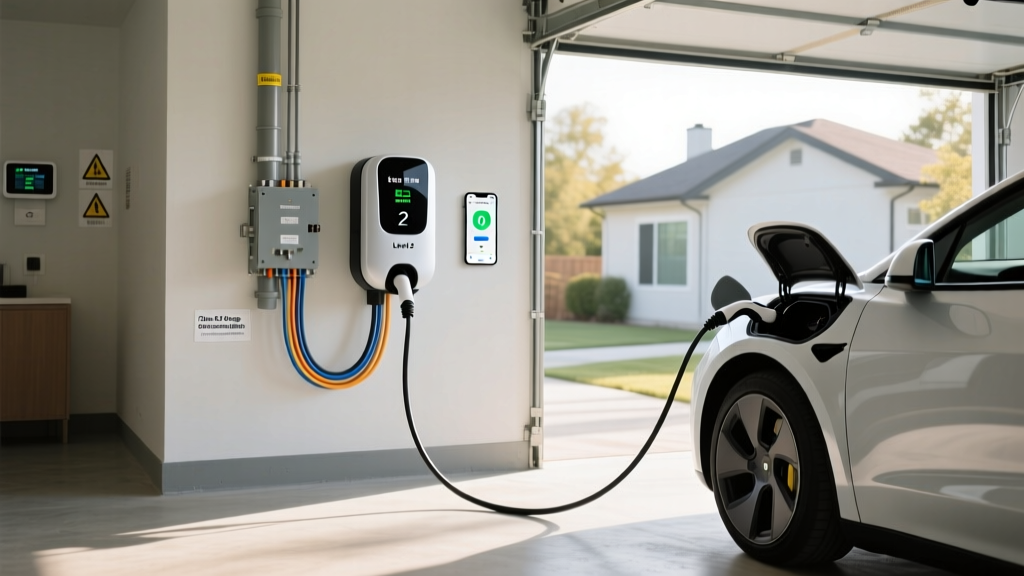
Level 2 charger installation must comply with the National Electrical Code (NEC) Article 625 and local building codes. Key requirements include:
- Dedicated Circuit: Your EV charger must be on its own dedicated breaker — no shared circuits with other appliances. A 40-amp charger requires a 50-amp breaker (NEC requires 125% overcurrent protection for continuous loads).
- GFCI Protection: NEC 2020 and later require GFCI (Ground Fault Circuit Interrupter) protection for all EV charging outlets. Hardwired chargers with built-in GFCI are acceptable.
- Outdoor Rating: If your charger is installed outdoors (garage exterior, driveway post), the unit must carry a NEMA 4 or IP55+ weatherproof rating. All recommended chargers above meet this standard.
- Wire Gauge: A 48-amp charger on a 60-amp breaker typically requires 4 AWG copper wire for runs under 50 feet. Longer runs may require 3 AWG to minimize voltage drop. Your electrician will calculate this.
- Permit and Inspection: Nearly all jurisdictions require an electrical permit and post-installation inspection for EV charger circuits. Skipping this can void homeowner's insurance claims related to electrical fires.
Federal Tax Credits and Incentives for Home Charging
The IRS §30C Alternative Fuel Vehicle Refueling Property Credit covers 30% of home EV charger equipment and installation costs, up to a maximum of $1,000. Key eligibility rules for 2025–2026:
- The charger must be installed at your primary residence in the United States.
- The property must be located in an eligible census tract (generally non-urban or lower-income areas — check the IRS eligibility tool or Argonne National Laboratory's mapping tool).
- The credit covers both hardware and electrician labor costs.
- There is no income cap for the §30C credit (unlike the §30D vehicle purchase credit).
- The credit is non-refundable — it reduces your tax liability but won't generate a refund beyond zero.
Many utilities also offer rebates of $200–$700 for Level 2 charger purchases or installations. Check with your local utility's EV program page before buying equipment, as some require pre-approval or specific charger models to qualify.
Frequently Asked Questions
Does the Toyota RAV4 PHEV really have a 150 km electric range?
Not yet. The current 2025 RAV4 Prime delivers an EPA-rated 42 miles (68 km) of electric range. A next-generation RAV4 PHEV with a larger battery — potentially approaching 100–150 km under optimistic WLTP testing — is expected for the 2026–2027 model year, but final EPA-verified specs have not been published. The 150 km figure circulating online likely reflects WLTP or CLTC testing, which tend to produce higher range numbers than EPA methodology.
Can I charge the RAV4 Prime on a regular household outlet?
Yes. The RAV4 Prime supports Level 1 charging at 120V / 12A (~1.4 kW), adding roughly 4 miles of EV range per hour. A full charge from empty takes about 12–14 hours. This is adequate for drivers who use fewer than 40 electric miles per day and can charge overnight, but a Level 2 installation is strongly recommended for convenience and to precondition the cabin while plugged in.
Do I need a 200-amp electrical panel for a home charger?
Not necessarily. A 200-amp panel is standard in most homes built after 2000 and can typically support a 40-amp or 48-amp EV circuit. However, if you have a 100-amp or 125-amp panel with existing high-load appliances (electric range, heat pump, dryer), your electrician may recommend a panel upgrade to 200 amps. Budget $1,500–$4,000 for this work if required.
Is it worth installing a 48-amp charger if the RAV4 Prime only accepts 6.6 kW?
If you plan to keep the RAV4 Prime long-term, a 32-amp charger (7.7 kW) is perfectly adequate. However, if you anticipate upgrading to a future PHEV with a larger battery or a full BEV, installing a 48-amp unit on a 60-amp breaker now avoids a costly re-wire later. The incremental hardware cost is typically $100–$200, and the electrician labor difference is minimal since the wire run is the same.
How does cold weather affect the RAV4 Prime's electric range?
In real-world cold-weather testing (below 32°F / 0°C), expect the RAV4 Prime's electric range to drop by 20–35% depending on whether you use resistive cabin heat or the available heat pump. That 42-mile EPA rating may shrink to 28–34 miles in freezing conditions with cabin heating active. Preconditioning the cabin while plugged in — using grid power rather than battery power — mitigates this loss significantly. A future 150 km-range PHEV would have more buffer to absorb cold-weather reduction while still covering most daily commutes.
What's the battery warranty on the RAV4 Prime?
Toyota covers the RAV4 Prime's hybrid battery for 10 years or 150,000 miles (whichever comes first), with a capacity retention guarantee. If the battery degrades below a defined threshold (typically 60–70% of original capacity), Toyota will repair or replace it under warranty. This is one of the longest PHEV battery warranties in the U.S. market and provides strong long-term ownership confidence.