The Toyota RAV4 has long been America's best-selling non-truck, and its evolution into a plug-in hybrid — the RAV4 Prime — proved that Toyota's compact SUV can deliver meaningful electric-only range. As Toyota expands its electrified lineup, the Toyota RAV4 Extended Range EV concept (a fan-coined term often applied to the RAV4 Prime PHEV and Toyota's upcoming BEV SUV plans) has become a top search for buyers weighing plug-in efficiency against full-electric commitment.
Whether you own a RAV4 Prime PHEV (18.1 kWh usable battery, 42 miles EPA electric range) or are planning ahead for a future Toyota BEV SUV, the charging fundamentals remain the same. This guide breaks down exactly how to charge at home, what public networks offer, what electrical upgrades you may need, and what you'll actually pay per mile — with real numbers, not marketing fluff.
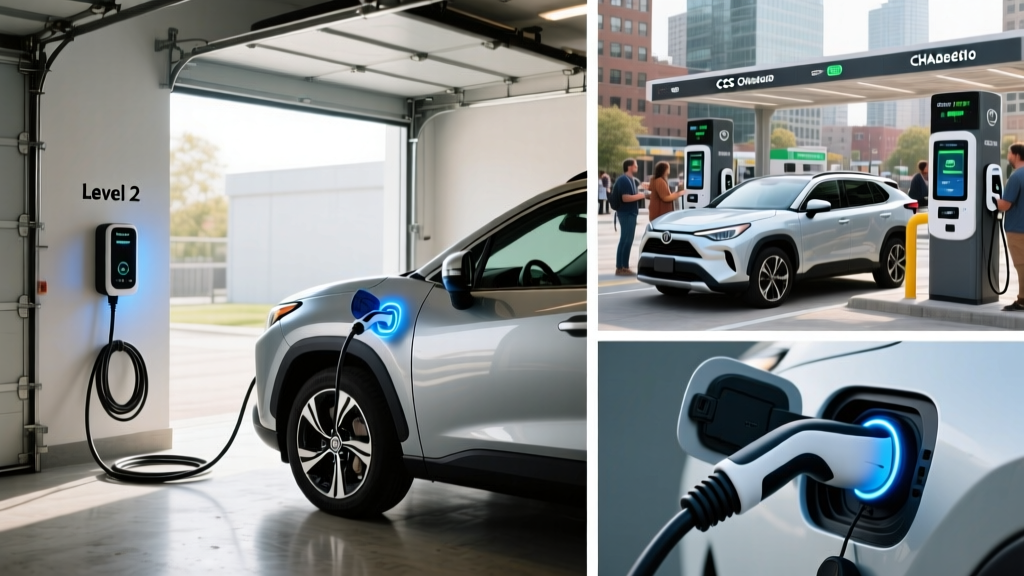
Charging Levels Explained: Level 1, Level 2, and DC Fast Charging
Before plugging in, you need to understand the three charging tiers. The distinction between kW (kilowatts — the rate of power delivery, like water pressure) and kWh (kilowatt-hours — the total energy stored, like gallons in a tank) is critical and non-negotiable. Your charger's kW rating determines how fast energy flows; your battery's kWh capacity determines how much it holds.
| Level | Voltage / Amperage | Power (kW) | Miles of Range Added per Hour | Best For |
|---|---|---|---|---|
| Level 1 (120V) | 120V / 12A | ~1.4 kW | 3–5 mi/hr | Overnight top-offs, PHEV owners with short commutes |
| Level 2 (240V) | 240V / 32A–48A | 7.7–11.5 kW | 25–44 mi/hr | Daily home charging (BEV and PHEV) |
| DC Fast Charging | 400V–800V DC | 50–350 kW | 150–800+ mi/hr (peak) | Road trips, emergency top-ups |
What this means for a RAV4 Prime PHEV: Its 18.1 kWh battery charges fully on Level 1 in roughly 12 hours (adequate for overnight), or on Level 2 in about 2.5 hours. The RAV4 Prime does not support DC fast charging — a notable limitation Toyota has acknowledged. A future Toyota RAV4 BEV with a ~70–80 kWh battery would need Level 2 for daily use and DC fast charging for road trips, with a typical 10–80% session taking 18–30 minutes at a 150+ kW station.
Home Charger Installation: Electrical Requirements and Real Costs
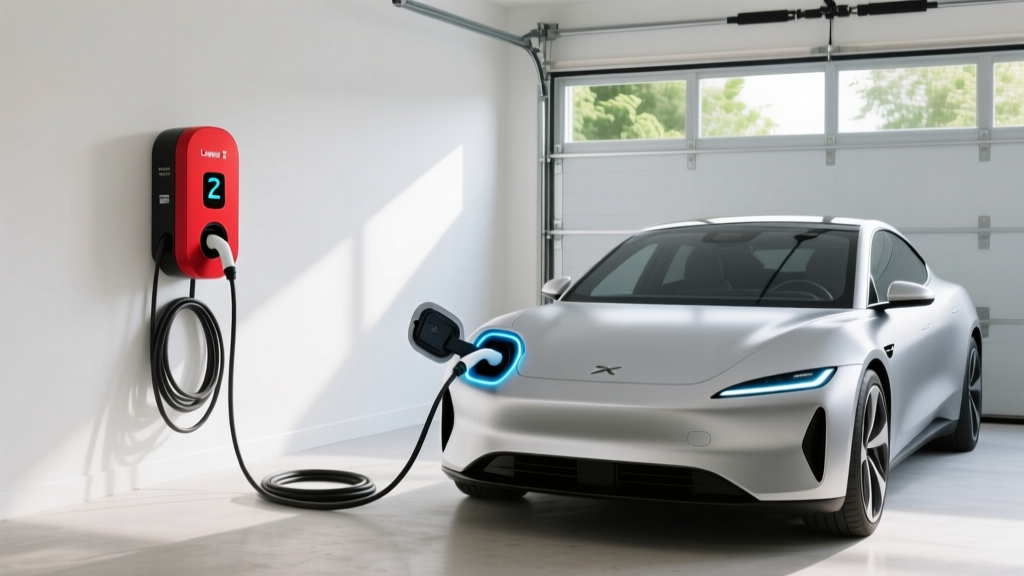
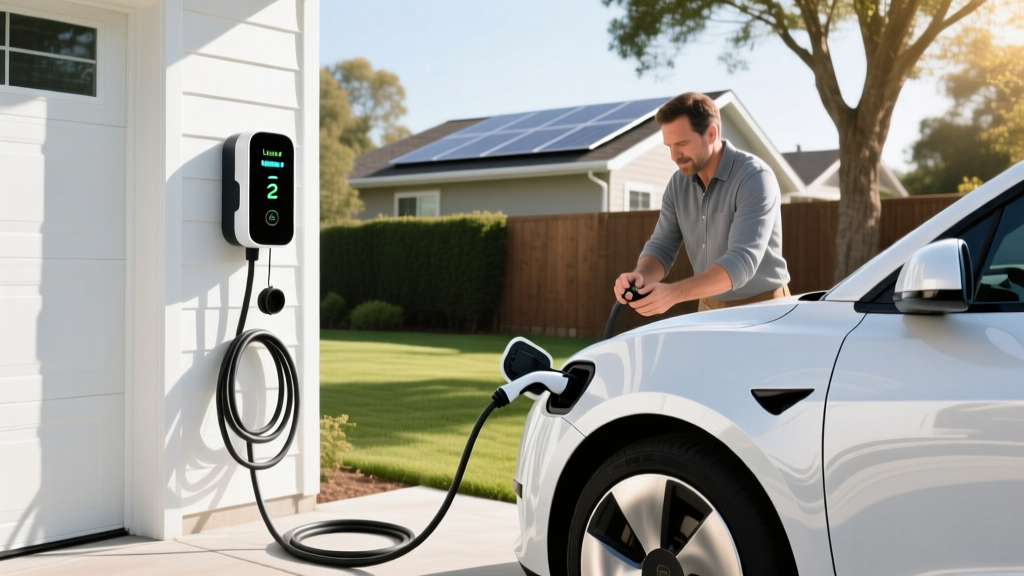
Installing a Level 2 home charger is the single highest-impact upgrade for EV ownership. Here's what's involved electrically and financially.
Electrical Requirements
- Circuit: A dedicated 240V circuit — typically 40A or 50A — run from your main electrical panel to the charger location.
- Wire gauge: 6 AWG copper for a 50A circuit; 8 AWG for 40A. Your electrician will size this based on run length and local code.
- Hardwired vs. plug: Chargers above 40A (9.6 kW+) generally require hardwiring. Units at 32A (7.7 kW) can use a NEMA 14-50 outlet, which offers portability.
- GFCI protection: The 2023 NEC (National Electrical Code) requires GFCI protection for EV receptacles. Hardwired units have this built in; receptacle installations need a GFCI breaker (~$50–$120).
- Outdoor rating: If your charger is in a carport or exterior wall, it must carry a NEMA 4 (weatherproof) rating. Most major chargers do.
Do You Need a Panel Upgrade?
This is the cost variable that catches homeowners off guard. Most modern homes have 200A electrical service. If your panel is already near capacity (electric range, dryer, HVAC, water heater), adding a 40A EV circuit may require a service panel upgrade to 200A or even 400A. Older homes with 100A service almost certainly need an upgrade.
A panel upgrade from 100A to 200A typically costs $1,500–$3,500. Upgrading to 400A (increasingly common for homes with EVs, heat pumps, and solar) runs $2,500–$5,000+. Get a load calculation from your electrician before committing to a charger size.
Installation Cost Breakdown
| Component | Typical Range | Notes |
|---|---|---|
| Level 2 charger (hardware) | $350–$750 | Varies by brand, power output, smart features |
| Electrician labor (standard install) | $500–$1,500 | Depends on panel distance, wall type, conduit run |
| Electrical permit | $50–$250 | Varies by municipality |
| Panel upgrade (if needed) | $1,500–$5,000 | 100A→200A or 200A→400A service upgrade |
| Total (no panel upgrade) | $900–$2,500 | Most homeowners in this range |
| Total (with panel upgrade) | $2,400–$7,500 | Older homes, high-load households |
Federal incentive: The IRS Residential Clean Energy Credit (IRC §25D) covers 30% of charger hardware and installation costs, up to $1,000, for equipment placed in service through 2032. Some states and utilities offer additional rebates — check the AFDC state law database for your area.
Connector Compatibility: NACS, CCS1, and CHAdeMO
The connector landscape has shifted dramatically. As of 2026, the Tesla-designed NACS (North American Charging Standard) has been adopted by nearly every major automaker for new BEV models, while CCS1 remains on many vehicles already on the road. The RAV4 Prime PHEV uses a standard J1772 connector for Level 1 and Level 2 AC charging — the universal plug for all non-Tesla plug-in vehicles in North America.
| Connector | Type | Used By | Max Power |
|---|---|---|---|
| J1772 | AC (Level 1/2) | All PHEVs and BEVs (non-Tesla) | Up to 19.2 kW |
| NACS (J3400) | AC + DC | Tesla, Ford, GM, Rivian, Hyundai, Toyota (new BEVs 2025+) | Up to 350 kW DC |
| CCS1 | DC Fast | VW ID.4, BMW iX, older Ford/GM BEVs | Up to 350 kW DC |
| CHAdeMO | DC Fast | Nissan LEAF (legacy — being phased out) | Up to 100 kW DC |
For RAV4 Prime owners: You only need J1772 for home Level 2 charging. Any J1772-compatible home charger works. No adapter needed. If you later upgrade to a Toyota BEV SUV with a NACS port, you'll access Tesla Superchargers natively and can use a NACS-to-CCS adapter for Electrify America and other CCS-based networks.
Charging Cost: Home vs. Public vs. Gas
The economic case for plug-in driving hinges on your electricity rate and driving pattern. Here's a realistic comparison using the RAV4 Prime's efficiency and a hypothetical Toyota RAV4 BEV.
| Scenario | Rate / Price | Vehicle Efficiency | Cost Per Mile |
|---|---|---|---|
| Home charging (off-peak) | $0.13/kWh | 3.5 mi/kWh (RAV4 BEV est.) | $0.037 |
| Home charging (peak) | $0.22/kWh | 3.5 mi/kWh | $0.063 |
| Public Level 2 (network) | $0.30/kWh | 3.5 mi/kWh | $0.086 |
| DC fast charging (public) | $0.45/kWh | 3.5 mi/kWh | $0.129 |
| Gasoline (RAV4 gas, 30 MPG combined) | $3.40/gallon | 30 MPG | $0.113 |
The takeaway: Home off-peak charging delivers fuel costs roughly one-third the price of gasoline. Public DC fast charging, however, can exceed gas costs per mile — it's a convenience premium for road trips, not a daily strategy. RAV4 Prime owners charging at home overnight see the best economics: their 42-mile electric range covers most daily commutes at roughly 4 cents per mile, with the gas engine kicking in only for longer trips.
Charging Time Examples: What to Expect by Battery Size
Charging time depends on battery capacity (kWh), charger power (kW), and the charge curve — the physics-driven taper that slows charging above ~80% State of Charge to protect battery health.
| Vehicle Profile | Battery (kWh) | Level 1 (1.4 kW) | Level 2 (7.7 kW) | Level 2 (11.5 kW) | DC Fast 10–80% |
|---|---|---|---|---|---|
| RAV4 Prime PHEV | 18.1 | ~12 hrs (0–100%) | ~2.5 hrs (0–100%) | ~1.6 hrs (0–100%) | N/A (no DC port) |
| Mid-size BEV (est.) | 72 | ~51 hrs | ~9.4 hrs | ~6.3 hrs | ~25 min at 150 kW |
| Large BEV SUV (est.) | 100 | ~71 hrs | ~13 hrs | ~8.7 hrs | ~30 min at 150 kW |
Charge curve reality check: A 150 kW DC fast charger does not deliver 150 kW for the entire session. Peak rate is sustained from roughly 10–50% SoC, then tapers. A vehicle advertising "150 kW peak" may average only 90–110 kW over a full 10–80% session. Always look at the 10–80% time, not the peak kW number, when evaluating charging speed.
Recommended Level 2 Home Chargers for RAV4 Plug-In Owners
These chargers are proven, UL-listed, and compatible with the J1772 inlet on the RAV4 Prime (and future Toyota BEVs with a J1772-to-NACS adapter or native NACS port).
ChargePoint Home Flex
- Power: Up to 11.5 kW (48A) on a 60A circuit; configurable down to 16A
- Connector: J1772 (25-ft cable)
- Smart features: Wi-Fi, scheduling, energy tracking, Alexa integration
- Price: ~$649
- Best for: Flexible amperage — ideal if your panel has limited headroom
Emporia Level 2 EV Charger
- Power: Up to 11.5 kW (48A)
- Connector: J1772 (24-ft cable)
- Smart features: Wi-Fi, real-time energy monitoring, solar integration, load management
- Price: ~$399
- Best for: Budget-conscious buyers who want full smart features
Grizzl-E Smart
- Power: Up to 10 kW (40A)
- Connector: J1772 (24-ft cable)
- Smart features: OCPP-compatible, adjustable amperage, extreme cold rated (-40°F)
- Price: ~$449
- Best for: Cold-climate owners; Canadian-built, extremely rugged
For a RAV4 Prime specifically: The onboard charger is rated at 6.6 kW, meaning even a 48A (11.5 kW) charger will only deliver 6.6 kW to the battery. A 32A (7.7 kW) unit is sufficient and allows a smaller circuit breaker (40A), reducing installation cost. If you plan to own a future BEV, investing in a 48A charger now future-proofs your garage.
Public Charging Networks: Where to Plug In
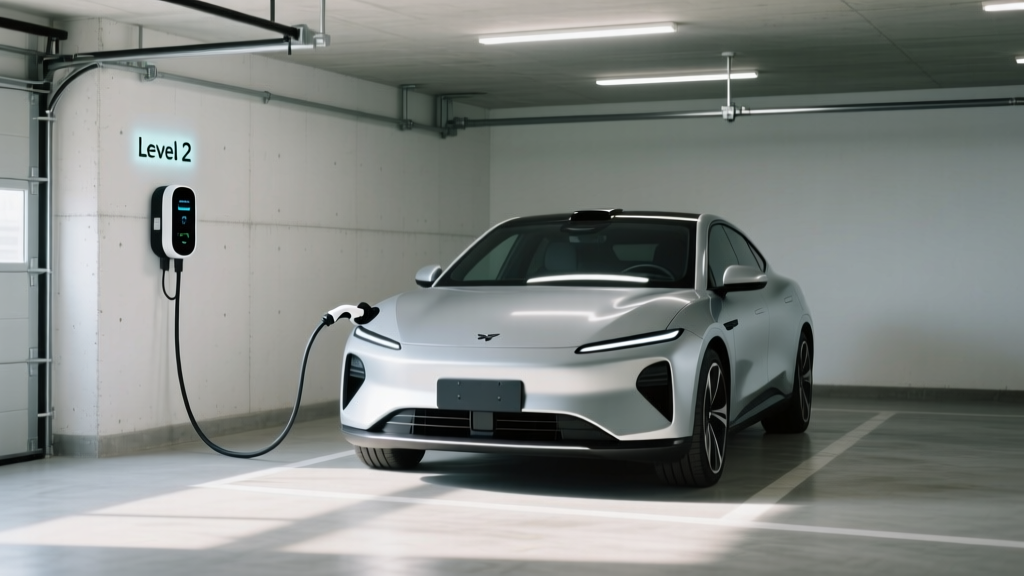
For RAV4 Prime owners, public Level 2 chargers at shopping centers, workplaces, and parking garages provide convenient top-ups during errands. Since the Prime lacks DC fast charging capability, you won't use Electrify America or Tesla Superchargers — stick to Level 2 destination chargers.
Major networks for J1772 Level 2:
- ChargePoint: Largest North American Level 2 network; reliable app with real-time availability
- EVgo: Mix of Level 2 and DC fast; eXtend partnership with Toyota for select locations
- Tesla Destination Chargers: Some locations now offer J1772 connectors alongside NACS, but availability varies — confirm before relying on them
For future Toyota BEV owners with NACS ports, the Tesla Supercharger network (20,000+ stalls in the U.S.) becomes your primary road-trip infrastructure, with Electrify America and others accessible via adapter.
Frequently Asked Questions
How much does it cost to install a home EV charger?
Expect $900–$2,500 for a standard Level 2 installation (charger + electrician + permit) if your electrical panel has adequate capacity. If a panel upgrade is required, total costs can reach $2,400–$7,500. The federal §25D credit covers 30% of costs up to $1,000.
How fast will each charging level add range?
Level 1 (120V) adds 3–5 miles per hour. Level 2 (240V, 32A) adds roughly 25–30 miles per hour for a BEV, or fully charges a RAV4 Prime's 18.1 kWh battery in about 2.5 hours. DC fast charging adds 150+ miles in 15–20 minutes for BEVs — but the RAV4 Prime does not support DC charging.
Which connector and charger is compatible with my RAV4 Prime?
The RAV4 Prime uses a J1772 connector for all AC charging (Level 1 and Level 2). Any J1772 home charger is compatible. For a 6.6 kW onboard charger, a 32A (7.7 kW) Level 2 unit is optimal; a 48A unit works but won't charge faster due to the vehicle's onboard limitation.
How much does charging cost per mile compared to gas?
Home off-peak charging costs roughly $0.037 per mile (at $0.13/kWh), compared to $0.113 per mile for a gas RAV4 at 30 MPG and $3.40/gallon. That's roughly a 67% fuel cost reduction. Public DC fast charging at $0.45/kWh costs about $0.129 per mile — slightly more than gas — so reserve it for road trips.
What electrical upgrades might I need for a home charger?
You'll need a dedicated 240V circuit (40A or 50A). If your home has 100A service or your panel is near capacity, a panel upgrade to 200A or 400A may be required ($1,500–$5,000). A licensed electrician should perform a load calculation before you purchase a charger. Older homes (pre-1990) are the most likely candidates for upgrades.
Sources: fueleconomy.gov — 2025 Toyota RAV4 Prime, IRS Residential Clean Energy Credit, Alternative Fuels Data Center.