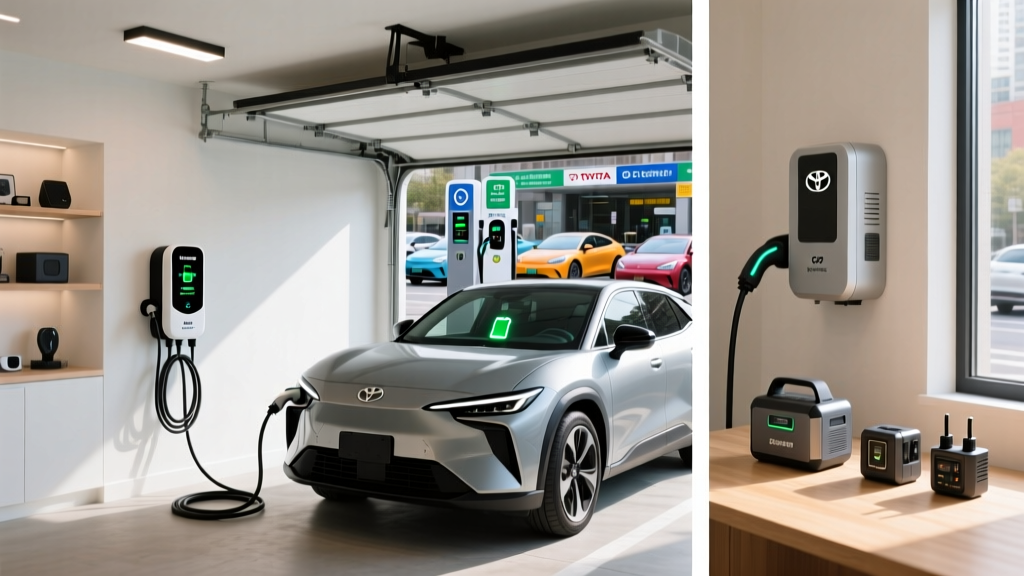
If you own a Toyota bZ4X or are considering Toyota's growing battery-electric lineup, understanding your charging options is the single most important ownership decision you'll make. Home charging covers the vast majority of daily driving needs, but the equipment you choose, the electrical work required, and the connector standard your vehicle uses all directly affect convenience and cost.
This guide breaks down exactly what it takes to charge a Toyota EV at home and on the road — with precise numbers for the bZ4X's 72.8 kWh battery pack, real installation costs, and equipment that actually works with Toyota's charging architecture.
Understanding Toyota's Charging Ecosystem in 2026
Toyota's current flagship BEV, the bZ4X, ships with a 72.8 kWh usable battery (NMC chemistry) and uses the J1772 connector for AC charging and CCS1 for DC fast charging in North America. Toyota has announced a transition to the NACS (Tesla-style) connector for future models, but as of the 2026 model year, the bZ4X retains CCS1. This matters enormously when choosing home equipment and planning road trips.
Toyota also offers the Home Charge System, a branded Level 2 charger available through dealerships, but third-party chargers often deliver better value and features. Let's look at what each charging level actually delivers.
Charging Levels Explained: Speeds, Power, and Range Added
The most common EV mistake is confusing kW (kilowatts) — the rate of power delivery — with kWh (kilowatt-hours) — the total energy stored in your battery. Think of kW as the width of a hose and kWh as the size of the bucket. A wider hose fills the bucket faster, but the bucket size doesn't change.
| Charging Level | Voltage | Power (kW) | Miles of Range per Hour | Best For |
|---|---|---|---|---|
| Level 1 (120V household) | 120V | 1.0–1.4 kW | 3–5 miles/hr | Overnight top-off, low daily mileage |
| Level 2 (240V home/public) | 240V | 3.3–19.2 kW | 12–75 miles/hr | Daily home charging, workplace |
| DC Fast Charging | 400–800V DC | 50–350 kW | 150–300+ miles in 20–30 min | Road trips, rapid top-ups |
For the Toyota bZ4X specifically, the onboard AC charger accepts up to 6.6 kW on Level 2, meaning even a 48-amp (11.5 kW) home charger will only deliver 6.6 kW to the battery. DC fast charging peaks at 150 kW on 400V architecture, with a 10–80% charge time of approximately 30 minutes under ideal conditions. In cold weather (below 40°F), expect that 10–80% time to stretch to 40–50 minutes unless the battery is preconditioned.
Real-World Range Reality: The bZ4X carries an EPA-estimated range of 222–252 miles depending on trim and drivetrain (FWD vs. AWD). In real-world highway driving at 70 mph, expect 185–210 miles. In winter conditions below freezing, plan for 155–185 miles. Always budget your trips around the lower number.
Home Charger Installation: Electrical Requirements and Costs
Installing a Level 2 home charger requires a dedicated 240V circuit, typically on a NEMA 14-50 outlet or hardwired connection. Here's what that actually involves and what it costs.
Electrical Panel and Circuit Requirements
A Level 2 charger delivering 6.6 kW (matching the bZ4X's onboard charger maximum) requires a 240V, 30-amp dedicated circuit. If you want future-proofing for a vehicle with a larger onboard charger, a 240V, 50-amp circuit (NEMA 14-50) is the standard recommendation — it supports up to 40 amps continuous draw (11.5 kW) and costs only marginally more to install.
Your electrical panel must have sufficient spare capacity. A typical home needs at least 50 amps of unused panel capacity to safely add a 40-amp EV circuit (the National Electrical Code requires circuits to be loaded to no more than 80% of breaker rating for continuous loads like EV charging). If your panel is already near capacity — common in older homes with 100-amp service — you may need a panel upgrade to 200 amps, which significantly increases cost.
Installation Cost Breakdown
| Item | Cost Range | Notes |
|---|---|---|
| Level 2 Charger (Equipment) | $300–$700 | Smart Wi-Fi chargers, 32–48A |
| Electrician Labor (standard install) | $500–$1,500 | Varies by run length from panel to garage |
| Permit & Inspection | $50–$300 | Required in most jurisdictions |
| Electrical Panel Upgrade (if needed) | $1,500–$3,500 | 100A → 200A service upgrade |
| Total (No Panel Upgrade) | $850–$2,500 | Typical scenario for modern homes |
| Total (With Panel Upgrade) | $2,350–$6,000 | Older homes with 100A service |
The single biggest cost variable is the distance from your electrical panel to the charging location. A panel in the garage next to where you park might cost $500 in labor. A panel in the basement requiring a 60-foot conduit run through finished walls can push labor past $1,500. Always get at least two quotes from licensed electricians, and confirm they pull a permit — unpermitted work can void home insurance coverage and create resale issues.
Safety and Code Considerations
- Dedicated circuit: EV chargers must be on their own dedicated breaker — never shared with other appliances.
- GFCI protection: The 2023 NEC requires GFCI protection for all EV charging outlets. Hardwired chargers with built-in GFCI are often preferred to avoid nuisance tripping on outdoor receptacles.
- Outdoor rating: If your charger is installed outside, it must carry a NEMA 4 or NEMA 4X weather rating. All recommended chargers below meet this standard.
- Cable management: A wall-mounted hook or reel prevents cable damage and tripping hazards — especially important for 25-foot cables.
Connector Compatibility: CCS1, NACS, and the Toyota Transition
Connector standards are in active transition across the industry. Here's where Toyota stands and what it means for your charger choice.
| Connector Type | Used For | Toyota Models (2026) | Adapter Needed? |
|---|---|---|---|
| J1772 | AC Level 1 & Level 2 | bZ4X (all trims) | No — standard on all home L2 chargers |
| CCS1 (Combo) | DC Fast Charging | bZ4X (all trims) | No at CCS stations; NACS→CCS adapter needed at Tesla Superchargers |
| NACS (Tesla) | AC & DC (Tesla standard) | Future Toyota BEVs (announced) | CCS1→NACS adapter needed for current bZ4X at Superchargers |
| CHAdeMO | DC Fast Charging (legacy) | Not supported (2026) | N/A — being phased out in North America |
What this means practically: If you buy a Level 2 home charger today, it will come with a J1772 plug that works directly with your bZ4X. For DC fast charging on road trips, the bZ4X natively uses CCS1 stations (Electrify America, EVgo, ChargePoint DC). Toyota has been expanding Supercharger access for bZ4X owners using a CCS1-to-NACS adapter, but verify adapter availability and compatibility with your specific model year before relying on it.
Looking ahead: if you plan to eventually replace the bZ4X with a future NACS-equipped Toyota, consider buying a NACS-native home charger now (such as the Tesla Wall Connector) and using a NACS-to-J1772 adapter for your current bZ4X. This future-proofs your installation.
Charging Cost: Home vs. Public vs. Gas Comparison
One of the strongest economic arguments for EV ownership is fuel cost savings — but only if you charge smart. Here's what you'll actually spend.
| Charging Scenario | Cost per kWh | Cost to Fill bZ4X (10–80%, ~51 kWh) | Cost per Mile |
|---|---|---|---|
| Home (off-peak utility rate) | $0.08–$0.14 | $4.08–$7.14 | $0.02–$0.04 |
| Home (standard residential rate) | $0.14–$0.20 | $7.14–$10.20 | $0.04–$0.05 |
| Public Level 2 (ChargePoint, etc.) | $0.25–$0.49 | $12.75–$24.99 | $0.06–$0.12 |
| DC Fast Charging (Electrify America) | $0.35–$0.56 | $17.85–$28.56 | $0.09–$0.14 |
| Gas equivalent (25 MPG, $3.40/gal) | $3.40/gallon | $27.20 (for ~200 mi) | $0.14 |
The bZ4X achieves approximately 3.5–3.8 miles per kWh in mixed driving (EPA-rated at 119–131 MPGe depending on trim). At a national average residential electricity rate of about $0.17/kWh, that translates to roughly $0.045 per mile — about one-third the cost of a 25 MPG gas vehicle at $3.40/gallon.
The catch: exclusive reliance on DC fast charging erases most of the cost advantage. At $0.48/kWh (common at highway Electrify America stations), you're paying $0.13/mile — nearly gas-equivalent. Home charging is where the economics work. If you cannot charge at home, a PHEV like the Toyota RAV4 Prime may be a more cost-effective choice.
Best Home Chargers for Toyota bZ4X: Equipment Picks
Since the bZ4X's onboard charger caps at 6.6 kW (about 28 amps), you don't strictly need a 48-amp charger. However, installing a higher-capacity unit now future-proofs your garage for your next EV — most newer models accept 11.5 kW or more.
ChargePoint Home Flex — Best Overall
- Power Output: Up to 12 kW (50 amps), adjustable down to 16A/24A/32A/40A/48A
- Connector: J1772 (NACS version also available)
- Cable Length: 23 feet
- Smart Features: Wi-Fi, Alexa/Google integration, scheduled charging, utility demand-response, detailed session logging
- Price: ~$550
- Why for Toyota: The adjustable amperage lets you match your circuit capacity precisely. Works flawlessly with the bZ4X at its 6.6 kW maximum, with headroom for future vehicles. UL-listed, NEMA 4 rated for outdoor use.
Emporia Level 2 EV Charger — Best Value
- Power Output: Up to 11.5 kW (48 amps)
- Connector: J1772
- Cable Length: 24 feet
- Smart Features: Wi-Fi, real-time energy monitoring, solar integration (pairs with Emporia Vue panel monitor), off-peak scheduling
- Price: ~$350
- Why for Toyota: Excellent energy monitoring helps you track exact charging costs per session. Solar-aware scheduling is ideal if you have rooftop panels. NEMA 4 outdoor rated. Best price-to-feature ratio available.
Tesla Wall Connector (Gen 3) — Best for Future-Proofing to NACS
- Power Output: Up to 11.5 kW (48 amps)
- Connector: NACS native (J1772 adapter included for non-Tesla vehicles)
- Cable Length: 24 feet
- Smart Features: Wi-Fi, over-the-air updates, power sharing between multiple units, load management
- Price: ~$475
- Why for Toyota: If you anticipate your next EV being NACS-equipped (likely for future Toyota BEVs), this charger eliminates the need to replace hardware later. Use the included J1772 adapter for your current bZ4X.
Toyota Home Charge System (Dealer Option)
- Power Output: Up to 7.2 kW (30 amps)
- Connector: J1772
- Cable Length: 18 feet
- Smart Features: Basic app connectivity, scheduled charging
- Price: ~$600–$750 (through Toyota dealer)
- Why for Toyota: Branded option that some buyers prefer for single-source warranty support. However, it offers fewer smart features and a shorter cable than third-party alternatives at a higher price. Recommended only if bundled with dealer installation incentives.
Public Charging for Toyota bZ4X: Networks and Real-World Speeds
The bZ4X's 150 kW DC fast-charging peak means you'll get the best results at 150 kW or higher stations. On a 350 kW Electrify America charger, the bZ4X will peak around 140–150 kW and taper as state of charge rises — a typical 10–80% session takes about 30 minutes in moderate temperatures.
Key public charging networks compatible with the bZ4X's CCS1 connector:
- Electrify America: Largest CCS1 network; 150–350 kW stations common. Toyota bZ4X includes a complimentary charging period (check current terms with your dealer).
- EVgo: Growing 350 kW station footprint; CCS1 native.
- ChargePoint: Mix of Level 2 and DC fast; app-based activation.
- Tesla Supercharger: Accessible via CCS1-to-NACS adapter — verify Toyota's current adapter program status and station compatibility before planning trips around Superchargers.
Charging curve reality: The bZ4X does not sustain 150 kW for the entire session. Expect peak power between 10–40% SoC, tapering to roughly 80–90 kW from 40–60%, and dropping below 50 kW past 70%. This is normal lithium-ion behavior — the battery management system protects cell health by reducing charge rate as voltage rises. Plan road-trip stops around the 10–80% window for the fastest sessions.
Charging Time Examples for the Toyota bZ4X
Here's how long common charging scenarios take with the bZ4X's 72.8 kWh battery:
| Scenario | Power | Time (10–80%, ~51 kWh needed) | Notes |
|---|---|---|---|
| Level 1 (120V, 12A) | 1.4 kW | ~36 hours | Emergency/overnight trickle only |
| Level 2 (240V, 30A) | 6.6 kW | ~8 hours | Standard overnight home charge |
| Level 2 (240V, 48A charger) | 6.6 kW (bZ4X limit) | ~8 hours | Charger capable of more, but car caps at 6.6 kW |
| DC Fast (150 kW peak) | ~100 kW avg | ~30 minutes | Ideal conditions, 68°F, preconditioned battery |
| DC Fast (50 kW station) | 50 kW | ~60 minutes | Older CCS stations, still adequate for breaks |
For daily driving of 30–50 miles, a Level 2 home charger replenishes your battery in 2–3 hours — meaning you can schedule charging during off-peak utility hours (typically 10 PM–6 AM) and wake up to a full battery every morning. This is the ownership experience that makes EVs practical: you never visit a "station" for daily needs.
Frequently Asked Questions
How much does it cost to install a home EV charger for my Toyota?
A standard Level 2 home charger installation costs between $850 and $2,500, including equipment ($300–$700), electrician labor ($500–$1,500), and permits ($50–$300). If your home requires an electrical panel upgrade from 100A to 200A service, add $1,500–$3,500. Get multiple quotes from licensed electricians and always require a permit and inspection.
How fast will each charging level add range to the bZ4X?
Level 1 (120V) adds about 3–5 miles per hour. Level 2 (240V) at the bZ4X's 6.6 kW maximum adds approximately 22–25 miles per hour. DC fast charging at 150 kW can add roughly 150 miles in 20 minutes under ideal conditions, tapering significantly above 80% state of charge.
Which connector and charger is compatible with my Toyota bZ4X?
The bZ4X uses a J1772 connector for Level 1 and Level 2 AC charging (all standard home chargers include this plug) and a CCS1 connector for DC fast charging. For Tesla Supercharger access, you'll need a CCS1-to-NACS adapter through Toyota's adapter program. Future Toyota BEVs are expected to adopt NACS natively.
How much does charging cost per mile compared to gas?
At a national average residential rate of $0.17/kWh, the bZ4X costs approximately $0.045 per mile to drive — about one-third the cost of a 25 MPG gasoline vehicle at $3.40/gallon ($0.14/mile). Off-peak home charging can drop this to $0.02–$0.03/mile. Exclusive use of DC fast charging at $0.40+/kWh narrows the gap to roughly $0.10–$0.12/mile.
What electrical upgrades might I need for a home charger?
You need a dedicated 240V circuit — typically 30A minimum (for 6.6 kW charging) or 50A (for future-proofing). If your electrical panel lacks sufficient spare capacity (common in homes with 100A service), you may need a panel upgrade to 200A, costing $1,500–$3,500. A licensed electrician can assess your panel during a pre-installation inspection. Some utilities offer rebates that offset panel upgrade costs — check with your provider before proceeding.
Does the federal tax credit apply to home charger installation?
The Residential Clean Energy Credit (IRS §25D) previously covered 30% of home EV charger equipment and installation costs up to $1,000. However, the charger-specific portion of this credit has undergone legislative changes. Consult the current IRS guidance or a tax professional to confirm eligibility for the current tax year, as rules around qualifying equipment and income caps are subject to change.