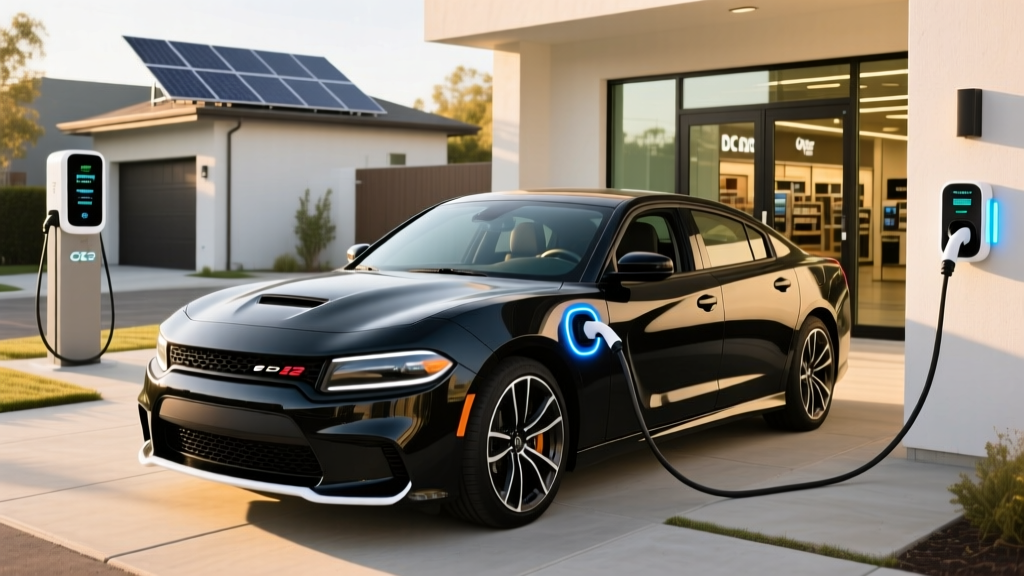
The Dodge Charger Daytona EV marks the return of American muscle in an all-electric, 4-door package. Built on Stellantis' STLA Large platform with an 800-volt architecture and a usable battery capacity of approximately 100.5 kWh (NMC chemistry), the Charger Daytona R/T produces 496 hp with a 317-mile EPA range, while the Scat Pack variant pushes 670 hp and an estimated 260-mile range. But owning this electric muscle car means understanding how to feed its massive battery efficiently — whether that's overnight at home or at a DC fast charger on a road trip.
This guide covers every charging scenario for the Dodge Charger EV 4-door, from Level 1 trickle charging to 350 kW DC fast charging, including real installation costs, connector compatibility, and the true cost-per-mile compared to a gas V8.
| Trim | EPA Range | Real-World Highway (70 mph) | Cold Weather (20°F) |
|---|---|---|---|
| Daytona R/T (496 hp) | 317 miles | ~265–280 miles | ~220–240 miles |
| Daytona Scat Pack (670 hp) | 260 miles (est.) | ~215–230 miles | ~180–200 miles |
Source: fueleconomy.gov. Real-world figures reflect highway driving at 70+ mph and cold-weather range loss typical of NMC packs without active preconditioning.
Charging Levels Explained: How Fast Will Each Add Range?
Before plugging in the Charger Daytona, you need to understand the three charging levels. The distinction between kW (kilowatts — the rate of power delivery) and kWh (kilowatt-hours — the total energy stored in the battery) is critical. Think of kW as how fast water flows from a hose, and kWh as the size of the bucket you're filling. The Charger Daytona's battery holds roughly 100.5 kWh of usable energy.
| Level | Voltage | Max Power (kW) | Miles of Range Per Hour | Best For |
|---|---|---|---|---|
| Level 1 (120V outlet) | 120V AC | 1.4–1.9 kW | ~4–6 miles/hr | Emergency top-ups, low-mileage drivers |
| Level 2 (240V home/public) | 240V AC | 11.5 kW (onboard charger limit) | ~32–38 miles/hr | Daily home charging, overnight fills |
| DC Fast Charging | 400–800V DC | Up to ~270 kW peak | ~700+ miles/hr (at peak) | Road trips, rapid top-ups |
Level 1 reality check: Plugging the Charger Daytona into a standard 120V household outlet delivers roughly 1.4 kW continuously. To fully recharge a depleted 100.5 kWh battery at this rate takes over 70 hours. Level 1 is viable only for drivers covering under 30 miles per day who can leave the car plugged in overnight consistently.
Level 2 is the daily standard: The Charger Daytona's onboard AC charger accepts up to 11.5 kW, meaning a full 0–100% charge at home takes approximately 9–10 hours. Most owners charge from 20–80% overnight, which takes about 5.5–6 hours on an 11.5 kW Level 2 circuit.
DC Fast Charging and the 800V advantage: The STLA Large platform's 800-volt architecture allows the Charger Daytona to accept high DC charge rates. Stellantis indicates peak DC fast-charging capability of approximately 270 kW at compatible 350 kW stations. In practice, expect a 10–80% charge in roughly 25–30 minutes under ideal conditions, though the charge curve tapers significantly above 80% SoC to protect the NMC cells.
| Battery Capacity (usable) | ~100.5 kWh (NMC) |
| Onboard AC Charger | 11.5 kW |
| Peak DC Fast Charge | ~270 kW |
| 10–80% DC Fast Charge Time | ~25–30 minutes |
| Full Level 2 Charge (0–100%) | ~9–10 hours |
| Charging Architecture | 800V |
| Connector (North America) | CCS1 (NACS adapter available) |
Home Charger Installation: Requirements, Costs, and Panel Upgrades
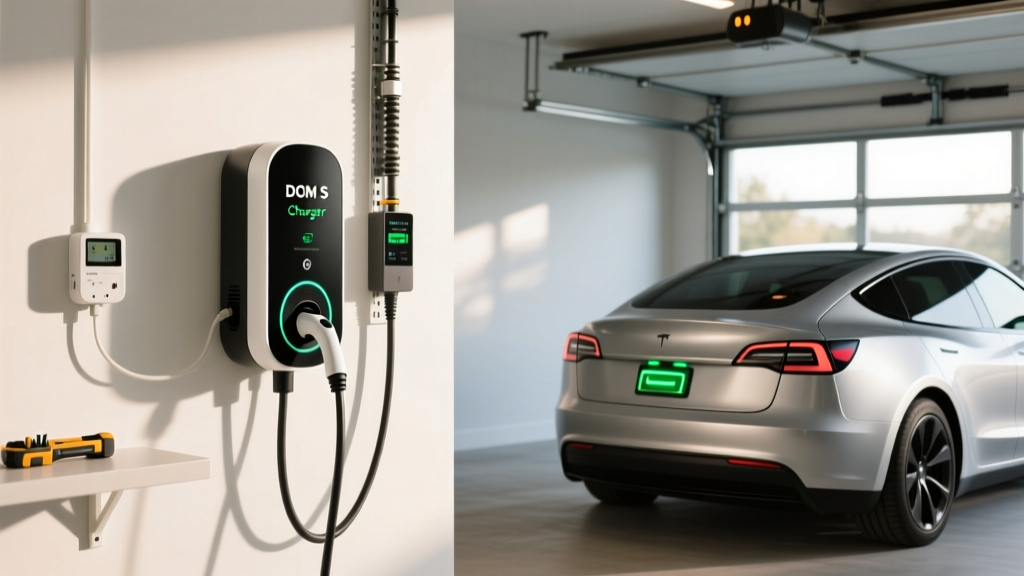
To unlock Level 2 charging at the Charger Daytona's full 11.5 kW AC rate, you need a 240V circuit rated for at least 50 amps (which delivers 48 amps continuous, per the 80% NEC derating rule for continuous loads). A 60-amp breaker with appropriate wire gauge (typically 6 AWG copper for runs under 50 feet, 4 AWG for longer runs) is the standard specification.
Electrical Requirements at a Glance
- Voltage: 240V (split-phase residential)
- Amperage: 48A continuous draw requires a 60A breaker
- Wire gauge: 6 AWG copper (short runs) or 4 AWG (long runs or conduit)
- Circuit: Dedicated — no shared outlets or appliances on the same breaker
- Outlet vs. hardwired: NEMA 14-50 outlet offers portability; hardwired is more reliable and avoids GFCI nuisance trips common with some 50A receptacles
Installation Cost Breakdown
Home EV charger installation costs vary dramatically based on your home's electrical panel capacity and the distance from the panel to the charging location. Here is a realistic breakdown for 2025–2026:
| Component | Simple Install (panel nearby) | Complex Install (long run or panel upgrade) |
|---|---|---|
| Level 2 Charger Equipment | $400–$700 | $400–$700 |
| Electrician Labor | $500–$1,200 | $1,500–$3,000 |
| Permit & Inspection | $50–$200 | $50–$200 |
| Electrical Panel Upgrade (100A → 200A) | N/A | $1,500–$3,500 |
| Conduit, Wire, Misc. Materials | $100–$300 | $300–$800 |
| Total Estimated Cost | $1,050–$2,400 | $3,750–$8,200 |
The panel upgrade gotcha: Many homes built before 2000 have 100-amp or 150-amp main service panels. Adding a 60A EV circuit to an already-loaded panel may require a service upgrade to 200A or even 400A. This is the single biggest variable in installation cost. Before purchasing a charger, have a licensed electrician perform a load calculation per NEC Article 220 to determine if your panel can handle the additional draw. The U.S. Department of Energy's home charging guide provides additional context on residential electrical assessments.
Safety and Code Considerations
- Dedicated circuit: NEC requires EV chargers to have a dedicated breaker — no sharing with dryers, HVAC, or other appliances.
- GFCI protection: The 2020 NEC (and later) requires GFCI protection for receptacles used for EV charging. Hardwired installations often avoid this requirement and eliminate nuisance tripping issues.
- Outdoor rating: If your charger is installed outdoors (garage-free homes), ensure the unit carries a NEMA 4 or IP65 weather rating. Most quality Level 2 chargers meet this standard.
- Cable management: For wall-mounted units, plan cable routing to avoid tripping hazards and protect the cable from UV degradation if exposed to sunlight.
Which Connector and Charger Is Compatible with the Charger Daytona?
The Dodge Charger Daytona EV ships with a CCS1 (Combined Charging System) port for the North American market. However, with Tesla opening its Supercharger network and Stellantis announcing NACS adoption for future models, connector compatibility is evolving rapidly.
| Connector Type | AC Level 2 Charging | DC Fast Charging | Network Access |
|---|---|---|---|
| CCS1 (native port) | ✅ Yes — J1772 AC portion | ✅ Yes — native CCS DC | Electrify America, EVgo, ChargePoint, Ionity |
| NACS (Tesla) | ✅ With CCS-to-NACS adapter | ✅ With CCS-to-NACS adapter | Tesla Supercharger network (with adapter) |
| CHAdeMO | N/A | ❌ Not compatible | Phasing out in North America |
Adapter note: To access Tesla Superchargers with your Charger Daytona, you will need a CCS1-to-NACS adapter. Stellantis has indicated that adapters will be available through dealerships and aftermarket suppliers. Third-party adapters from brands like Lectron and A2Z are available for $150–$300, but always verify the adapter is rated for the DC fast-charging power levels you intend to use — some adapters are rated only for AC charging.
Level 2 Home Charger Equipment Recommendations
Because the Charger Daytona's onboard AC charger tops out at 11.5 kW, you need a Level 2 unit that can deliver at least 48 amps to capture the full charge rate. Here are three proven options:
ChargePoint Home Flex
- Power Output: Up to 12 kW (50A, adjustable down to 16A)
- Connector: J1772 (CCS1 AC compatible)
- Cable Length: 23 feet
- Smart Features: Wi-Fi, app scheduling, Alexa integration, energy tracking
- Price: ~$550–$650
- Best For: Flexible amperage settings for homes with limited panel capacity
Emporia Level 2 EV Charger
- Power Output: Up to 11.5 kW (48A)
- Connector: J1772 (CCS1 AC compatible)
- Cable Length: 24 feet
- Smart Features: Wi-Fi, app control, solar integration, energy monitoring with included Emporia Vue panel monitor
- Price: ~$400–$500
- Best For: Budget-conscious buyers who want whole-home energy monitoring
Wallbox Pulsar Plus
- Power Output: Up to 11.5 kW (48A)
- Connector: J1772 (CCS1 AC compatible)
- Cable Length: 25 feet
- Smart Features: Wi-Fi + Bluetooth, app scheduling, Power Sharing (daisy-chain two units on one circuit), Eco-Smart solar mode
- Price: ~$550–$650
- Best For: Two-EV households needing load-sharing on a single circuit
Hardwired vs. plug-in: All three chargers above are available in both hardwired and NEMA 14-50 plug-in configurations. For the Charger Daytona's 48A continuous draw, a hardwired installation is generally more reliable. NEMA 14-50 receptacles have been associated with overheating and GFCI nuisance trips at sustained high amperage — a known issue documented by EV owners and electricians alike.
Cost to Charge: Home vs. Public vs. Gas Comparison
The Charger Daytona R/T's 317-mile EPA range and 100.5 kWh battery make charging cost a significant ownership variable. Here is how the math works across scenarios:
| Scenario | Rate ($/kWh) | Cost for Full 100.5 kWh Charge | Cost Per Mile (317 mi range) |
|---|---|---|---|
| Home — Off-Peak Utility Rate | $0.08–$0.12 | $8.04–$12.06 | $0.025–$0.038 |
| Home — Standard Residential Rate | $0.14–$0.18 | $14.07–$18.09 | $0.044–$0.057 |
| Public Level 2 (ChargePoint, etc.) | $0.25–$0.49 | $25.13–$49.25 | $0.079–$0.155 |
| DC Fast Charging (Electrify America) | $0.35–$0.55 | $35.18–$55.28 | $0.111–$0.174 |
| Gas Equivalent (Dodge Challenger R/T, 19 MPG combined, $3.40/gal) | — | $56.84 (for 317 miles) | $0.179 |
The bottom line: Charging at home on off-peak rates costs roughly $0.03 per mile, compared to $0.18 per mile for a gas V8 Challenger R/T. That's an 83% per-mile fuel savings. Even exclusive reliance on DC fast charging at $0.48/kWh averages $0.15/mile — still cheaper than premium gasoline. However, if your utility charges peak rates above $0.30/kWh or you rely entirely on public DC chargers, the cost advantage narrows significantly.
Many utilities offer time-of-use (TOU) plans specifically designed for EV owners, with rates as low as $0.05–$0.08/kWh during overnight hours (typically 11 PM – 6 AM). Check with your local utility for EV-specific rate plans before installing your home charger.
DC Fast Charging on Road Trips: What to Expect
The Charger Daytona's 800V architecture positions it well for DC fast charging, but real-world charge curves tell a more nuanced story than peak kW numbers suggest.
Charge curve reality: While the Charger Daytona can accept up to ~270 kW at compatible 350 kW chargers, this peak rate is typically sustained only between 10–30% State of Charge (SoC). As the battery fills, the Battery Management System (BMS) tapers the charge rate to protect the NMC cells:
- 10–30% SoC: Peak ~250–270 kW (fastest segment)
- 30–60% SoC: ~180–220 kW (still very fast)
- 60–80% SoC: ~100–150 kW (noticeable taper)
- 80–100% SoC: ~30–60 kW (significantly slower — avoid charging past 80% on road trips unless necessary)
Preconditioning matters: The Charger Daytona's thermal management system works best when the battery is at optimal temperature. In cold weather (below 40°F), expect slower initial charge rates until the pack warms up. Use the vehicle's navigation system to route to a charger when possible — this triggers battery preconditioning, warming the pack before you arrive and enabling faster charge acceptance from the start.
Real-world road trip example: On a 400-mile trip starting at 100% SoC, expect to stop once for approximately 25–30 minutes at a DC fast charger (charging from ~15% to 80% SoC), adding roughly 240–250 miles of range. Total trip time including the charge stop: approximately 7.5–8 hours vs. 6.5 hours in a gas car with one fuel stop.
Federal Tax Credits and Charging Incentives
The IRS §30D federal tax credit offers up to $7,500 for qualifying new EVs, but eligibility for the Charger Daytona depends on several factors that change annually:
- MSRP cap: The vehicle must have an MSRP at or below $55,000 for sedans (the Charger Daytona R/T starts around $51,595, potentially qualifying; the Scat Pack at ~$59,595 likely exceeds the sedan cap — verify current classification with your dealer)
- Buyer income limits: Adjusted gross income must not exceed $150,000 (single), $225,000 (head of household), or $300,000 (joint filers)
- Battery sourcing: Critical minerals and battery components must meet phased-in domestic-content thresholds — Stellantis has been working to localize supply chains, but verify current-year compliance at the point of sale
- Point-of-sale transfer: As of 2024, eligible buyers can transfer the credit to the dealer for an immediate price reduction rather than waiting for a tax refund
Additionally, the Alternative Fuel Vehicle Refueling Property Credit (§30C) provides up to $1,000 (30% of cost) for home EV charger equipment and installation, but only for installations in qualifying census tracts. Consult a tax professional to verify eligibility for both credits.
Frequently Asked Questions
How much does it cost to install a home EV charger for the Dodge Charger EV?
Expect $1,050–$2,400 for a straightforward installation where your electrical panel has sufficient capacity and is located near the charging spot. If your home requires a panel upgrade from 100A to 200A service, total costs can reach $3,750–$8,200. Always get a load calculation from a licensed electrician before committing.
How fast will each charging level add range to the Charger Daytona?
Level 1 (120V) adds about 4–6 miles per hour — essentially overnight trickle charging. Level 2 (240V, 48A) adds approximately 32–38 miles per hour, fully recharging the 100.5 kWh battery in 9–10 hours. DC fast charging at 270 kW peak can add over 700 miles per hour at peak rate, realistically delivering a 10–80% charge in 25–30 minutes.
Which connector does the Dodge Charger EV 4-door use?
The Charger Daytona uses a CCS1 connector natively. For Tesla Supercharger access, you will need a CCS1-to-NACS adapter (available from Stellantis dealers and third-party suppliers for $150–$300). CHAdeMO is not compatible.
How much does charging cost per mile compared to gas?
Home charging on off-peak rates costs approximately $0.03 per mile. DC fast charging averages $0.11–$0.17 per mile. A comparable gas V8 muscle car (19 MPG combined at $3.40/gallon) costs about $0.18 per mile. Home charging delivers roughly 83% fuel cost savings.
What electrical upgrades might I need for a Level 2 charger?
You need a dedicated 240V circuit with a 60-amp breaker (for 48A continuous draw). If your home has a 100A or 150A main service panel that is already heavily loaded, you may need a panel upgrade to 200A — a $1,500–$3,500 expense. Homes with 200A or greater panels typically accommodate a Level 2 circuit without upgrades.
Can I use a Tesla Supercharger with the Dodge Charger EV?
Yes, but only with a CCS1-to-NACS adapter. Tesla has opened its Supercharger network to non-Tesla EVs with CCS ports via adapters and the Tesla app. Verify adapter compatibility and maximum supported DC charge rate before purchasing.
Should I charge to 100% every night?
For the Charger Daytona's NMC battery, daily charging to 80% is recommended for long-term battery health. Reserve 100% charges for road trips where you need maximum range. The vehicle's infotainment system allows you to set a charge limit — use it. LFP batteries tolerate 100% daily charging better, but the Charger Daytona uses NMC chemistry, which degrades faster when held at high SoC.