The Tesla Wall Connector is one of the most popular Level 2 home chargers on the market, and for good reason: it delivers up to 11.5 kW (48 amps) of power on a 60-amp circuit, features a 24-foot cable, and integrates deeply with the Tesla ecosystem. But a surprising number of owners underutilize its smart features because they never properly set up the Tesla Wall Charger app functionality within the main Tesla app.
This guide walks you through everything the app can do — from Wi-Fi pairing and charge scheduling to Power Sharing across multiple units — while covering the critical installation, electrical, and cost details every EV owner needs before mounting one on their garage wall.
What the Tesla Wall Charger App Actually Controls
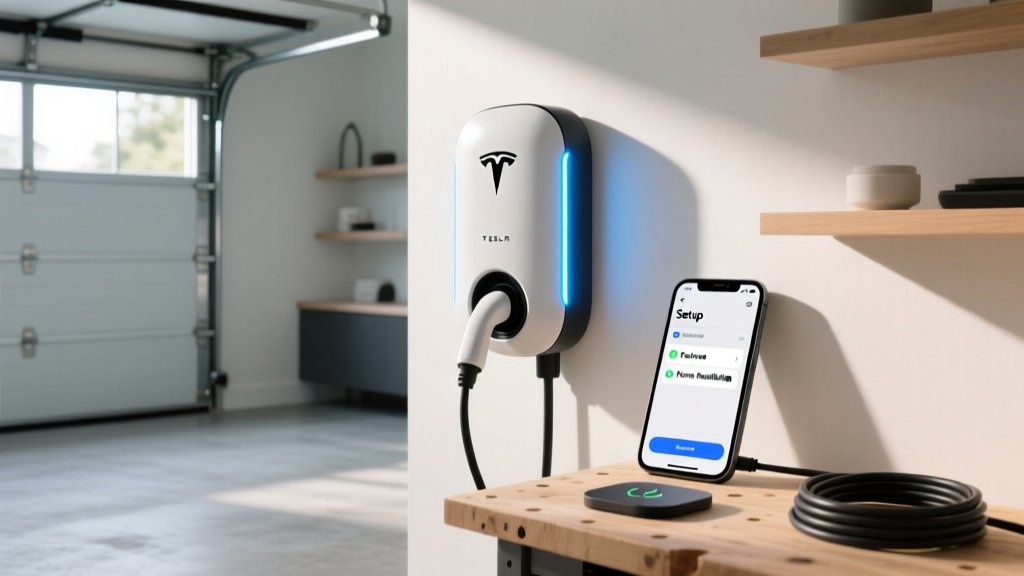
The Tesla Wall Connector doesn't have a standalone app. Instead, all smart features are managed through the Tesla app (iOS/Android) under the "Wall Connector" section once the unit is paired via Wi-Fi. Here's what you can do:
- Schedule charging: Set time-of-use windows to charge during off-peak electricity rates (e.g., 11 PM – 6 AM).
- Monitor session data: Track energy delivered (kWh), charge duration, and estimated cost per session.
- Access control: Restrict charging to specific Tesla vehicles by VIN, or open it to any plugged-in vehicle — useful for multi-EV households with a non-Tesla EV using a NACS adapter.
- Power Sharing: If you install two or more Wall Connectors on a single circuit, the app lets you configure how they split available amperage dynamically.
- Firmware updates: Over-the-air updates are pushed automatically via Wi-Fi — critical for maintaining compatibility with newer vehicles and grid features.
- Charge history and export: View lifetime energy delivered and export session logs for tax or reimbursement purposes.
Charging Levels Explained: How Fast Will You Add Range?
Before evaluating the Wall Connector specifically, it's essential to understand the three charging levels and what they deliver in real-world miles per hour. Remember: kW (kilowatts) measures power — the rate of energy flow — while kWh (kilowatt-hours) measures energy capacity, like gallons in a tank.
| Level | Voltage | Max Power (kW) | Miles of Range Added/Hour | Typical Use Case |
|---|---|---|---|---|
| Level 1 | 120V AC | 1.4–1.9 kW | 3–5 miles | Overnight trickle; PHEVs with small batteries |
| Level 2 | 240V AC | 3.3–19.2 kW | 12–75 miles | Home daily charging; workplace; destination |
| DC Fast | 400–800V DC | 50–350 kW | 150–1,000+ miles | Road trips; highway corridors; 10–80% in 15–30 min |
The Tesla Wall Connector (Gen 3) is a Level 2 charger delivering up to 11.5 kW on a 60-amp dedicated circuit (48 amps continuous, per NEC derating rules). For a Tesla Model Y Long Range (75 kWh usable battery, ~310 EPA miles), that translates to roughly 44 miles of range per hour of charging — enough to fully replenish a daily commute overnight.
Home Installation: Electrical Requirements and Real Costs
The single biggest variable in home charging setup is your electrical panel's capacity. Here's what the Tesla Wall Connector requires and what you'll actually spend.
Electrical Specifications
- Voltage: 240V (split-phase, standard US residential)
- Circuit breaker: 60-amp dedicated (for full 48A / 11.5 kW output)
- Minimum panel capacity: 100-amp service recommended; 200-amp ideal
- Wire gauge: 6 AWG copper (THHN in conduit) for runs up to ~50 feet; 4 AWG for longer runs
- Hardwired only: The Gen 3 Wall Connector is hardwired — no plug. This is a NEC code advantage (no 14-50 receptacle required) but means the unit is semi-permanent.
You can also install the Wall Connector on a 40-amp circuit (delivering 32A / 7.7 kW) or a 50-amp circuit (40A / 9.6 kW) if your panel can't accommodate 60 amps. The app lets you configure the breaker size during setup so the unit self-limits accordingly.
Installation Cost Breakdown
| Component | Low End | High End | Notes |
|---|---|---|---|
| Tesla Wall Connector (Gen 3) unit | $420 | $420 | Fixed MSRP from Tesla; 24-ft cable, NACS connector |
| Electrician labor (standard install) | $400 | $900 | Assumes panel is nearby, short wire run, no conduit complications |
| Wire, conduit, breaker, misc. materials | $100 | $350 | Varies by run length and local code |
| Permit and inspection | $50 | $250 | Required in most jurisdictions; varies by municipality |
| Subtotal — Standard Install | $970 | $1,920 | Most homeowners land in the $1,200–$1,500 range |
| Electrical panel upgrade (100A → 200A) | $1,500 | $4,000 | Required if existing panel lacks capacity; common in pre-1990 homes |
| Trenching (for detached garage) | $800 | $3,000 | Underground conduit run; varies by distance and soil |
Connector Compatibility: NACS, CCS, and Adapters
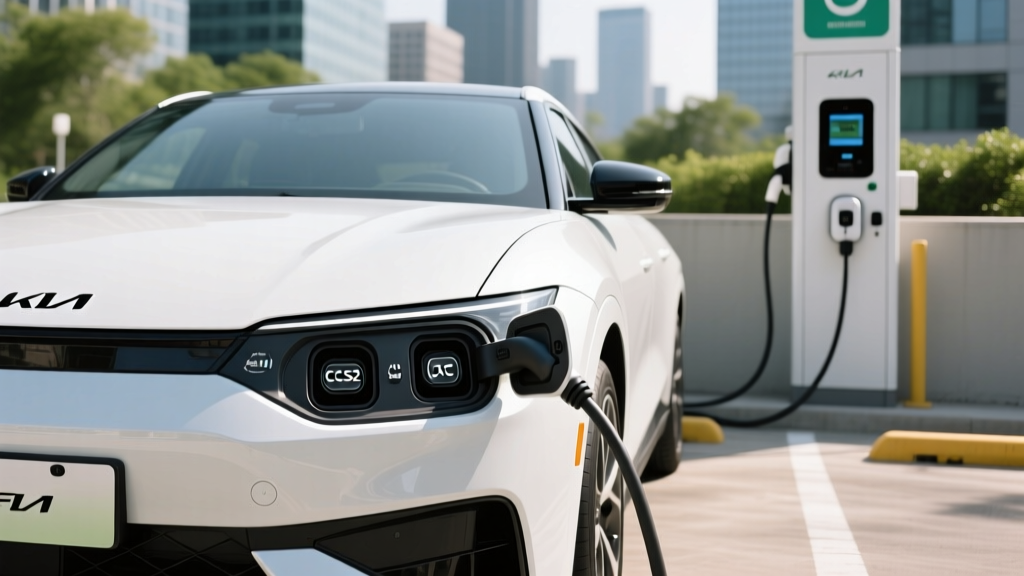
The Tesla Wall Connector ships with a NACS (North American Charging Standard) connector — the Tesla-native plug. As of 2025–2026, nearly every major automaker has adopted NACS for new vehicles, but millions of CCS1-equipped EVs are still on the road. Here's how compatibility breaks down:
| EV Brand / Connector | Native Fit? | Adapter Needed? | Notes |
|---|---|---|---|
| Tesla (all models) | Yes — native NACS | None | Full app integration; scheduled charging, access control |
| Ford (F-150 Lightning, Mustang Mach-E 2025+) | Yes — NACS | None | Ford switched to NACS port starting 2025 model year |
| Rivian (R1T, R1S 2025+) | Yes — NACS | None | NACS standard on 2025+ models |
| GM (Cadillac, Chevy, GMC 2025+) | Yes — NACS | None | GM transitioned to NACS for 2025 model year |
| Hyundai/Kia (CCS1 models) | No | CCS1-to-NACS adapter (~$200–$300) | Works for Level 2 AC; verify adapter is UL-listed |
| VW ID.4, BMW iX (CCS1 models) | No | CCS1-to-NACS adapter | Lectron and Tesla both sell adapters; check amp rating |
| Nissan Leaf (CHAdeMO) | No | Not practical | No reliable CHAdeMO-to-NACS adapter exists; use a J1772 charger |
If your household includes a CCS1-equipped EV, you have two options: buy a quality CCS1-to-NACS adapter (rated for at least 48 amps), or install a universal J1772 charger alongside the Wall Connector. The Tesla app's access-control feature can be set to "open" mode so non-Tesla vehicles can charge without VIN restriction.
Charging Cost: Home vs. Public vs. Gas
The economics of home Level 2 charging are compelling, but they depend heavily on your local electricity rate and whether you can charge during off-peak hours. The Tesla Wall Charger app's scheduling feature is the key to minimizing cost.
| Scenario | Rate | Cost per kWh | Cost per Mile (EV at 3.5 mi/kWh) | Annual Cost (12,000 mi) |
|---|---|---|---|---|
| Home off-peak (utility TOU rate) | $0.08–$0.12/kWh | $0.10 avg | $0.029 | $343 |
| Home standard rate | $0.13–$0.20/kWh | $0.16 avg | $0.046 | $549 |
| Public Level 2 (ChargePoint, etc.) | $0.25–$0.49/kWh | $0.35 avg | $0.100 | $1,200 |
| DC Fast Charging (EA, Tesla Supercharger) | $0.30–$0.55/kWh | $0.40 avg | $0.114 | $1,371 |
| Gas vehicle (28 MPG avg, $3.40/gal) | $3.40/gallon | — | $0.121 | $1,457 |
At off-peak home rates, charging a Tesla Model Y costs roughly $0.03 per mile — about one-quarter the cost of a 28 MPG gas car. Even at standard residential rates, you're saving $900+ annually versus gas. The Tesla Wall Charger app's scheduled charging feature lets you lock in those off-peak windows automatically, so you plug in at 6 PM but charging doesn't begin until 11 PM when rates drop.
For a full charge of a 75 kWh battery (Model Y Long Range) at $0.10/kWh off-peak, you're looking at roughly $7.50 for a 0–100% session — delivering about 310 EPA miles of range. Expect roughly 250–270 real-world highway miles in moderate weather, and 200–230 miles in sub-freezing cold due to cabin heating and battery resistance.
Equipment Picks: Tesla Wall Connector vs. Alternatives
The Tesla Wall Connector is excellent for Tesla-centric households, but it's not the only option. Here's how it compares to top alternatives in 2026:
Tesla Wall Connector (Gen 3)
- Max output: 11.5 kW (48A)
- Connector: NACS native
- Cable length: 24 feet
- Smart features: Scheduling, access control, Power Sharing, OTA updates via Tesla app
- Wi-Fi: 2.4 GHz only
- Price: ~$420
- Best for: Tesla owners; multi-Tesla households with Power Sharing
ChargePoint Home Flex
- Max output: 12 kW (50A)
- Connector: J1772 (NACS adapter available)
- Cable length: 23 feet
- Smart features: ChargePoint app scheduling, Alexa, energy reports
- Wi-Fi: 2.4 GHz + Bluetooth
- Price: ~$550–$650
- Best for: Mixed-fleet households (CCS + NACS vehicles via J1772)
Emporia Vue Level 2 Charger
- Max output: 11.5 kW (48A)
- Connector: J1772 (NACS version available)
- Cable length: 24 feet
- Smart features: Energy monitoring, solar integration, scheduling via Emporia app
- Wi-Fi: 2.4 GHz
- Price: ~$399
- Best for: Solar-panel owners wanting to charge on excess production
Grizzl-E Smart
- Max output: 10 kW (40A)
- Connector: J1772 or NACS
- Cable length: 24 feet
- Smart features: Basic app, OCPP support, adjustable amperage
- Wi-Fi: 2.4 GHz
- Price: ~$449
- Best for: Cold-climate durability (rated to -40°F); outdoor installs
If your garage holds a Tesla and a CCS-equipped vehicle (say, a pre-2025 Hyundai Ioniq 5), the ChargePoint Home Flex with its universal J1772 plug — plus each car's native adapter — offers the most flexibility without sacrificing smart scheduling.
Charging Time Examples: What to Expect
Charge times depend on battery size, state of charge, and circuit capacity. Here are real-world estimates using the Tesla Wall Connector at its maximum 11.5 kW output (assuming ~90% charging efficiency):
- Tesla Model 3 RWD (57.5 kWh battery): 10–80% in approximately 4 hours 15 minutes
- Tesla Model Y Long Range (75 kWh battery): 10–80% in approximately 5 hours 30 minutes
- Tesla Model S (100 kWh battery): 10–80% in approximately 7 hours 30 minutes
- Ford F-150 Lightning Extended Range (131 kWh battery): 10–80% in approximately 10 hours (requires CCS-to-NACS adapter or J1772 charger)
Level 2 home charging follows a relatively flat power curve — unlike DC fast charging, which tapers significantly above 80% SoC. You'll see near-constant 11.5 kW draw from 10% to about 90%, with a slight taper in the final 10% as the battery management system balances cells. This means scheduling an overnight window of 6–8 hours comfortably covers virtually any passenger EV from near-empty to full.
Safety, Code, and Permit Considerations
A Level 2 charger installation is a permanent electrical modification and must comply with the National Electrical Code (NEC) and local amendments. Key requirements:
- Dedicated circuit: The Wall Connector must be on its own breaker — no sharing with other outlets or appliances.
- GFCI protection: NEC 2020 and later require GFCI protection for EV charging outlets. However, since the Wall Connector is hardwired (not a receptacle), it typically does not require an external GFCI breaker — the unit has internal ground-fault protection. Confirm with your local inspector.
- Outdoor rating: The Gen 3 Wall Connector is NEMA 4-rated (suitable for outdoor installation and resistant to rain, snow, and hose-directed water). If mounting outdoors, ensure the conduit entry point is sealed per manufacturer instructions.
- Permit required: Virtually all jurisdictions require an electrical permit for a new 240V circuit. Permit fees range from $50 to $250. An inspection follows after installation.
- Utility notification: Some utilities require you to notify them before installing an EV charger, especially if you're enrolling in a time-of-use (TOU) rate plan. Some offer rebates of $250–$1,000 for charger installation — check with your local provider.
Always hire a licensed electrician familiar with NEC Article 625 (Electric Vehicle Charging Systems). According to the National Fire Protection Association, improper EV charger installations are a growing cause of residential electrical fires — typically from undersized wire, shared circuits, or unpermitted work.
Frequently Asked Questions
How much does it cost to install a Tesla Wall Connector at home?
Expect $970–$1,920 for a standard installation (unit + electrician + materials + permit), with most homeowners paying around $1,200–$1,500. If your home needs a panel upgrade from 100A to 200A service, add $1,500–$4,000. Detached garages requiring underground trenching add $800–$3,000.
Can I use the Tesla Wall Connector app without owning a Tesla vehicle?
Yes. You can create a Tesla account and pair the Wall Connector even if you own a non-Tesla EV. However, some features like VIN-based access control and vehicle-specific charge history only work with Tesla vehicles. Non-Tesla EVs will charge in "open" mode, and session energy data is still tracked by the Wall Connector itself.
How fast will the Tesla Wall Connector charge my EV?
At its maximum 11.5 kW (48 amps on a 60-amp circuit), the Wall Connector adds approximately 44 miles of range per hour for a Tesla Model Y. Actual speed depends on your vehicle's onboard charger capacity — some EVs accept only 7.2 kW or 9.6 kW, which caps the charge rate regardless of the Wall Connector's capability.
Which connector does the Tesla Wall Connector use, and will it fit my non-Tesla EV?
The Gen 3 Wall Connector uses a NACS (Tesla) connector. It fits all Tesla vehicles natively and all 2025+ Ford, GM, Rivian, and other NACS-adopting brands. For CCS1-equipped EVs (pre-2025 Hyundai, Kia, VW, BMW), you'll need a CCS1-to-NACS adapter rated for 48 amps. CHAdeMO vehicles (Nissan Leaf) are not practically compatible.
How much does home EV charging cost per mile compared to gas?
At off-peak residential rates (~$0.10/kWh), home EV charging costs about $0.03 per mile — roughly one-quarter the cost of a 28 MPG gas vehicle at $3.40/gallon ($0.12/mile). Even at standard residential rates ($0.16/kWh), you're paying about $0.05/mile. The Tesla Wall Charger app's scheduling feature helps you lock in the cheapest rates automatically.
What electrical upgrades might I need before installing a Level 2 charger?
The most common upgrade is a panel capacity increase from 100A to 200A service, needed in roughly 20–30% of older homes. Your electrician will perform a NEC Article 220 load calculation. Other potential upgrades include adding a sub-panel in an attached garage, replacing an outdated fuse box with a modern breaker panel, or upgrading the utility service drop. Budget $1,500–$4,000 if a panel upgrade is required.
Does the Tesla Wall Connector qualify for a tax credit?
The federal Residential Clean Energy Credit (IRS §25D) was modified under recent legislation. As of 2026, standalone EV charger hardware is generally no longer eligible for the federal credit for most taxpayers, though some state and utility rebate programs still cover $250–$1,000 of installation costs. Always check irs.gov and your state energy office for current incentive eligibility before purchasing.