Why Charging Strategy Defines Your Real-World Polestar Range
If you own or are shopping for a Polestar, you already know the EPA window sticker. The 2025 Polestar 2 Long Range Single Motor carries an EPA-estimated 320 miles of range from its 78 kWh (usable) NMC lithium-ion battery. The dual-motor variant with the same pack nets around 298 miles. The larger Polestar 4 SUV-coupe pushes toward 300+ miles depending on trim and wheel size.
But here's what the sticker doesn't tell you: your actual Polestar range on any given day depends heavily on how and where you charge. Battery preconditioning before DC fast charging, ambient temperature, state of charge (SoC) habits, and whether you're using Level 2 home charging versus public DC fast charging all shift the real-world equation. Expect roughly 250–280 highway miles from the Polestar 2 LR in moderate weather, and closer to 200–220 in sub-freezing conditions without a heat pump engaged.
EPA (Polestar 2 LR SM): 320 mi | Real-world highway (65°F): ~255–280 mi | Cold-weather highway (25°F): ~200–225 mi
Highway driving at 70+ mph and cold temperatures reduce range 15–35%. Preconditioning the battery while plugged in recovers some of this loss.
This guide walks through every charging option available to Polestar owners in 2026 — from a standard wall outlet to 200 kW DC fast chargers — with exact speeds, costs, installation requirements, and equipment picks.
Charging Levels Explained: Speeds, Power, and Range Added
Before choosing equipment, you need to understand the three charging tiers and how they translate to miles on your Polestar's battery. The critical distinction: kW (kilowatts) measures power — how fast energy flows into the battery. kWh (kilowatt-hours) measures energy — the total capacity stored. Think of kW as the flow rate of a hose and kWh as the size of the bucket.
| Level | Voltage / Amps | Max Power (kW) | Miles of Range per Hour | Full Charge Time (78 kWh) |
|---|---|---|---|---|
| Level 1 (120V outlet) | 120V / 12A | ~1.4 kW | 3–5 mi/hr | 55+ hours |
| Level 2 (240V home/public) | 240V / 32–48A | 7.7–11.5 kW | 25–40 mi/hr | 7–10 hours |
| DC Fast Charging | 400V+ architecture | Up to 200 kW (Polestar 2) | ~600–800 mi/hr (peak) | 10–80% in ~28 min |
DC fast charging reality check: The Polestar 2 Long Range peaks at approximately 200 kW on a compatible DC fast charger, but only between roughly 10–30% SoC. The charge curve tapers significantly above 80%, dropping to under 50 kW. This is why manufacturers quote 10–80% times rather than 0–100%. Charging from 80–100% on DC fast charging can take as long as the initial 10–80% — plan your road trips around 80% stops for the best time efficiency.
Home Level 2 Installation: Electrical Requirements, Costs, and Panel Upgrades
Level 2 home charging is the backbone of practical Polestar ownership. You'll plug in when you get home and wake up to a full battery every morning — no detours, no waiting. But installation isn't just plugging into a dryer outlet.
Electrical Requirements
A Level 2 charger for the Polestar 2 requires a 240-volt dedicated circuit. The Polestar 2's onboard charger accepts up to 11 kW (single-phase, 48A), meaning a 60A circuit breaker with a 48A continuous-rated charger is optimal. A 50A breaker / 40A charger (9.6 kW) is also common and still delivers ~32 miles of range per hour — enough to fully replenish a day's driving overnight.
Do You Need a Panel Upgrade?
This is the variable that catches many homeowners off guard. If your home has a 100A main electrical panel — common in houses built before the 1990s — adding a 50–60A EV circuit may exceed your panel's capacity, especially if you're already running central A/C, an electric range, and an electric dryer. A licensed electrician will perform a load calculation (NEC Article 220) to determine if your panel can handle the additional draw.
If an upgrade from 100A to 200A service is required, expect to pay $1,500–$3,500 for the panel upgrade alone, before charger installation. Homes with existing 200A panels rarely need an upgrade for a single Level 2 circuit.
| Component | Typical Range | Notes |
|---|---|---|
| Level 2 charger (hardware) | $350–$700 | Smart Wi-Fi chargers; basic models from $250 |
| Electrician labor (install) | $500–$2,000 | Depends on run length from panel to garage |
| Electrical permit | $50–$200 | Required in most jurisdictions |
| Conduit, wiring, breaker | $100–$500 | 6 AWG copper for 50A; longer runs cost more |
| Panel upgrade (if needed) | $1,500–$3,500 | 100A → 200A service upgrade |
| Total (no panel upgrade) | $1,000–$3,400 | Most homes with 200A panels |
| Total (with panel upgrade) | $2,500–$6,900 | Older homes with 100A service |
Federal incentive note: The Alternative Fuel Vehicle Refueling Property Credit (IRC §30C) covers 30% of home charger hardware and installation costs, up to $1,000, for equipment placed in service in eligible census tracts. Check IRS guidance for your ZIP code — eligibility depends on whether your area meets specific low-income or non-urban criteria.
Connector Compatibility: NACS, CCS, and What Polestar Uses
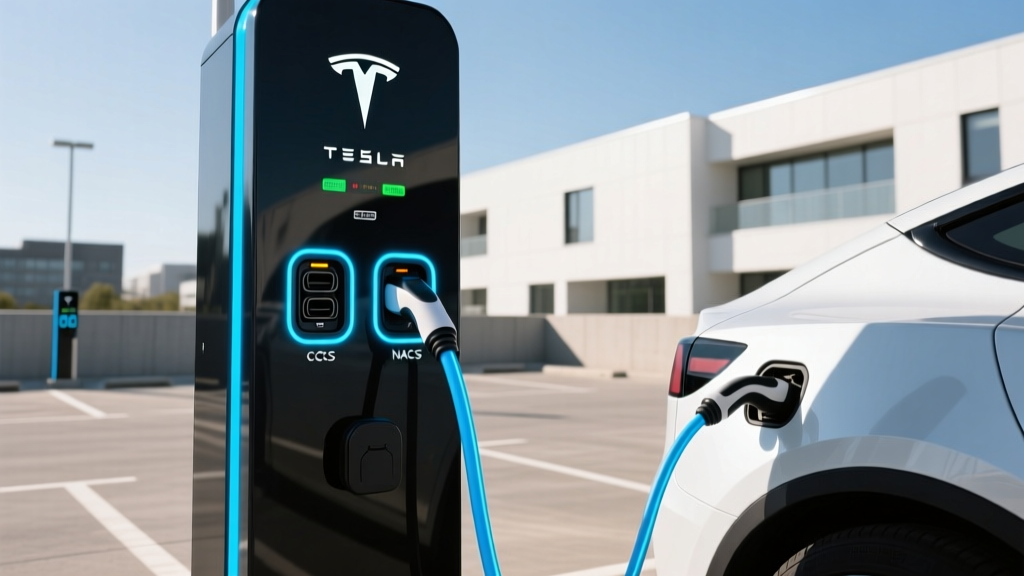
The connector landscape has shifted dramatically. As of 2025–2026, most Polestar vehicles sold in North America ship with the CCS1 (Combined Charging System) port. However, Polestar has announced a transition to the NACS (North American Charging Standard / Tesla connector) for future models, and current CCS-equipped Polestars can access Tesla Superchargers via an approved adapter.
| Connector | Polestar Compatibility | Network Access |
|---|---|---|
| CCS1 | Native port on 2022–2025 Polestar 2 & 4 | Electrify America, EVgo, ChargePoint DC |
| NACS (Tesla) | Via CCS-to-NACS adapter (~$200–$250) | Tesla Supercharger network (15,000+ stalls) |
| J1772 (Level 2 AC) | Native (AC portion of CCS port) | All public Level 2 stations, home chargers |
| CHAdeMO | Not compatible (no adapter available) | Legacy Nissan Leaf network — avoid |
Adapter tip: If you plan road trips through areas where Tesla Superchargers dominate (rural corridors, national parks), a CCS-to-NACS adapter is a worthwhile $200–$250 investment. Polestar has confirmed compatibility with Tesla's Magic Dock adapter at select Supercharger stations as well. Always verify adapter approval with Polestar before purchasing third-party options — using an uncertified adapter can void your charging-system warranty.
Cost to Charge: Home vs. Public vs. Gas Comparison
One of the strongest arguments for Polestar ownership is the per-mile fuel cost — but only if you're charging strategically. Public DC fast charging can approach or even exceed gasoline costs on a per-mile basis.
| Scenario | Rate | Cost per Mile (Polestar 2, 3.1 mi/kWh) | Cost per Mile (30 MPG gas car @ $3.50/gal) |
|---|---|---|---|
| Home (off-peak utility rate) | $0.10/kWh | $0.032 | $0.117 |
| Home (avg. national rate) | $0.17/kWh | $0.055 | $0.117 |
| Public Level 2 | $0.25–$0.35/kWh | $0.081–$0.113 | $0.117 |
| DC Fast Charging (EA, EVgo) | $0.40–$0.55/kWh | $0.129–$0.177 | $0.117 |
The takeaway is stark: home charging at off-peak rates saves roughly 70% per mile versus gasoline. But exclusive reliance on DC fast charging can actually cost more than gas. The economics of Polestar ownership depend heavily on having reliable Level 2 access at home or work.
For a Polestar 2 LR driven 12,000 miles/year with 80% home charging at $0.14/kWh and 20% public DC at $0.48/kWh, annual electricity cost runs approximately $830. A comparable 30 MPG gas car at $3.50/gallon would cost $1,400 — a savings of roughly $570/year, or $2,850 over five years.
Recommended Level 2 Home Chargers for Polestar Owners
Not all Level 2 chargers are equal. Here are three proven options that pair well with the Polestar 2's 11 kW onboard charger, with specific specs that matter.
ChargePoint Home Flex
- Power: Up to 11.5 kW (240V/48A)
- Connector: J1772 (NACS version available)
- Cable length: 23 ft
- Smart features: Wi-Fi, app scheduling, Alexa, utility demand-response
- Price: ~$550–$650
- Why for Polestar: Matches the Polestar 2's 11 kW onboard max; adjustable amperage from 16A–50A to fit your circuit
Emporia Vue Level 2
- Power: Up to 11.5 kW (240V/48A)
- Connector: J1772
- Cable length: 24 ft
- Smart features: Wi-Fi, energy monitoring, solar integration, scheduling
- Price: ~$400–$500
- Why for Polestar: Best value at full 48A; pairs with Emporia home energy monitor for solar-aware charging
Tesla Wall Connector
- Power: Up to 11.5 kW (240V/48A)
- Connector: NACS (native) + J1772 adapter included
- Cable length: 24 ft
- Smart features: Wi-Fi, OTA updates, power sharing between units
- Price: ~$420–$475
- Why for Polestar: If you plan to switch to NACS-native Polestar in the future; J1772 adapter covers current CCS Polestars
Hardwired vs. plug-in: Chargers rated above 40A (continuous) typically require hardwiring rather than a NEMA 14-50 plug. Hardwired installs are slightly more expensive but eliminate a common failure point (loose receptacle connections) and are required by code for continuous loads above 40A on a plug. For a 48A charger on a 60A breaker, hardwiring is the correct and code-compliant choice.
Safety, Electrical Code, and Installation Best Practices
EV charging is a continuous high-draw load — your charger will run at full amperage for 6–10 hours at a time. This is fundamentally different from a dryer or oven that cycles on and off. The National Electrical Code (NEC) treats it accordingly.
- Dedicated circuit required: Your Level 2 charger must be on its own breaker — no sharing with other outlets or appliances.
- 125% rule: NEC requires the circuit breaker to be rated at 125% of the continuous load. A 48A charger needs a 60A breaker; a 32A charger needs a 40A breaker.
- GFCI protection: The 2020 NEC and later require GFCI protection for EV charging outlets in garages. Hardwired installations are exempt from this specific requirement, which is one reason hardwired is preferred.
- Outdoor rating: If your charger is installed outside (carport, driveway), ensure the unit carries a NEMA 4 or IP65 weather rating. All three chargers above meet this standard.
- Permit and inspection: Nearly all jurisdictions require an electrical permit for EV charger installation. The inspection verifies wire gauge, breaker sizing, grounding, and proper mounting. Skipping the permit risks insurance claim denial if an electrical fire occurs.
DC Fast Charging on Road Trips: Polestar Charging Times and Network Tips
For road trips exceeding your Polestar's real-world range, DC fast charging is your tool. Here's what to expect from the Polestar 2 Long Range's charging curve:
- 10–30% SoC: Peaks near 200 kW (on a 350 kW-capable station)
- 30–60% SoC: Sustains ~120–150 kW
- 60–80% SoC: Tapers to ~70–90 kW
- 80–100% SoC: Drops below 40 kW — avoid charging past 80% on road trips
- 10–80% total time: ~28 minutes at a 200+ kW station; ~38 minutes at a 150 kW station
Preconditioning matters. The Polestar 2 will precondition its battery for fast charging when you navigate to a DC fast charger through the built-in navigation system. This warms the battery to optimal temperature (roughly 86–95°F internally), enabling the peak charge curve. Without preconditioning — especially in cold weather — your peak charge rate may be limited to 100 kW or less, adding 10–15 minutes to your stop.
For network reliability, Electrify America offers the most 150–350 kW stations along major US highway corridors. EVgo and ChargePoint are expanding 200+ kW coverage. Tesla Superchargers (via adapter) tend to have the highest uptime rates in the industry — consistently above 95%.
Frequently Asked Questions
How much does it cost to install a home EV charger for my Polestar?
Most homeowners with a 200A electrical panel will pay $1,000–$3,400 total for a Level 2 charger installation, including hardware ($350–$700), electrician labor ($500–$2,000), permits ($50–$200), and wiring materials ($100–$500). If your home has an older 100A panel that requires a service upgrade, add $1,500–$3,500 to that total.
How fast will each charging level add range to my Polestar 2?
Level 1 (120V) adds roughly 3–5 miles per hour — barely practical for daily use. Level 2 (240V, 48A) adds approximately 35–40 miles per hour, fully replenishing a Polestar 2's 78 kWh battery overnight in 7–10 hours. DC fast charging at peak rate can add 100+ miles in 10 minutes, but charge speed tapers significantly above 80% SoC.
Which connector and charger is compatible with my Polestar?
Current Polestar 2 and Polestar 4 models use a CCS1 port for DC fast charging and a J1772 inlet for Level 2 AC charging. Any J1772 Level 2 home charger will work natively. For Tesla Supercharger access, you'll need a CCS-to-NACS adapter. CHAdeMO is not compatible with any Polestar vehicle.
How much does charging a Polestar cost per mile compared to gas?
At the national average home electricity rate of ~$0.17/kWh, the Polestar 2 LR costs about $0.055/mile to fuel — roughly 53% less than a 30 MPG gas car at $3.50/gallon ($0.117/mile). Off-peak home rates ($0.10/kWh) drop that to $0.032/mile. However, exclusive DC fast charging at $0.48–$0.55/kWh can cost $0.155–$0.177/mile, exceeding gasoline.
What electrical upgrades might I need for a home charger?
The most common upgrade is a panel service increase from 100A to 200A ($1,500–$3,500) in older homes. Your electrician will perform a NEC Article 220 load calculation. Other potential needs include running new 6 AWG copper wire from the panel to the garage ($3–$8 per foot for long runs), adding a sub-panel if the main panel is full, or upgrading your utility meter socket. Most homes built after 2000 with 200A service need no panel upgrade.