If you drive a Tesla or any EV equipped with the North American Charging Standard (NACS) port, you've probably pulled up to a public Level 2 charger only to find a J1772 connector staring back at you. That's where the Lectron Tesla to J1772 adapter earns its keep — a compact, roughly $100 accessory that bridges the gap between your NACS inlet and the legacy J1772 plugs still dominating hotels, workplaces, and shopping-center garages across the country.
This guide breaks down exactly what the Lectron adapter does, how it fits into the broader Level 2 and DC fast-charging landscape, what you'll pay per mile to charge, and whether your home electrical panel can support a dedicated Level 2 circuit. We'll also cover the installation math, the connector transition happening across the industry, and which home chargers pair best with a NACS-equipped EV in 2026.
What the Lectron Tesla to J1772 Adapter Actually Does
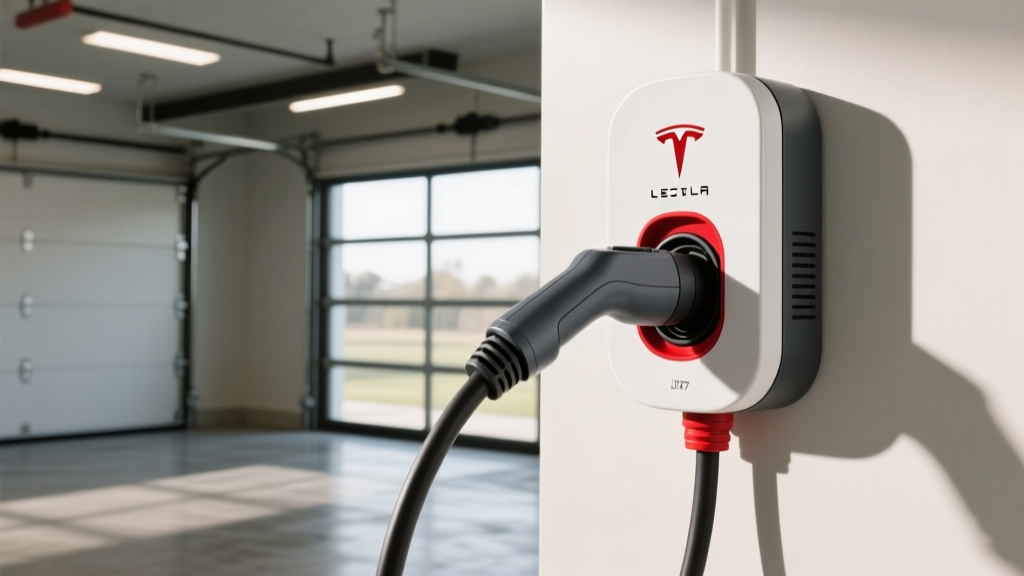
The Lectron Tesla to J1772 adapter is a passive, single-direction adapter. Its sole job: let you plug a J1772 connector (the standard on nearly all non-Tesla Level 2 public chargers installed before 2025) into a NACS/Tesla charge port. It does not convert DC fast charging — it is rated exclusively for Level 1 and Level 2 AC charging.
Key specifications for the current-generation Lectron adapter:
- Max current rating: 40 amps (some listings also offer a 48A variant)
- Max voltage: 250V AC
- Max power throughput: ~10 kW (40A model) / ~11.5 kW (48A model)
- Connector side A: J1772 (male, plugs into station cable)
- Connector side B: NACS / Tesla (female, plugs into vehicle port)
- Weight: ~1.1 lbs
- IP rating: IP54 (splash-resistant; not submersible)
- Typical street price: $95–$130 depending on retailer and amperage variant
In practice, this means you can pull into a ChargePoint, Blink, or older EVgo Level 2 station with a J1772 tethered cable, click the Lectron adapter onto the plug, insert it into your Tesla or NACS-equipped Ford, Hyundai, or Rivian, and initiate a charge through the station's app or RFID card. The adapter passes through the J1772 pilot signal so the vehicle and station handshake normally.
Charging Levels Explained: Speeds, kW, and Miles Per Hour
Before evaluating any adapter or charger, you need to understand the three charging tiers. The critical distinction: kW (kilowatts) measures power — the rate of energy flow, while kWh (kilowatt-hours) measures energy — the total capacity stored in your battery. Think of kW as the width of a pipe and kWh as the size of the tank it's filling.
| Level | Voltage | Max Power (kW) | Miles of Range Added Per Hour | Typical Use Case |
|---|---|---|---|---|
| Level 1 | 120V AC | 1.4–1.9 kW | 3–5 miles | Overnight trickle; emergency top-up |
| Level 2 | 208–240V AC | 3.3–19.2 kW | 12–75 miles | Home daily charging; workplace; public destinations |
| DC Fast Charge | 400–800V DC | 50–350 kW | 180–1,200+ miles (equivalent rate) | Road trips; 10–80% in 18–40 minutes |
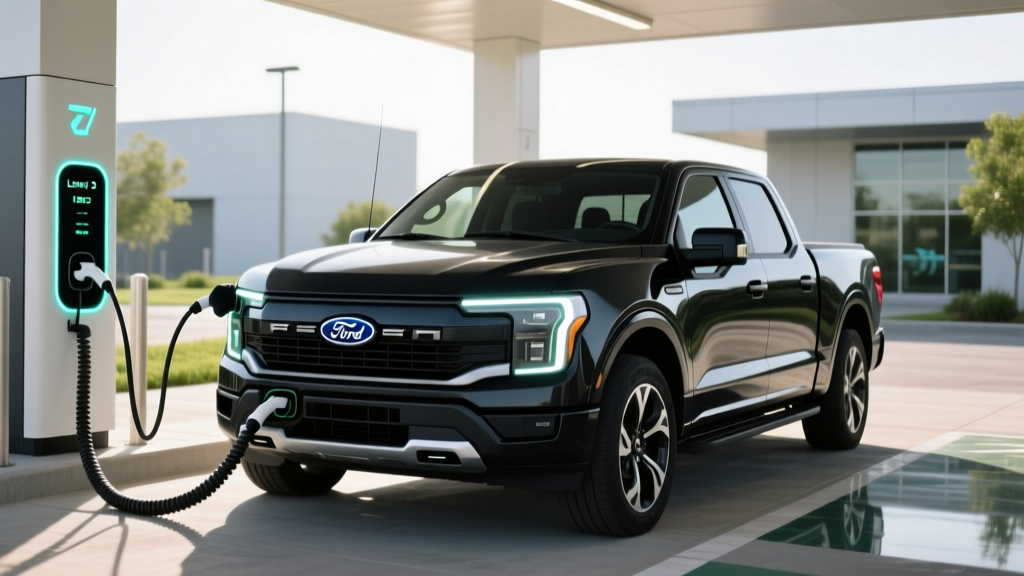
The Lectron Tesla to J1772 adapter operates exclusively at Level 1 and Level 2. It has no role in DC fast charging, where Tesla Superchargers (now open to many non-Tesla NACS vehicles) and CCS-equipped stations deliver direct current straight to the battery, bypassing the vehicle's onboard charger entirely.
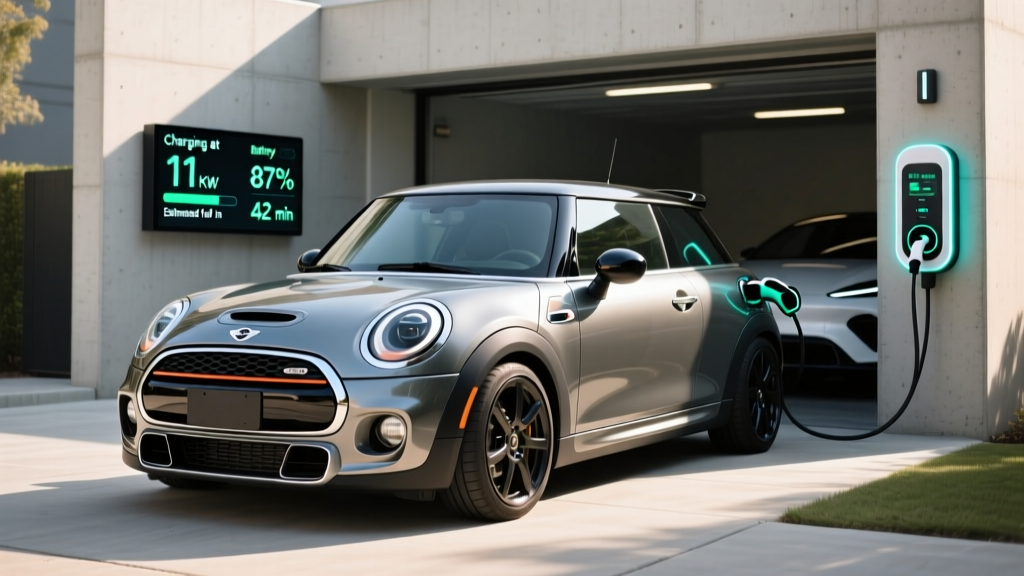
For context on what Level 2 means in practice: a Tesla Model Y Long Range with an 81 kWh usable battery charging at 11.5 kW (48A × 240V) will add roughly 32 kWh in three hours — enough to go from 20% to about 60% state of charge. A 40A adapter caps that at ~10 kW, adding about 28 kWh in the same window.
Connector Compatibility: NACS, J1772, CCS1, and CHAdeMO
The EV industry is in the middle of a massive connector transition. Here's where things stand in 2026:
| Connector | AC Level 2? | DC Fast? | Vehicles Using It (2026) | Adapter Needed for J1772 Stations? |
|---|---|---|---|---|
| NACS (Tesla) | Yes | Yes | Tesla (all); Ford F-150 Lightning, Mustang Mach-E (2025+); GM Ultium vehicles (2025+); Hyundai Ioniq 5/6 (2026); Rivian R1T/R1S (2025+) | Yes — J1772-to-NACS adapter (e.g., Lectron) |
| J1772 | Yes | No | Older non-Tesla EVs (pre-2025 Nissan Leaf, VW ID.4 pre-NACS, etc.) | No — native |
| CCS1 | Yes (via J1772 upper portion) | Yes | Legacy non-Tesla DC fast charging; being phased out for NACS | No for DC; J1772 portion is native |
| CHAdeMO | Yes (separate J1772 port) | Yes | Nissan Leaf (legacy); Mitsubishi Outlander PHEV | No for DC; J1772 for AC |
The Lectron Tesla to J1772 adapter solves a specific problem: NACS-equipped vehicles encountering the installed base of roughly 80,000+ J1772 Level 2 ports across the U.S. that haven't yet been retrofitted with NACS connectors. As of 2026, most charging networks are adding NACS tethers to new installations, but the legacy J1772 footprint will persist for years.
According to the U.S. Department of Energy's Alternative Fuels Data Center, J1772 remains the most common Level 2 connector at public stations. Carrying a J1772-to-NACS adapter is now as essential for Tesla and NACS drivers as keeping a spare tire inflator in the trunk.
Home Level 2 Charger Installation: Electrical Requirements and Costs
Most EV owners do the bulk of their charging at home. Installing a dedicated Level 2 charger requires a 240V circuit — the same voltage your electric dryer or oven uses — and the costs vary dramatically depending on your home's electrical panel.
Electrical Requirements for a Home Level 2 Charger
- Voltage: 240V (split-phase, standard U.S. residential)
- Amperage: 40A circuit for a 32A charger (NEC requires 125% headroom); 60A circuit for a 48A charger
- Dedicated circuit: Required — no sharing with other appliances
- Breaker: Double-pole breaker sized to 125% of continuous load
- Wiring: Typically 6 AWG copper (40A) or 4 AWG copper (60A), run in conduit
- GFCI protection: NEC 2020+ requires GFCI breaker for EV receptacles (NEMA 14-50); hardwired chargers may not require a separate GFCI depending on local code
- Outdoor rating: If installed outside, the charger must carry a NEMA 4 or IP54+ rating
| Component | Low Estimate | High Estimate | Notes |
|---|---|---|---|
| Level 2 charger (hardware) | $300 | $700 | 32A–48A smart chargers; Tesla Wall Connector, ChargePoint Home Flex, Emporia Vue |
| Electrician labor | $400 | $1,800 | Depends on run length, wall type, conduit needs |
| Electrical permit | $50 | $250 | Varies by municipality; some jurisdictions waive for EV |
| Panel upgrade (if needed) | $1,500 | $3,500 | 100A→200A service upgrade; not always required |
| NEMA 14-50 receptacle (optional) | $50 | $150 | If using plug-in charger vs. hardwired |
| Total (no panel upgrade) | $750 | $2,750 | Most installations fall in $1,000–$1,800 |
| Total (with panel upgrade) | $2,250 | $6,250 | Older homes with 100A service |
Some utilities offer rebates of $200–$500 for Level 2 charger installation, and certain states provide additional incentives. Check your local utility's EV program page before scheduling the electrician. The AFDC state incentives database maintains a current list.
How Much Does EV Charging Cost Per Mile vs. Gas?
The economics of EV charging depend heavily on where and when you charge. Here's a realistic breakdown using a 2026 Tesla Model Y Long Range (averaging 3.5 miles per kWh, or roughly 120 MPGe combined per fueleconomy.gov) as the baseline.
| Charging Scenario | Cost per kWh | Cost per Mile (at 3.5 mi/kWh) | Equivalent Gas Price (at 30 MPG) |
|---|---|---|---|
| Home — off-peak utility rate | $0.08–$0.12 | $0.023–$0.034 | $0.69–$1.02/gallon |
| Home — standard residential rate | $0.14–$0.18 | $0.040–$0.051 | $1.20–$1.53/gallon |
| Public Level 2 (ChargePoint, EVgo) | $0.25–$0.49 | $0.071–$0.140 | $2.13–$4.20/gallon |
| DC Fast Charge (Supercharger / EA) | $0.32–$0.58 | $0.091–$0.166 | $2.73–$4.98/gallon |
For comparison, a 30 MPG gasoline vehicle at $3.40/gallon costs $0.113 per mile. The takeaway: home charging at off-peak rates is roughly one-quarter to one-third the per-mile cost of gasoline. Public DC fast charging, however, can approach or exceed gasoline costs in high-price markets — which is why maximizing home and workplace charging is the key to EV economics.
The Lectron adapter plays a role here indirectly: by enabling you to use free or low-cost J1772 Level 2 chargers at workplaces, hotels, and shopping centers, it helps you avoid the premium pricing of DC fast stations for routine top-ups.
Recommended Home Level 2 Chargers for NACS-Equipped EVs
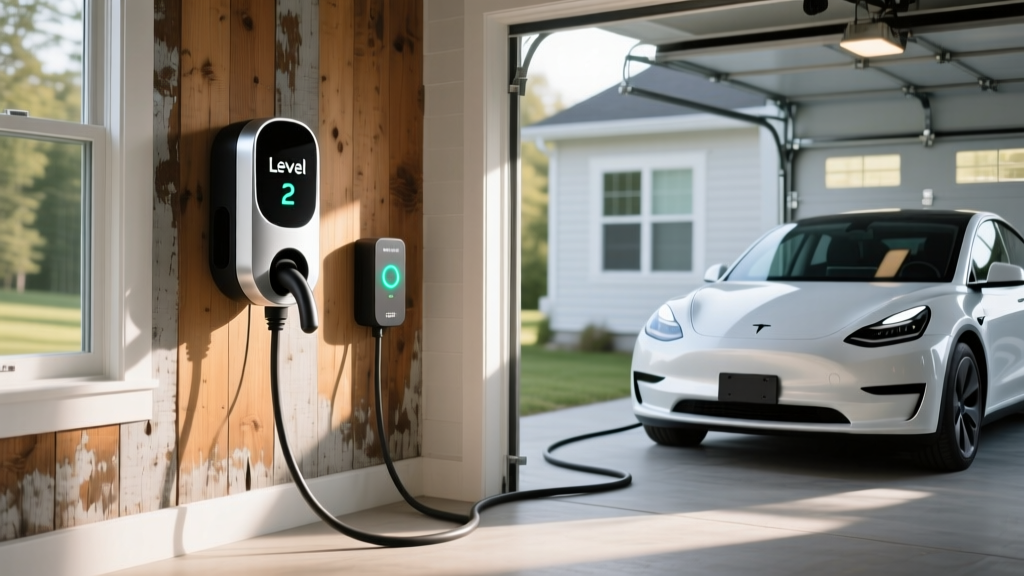
If you own a NACS-equipped vehicle and are installing a home charger, you have two paths: buy a charger with a native NACS connector, or buy a J1772 charger and use the Lectron adapter. The native-NACS route is cleaner for daily use.
Tesla Wall Connector
- Max output: 11.5 kW (48A at 240V)
- Connector: Native NACS
- Cable length: 24 ft
- Smart features: Wi-Fi, OTA updates, power sharing between units, load management
- Price: ~$450
- Best for: Tesla owners; cleanest native integration
ChargePoint Home Flex
- Max output: 12 kW (50A at 240V)
- Connector: J1772 (NACS adapter needed) or NACS (2025+ models)
- Cable length: 24 ft
- Smart features: Wi-Fi, app scheduling, Alexa integration, amperage configurable 16A–50A
- Price: ~$550–$650
- Best for: Multi-EV households (J1772 + NACS vehicles)
Emporia Level 2 EV Charger
- Max output: 11.5 kW (48A at 240V)
- Connector: J1772 or NACS (select at purchase)
- Cable length: 24 ft
- Smart features: Wi-Fi, energy monitoring via Emporia Vue panel integration, solar-aware scheduling
- Price: ~$350–$400
- Best for: Budget-conscious; solar-home integration
If you choose a J1772-terminated home charger (like older ChargePoint Home Flex units), the Lectron Tesla to J1772 adapter will work — but you'll be plugging and unplugging it daily, which adds wear. For a dedicated NACS vehicle, a native NACS charger is the better long-term investment.
Charging Time Examples: 10–80% at Different Power Levels
Charging speed isn't linear. EVs charge fastest at low states of charge and taper significantly above 80% to protect battery longevity. Here's what 10–80% looks like for common battery sizes at various AC power levels — relevant to the Lectron adapter's throughput ceiling.
| Battery Size (usable kWh) | Example Vehicle | At 7.2 kW (32A) | At 10 kW (40A — Lectron 40A adapter) | At 11.5 kW (48A) |
|---|---|---|---|---|
| 58 kWh | VW ID.4 Standard | ~5 hr 40 min | ~4 hr 5 min | ~3 hr 30 min |
| 75 kWh | Ford Mustang Mach-E ER | ~7 hr 15 min | ~5 hr 15 min | ~4 hr 35 min |
| 81 kWh | Tesla Model Y Long Range | ~7 hr 50 min | ~5 hr 40 min | ~4 hr 55 min |
| 100 kWh | Rivian R1T Large Pack | ~9 hr 45 min | ~7 hr | ~6 hr 5 min |
Notice that the jump from 10 kW (the Lectron 40A adapter's ceiling) to 11.5 kW saves roughly 45 minutes on a Model Y-sized battery. That's meaningful if you're charging during a short hotel stop, but negligible for overnight home charging where you have 8–10 hours available.
Safety, Code, and Adapter Best Practices
The Lectron adapter is a simple passive device, but proper use matters for safety and longevity:
- Inspect contacts before each use. Look for discoloration, pitting, or melted plastic on either the J1772 or NACS pins. Discolored pins indicate arcing and the adapter should be replaced.
- Don't use in heavy rain without shelter. The IP54 rating handles splashes, but driving rain hitting the connection point during plug-in can allow moisture ingress. Charge under a canopy when possible.
- Store in a dry, padded case. Dropping the adapter on concrete can misalign internal contacts. Most Lectron adapters ship with a small carry pouch — use it.
- Never use an adapter for DC fast charging. The Lectron Tesla to J1772 adapter is rated for AC only. Attempting to pass DC current through it will damage the adapter and potentially the vehicle's charge port.
- Ensure your home circuit is dedicated. NEC Article 625 requires EV charging circuits to be dedicated — no shared outlets on the same breaker. A licensed electrician will verify this during installation.
Frequently Asked Questions
How much does it cost to install a home EV charger?
A typical Level 2 home charger installation costs between $750 and $2,750 when no panel upgrade is needed, with most homeowners paying $1,000–$1,800. The breakdown: $300–$700 for the charger hardware, $400–$1,800 for electrician labor, and $50–$250 for the permit. If your home needs a 200A panel upgrade (common in pre-2000 construction), add $1,500–$3,500 to the total.
How fast will each charging level add range?
Level 1 (120V) adds roughly 3–5 miles of range per hour. Level 2 (240V) adds 12–75 miles per hour depending on amperage — a 40A circuit delivers about 30 miles/hour for a typical midsize EV. DC fast charging can add 180–300+ miles in a 20–30 minute session at 150–350 kW stations, though charge speed tapers significantly above 80% state of charge.
Which connector and charger is compatible with my EV?
Check your vehicle's charge port. If it's NACS (Tesla-style, used by all Teslas and an expanding list of 2025–2026 Ford, GM, Hyundai, and Rivian models), you need a NACS home charger or a J1772 charger with a J1772-to-NACS adapter like the Lectron. If your vehicle has a J1772 port (most pre-2025 non-Tesla EVs), any J1772 Level 2 charger works natively. For DC fast charging, NACS vehicles use Tesla Superchargers and NACS-equipped stations; J1772/CCS vehicles use Electrify America and other CCS networks.
How much does charging cost per mile vs. gas?
Home charging at off-peak utility rates ($0.08–$0.12/kWh) costs roughly $0.02–$0.03 per mile for a typical EV — equivalent to gasoline at $0.69–$1.02/gallon for a 30 MPG vehicle. Standard residential rates push that to $0.04–$0.05/mile. Public DC fast charging ($0.32–$0.58/kWh) costs $0.09–$0.17/mile, approaching the $0.11/mile cost of $3.40/gallon gasoline. The economic advantage of EVs is maximized when most charging happens at home.
What electrical upgrades might I need for a home charger?
The most common upgrade is a panel capacity increase from 100A or 150A to 200A, which costs $1,500–$3,500 and is typically needed in older homes with high existing electrical loads. You may also need a new double-pole breaker, dedicated wiring run (6 AWG or 4 AWG copper in conduit), and a NEMA 14-50 receptacle or hardwired junction box. Your electrician will perform an NEC Article 220 load calculation to determine exactly what's required.
Does the Lectron Tesla to J1772 adapter work with non-Tesla NACS vehicles?
Yes. The adapter connects any J1772 plug to any NACS charge port — whether that port belongs to a Tesla, a 2025+ Ford F-150 Lightning, a 2025+ GM Ultium vehicle, or a 2026 Hyundai Ioniq 5 with the NACS port. The NACS connector is physically identical across all vehicles that use it.
Can I use the Lectron adapter at a Tesla Supercharger?
No. Tesla Superchargers deliver DC fast charge current and use the NACS connector natively. The Lectron Tesla to J1772 adapter is designed for AC Level 2 stations with J1772 connectors only. It has no role — and should never be used — at any DC fast charger.