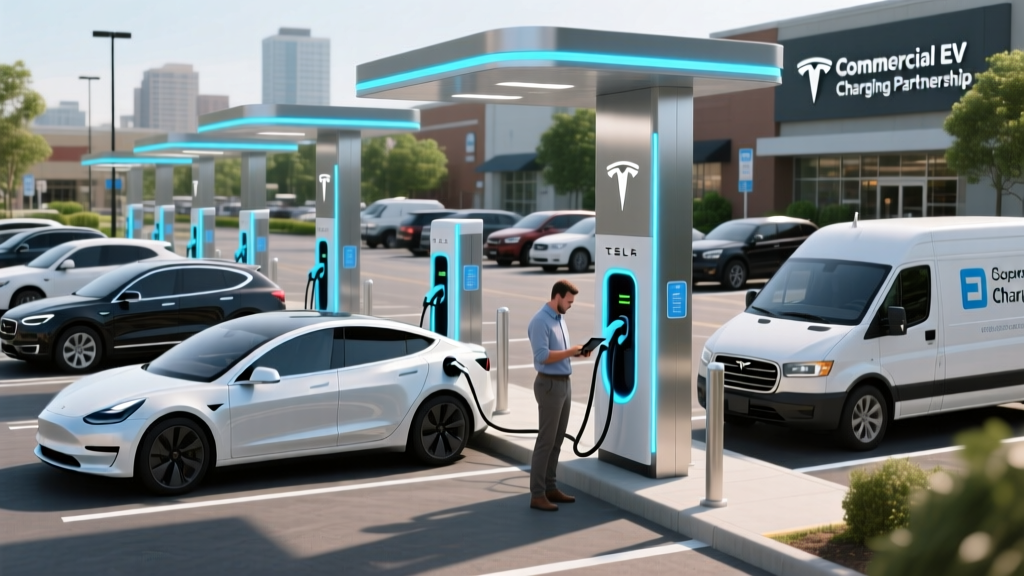
For years, the Tesla Supercharger network was a walled garden—exclusive to Tesla vehicles and strategically placed by Tesla itself. In 2026, that model has fundamentally shifted. Through programs like Supercharger Host and the expanded deployment of NACS-equipped DC fast charging stations, Tesla has opened the door for commercial property owners to install, host, and profit from Supercharger stalls on their own land. If you're a business owner, fleet operator, or real estate developer evaluating Tesla Supercharger sales to businesses, this guide breaks down the electrical realities, equipment specs, connector standards, and cost structures you need to understand before signing a hosting agreement.
How Tesla's Business Supercharger Program Works in 2026
Tesla's commercial charging programs fall into two primary categories: Supercharger Host (where Tesla owns and operates the chargers on your property) and Destination/Megacharger partnerships (where businesses purchase and manage their own Tesla-branded or Tesla-compatible DC fast chargers). In the host model, Tesla covers equipment and installation costs; the business provides the land, electrical infrastructure access, and parking spaces. Revenue is typically shared, with hosts earning a per-kWh or per-session fee. In the purchase model, businesses buy the chargers outright—often Tesla's V4 Supercharger cabinets—and manage pricing, uptime, and maintenance through Tesla's commercial portal.
Understanding the distinction between kW (kilowatts)—the rate of power delivery—and kWh (kilowatt-hours)—the total energy transferred—is essential for evaluating any hosting agreement. A 250 kW V3 Supercharger stall delivers power at a peak rate of 250 kilowatts, while a charging session might transfer 40 kWh of energy into a vehicle's battery over 20 minutes. Your utility demand charges, revenue calculations, and equipment sizing all hinge on this distinction.
Charging Levels Explained: Speeds, Power, and Range Added
Whether you're hosting a Supercharger site or evaluating what level of charging infrastructure your business needs, here's a breakdown of the three charging tiers relevant to commercial and residential EV charging:
| Level | Voltage | Max Power (kW) | Miles of Range per Hour | Typical Use Case |
|---|---|---|---|---|
| Level 1 (AC) | 120V | 1.4–1.9 kW | 3–5 mi/hr | Overnight home trickle charge |
| Level 2 (AC) | 240V | 7.2–19.2 kW | 20–60 mi/hr | Home, workplace, retail destination |
| DC Fast Charge (V3 Supercharger) | 400–800V DC | 250 kW | ~200+ mi in 15 min | Highway travel, commercial fleet depots |
| DC Fast Charge (V4 Supercharger) | Up to 900V DC | 350+ kW | ~250+ mi in 15 min | Next-gen highway, business host sites |
For business hosts, the relevant tier is DC fast charging. A Tesla V3 Supercharger stall peaks at 250 kW, while the newer V4 architecture supports up to 350 kW for compatible vehicles with 800V battery architectures (such as the Hyundai Ioniq 5, Kia EV6, and Porsche Taycan). In real-world conditions, most EVs will see peak charge rates only between 10–50% State of Charge (SoC); above 80%, the charge curve tapers significantly to protect battery health. A typical 10–80% session on a V3 stall takes 18–25 minutes for a 75–85 kWh battery pack.
Electrical Requirements: What Your Site Needs
Hosting a Supercharger station is an industrial-scale electrical project. A typical 4-stall V3 Supercharger site requires a dedicated utility transformer, 480V three-phase service, and a total site capacity of approximately 500–1,000 kW depending on stall count and power-sharing architecture. Here's what that means in practical terms:
- Utility service upgrade: Most commercial sites need a dedicated medium-voltage feed. Tesla or your electrical contractor will coordinate with the local utility for a new transformer and switchgear.
- Panel and switchgear: A 480V/3-phase distribution panel with individual breakers for each charger cabinet. Expect 400–600A service per cabinet cluster.
- Conduit and trenching: Underground conduit runs from the transformer pad to each charger pedestal, typically 100–300 feet of trenching at $50–$150 per linear foot.
- Permitting: Commercial electrical permits, utility interconnection agreements, and in many jurisdictions, ADA-compliant site design reviews.
- Demand charges: Utilities levy demand charges based on your site's peak kW draw. A 4-stall site pulling 800 kW simultaneously could trigger demand charges of $10–$25/kW per month, adding $8,000–$20,000 to your monthly utility bill before any energy (kWh) charges.
Installation Cost Breakdown for a Commercial Supercharger Site
Costs vary enormously based on site conditions, utility proximity, and stall count. Below is a realistic range for a 4-stall V3 Supercharger host site in 2026:
| Component | Low Estimate | High Estimate |
|---|---|---|
| Utility transformer & service upgrade | $40,000 | $150,000 |
| Switchgear & distribution panel | $15,000 | $45,000 |
| Trenching & conduit (200 ft avg) | $10,000 | $30,000 |
| Charger equipment (if purchased, not hosted) | $120,000 | $200,000 |
| Concrete pads & bollards | $8,000 | $20,000 |
| Permitting & engineering | $5,000 | $25,000 |
| Electrician labor (licensed commercial) | $25,000 | $75,000 |
| Total (Hosted model — Tesla covers equipment) | $60,000 | $270,000 |
| Total (Purchase model — business buys all) | $180,000 | $470,000 |
In the hosted model, Tesla typically absorbs equipment and charger installation costs, while the business covers site preparation, utility upgrades, and permitting. This dramatically lowers upfront capital but means less control over pricing and operations. In the purchase model, businesses buy V4 Supercharger cabinets directly from Tesla's commercial sales channel—pricing starts around $30,000–$50,000 per cabinet (each cabinet powers two stalls)—and assume full operational responsibility.
Connector Compatibility: NACS, CCS1, and the 2026 Landscape
The connector landscape has consolidated significantly since Ford, GM, Rivian, Volvo, and most major automakers adopted the North American Charging Standard (NACS) for their 2025+ model-year vehicles. Here's what business hosts need to know about serving the broadest range of EVs:
| Connector | Standard | Vehicles Using It | Adapter Needed? |
|---|---|---|---|
| NACS (Tesla) | SAE J3400 | Tesla (all), Ford F-150 Lightning, GM Ultium vehicles, Rivian, Volvo, Polestar, Hyundai/Kia (2025+) | No — native on most new EVs |
| CCS1 | SAE J1772 Combo | Older VW ID.4, BMW iX (pre-2025), legacy EVs | CCS-to-NACS adapter (~$200) or dual-cable charger |
| CHAdeMO | IEC 62196 | Nissan Leaf (legacy), Mitsubishi Outlander PHEV | Effectively obsolete for new installs |
Tesla's V4 Supercharger cabinets now ship with a built-in CCS adapter cable (the "Magic Dock" integrated connector), meaning a single V4 stall can serve both NACS-native and CCS1-equipped vehicles without requiring the driver to carry an adapter. For businesses purchasing chargers, specifying V4 cabinets with dual-connector capability maximizes your addressable customer base. According to Tesla's NACS documentation, over 85% of new EVs sold in the US for the 2026 model year feature native NACS ports.
Charging Cost per Mile: DC Fast vs. Gas vs. Home Level 2
For business hosts setting per-kWh pricing, understanding the comparative economics helps you price competitively while maintaining margins:
| Scenario | Rate | Cost per Mile (at 3 mi/kWh or 28 MPG) |
|---|---|---|
| Home Level 2 (off-peak utility rate) | $0.10–$0.15/kWh | $0.03–$0.05/mi |
| Home Level 2 (standard rate) | $0.15–$0.20/kWh | $0.05–$0.07/mi |
| Public Level 2 (workplace/retail) | $0.20–$0.35/kWh | $0.07–$0.12/mi |
| DC Fast Charge (Tesla Supercharger, typical) | $0.28–$0.40/kWh | $0.09–$0.13/mi |
| DC Fast Charge (third-party network) | $0.35–$0.55/kWh | $0.12–$0.18/mi |
| Gasoline (national avg $3.40/gal, 28 MPG) | $3.40/gallon | $0.12/mi |
As a business host, pricing your Supercharger sessions at $0.30–$0.38/kWh positions you competitively against gasoline on a per-mile basis while generating revenue above your electricity cost. Sites with high utilization (8+ sessions per stall per day) can achieve payback on purchased equipment in 3–5 years, depending on local utility rates and demand charges. Data from fueleconomy.gov confirms that the average 2026 EV achieves 3.0–3.5 miles per kWh, making per-mile cost calculations straightforward for pricing decisions.
Equipment Options for Business Buyers
If you're purchasing rather than hosting, here are the primary Tesla and Tesla-compatible DC fast charging options available to businesses in 2026:
Tesla V4 Supercharger Cabinet
- Power Output: Up to 350 kW per stall (700 kW per cabinet, 2 stalls)
- Connector: NACS native + integrated CCS1 (Magic Dock)
- Cable Length: 9.8 ft (3m) reach per connector
- Smart Features: Remote diagnostics, dynamic pricing via Tesla commercial portal, automatic firmware updates, Plug & Charge payment
- Price: ~$35,000–$50,000 per cabinet (equipment only)
- Best For: Highway-adjacent retail, fleet depots, high-volume travel corridors
Tesla V3 Supercharger (Legacy Deployment)
- Power Output: 250 kW peak per stall
- Connector: NACS native (CCS1 via Magic Dock retrofit on select sites)
- Cable Length: 8 ft (2.4m)
- Smart Features: Tesla app integration, remote monitoring
- Price: ~$25,000–$35,000 per pedestal (secondary market/legacy)
- Best For: Existing site expansions, lower-budget deployments
For businesses that want to serve the broadest range of vehicles including older CCS1-only EVs, pairing a V4 Supercharger cabinet with a dedicated Level 2 ChargePoint or Autel AC charger (7.2–19.2 kW, $600–$1,200 per unit) in adjacent parking stalls creates a multi-tier charging destination.
Safety, Code, and Compliance Considerations
Commercial DC fast charger installations are governed by the National Electrical Code (NEC) Article 625 and local amendments. Key requirements include:
- Dedicated circuit: Each charger cabinet requires its own dedicated breaker and disconnect switch within sight of the equipment.
- Ground-fault protection: GFCI or ground-fault equipment protection (GFPE) is required for all outdoor receptacles and charger circuits per NEC 625.54.
- Outdoor rating: All outdoor-rated equipment must carry a NEMA 3R or NEMA 4 enclosure rating for weather resistance. Tesla V4 cabinets are rated NEMA 3R.
- ADA compliance: The US Department of Justice and many state building codes now require that at least one EV charging stall per site meet accessible-design standards, including wider parking spaces, accessible route to the connector, and operable controls at compliant heights.
- Fire code: Local fire marshals may require specific setbacks from building walls, fire-rated bollards, and emergency disconnect switches. Plan for a pre-installation fire code review.
- Utility interconnection: Sites drawing over 500 kW typically require a formal interconnection agreement with the local utility, including relay protection and metering specifications.
Revenue Potential and ROI for Business Hosts
A 4-stall Supercharger site with moderate highway traffic can expect 15–30 sessions per day across all stalls. At an average session size of 35 kWh and a host revenue share of $0.04–$0.08 per kWh (in the hosted model), daily revenue ranges from $21–$67, or roughly $7,700–$24,500 annually. In the purchase model, where the business sets pricing at $0.35/kWh and pays $0.12/kWh for electricity (including demand charges), net margin per session is approximately $8.05, yielding $44,000–$88,000 annually at 15–30 sessions per day.
Payback periods for purchased equipment typically range from 3–7 years depending on utilization, local electricity rates, and whether utility demand charges apply. Sites near interstate highways, large retail centers, and hotels consistently outperform rural or low-traffic locations.
Frequently Asked Questions
How much does it cost to install a commercial Supercharger site?
For a 4-stall V3 site in the hosted model (Tesla covers equipment), expect $60,000–$270,000 for site prep, utility upgrades, and permitting. In the purchase model, total costs range from $180,000–$470,000 including equipment.
How fast will a V4 Supercharger add range?
At peak 350 kW, a compatible 800V-architecture EV (like the Hyundai Ioniq 5) can add approximately 250+ miles of range in 15 minutes. Most 400V vehicles peak at 250 kW and add roughly 200 miles in the same timeframe. Real-world 10–80% sessions take 18–25 minutes depending on battery size and temperature.
Which connector should my business Supercharger support?
NACS (SAE J3400) is now the dominant standard for 2025+ EVs. Tesla V4 cabinets include an integrated CCS1 adapter, serving both connector types from a single stall. CHAdeMO is effectively obsolete for new installations.
How does Supercharger hosting revenue compare to leasing space?
Hosting revenue is usage-based, not fixed. High-traffic highway locations can generate $20,000+ annually in host fees, while low-utilization sites may earn under $8,000. Unlike a fixed-lease arrangement, revenue scales with EV adoption in your area.
What electrical upgrades might my commercial property need?
Most sites require a new 480V three-phase utility feed, a dedicated transformer ($40,000–$150,000), and upgraded switchgear. Older properties may need a complete service entrance replacement. A licensed commercial electrician and utility coordination are mandatory.
Can I set my own pricing as a Supercharger host?
In the hosted model, Tesla sets the per-kWh price displayed in the Tesla app and in-vehicle navigation. In the purchase model, you control pricing through Tesla's commercial management portal.