If you own a Chevy Bolt EV or the newer Bolt EUV, understanding your charging options is the single most important factor in daily satisfaction. The Bolt's 65 kWh (Bolt EV) or 65 kWh (Bolt EUV) battery pack offers solid range, but how quickly you replenish that energy depends entirely on the charging equipment you use. This guide breaks down every Chevy Bolt charging scenario — from a standard wall outlet to DC fast chargers — with exact speeds, costs, and the home installation details you need before calling an electrician.
Chevy Bolt Charging Levels: Speed, Power, and Range Added
The Bolt EV and Bolt EUV accept three charging levels, but there's a critical distinction to understand first: kW (kilowatts) measures power — the rate at which energy flows into your car. kWh (kilowatt-hours) measures energy — the total capacity stored in your battery. Think of kW as how fast water flows through a hose, and kWh as the size of the bucket. A higher kW rating means faster charging.
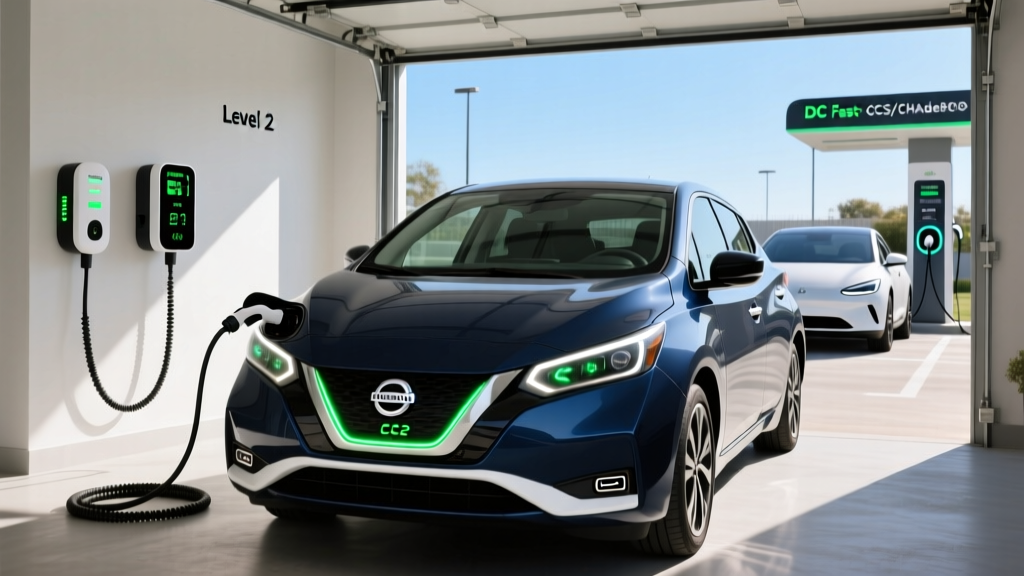
The current-generation Bolt EUV (and the upcoming next-gen Bolt expected for 2026) uses a CCS1 (Combined Charging System) connector natively, though GM has begun transitioning its lineup to the NACS (Tesla) standard. Here's what each level delivers for the Bolt:
| Charging Level | Power (kW) | Voltage / Amperage | Miles of Range Added Per Hour | Typical Use Case |
|---|---|---|---|---|
| Level 1 (120V outlet) | 1.2–1.4 kW | 120V / 12A | ~4 miles/hr | Overnight top-off, low-mileage drivers |
| Level 2 (240V home/public) | 7.7–11.5 kW | 240V / 32–48A | ~25–37 miles/hr | Daily home charging, workplace |
| DC Fast Charging | Up to 55 kW (Bolt EV/EUV) | 200–500V DC | ~100 miles in ~30 min | Road trips, highway corridors |
Real-world note: The Bolt EV and EUV's onboard charger maxes out at 11.5 kW on Level 2 AC. That means even if you install a 48-amp (11.5 kW) charger, the car won't accept more than that. On DC fast charging, the Bolt's peak rate is approximately 55 kW — considerably slower than newer 800V architectures that pull 200+ kW. This is the Bolt's most significant charging limitation. Expect a 10–80% DC fast charge to take roughly 55–65 minutes on a 50+ kW station, according to fueleconomy.gov data.
Home Charger Installation: Electrical Requirements and Costs
Installing a Level 2 home charger is the most impactful upgrade a Bolt owner can make. Here's what's involved electrically and financially.
Electrical Requirements
A Level 2 charger requires a dedicated 240-volt circuit, similar to what powers an electric dryer or oven. For the Bolt's 11.5 kW maximum acceptance rate, you'll want one of these setups:
- 40-amp circuit with a 32-amp charger (7.7 kW) — adequate for most Bolt owners driving under 60 miles/day
- 50-amp circuit with a 40-amp charger (9.6 kW) — the sweet spot for full overnight replenishment
- 60-amp circuit with a 48-amp charger (11.5 kW) — maxes out the Bolt's onboard charger
The National Electrical Code (NEC) requires that continuous loads (like EV charging) use no more than 80% of a circuit's rated capacity. That's why a 50-amp breaker supports a 40-amp charger, not a 50-amp charger.
Installation Cost Breakdown
Home charger installation costs vary dramatically based on your electrical panel's capacity, the distance from panel to charger location, and local permit fees. Here's a realistic breakdown:
| Cost Component | Simple Install (panel nearby, no upgrade) | Complex Install (panel far or upgrade needed) |
|---|---|---|
| Level 2 Charger (hardware) | $350–$650 | $350–$650 |
| Electrician labor (2–4 hrs typical) | $400–$800 | $800–$2,000 |
| Wiring, conduit, connectors | $100–$300 | $300–$800 |
| Electrical permit | $50–$150 | $50–$200 |
| Panel upgrade (if needed: 100A → 200A) | N/A | $1,500–$3,500 |
| Total estimated cost | $900–$1,900 | $3,000–$7,150 |
Panel upgrade reality check: Many homes built before 2000 have 100-amp electrical panels. Adding a 50- or 60-amp dedicated EV circuit may push total load beyond the panel's capacity, requiring a 200-amp upgrade. This is the single biggest variable in installation cost. Have an electrician perform a load calculation before committing to a charger amperage.
Some utility companies offer rebates of $200–$500 for Level 2 charger installation, and certain states provide additional incentives. Check your local utility's EV programs before scheduling work.
Connector Compatibility: CCS1, NACS, and Adapters
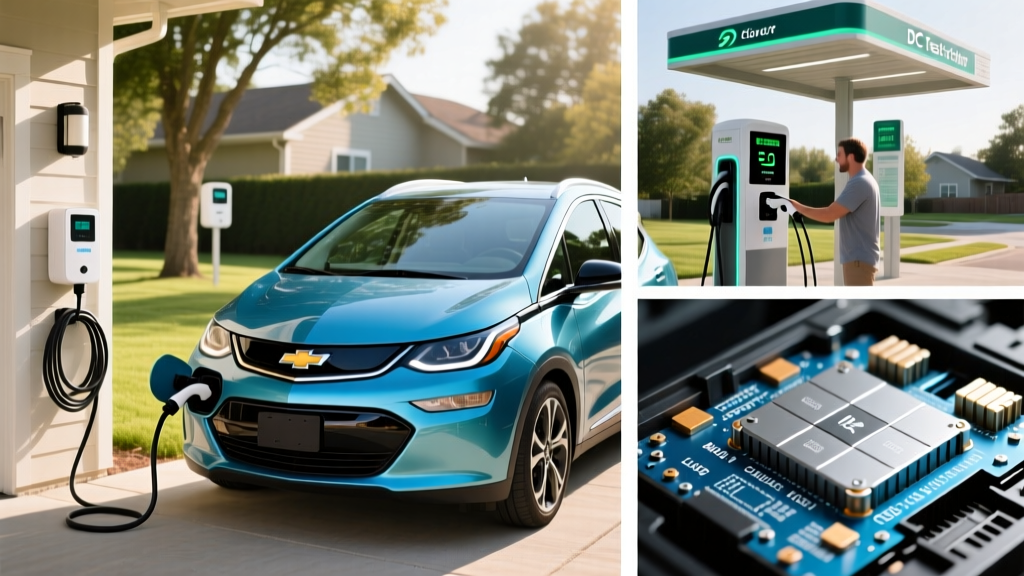
The Chevy Bolt EV and Bolt EUV use the CCS1 (Combined Charging System) connector for both Level 2 AC and DC fast charging. This is the standard J1772 plug with two additional DC pins below it.
| Connector Type | Bolt Compatibility | Notes |
|---|---|---|
| CCS1 (J1772 + DC pins) | ✅ Native — no adapter needed | Standard on all Bolt EV/EUV models |
| NACS (Tesla) | ⚠️ Adapter required | GM-approved NACS-to-CCS adapters available (~$200–$300); enables Tesla Supercharger access |
| CHAdeMO | ❌ Not compatible | Legacy DC standard; essentially discontinued in North America |
| J1772 (AC only, no DC pins) | ✅ Native | Used for Level 1 and Level 2 AC charging only |
Tesla Supercharger access: GM has opened Supercharger access to non-Tesla EVs via an approved adapter. For Bolt owners, this significantly expands the DC fast-charging map. However, because the Bolt's DC charge rate peaks at ~55 kW, you won't benefit from Supercharger V3 stalls capable of 250 kW — the car will simply charge at its maximum rate. Purchase only a GM-approved adapter to ensure safe communication between the vehicle and charger.
How Much Does Chevy Bolt Charging Cost? Per-Mile vs. Gas
One of the strongest arguments for the Bolt is its low operating cost. The Bolt EUV achieves approximately 115 MPGe combined (roughly 29 kWh per 100 miles), per EPA data. Here's what that translates to in real dollars:
| Charging Scenario | Rate ($/kWh) | Cost to Charge 29 kWh (100 miles) | Cost Per Mile |
|---|---|---|---|
| Home — off-peak utility rate | $0.08–$0.12 | $2.32–$3.48 | $0.023–$0.035 |
| Home — standard residential rate | $0.13–$0.18 | $3.77–$5.22 | $0.038–$0.052 |
| Public Level 2 (ChargePoint, etc.) | $0.25–$0.40 | $7.25–$11.60 | $0.073–$0.116 |
| DC Fast Charging (Electrify America, EVgo) | $0.35–$0.55 | $10.15–$15.95 | $0.102–$0.160 |
| Gas car comparison (28 MPG, $3.40/gal) | — | $12.14 | $0.121 |
At home on off-peak rates, the Bolt costs roughly 2.5 to 3.5 cents per mile — about one-quarter the per-mile cost of a 28 MPG gas car. Even on public DC fast chargers at premium rates, the Bolt remains competitive with or cheaper than gasoline, though you're paying a premium for the convenience of fast charging on the road.
Pro tip: Many utilities offer time-of-use (TOU) plans with significantly cheaper rates between midnight and 6 AM. Set your Bolt's delayed charging feature (or your Level 2 charger's schedule) to charge during these windows and minimize cost.
Charging Times: What to Expect at Each Level
The Bolt EV's 65 kWh usable battery capacity (approximately) means charging times are straightforward to calculate. Here are real-world estimates accounting for typical charging-curve taper — the phenomenon where charging slows significantly above 80% state of charge to protect battery health:
- Level 1 (120V, 1.4 kW): Full charge in ~46 hours. Adds ~4 miles per hour. Practical only for overnight top-ups of 30–40 miles.
- Level 2 (240V, 11.5 kW): Full charge in ~7 hours. 10–80% in approximately 4 hours. Ideal for overnight home charging — plug in at 10 PM, full by 5 AM.
- Level 2 (240V, 7.7 kW): Full charge in ~9 hours. Sufficient for most daily needs if you start charging by 9 PM.
- DC Fast Charge (55 kW peak): 10–80% in ~55–65 minutes. Charge curve tapers significantly above 80% — don't plan to DC fast-charge to 100% unless you have time to wait.
Note: Cold weather (below 32°F) can increase charging times by 20–30% and reduce regenerative braking effectiveness until the battery warms. The Bolt does not have a dedicated battery preconditioning feature for DC fast charging, which means cold-weather fast-charging sessions may start at lower kW rates until the pack reaches optimal temperature.
Best Home Chargers for the Chevy Bolt
Because the Bolt's onboard charger maxes out at 11.5 kW, you don't need the most powerful (or most expensive) charger on the market. Here are three well-matched options:
Emporia Vue Level 2 Charger
- Power output: Up to 48 amps (11.5 kW on 60A circuit)
- Connector: CCS1/J1772
- Cable length: 24 feet
- Smart features: Wi-Fi, app scheduling, energy monitoring, solar integration
- Price: ~$400
- Best for: Budget-conscious Bolt owners who want smart scheduling and energy tracking
ChargePoint Home Flex
- Power output: Configurable 16–50 amps (up to 12 kW on 60A circuit)
- Connector: CCS1/J1772
- Cable length: 23 feet
- Smart features: Wi-Fi, app control, Alexa integration, flexible amperage settings
- Price: ~$550–$650
- Best for: Owners who want adjustable amperage to match their circuit without buying a new charger
Grizzl-E Smart
- Power output: Up to 40 amps (9.6 kW on 50A circuit)
- Connector: CCS1/J1772
- Cable length: 24 feet
- Smart features: Wi-Fi, OCPP compatibility, adjustable amperage, extreme-weather rated
- Price: ~$450–$550
- Best for: Outdoor installations in cold climates — rated to -40°F, built in Canada
Any of these chargers will fully utilize the Bolt's 11.5 kW onboard charger when installed on an appropriate circuit. All are UL-listed and include GFCI protection as required by code.
Safety, Electrical Code, and Installation Best Practices
EV charging involves sustained high-current draw — your charger will pull maximum amperage for 6–8 hours straight, night after night. This makes code compliance and quality installation non-negotiable:
- Dedicated circuit: Your Level 2 charger must be on its own dedicated breaker — never shared with other outlets or appliances.
- GFCI protection: NEC 2020 and later require ground-fault circuit interrupter protection for EV charging outlets. Hardwired chargers often include built-in GFCI; plug-in units rely on the breaker.
- Outdoor rating: If installing outdoors, ensure the charger carries a NEMA 4 (or IP65+) rating for weather resistance. All three chargers recommended above qualify.
- Hardwired vs. plug-in: Hardwired installations (no plug, direct wire connection) are generally preferred for 48-amp and above chargers, as NEMA 14-50 receptacles can loosen over time under sustained high-current draw. A 40-amp charger on a NEMA 14-50 plug is fine and offers portability.
- Permit and inspection: Most jurisdictions require an electrical permit for new 240V circuits. The inspection ensures your installation meets code — don't skip this step, as it also protects your home insurance coverage.
Hire a licensed electrician experienced with EV charger installations. Ask whether they perform a load calculation and whether they pull permits — if either answer is no, find another electrician.
Frequently Asked Questions
How much does it cost to install a home EV charger for my Chevy Bolt?
A straightforward installation with an adequate electrical panel typically costs $900–$1,900 including the charger, labor, wiring, and permit. If your home requires a 200-amp panel upgrade, total costs can range from $3,000 to $7,150. Always get a load calculation from a licensed electrician before committing.
How fast will each charging level add range to my Bolt?
Level 1 (120V) adds about 4 miles of range per hour. Level 2 (240V at 11.5 kW) adds approximately 37 miles per hour. DC fast charging at the Bolt's 55 kW peak can add roughly 100 miles in 30 minutes, though charging speed tapers above 80% state of charge.
Which connector is compatible with my Chevy Bolt?
The Bolt EV and EUV use CCS1 natively for all AC and DC charging. You can access Tesla Superchargers with a GM-approved NACS-to-CCS adapter. CHAdeMO is not compatible with the Bolt.
How much does charging the Bolt cost per mile compared to gas?
Charging at home on off-peak rates costs approximately 2.5–3.5 cents per mile. A comparable 28 MPG gas car at $3.40/gallon costs about 12 cents per mile — roughly 3–4× more. Even public DC fast charging at premium rates (10–16 cents/mile) remains competitive with gasoline.
What electrical upgrades might I need for a home charger?
Homes with older 100-amp electrical panels may need a 200-amp panel upgrade ($1,500–$3,500) to support a dedicated 50- or 60-amp EV charging circuit. Your electrician will perform a load calculation to determine if your existing panel has sufficient spare capacity. Homes built after 2010 with 200-amp panels rarely need an upgrade.
Does the Chevy Bolt have battery preconditioning for DC fast charging?
The current Bolt EV and EUV do not feature active battery preconditioning (pre-warming the pack before arriving at a DC fast charger). In cold weather, this means initial charging speeds may be reduced until the battery reaches optimal operating temperature through the charging process itself. Plan for longer DC fast-charge sessions in winter.
Can I use a Tesla Supercharger with my Chevy Bolt?
Yes, with a GM-approved NACS-to-CCS1 adapter (approximately $200–$300). However, the Bolt's 55 kW peak DC charge rate means you won't benefit from the higher speeds available at Supercharger V3/V4 stalls. You'll charge at the Bolt's maximum rate, which is still useful for expanding your road-trip charging options.
For the latest Chevy Bolt specifications and EPA range data, visit Chevrolet's official Bolt configurator. For federal and state EV charging incentive information, consult the Alternative Fuels Data Center.