What Tesla Supercharger Rates Look Like Across the U.S.
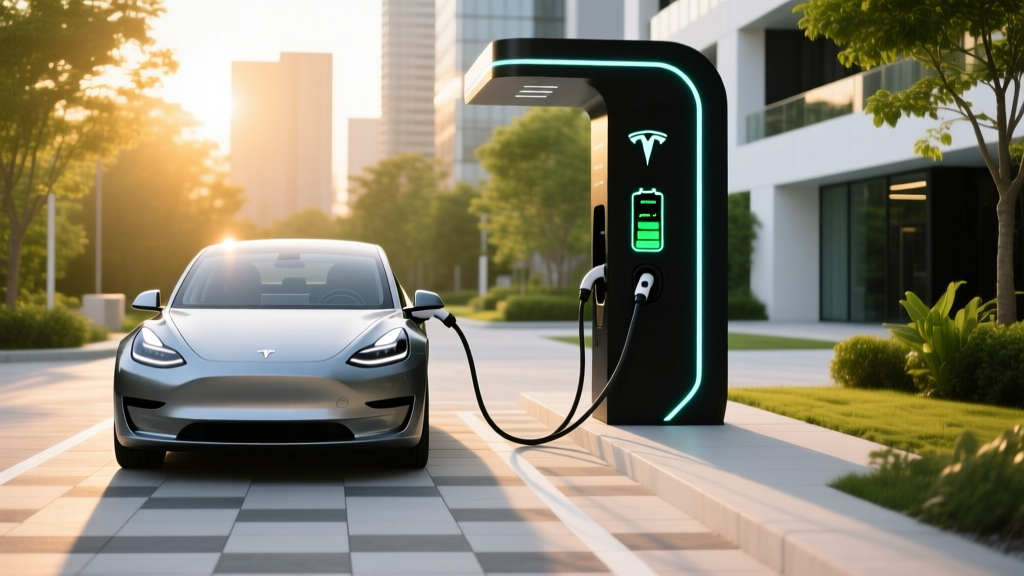
If you've pulled up to a Tesla Supercharger recently, you've probably noticed the per-kWh price on the screen varies wildly depending on where you are. In 2026, Tesla Supercharger rates in the United States typically range from $0.28 to $0.48 per kWh, with a national average hovering around $0.36/kWh. That's a meaningful spread — charging a 75 kWh battery from 10% to 80% could cost you $18.90 in rural Oklahoma or $33.60 in downtown San Francisco.
Tesla moved away from per-minute billing years ago, and the per-kWh model is now standard across the network. But understanding what you'll actually pay — and how that compares to home charging or gas — requires looking beyond the sticker rate.
Tesla Supercharger Pricing Tiers and Time-of-Use Variability
Tesla has increasingly adopted time-of-use (TOU) pricing at high-traffic urban Supercharger locations. This means the rate you see at 2 PM on a Saturday may differ from the rate at 11 PM on a Tuesday. Here's what the pricing tiers generally look like in 2026:
- Off-peak hours (typically 9 PM – 9 AM, weekdays): $0.28–$0.34/kWh
- Standard hours (most daytime periods): $0.34–$0.40/kWh
- Peak hours (weekday evenings, holiday weekends): $0.40–$0.48/kWh
Not every station uses TOU pricing — many highway and rural Superchargers still charge a flat rate 24/7. You can check the current rate for any station directly in the Tesla app or on the vehicle's navigation screen before you arrive.
One cost factor that catches new owners off guard: idle fees. If your car remains plugged in after reaching its charge limit, Tesla charges $0.50 per minute (or $1.00/minute if the station is at 100% capacity). A 20-minute idle at a busy station can add $20 to your session.
How Supercharger Rates Compare to Home Charging Costs
The most compelling argument for home charging isn't convenience — it's economics. Even at the higher end of Tesla Supercharger rates, public DC fast charging costs 2–4x more per kWh than Level 2 home charging in most U.S. markets.
| Scenario | Cost/kWh | Cost per Mile | Full "Tank" (10-80%) |
|---|---|---|---|
| Home (national avg. $0.16/kWh) | $0.16 | $0.035 | $8.40 |
| Home off-peak TOU ($0.09/kWh) | $0.09 | $0.020 | $4.73 |
| Tesla Supercharger (avg. $0.36/kWh) | $0.36 | $0.079 | $18.90 |
| Tesla Supercharger (peak $0.48/kWh) | $0.48 | $0.105 | $25.20 |
| Gas SUV (28 MPG, $3.40/gal) | — | $0.121 | ~$36 (12 gal) |
Calculations based on a Tesla Model Y Long Range at ~4.5 miles/kWh efficiency. Source: fueleconomy.gov
The takeaway is clear: home charging is where EV ownership economics shine. Superchargers are best reserved for road trips and occasional top-ups when you're away from home. If you rely exclusively on Superchargers, your per-mile cost drops below gas but doesn't achieve the dramatic savings that home charging delivers.
Understanding Charging Levels: Speed, Power, and What to Expect
Before we dig into home charging setup, it's critical to understand the three charging levels and what each delivers. Note the distinction: kW (kilowatts) measures power — how fast energy flows into your car. kWh (kilowatt-hours) measures energy — how much your battery holds. Think of kW as the width of a hose and kWh as the size of the bucket.
| Level | Voltage | Max Power (kW) | Miles of Range/Hour | 10-80% Time (75 kWh) |
|---|---|---|---|---|
| Level 1 (120V household) | 120V | 1.0–1.4 kW | 3–5 mi/hr | ~40+ hours |
| Level 2 (240V home/public) | 240V | 7.2–19.2 kW | 20–60 mi/hr | 3.5–8 hours |
| DC Fast (Supercharger/CCS) | 400–800V | 50–350 kW | 150–600+ mi/hr | 15–35 min |
A Tesla Supercharger V4 station delivers up to 350 kW peak to compatible vehicles, though sustained rates taper significantly above 60% state of charge. A Model Y Long Range typically peaks around 250 kW and averages closer to 150 kW across a 10-80% session, completing it in roughly 22–28 minutes depending on battery temperature and station output.
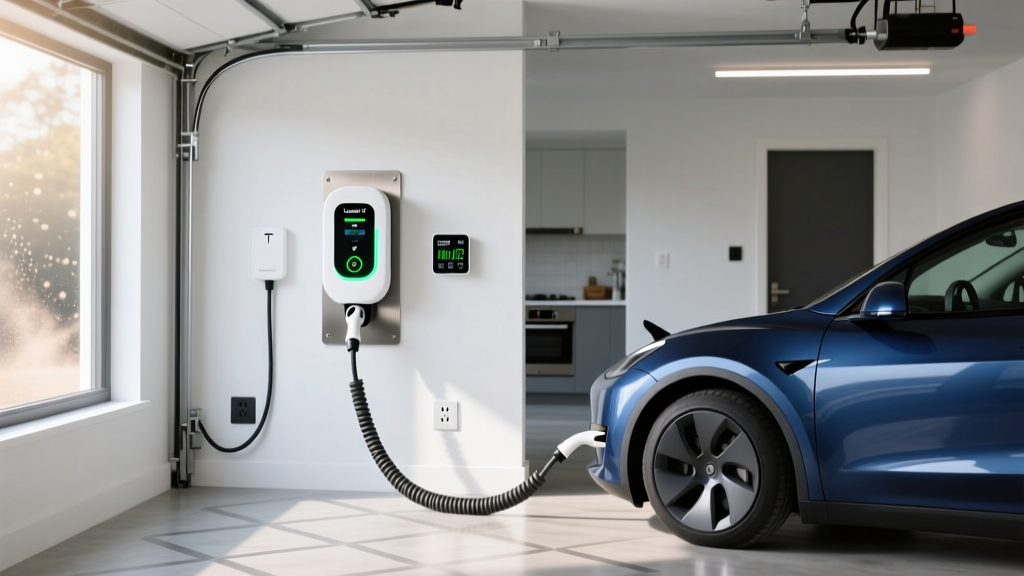
For daily driving, Level 2 at home is the sweet spot. A 48-amp Level 2 charger on a 240V circuit delivers 11.5 kW — enough to fully replenish a Model Y overnight, adding roughly 44 miles of range per hour of charging.
Home EV Charger Installation: Requirements, Costs, and Panel Upgrades
Installing a Level 2 home charger is the single most impactful upgrade for EV ownership. Here's what the process actually involves and what you should budget.
Electrical Requirements
A typical Level 2 home charger requires a 240-volt dedicated circuit, similar to what a clothes dryer or electric range uses. The most common configurations:
- 40-amp circuit → supports up to 32 amps continuous (7.7 kW) — sufficient for most overnight charging
- 50-amp circuit → supports up to 40 amps continuous (9.6 kW) — faster, recommended for larger batteries
- 60-amp circuit → supports up to 48 amps continuous (11.5 kW) — maximum Level 2 speed for most EVs
The National Electrical Code (NEC) requires that continuous loads (like EV charging) use no more than 80% of a circuit's rated capacity. So a 48-amp charger requires a 60-amp breaker.
Panel Upgrade Considerations
This is where costs can escalate. Most homes built after 1990 have a 200-amp electrical panel, which usually supports a Level 2 charger without upgrade. However, older homes with 100-amp or 150-amp service may need a panel upgrade — especially if you're also running electric heat, a dryer, and an oven simultaneously.
A licensed electrician will perform a load calculation to determine if your panel has headroom. If an upgrade to 200A is needed, expect to add $1,500–$3,500 to your project cost. In rare cases (very old homes, 60A service), a full service upgrade can exceed $5,000.
Installation Cost Breakdown
| Component | Low End | High End | Notes |
|---|---|---|---|
| Level 2 charger hardware | $350 | $750 | Smart Wi-Fi chargers (ChargePoint, Wallbox, Emporia) |
| Electrician labor (standard install) | $400 | $1,200 | Varies with run length, conduit, wall type |
| Electrical permit | $50 | $200 | Required in most jurisdictions |
| Panel upgrade (if needed) | $1,500 | $3,500 | 100A → 200A service upgrade |
| Total (no panel upgrade) | $800 | $2,150 | Most common scenario |
| Total (with panel upgrade) | $2,300 | $5,650 | Older homes with limited service |
The federal §30C tax credit covers 30% of home charger equipment and installation costs, up to $1,000, for qualifying installations. Eligibility depends on whether your census tract meets specific income or rural criteria — check IRS guidance before assuming you qualify.
Connector Compatibility: NACS, CCS, and CHAdeMO in 2026
The connector landscape has consolidated dramatically. Tesla's North American Charging Standard (NACS) is now the dominant connector for new EVs sold in the U.S., with Ford, GM, Rivian, Volvo, Hyundai, and others adopting it starting in 2025.
| Connector | Native Brands | Adapter Needed? |
|---|---|---|
| NACS (Tesla) | Tesla, Ford, GM, Rivian, Volvo, Polestar, Hyundai (new models) | CCS-to-NACS adapter for older CCS stations (~$150-$200) |
| CCS1 | VW, BMW, Mercedes, older Ford/GM/Hyundai models | NACS-to-CCS adapter to use Superchargers (~$200-$250) |
| CHAdeMO | Nissan Leaf (legacy only) | No reliable adapter; network shrinking |
For Tesla owners, the Supercharger network is native — no adapter required. If you drive a non-Tesla EV with NACS, you now have access to Tesla Superchargers (V3 and V4 stations with the magic dock or native NACS cables). CCS-connector EVs can access a growing subset of Superchargers using a Tesla-approved adapter, but not all stations support this.
Recommended Home Chargers: Specs, Features, and Pricing
Not all Level 2 chargers are equal. Here are three well-regarded options for 2026, each suited to different needs:
Tesla Wall Connector
- Power: Up to 11.5 kW (48A)
- Connector: NACS (native Tesla)
- Cable length: 24 ft
- Smart features: Wi-Fi, OTA updates, power sharing with 2nd unit
- Price: ~$475
- Best for: Tesla owners wanting native integration
ChargePoint Home Flex
- Power: Up to 12 kW (50A, configurable)
- Connector: J1772 (NACS adapter included)
- Cable length: 23 ft
- Smart features: Wi-Fi, scheduling, Alexa, energy tracking
- Price: ~$550
- Best for: Multi-EV households, non-Tesla owners
Emporia Vue Level 2
- Power: Up to 11.5 kW (48A)
- Connector: J1772 (NACS adapter available)
- Cable length: 24 ft
- Smart features: Wi-Fi, solar integration, load management
- Price: ~$399
- Best for: Budget-conscious, solar-home owners
Safety and Code Requirements
Any Level 2 installation must comply with NEC Article 625. Key requirements include:
- Dedicated circuit: Your EV charger must have its own breaker — no shared circuits with other appliances
- GFCI protection: Required for outdoor installations and recommended for garages (NEC 2023 update)
- NEMA rating: Outdoor-rated chargers need at minimum a NEMA 3R (rain-resistant) or NEMA 4 (watertight) enclosure
- Conduit and wiring: Must use appropriately gauged wire (typically 6 AWG copper for 50A circuits) in conduit where exposed
Always hire a licensed electrician for the installation. DIY electrical work on 240V circuits carries serious shock and fire risk, and unpermitted work may void your homeowner's insurance coverage.
Frequently Asked Questions
How much does it cost to install a home EV charger?
A standard Level 2 home charger installation (no panel upgrade) typically costs $800–$2,150 including hardware, electrician labor, and permits. If your home needs a panel upgrade from 100A to 200A service, total costs can reach $2,300–$5,650. The federal §30C credit can offset up to $1,000 (30% of costs) if your location qualifies.
How fast will each charging level add range?
Level 1 (120V) adds 3–5 miles per hour — practical only for PHEVs with small batteries. Level 2 (240V) adds 20–60 miles per hour depending on amperage — sufficient for overnight replenishment of any EV. DC fast charging (Supercharger/CCS) adds 150–600+ miles per hour at peak rates, enabling 10-80% charges in 15–35 minutes.
Which connector is compatible with my EV?
All 2026 Tesla vehicles use NACS natively. Most new Ford, GM, Rivian, Volvo, and Hyundai models also ship with NACS. Older non-Tesla EVs (VW ID.4, BMW i4, etc.) use CCS1 and require an adapter for Supercharger access. The Nissan Leaf uses CHAdeMO, a legacy standard with a shrinking network. Check your vehicle's charge port or owner's manual to confirm.
How much does charging cost per mile compared to gas?
At home (national average $0.16/kWh), a Tesla Model Y costs roughly $0.035/mile. At a Supercharger ($0.36/kWh average), it's about $0.079/mile. A comparable 28-MPG gas SUV at $3.40/gallon costs $0.121/mile. Even at peak Supercharger rates, EV charging undercuts gasoline — but home charging delivers 3–4x the savings.
What electrical upgrades might I need for a home charger?
If your home has a 200-amp electrical panel (standard in most post-1990 construction), you likely need nothing beyond a dedicated 50A or 60A breaker. Homes with 100A or 150A service may require a panel upgrade ($1,500–$3,500) to safely support simultaneous EV charging, electric heating, and other large loads. A licensed electrician's load calculation is the definitive answer.