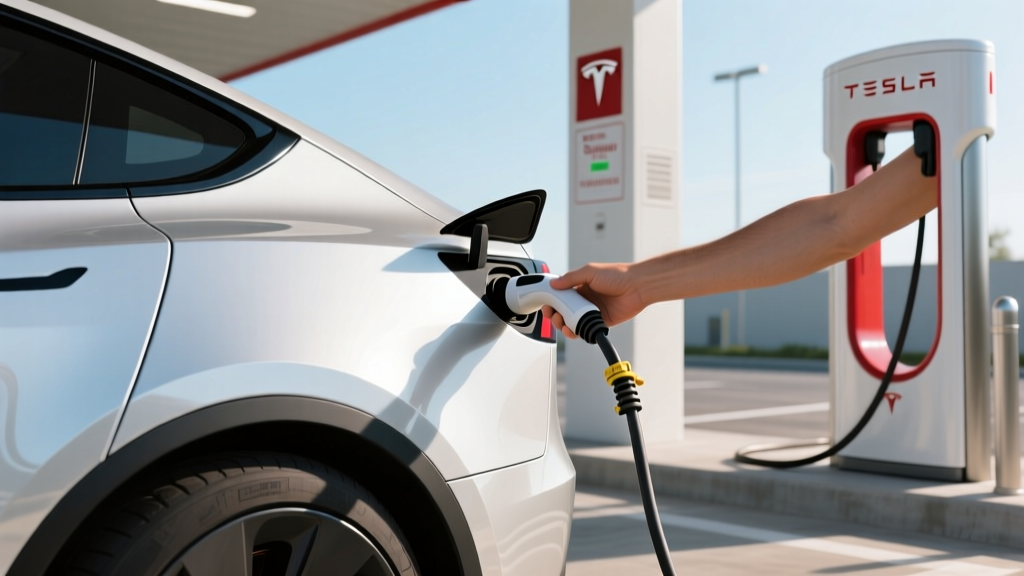
If you've ever pulled into a Supercharger stall only to find your charge port is on the wrong side, or your cable doesn't quite reach, you've probably searched for a Tesla Supercharger extension cord. The results are either nonexistent, prohibitively expensive, or downright dangerous. There is a reason for that: extending a DC fast-charging cable introduces electrical, thermal, and protocol risks that no consumer-grade product can safely solve in 2026.
This guide explains the physics and safety realities behind DC fast-charging extensions, then pivots to what actually works — from strategic parking techniques to the right Level 2 home equipment that eliminates the "cable too short" problem entirely.
Why a Tesla Supercharger Extension Cord Doesn't Really Exist
A Tesla Supercharger delivers up to 250 kW (V3) or 325 kW (V4) of direct current at voltages exceeding 400V and currents above 600 amps. That is not a household extension cord scenario. For context, a typical home dryer runs at 240V and 30 amps — roughly 7.2 kW. A V3 Supercharger pushes more than 30 times that power through a liquid-cooled cable roughly 1.1 inches in diameter.
Any extension to that cable must:
- Maintain the liquid cooling loop without introducing leak points
- Preserve the CAN-bus and pilot-signal communication between the vehicle and the charger's power cabinet
- Handle 600+ amps without voltage drop that triggers the charger's safety cutoff
- Meet UL, IEC, or equivalent certification for outdoor DC high-power use
No aftermarket manufacturer produces a certified consumer extension for DC fast-charging connectors (NACS, CCS1, or CHAdeMO). Products you may find on third-party marketplaces claiming to be "Supercharger extensions" are either mislabeled Level 2 J1772/NACS extensions (which operate at a fraction of the power) or uncertified cables that pose serious arc-flash and fire risk.
Understanding Charging Levels: Speeds That Matter
Before evaluating alternatives, it helps to ground yourself in what each charging level actually delivers. Remember: kW (kilowatts) measures power — the rate of energy flow. kWh (kilowatt-hours) measures energy — the total amount stored in your battery. A 75 kWh battery charged at 7 kW takes roughly 10+ hours; at 250 kW, the same battery can go from 10–80% in under 20 minutes.
| Level | Voltage / Phase | Power (kW) | Miles of Range per Hour | Typical Use |
|---|---|---|---|---|
| Level 1 | 120V AC / 1-phase | 1.2–1.9 kW | 3–5 mi/hr | Emergency / overnight trickle |
| Level 2 | 240V AC / 1-phase | 7.2–19.2 kW | 20–60 mi/hr | Home daily, workplace, destination |
| DC Fast (V3) | 400–500V DC | Up to 250 kW | ~1,000 mi/hr (peak) | Road trips, rapid top-ups |
| DC Fast (V4/Megacharger) | Up to 900V DC | Up to 325–400 kW | ~1,200+ mi/hr (peak) | Next-gen platforms (Cybertruck, Semi) |
Peak DC fast-charging rates are sustained only while the battery's state of charge (SoC) is low and the battery is preconditioned. Above roughly 80% SoC, the charge curve tapers sharply — a 250 kW peak may drop to under 40 kW. This is why manufacturers quote "10–80%" times rather than 0–100%.
Real Solutions When the Supercharger Cable Won't Reach
Since a certified Supercharger extension cord isn't a viable product, here are the practical workarounds ranked by effectiveness:
1. Reposition Your Vehicle
Most Supercharger stalls are designed with enough slack for vehicles with charge ports on either side, but tight urban installations or pull-through stalls for trailers can be problematic. Simply pulling forward or backing in from the opposite direction solves 90% of reach issues. If you're towing, look for Supercharger locations marked as "pull-through" on the Tesla app or in-car navigation.
2. Use a CCS-to-NACS Adapter at Non-Tesla DC Chargers
If the problem is that a non-Tesla DC fast charger's CCS1 cable won't reach your Tesla's NACS port, Tesla sells an official CCS Combo 1 Adapter (approximately $175) that works at Electrify America, EVgo, and other CCS networks. This is not an extension — it's a form-factor adapter — and it's fully certified for DC fast charging up to 250 kW.
3. Install a Longer Level 2 Cable at Home
If your real frustration is a home charger cable that doesn't reach, this is where a legitimate solution exists. Many Level 2 home chargers offer 18-foot or 25-foot cable options. Upgrading to a 25-foot cable gives you flexibility to park in any orientation in your garage or driveway.
Home Level 2 Charging: Installation, Costs, and Equipment
For most EV owners, a properly installed Level 2 home charger eliminates public-charging frustrations entirely. You wake up to a full battery every morning at the lowest electricity rates.
Electrical Requirements
A standard Level 2 installation requires:
- 240V dedicated circuit on your main electrical panel
- 40-amp or 60-amp breaker (a 48A charger needs a 60A breaker per the NEC 80% continuous-load rule)
- NEMA 14-50 outlet (for plug-in units) or hardwired connection (for 48A+ units or where local code requires it)
- GFCI protection — required by NEC 2020 and later for EV receptacles; many modern chargers have built-in GFCI, which can conflict with panel GFCI breakers (your electrician will advise)
Do You Need a Panel Upgrade?
This is the single biggest variable in home-charging cost. If your home has a 100-amp main panel (common in homes built before the 1990s), adding a 60-amp EV circuit may exceed your panel's capacity. Upgrading to a 200-amp panel typically costs $1,500–$3,500 before the charger install. Homes with existing 200-amp panels usually have sufficient headroom.
| Item | Low End | High End | Notes |
|---|---|---|---|
| Level 2 Charger Unit | $350 | $750 | 32A–48A smart chargers |
| Electrician Labor | $400 | $1,800 | Depends on panel distance, conduit run |
| Permit & Inspection | $50 | $300 | Varies by municipality |
| Panel Upgrade (if needed) | $1,500 | $3,500 | 100A → 200A service upgrade |
| Total (no panel upgrade) | $800 | $2,850 | Most common scenario |
| Total (with panel upgrade) | $2,300 | $6,350 | Older homes |
Always get at least two quotes from licensed electricians, and confirm they hold the appropriate state electrical license. Some utilities offer rebates of $250–$1,000 for Level 2 installations — check with your provider before scheduling work.
Recommended Level 2 Home Chargers (2026)
These are proven units with the power output, cable lengths, and smart features that matter for daily use:
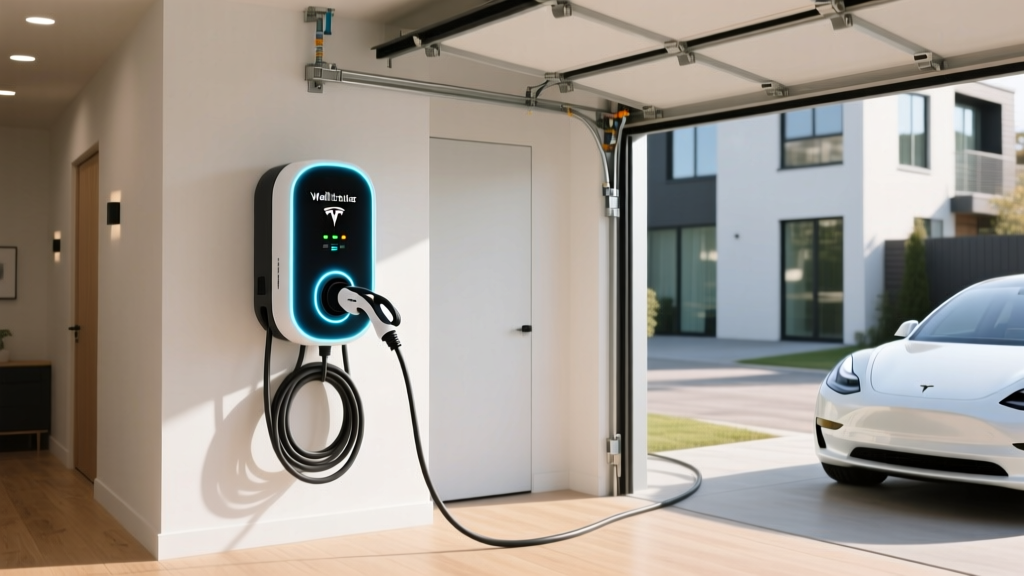
Tesla Wall Connector
- Power: Up to 11.5 kW (48A) at 240V
- Connector: NACS (native Tesla); J1772 adapter included
- Cable: 24 feet
- Smart Features: Wi-Fi, OTA updates, power-sharing with second unit, load management
- Price: ~$475
ChargePoint Home Flex
- Power: Up to 12 kW (50A) at 240V
- Connector: J1772 (NACS adapter available)
- Cable: 23 feet
- Smart Features: Wi-Fi, Alexa, scheduling, amperage adjustable 16A–50A
- Price: ~$699
Emporia Level 2 EV Charger
- Power: Up to 11.5 kW (48A) at 240V
- Connector: J1772
- Cable: 24 feet
- Smart Features: Wi-Fi, solar integration, energy monitoring via Emporia app
- Price: ~$399
Grizzl-E Smart
- Power: Up to 10 kW (40A) at 240V
- Connector: J1772
- Cable: 24 feet
- Smart Features: OCPP-compatible, adjustable amperage, extreme-cold rated (-40°F)
- Price: ~$549
Connector note: As of 2026, most non-Tesla EVs sold in North America now ship with NACS charge ports (Ford, GM, Rivian, Volvo, and others have transitioned). If you drive a non-Tesla EV with a NACS port, the Tesla Wall Connector is your most seamless option. For vehicles still using J1772 (older models, some PHEVs), the ChargePoint Home Flex or Emporia are excellent choices, and a J1772-to-NACS adapter (~$100–$200) covers future vehicles.
Connector Compatibility Across EV Brands
| Connector | Brands Using It | Adapter Needed for Tesla Superchargers? |
|---|---|---|
| NACS (Tesla) | Tesla, Ford, GM, Rivian, Volvo, Polestar, Mercedes (new), Hyundai/Kia (new) | No — native compatibility at Superchargers |
| CCS1 | Legacy VW ID.4, older BMW iX, some Stellantis models | Yes — CCS-to-NACS adapter required (~$175 from Tesla) |
| CHAdeMO | Nissan Leaf (discontinued in US for 2026), Mitsubishi Outlander PHEV | Not compatible with Superchargers; use CHAdeMO public networks |
| J1772 (Level 2 AC) | All EVs (via onboard adapter or native) | Tesla includes J1772 adapter; non-Tesla EVs use native J1772 |
Sources: Tesla CCS Adapter, manufacturer specifications.
Charging Cost: Per-Mile Breakdown vs. Gas
The economics of EV charging depend heavily on where and when you charge. Here's a realistic 2026 comparison using a mid-size EV averaging 3.5 miles per kWh (roughly 28.5 kWh/100mi — typical of a Tesla Model Y or Ford Mustang Mach-E):
| Scenario | Rate ($/kWh) | Cost per 100 Miles | Cost per Mile |
|---|---|---|---|
| Home (off-peak utility rate) | $0.09–$0.14 | $2.55–$3.99 | $0.026–$0.040 |
| Home (standard rate) | $0.15–$0.20 | $4.28–$5.70 | $0.043–$0.057 |
| Public Level 2 (ChargePoint, etc.) | $0.25–$0.49 | $7.13–$13.97 | $0.071–$0.140 |
| DC Fast (Tesla Supercharger) | $0.28–$0.45 | $8.00–$12.86 | $0.080–$0.129 |
| DC Fast (Electrify America) | $0.35–$0.56 | $10.00–$16.02 | $0.100–$0.160 |
| Gasoline (28 MPG combined @ $3.40/gal) | — | $12.14 | $0.121 |
Key takeaway: Home off-peak charging delivers fuel costs roughly 70–80% lower than gasoline. Even DC fast charging at Supercharger rates is competitive with or cheaper than gas on a per-mile basis. The cost advantage erodes significantly if you rely exclusively on public DC fast charging at peak rates.
Data reference: fueleconomy.gov EV side-by-side comparison tool for model-specific kWh/100mi figures.
Charging Time Examples for Common Battery Sizes
Real-world charging times depend on battery capacity, chemistry, temperature, and the charger's power output. Below are estimates for a 10–80% charge, which is the practical range most drivers use (charging above 80% is slow due to the taper in the charge curve and is generally avoided on road trips).
| Battery Size | Example Vehicles | Level 2 (11.5 kW) | DC Fast (150 kW peak) | DC Fast (250 kW peak) |
|---|---|---|---|---|
| 60 kWh usable | Tesla Model 3 RWD, Chevy Equinox EV | ~3.5 hours | ~28 min | ~18 min |
| 75 kWh usable | Tesla Model Y LR, Ford Mach-E ER | ~4.5 hours | ~33 min | ~22 min |
| 85 kWh usable | Tesla Model S, Hyundai Ioniq 5 LR | ~5 hours | ~38 min | ~25 min |
| 100 kWh usable | Tesla Model S Plaid, Rivian R1T Max | ~6 hours | ~45 min | ~30 min |
| 123 kWh usable | GMC Hummer EV | ~7.5 hours | ~55 min | ~38 min |
Cold-weather caveat: Lithium-ion batteries charge significantly slower when cold. In sub-freezing temperatures, expect 10–80% DC fast-charging times to increase by 20–40% unless your vehicle has preconditioned the battery (Tesla's navigation-to-charger feature does this automatically). LFP (lithium iron phosphate) batteries, found in the Model 3 RWD and some other base trims, are more tolerant of frequent 100% charging but still experience cold-weather charge-rate reduction.
Safety and Electrical Code Considerations
Whether you're installing a Level 2 charger at home or evaluating any cable or adapter, these are the non-negotiable safety and code requirements:
- Dedicated circuit: Your EV charger must be on its own dedicated breaker — never shared with other appliances. A 48A charger requires a 60A breaker; a 32A charger requires a 40A breaker.
- GFCI protection: NEC 2020 and later require ground-fault circuit-interrupter protection for EV charging receptacles. Many chargers (including the Tesla Wall Connector) have internal GFCI — installing a GFCI breaker in the panel on top of that can cause nuisance tripping. Hardwired installations (no receptacle) often avoid this conflict.
- Outdoor rating: If your charger is outdoors, it must carry at minimum a NEMA 4 (weather-resistant) rating. All recommended chargers above meet this standard.
- Cable management: Never run a charging cable across a driveway or walkway where it can be driven over or create a trip hazard. Use a wall-mounted cable organizer or retractable reel.
- Permit and inspection: Virtually all jurisdictions require an electrical permit for new 240V circuits. The inspection ensures proper wire gauge, breaker sizing, and grounding. Skipping the permit can void your homeowner's insurance coverage for electrical fires.
- Never extend DC fast-charging cables: As explained above, no certified consumer extension exists for Supercharger or other DC fast-charging cables. Attempting to fabricate or purchase one introduces arc-flash, fire, and equipment-damage risk.
Frequently Asked Questions
Can I buy a Tesla Supercharger extension cord?
No. As of 2026, no manufacturer produces a certified, safe extension cord for Tesla Supercharger (DC fast-charging) cables. The power levels (up to 250–325 kW at 400V+ DC) and liquid-cooling requirements make consumer-grade extensions impractical and dangerous. Products marketed online as "Supercharger extensions" are typically Level 2 AC extensions mislabeled for marketing purposes, or uncertified cables that pose serious safety risks.
How much does it cost to install a home EV charger?
A typical Level 2 home charger installation costs $800–$2,850 when no panel upgrade is needed (equipment + electrician + permit). If your home requires a panel upgrade from 100A to 200A service, expect a total of $2,300–$6,350. Always get multiple quotes from licensed electricians and check for utility rebates.
How fast will each charging level add range?
Level 1 (120V) adds roughly 3–5 miles per hour. Level 2 (240V, 48A) adds 30–45 miles per hour depending on vehicle efficiency. DC fast charging at 150–250 kW can add 150–200+ miles in 15–20 minutes, though the charge rate tapers significantly above 80% SoC.
Which connector and charger is compatible with my EV?
Check your vehicle's charge port. As of 2026, most new EVs in North America use the NACS (Tesla) connector, including Ford, GM, Rivian, Volvo, and Hyundai/Kia models. Older non-Tesla EVs may use CCS1. The Nissan Leaf used CHAdeMO. For home Level 2 charging, the Tesla Wall Connector works natively with NACS vehicles, while the ChargePoint Home Flex and Emporia use J1772 (adapters available for NACS vehicles).
How much does charging cost per mile compared to gas?
Home off-peak charging costs roughly $0.03–$0.04 per mile — about 70–80% less than gasoline at $3.40/gallon and 28 MPG combined. Even DC fast charging at Supercharger rates ($0.28–$0.45/kWh) costs $0.08–$0.13 per mile, competitive with or cheaper than gas. Public Level 2 charging varies widely but typically costs $0.07–$0.14 per mile.
What electrical upgrades might I need for a home charger?
The most common upgrade is a panel capacity increase from 100A to 200A service ($1,500–$3,500), needed in older homes. You'll also need a dedicated 240V circuit with a 40A or 60A breaker. Some installations require conduit runs, new sub-panels, or trenching for detached garages. A licensed electrician can assess your panel's available capacity during a site visit.
Sources: Tesla Home Charging Installation Guide, fueleconomy.gov EV Technology, IRS §30D Clean Vehicle Credits (for charger-adjacent incentive information).