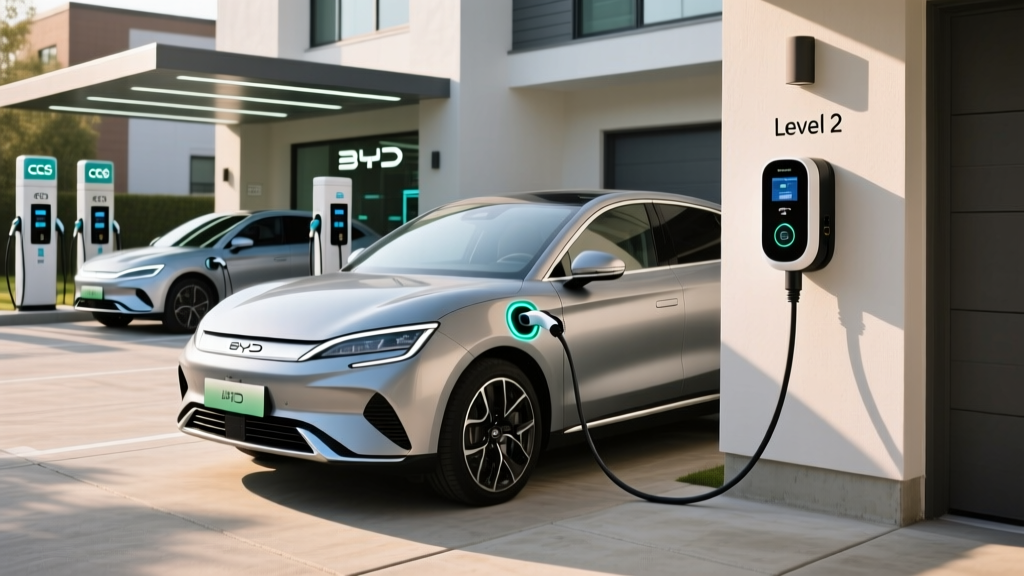
BYD's global expansion has brought models like the Atto 3, Seal, Dolphin, and upcoming Seagull to markets across Asia, Europe, Australia, and Latin America. If you own or are considering a BYD electric vehicle, understanding your charging ecosystem — from a BYD fast charger at a public DC station to the Level 2 wallbox you install at home — is essential for maximizing range, minimizing cost, and protecting long-term battery health.
This guide breaks down every charging tier available to BYD owners, the real-world speeds you can expect, home installation costs, connector standards by region, and the specific equipment we recommend in 2026.
Understanding kW vs kWh: The Critical Distinction
Before we talk chargers, let's eliminate the most common EV confusion:
- kW (kilowatt) = power, or the rate at which energy flows. Think of it as the width of a water hose. A 150 kW DC fast charger delivers energy faster than a 7 kW home wallbox.
- kWh (kilowatt-hour) = energy, or the total amount stored in your battery. A BYD Seal with an 82.5 kWh battery holds 82.5 kWh of energy when full.
Charging speed is measured in kW. Battery capacity is measured in kWh. A 100 kW charger filling a 60 kWh battery from 10% to 80% (42 kWh added) would take roughly 25 minutes under ideal conditions — though real-world charge curves taper significantly above 80% State of Charge (SoC).
Charging Levels Explained: Speeds and Range Added Per Hour
Every BYD EV sold globally supports three charging tiers. Here's what each delivers in practical terms:
| Level | Power (kW) | Voltage / Amps | Miles of Range Added Per Hour | Typical Use Case |
|---|---|---|---|---|
| Level 1 (AC) | 1.4–1.9 kW | 120V / 12–16A | 3–5 mi/hr | Overnight trickle; emergency top-up |
| Level 2 (AC) | 3.7–22 kW | 240V / 16–80A (or 400V 3-phase) | 12–75 mi/hr | Daily home charging; workplace |
| DC Fast Charge | 50–230 kW | 400–800V DC direct | 150–650+ mi/hr (peak) | Road trips; rapid top-ups |
Real-world note: BYD's Blade Battery (LFP chemistry) handles DC fast charging well thermally, but like all lithium cells, the charge curve tapers above ~80% SoC. A BYD Seal peaking at 150 kW on DC will typically sustain 120–140 kW from 10–60%, then drop to 60–80 kW from 60–80%, and trickle below 30 kW from 80–100%. Plan road-trip stops around 10–80% charges for the fastest sessions.
BYD DC Fast Charging: Real-World Speeds by Model
BYD equips its vehicles with varying onboard DC charge acceptance rates. Here's what you'll see at a public fast charger in 2026:
| Model | Battery (kWh) | Chemistry | Peak DC Rate (kW) | 10–80% Time | Connector |
|---|---|---|---|---|---|
| BYD Dolphin | 60.4 kWh | LFP (Blade) | 88 kW | ~29 min | CCS2 (EU/AU) / GB/T (China) |
| BYD Atto 3 | 60.5 kWh | LFP (Blade) | 88 kW | ~29 min | CCS2 / GB/T |
| BYD Seal (RWD) | 82.5 kWh | LFP (Blade) | 150 kW | ~26 min | CCS2 / GB/T |
| BYD Seal U | 87.0 kWh | LFP (Blade) | 140 kW | ~28 min | CCS2 / GB/T |
| BYD Han EV | 85.4 kWh | LFP (Blade) | 120 kW | ~30 min | CCS2 / GB/T |
Important context: BYD's LFP Blade Battery is renowned for thermal stability and longevity — BYD rates it for over 5,000 charge cycles before significant degradation. However, LFP chemistry charges slightly slower at DC than comparable NMC cells. If you're comparing a BYD Seal's 150 kW peak to a Hyundai Ioniq 5's 240 kW peak, remember that the Seal's larger 82.5 kWh battery and LFP chemistry mean actual 10–80% session times are closer than the peak kW figures suggest.
Home Level 2 Charging: Installation Costs and Electrical Requirements
For daily driving, a home Level 2 wallbox is the gold standard. Most BYD owners will add 200–250 miles of range overnight — more than enough for any daily commute. Here's what installation actually involves and costs.
Electrical Requirements
- Circuit: Dedicated 240V circuit, typically 40A or 50A (breaker rated 125% above continuous load, so a 32A charger needs a 40A breaker; a 40A charger needs a 50A breaker)
- Wire gauge: 6 AWG copper for 50A circuits; 8 AWG for 40A (varies by run length and local code)
- Panel capacity: Your main service panel must have both a spare double-pole breaker slot AND sufficient amperage headroom. A 200A panel serving a modern home with AC, electric stove, and dryer may need a load calculation before adding a 50A EV circuit
- GFCI protection: Required by NEC 2020+ (Article 625) for all EV receptacles — hardwired units may have internal GFCI
- Permit: Required in virtually all US jurisdictions; inspection ensures safe installation
Panel Upgrade Reality
Homes with 100A service or older panels (common in pre-1990 construction) may need a panel upgrade to 200A before adding a Level 2 circuit. This is the single biggest variable in home charging cost:
| Component | Cost Range (USD) | Notes |
|---|---|---|
| Level 2 Wallbox (equipment) | $350–$750 | 40A–48A smart charger, 25ft cable |
| Electrician labor (standard install) | $600–$1,500 | Panel to garage, <50ft run, no panel upgrade |
| Permit & inspection | $100–$300 | Varies by municipality |
| Panel upgrade (if needed) | $1,500–$3,500 | 100A→200A service upgrade; older homes |
| Total (no panel upgrade) | $1,050–$2,550 | Most newer homes with 200A service |
| Total (with panel upgrade) | $2,550–$6,050 | Older homes needing service upgrade |
Pro tip: Some utilities offer rebates of $250–$500 for Level 2 installation, and the federal Residential Clean Energy Credit (IRS Form 5695) may cover 30% of charger equipment and installation costs up to $1,000 through 2032 — check current-year eligibility with a tax professional.
Connector Compatibility: Which Plug Does Your BYD Use?
BYD uses different connectors depending on the market. This is critical for public charging access:
| Region | AC Connector | DC Fast Connector | BYD Models Affected |
|---|---|---|---|
| Europe / UK / Australia | Type 2 (Mennekes) | CCS2 (Combined Charging System) | All current BYD EVs |
| China (domestic) | GB/T AC | GB/T DC | All current BYD EVs |
| Southeast Asia (Thailand, Indonesia) | Type 2 | CCS2 | Atto 3, Dolphin, Seal |
| Latin America (Brazil, Mexico) | Type 1 / Type 2 (varies) | CCS1 / CCS2 (varies) | Varies by country |
| Japan | Type 1 (J1772) | CHAdeMO (legacy) / CCS1 | Limited BYD presence |
US market note: As of early 2026, BYD does not sell passenger EVs in the United States (commercial buses and trucks only). If you're importing a BYD or reading this from a market where BYD is available, CCS2 is your standard DC connector in most export markets. The North American Charging Standard (NACS/Tesla) is not used by BYD — adapters from CCS2 to NACS exist for Tesla Supercharger access in some regions, but compatibility varies by station hardware.
Cost to Charge: BYD per-Mile Economics vs Gas
Charging cost depends entirely on where and when you plug in. Here are realistic 2026 scenarios for a BYD Atto 3 (60.5 kWh battery, ~260 mi real-world range):
| Charging Scenario | $/kWh | Full Charge Cost (60.5 kWh) | Cost per Mile | Annual Cost (12,000 mi) |
|---|---|---|---|---|
| Home, off-peak utility rate | $0.09–$0.14 | $5.45–$8.47 | $0.021–$0.033 | $252–$396 |
| Home, standard residential rate | $0.15–$0.20 | $9.08–$12.10 | $0.035–$0.047 | $420–$564 |
| Public Level 2 (workplace/mall) | $0.20–$0.35 | $12.10–$21.18 | $0.047–$0.081 | $564–$972 |
| DC Fast Charge (public network) | $0.35–$0.55 | $21.18–$33.28 | $0.081–$0.128 | $972–$1,536 |
| Gasoline equivalent (28 MPG, $3.40/gal) | — | — | $0.121 | $1,457 |
The takeaway: Home charging at off-peak rates delivers fuel costs at roughly one-fifth to one-quarter the cost of gasoline per mile. Even DC fast charging on road trips is competitive with gas. The economics strongly favor installing a Level 2 home charger — the payback period vs. public charging alone is typically 8–14 months for a daily driver.
Recommended BYD Fast Charger Equipment for Home and Public Use
While BYD offers a branded home wallbox in some markets, third-party chargers often provide better smart features, longer cables, and broader compatibility. Here are our top picks for BYD owners in 2026:
Best Home Level 2 Wallbox Chargers (CCS2 / Type 2)
Wallbox Pulsar Max
- Power output: Up to 22 kW (400V 3-phase) or 7.4 kW (240V single-phase)
- Connector: Type 2 tethered cable (CCS2 DC not applicable for AC units)
- Cable length: 5m or 7m options
- Smart features: Wi-Fi, app scheduling, solar integration, load balancing, OTA updates
- Price: $550–$700 USD
- Best for: BYD owners in Europe/Australia with 3-phase home power who want max AC speed
ChargePoint Home Flex
- Power output: Up to 12 kW (240V/50A) — configurable down to 16A
- Connector: J1772 (Type 1); Type 2 adapter available
- Cable length: 23 ft (7m)
- Smart features: Wi-Fi, Alexa integration, scheduling, charge tracking, flexible amperage
- Price: $550–$650 USD
- Best for: BYD owners in markets using Type 1 AC, or those wanting adjustable amperage for panel-limited homes
BYD Home Charger (OEM)
- Power output: 7 kW (single-phase) or 11 kW (3-phase, select markets)
- Connector: Type 2 tethered
- Cable length: 5m
- Smart features: Basic app control, RFID authentication, some markets offer solar mode
- Price: $400–$600 USD (often bundled with vehicle purchase)
- Best for: Owners who want a single-brand ecosystem and don't need advanced smart features
Autel MaxiCharger AC Wallbox
- Power output: Up to 19.2 kW (240V/80A) — one of the most powerful single-phase home units
- Connector: Type 2 (CCS2 markets) or J1772
- Cable length: 7m (23 ft)
- Smart features: 4G + Wi-Fi, RFID, dynamic load balancing, commercial-grade durability
- Price: $650–$850 USD
- Best for: High-mileage BYD Seal or Han owners who need maximum overnight charge throughput
Public DC Fast Charging Networks for BYD
At public DC stations, look for CCS2-equipped chargers from networks like Ionity (Europe), Chargefox (Australia), PTT/EV Station PluZ (Thailand), or Shell Recharge. A BYD Seal will charge at its full 150 kW peak on any CCS2 station rated 150 kW or higher — no proprietary BYD fast charger hardware is needed at public stations.
Adapter note: If you need Tesla Supercharger access (increasingly open to non-Tesla EVs in Europe and Australia), a CCS2-to-NACS adapter may be required depending on the station's connector configuration. Verify compatibility with both the adapter manufacturer and your local Supercharger network before purchasing.
Safety and Code Considerations for Home BYD Charging
EV charging draws sustained high current for hours — this is fundamentally different from intermittent loads like a microwave. Safety requirements reflect that:
- Dedicated circuit: Your Level 2 charger MUST be on its own dedicated breaker — never share a circuit with other appliances. A 48A charger on a shared 60A circuit is a fire hazard.
- Hardwired vs. plug-in: Hardwired installations (no plug) are preferred for circuits above 40A and eliminate the GFCI nuisance-trip issues common with NEMA 14-50 receptacles. Most BYD-compatible chargers above 40A are hardwired-only.
- Outdoor rating: If your charger is mounted outside or in an open carport, ensure it carries an IP65 or IP66 weather-resistance rating. The Wallbox Pulsar Max and Autel MaxiCharger both meet this standard.
- GFCI protection: NEC 625.41 requires ground-fault protection for EV charging equipment. Hardwired chargers typically include internal GFCI; receptacle-based installations need a GFCI breaker.
- Cable management: A 25ft cable dragging on the ground degrades over time and creates a trip hazard. Wall-mounted cable organizers ($20–$40) extend cable life significantly.
- Load management: If your panel is near capacity, consider a charger with dynamic load balancing (Wallbox, Autel) that monitors total home draw and reduces charge rate in real-time to prevent breaker trips.
Frequently Asked Questions
How much does it cost to install a home EV charger for a BYD?
Expect $1,050–$2,550 for a standard Level 2 installation (equipment + electrician + permit) if your home has a 200A panel with available capacity. Older homes needing a panel upgrade should budget $2,550–$6,050 total. Get three electrician quotes and ask specifically about load calculations.
How fast will each charging level add range to my BYD?
Level 1 (120V) adds roughly 3–5 miles per hour — useful only for overnight trickle or emergencies. Level 2 (240V, 7–11 kW) adds 25–40 miles per hour, fully recharging a BYD Atto 3 overnight in 7–9 hours. DC fast charging at 88–150 kW adds 150–400+ miles per hour at peak, with a 10–80% session taking 26–30 minutes depending on model.
Which connector and charger is compatible with my BYD EV?
BYD export-market vehicles (Europe, Australia, Southeast Asia) use Type 2 for AC charging and CCS2 for DC fast charging. China-domestic models use GB/T for both. BYD does not use NACS (Tesla) natively. For home Level 2 charging, any Type 2 wallbox is compatible. For DC public charging, use CCS2 stations.
How much does charging a BYD cost per mile vs gas?
At home off-peak rates ($0.09–$0.14/kWh), a BYD Atto 3 costs roughly $0.02–$0.03 per mile — about one-quarter the cost of a 28 MPG gas car at $3.40/gallon ($0.12/mile). Even public DC fast charging at $0.35–$0.55/kWh ($0.08–$0.13/mile) is competitive with gasoline. Annual fuel savings for a 12,000-mile driver range from $900 (all home charging) to $500 (mixed home and public).
What electrical upgrades might I need for a BYD home charger?
If your home has a 200A service panel with an available double-pole breaker slot, you likely need no upgrade. Homes with 100A service, older Federal Pacific or Zinsco panels, or panels already near capacity will need a service upgrade ($1,500–$3,500). A licensed electrician should perform a NEC Article 220 load calculation to determine if your panel can handle the additional 40–50A continuous load.
Does BYD make its own fast charger for home use?
BYD offers a branded 7 kW or 11 kW AC home wallbox in select markets, typically bundled with vehicle purchase or available through dealers. For DC fast charging, BYD relies on public CCS2/GB/T infrastructure — there is no BYD-branded home DC fast charger for residential use (DC home units require 3-phase power and cost $15,000+, making them impractical for most homes).
Can I use a Tesla Supercharger with my BYD?
In Europe and Australia, Tesla has opened many Supercharger stations to non-Tesla EVs via the Tesla app. Your BYD with a CCS2 connector can use these open stations directly — no adapter needed, as Tesla's European and Australian Superchargers have CCS2 cables. In markets where Superchargers use NACS connectors exclusively, a CCS2-to-NACS adapter would be required, and access depends on Tesla's non-Tesla vehicle policy in that region.
Sources: BYD official specifications (byd.com), International Energy Agency Global EV Outlook, and regional charging network documentation. Tax credit and incentive information reflects 2026 rules — consult IRS.gov and a tax professional for current eligibility.