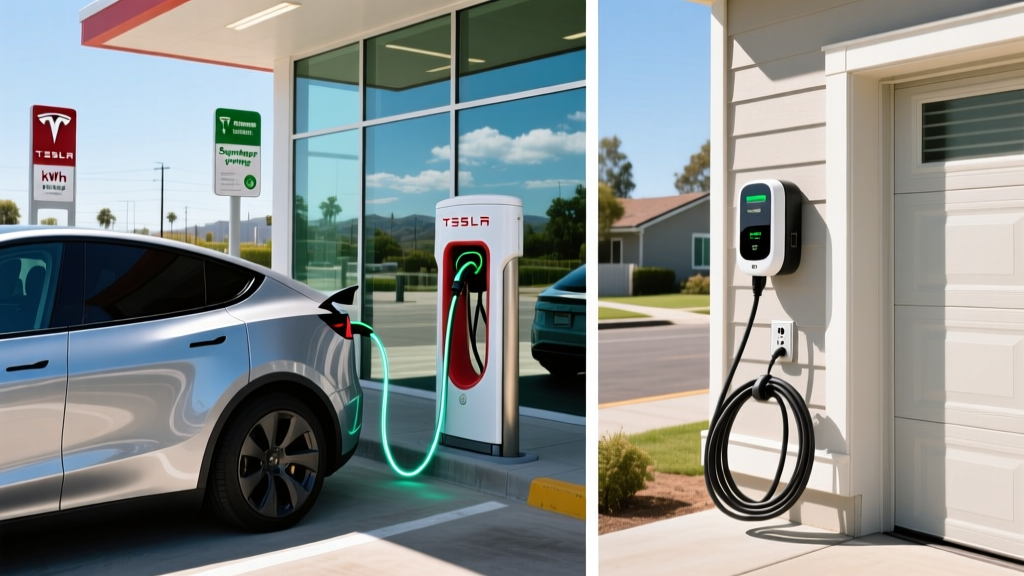
If you own or are considering a Tesla in California, you've likely checked the Supercharger map and noticed prices that seem to fluctuate by location and time of day. The Tesla Supercharger cost per kWh in California sits among the highest in the nation, driven by the state's elevated electricity rates and peak-demand pricing structures. But how does public fast charging actually compare to charging at home — and is installing a Level 2 home charger worth the upfront investment?
This guide breaks down every charging cost scenario California EV owners face in 2026, from Supercharger pricing to home installation economics, with exact numbers for Tesla vehicles and the broader EV market now that the North American Charging Standard (NACS) has been widely adopted.
Tesla Supercharger Pricing in California: What You Actually Pay
Tesla Supercharger rates in California vary by station, time of day, and whether you're driving a Tesla or a non-Tesla EV using the network. As of early 2026, here's what California drivers typically encounter:
- Off-peak hours (typically late night/early morning): $0.38–$0.48 per kWh
- Mid-peak hours (daytime, non-rush): $0.48–$0.55 per kWh
- On-peak hours (weekday evenings, summer afternoons): $0.55–$0.66 per kWh
- Non-Tesla vehicles (via Magic Dock or adapter): typically 15–25% surcharge, pushing rates to $0.58–$0.78 per kWh at some urban stations
These rates reflect California's broader electricity market. According to the U.S. Energy Information Administration, California's average residential electricity rate hovers around $0.33/kWh — roughly double the national average. Supercharger stations carry additional demand charges and commercial-rate overhead that push public pricing higher.
Understanding Charging Levels: Speed, Power, and Range Added
Before comparing costs, it's essential to understand what each charging level delivers. The critical distinction: kW (kilowatts) measures power — the rate at which energy flows into your battery. kWh (kilowatt-hours) measures energy — the total capacity stored in your battery. Think of kW as how fast water flows from a hose, and kWh as the size of the bucket you're filling.
| Charging Level | Voltage | Power (kW) | Miles of Range Added Per Hour | Typical Use Case |
|---|---|---|---|---|
| Level 1 (120V) | 120V AC | 1.2–1.9 kW | 3–5 miles | Overnight trickle; emergency backup |
| Level 2 (240V) | 240V AC | 7.2–19.2 kW | 20–60 miles | Daily home charging; workplace |
| DC Fast Charging | 400–800V DC | 50–350 kW | 150–1,000+ miles (equivalent) | Road trips; rapid top-ups |
For context, a Tesla Model 3 Long Range (82 kWh battery, EPA 363 miles) charging on a 48-amp Level 2 home circuit at 11.5 kW will add roughly 44 miles of range per hour. A full 10–80% charge takes about 5 hours overnight — ideal for daily use.
At a Tesla V4 Supercharger (capable of up to 250 kW for current Model 3/Y, higher for Cybertruck with 800V architecture), that same 10–80% charge takes approximately 25–30 minutes, though the charge curve tapers significantly above 80%. Peak charging speed is only sustained through roughly 30–50% State of Charge (SoC); above that, thermal management and battery protection protocols reduce the rate.
Home EV Charger Installation: Costs, Electrical Requirements, and What to Expect
Installing a Level 2 home charger is the single highest-impact upgrade an EV owner can make for daily convenience and long-term cost savings. But the total cost varies widely depending on your home's electrical infrastructure.
Electrical Requirements for Level 2 Charging
A Level 2 charger requires a dedicated 240-volt circuit, similar to what powers an electric dryer or oven. Common configurations:
- 40-amp circuit (delivers up to 32 amps / 7.7 kW continuous) — sufficient for most daily charging needs
- 50-amp circuit (delivers up to 40 amps / 9.6 kW continuous) — recommended for larger batteries like the Model S/X or Ford F-150 Lightning
- 60-amp circuit (delivers up to 48 amps / 11.5 kW continuous) — maximum for most residential chargers; future-proofs your setup
The National Electrical Code (NEC) requires that continuous loads (including EV charging, which runs for 3+ hours) use no more than 80% of the circuit's rated capacity. A 50-amp breaker therefore delivers a maximum continuous 40 amps.
Installation Cost Breakdown
| Component | Typical Range | Notes |
|---|---|---|
| Level 2 Charger (hardware) | $350–$750 | Wi-Fi-enabled smart chargers at upper end |
| Electrician labor (standard install) | $500–$1,500 | Short run from panel to garage; conduit, wiring, outlet or hardwire |
| Electrical permit | $50–$250 | Varies by city/county; required in most CA jurisdictions |
| Panel upgrade (if needed) | $1,500–$4,000 | Required if existing panel lacks capacity (common in pre-1990 homes with 100A service) |
| Total (no panel upgrade) | $900–$2,500 | Most homes with 200A service fall in this range |
| Total (with panel upgrade) | $2,400–$6,500 | Older homes or those adding multiple high-draw circuits |
Safety and Code Considerations
California enforces strict electrical codes for EV charger installations:
- Dedicated circuit: Your EV charger must have its own breaker — no sharing with other appliances.
- GFCI protection: NEC 2023 (adopted in California) requires Ground Fault Circuit Interrupter protection for all EV charging circuits. Most quality chargers have built-in GFCI; hardwired installations may require a GFCI breaker.
- Outdoor rating: If your charger is installed outside (carport, driveway), it must carry a NEMA 4 or IP55+ weather-resistance rating.
- Hardwired vs. plug: Hardwired chargers (no plug) eliminate the NEMA 14-50 receptacle as a failure point and are increasingly preferred by electricians for circuits above 40 amps.
Cost Per Mile: Supercharger vs. Home Charging vs. Gas
The most meaningful comparison for EV owners isn't cost per kWh — it's cost per mile driven. This normalizes the comparison across vehicles with different efficiencies.
| Scenario | Energy Cost | Vehicle Efficiency | Cost Per Mile |
|---|---|---|---|
| Home charging (off-peak, PG&E TOU-C plan ~$0.30/kWh) | $0.30/kWh | Model Y: 28 kWh/100mi | $0.084 |
| Home charging (off-peak, SCE TOU-D ~$0.22/kWh) | $0.22/kWh | Model 3: 25 kWh/100mi | $0.055 |
| Tesla Supercharger (CA mid-peak ~$0.52/kWh) | $0.52/kWh | Model Y: 28 kWh/100mi | $0.146 |
| Tesla Supercharger (CA on-peak ~$0.62/kWh) | $0.62/kWh | Model Y: 28 kWh/100mi | $0.174 |
| Non-Tesla DC fast charger (EA, EVgo ~$0.55/kWh) | $0.55/kWh | Ioniq 5: 30 kWh/100mi | $0.165 |
| Gas car (28 MPG combined, $4.80/gal CA avg) | $4.80/gal | 28 MPG | $0.171 |
| Gas car (22 MPG combined, $4.80/gal CA avg) | $4.80/gal | 22 MPG | $0.218 |
Home charging in California consistently delivers per-mile costs at roughly half the price of gasoline. Even at peak Supercharger rates, a Tesla Model Y is competitive with a 28 MPG gas car — and substantially cheaper than less efficient vehicles. The savings compound: driving 12,000 miles annually, the difference between home charging at $0.084/mile and gasoline at $0.171/mile saves approximately $1,044 per year.
For the most current efficiency data, the EPA's fueleconomy.gov provides kWh/100mi ratings for every EV sold in the U.S.
Connector Compatibility: NACS, CCS, and Adapters in 2026
The connector landscape has shifted dramatically. Tesla's North American Charging Standard (NACS) has been adopted by Ford, GM, Rivian, Volvo, BMW, Hyundai, and most major automakers for 2025–2026 model-year vehicles. Here's where things stand:
| Connector Type | Brands Using It (Native) | Tesla Supercharger Access | Adapter Needed? |
|---|---|---|---|
| NACS (Tesla) | Tesla, Ford (2025+), GM (2025+), Rivian, Volvo, Polestar, BMW (2025+), Hyundai (2026+) | Full access | None for Teslas; CCS-to-NACS adapter for older non-Tesla EVs |
| CCS1 | Hyundai/Kia (pre-2026), VW, legacy BMW/Mercedes, most pre-2025 non-Tesla EVs | Access via Tesla Magic Dock stations or NACS adapter | Tesla CCS adapter (~$175) or aftermarket NACS adapter ($200–$300) |
| CHAdeMO | Nissan Leaf (discontinued), Mitsubishi Outlander PHEV | No access | No reliable adapter available |
If you're buying a 2025–2026 model-year EV from Ford, GM, Rivian, or Volvo, your vehicle ships with a native NACS port and can access Tesla Superchargers without an adapter. For older CCS-equipped vehicles, Tesla sells a CCS-to-NACS adapter, and third-party options from companies like Lectron and A2Z are available, though always verify UL certification for safety.
Recommended Home EV Chargers: Equipment Picks for 2026
Based on power output, reliability, smart features, and connector compatibility, here are the top Level 2 home chargers for California EV owners:
Tesla Wall Connector
- Power: Up to 11.5 kW (48 amps)
- Connector: NACS (native Tesla)
- Cable length: 24 feet
- Smart features: Wi-Fi, OTA updates, load sharing, Powerwall integration
- Price: ~$475
- Best for: Tesla owners wanting seamless integration
ChargePoint Home Flex
- Power: Up to 12 kW (50 amps, configurable)
- Connector: NACS or CCS (J1772 with adapter)
- Cable length: 23 feet
- Smart features: Wi-Fi, Alexa/Google, scheduling, energy tracking
- Price: ~$550–$650
- Best for: Multi-EV households or non-Tesla NACS vehicles
Emporia Level 2 EV Charger
- Power: Up to 11.5 kW (48 amps)
- Connector: NACS or J1772
- Cable length: 24 feet
- Smart features: Wi-Fi, solar integration, real-time energy monitoring, V2H-ready
- Price: ~$400
- Best for: Budget-conscious buyers with solar panels
Grizzl-E Smart
- Power: Up to 10 kW (40 amps)
- Connector: NACS or J1772
- Cable length: 24 feet
- Smart features: Wi-Fi, adjustable amperage, extreme-weather rated (-40°F)
- Price: ~$450
- Best for: Durability; outdoor installs in variable climates
All recommended chargers carry UL or ETL certification, support NEMA 14-50 plug or hardwired installation, and include at minimum a 3-year manufacturer warranty. For California homeowners, hardwired installation is preferred for circuits above 40 amps to eliminate the receptacle as a potential failure point.
Charging Time Examples: 10–80% for Common EV Battery Sizes
Charging time depends on battery capacity (kWh), charger power (kW), and the charge curve — the reality that DC fast charging slows substantially above 80% SoC to protect battery longevity. Here are real-world 10–80% times for popular models:
| Vehicle | Battery (usable kWh) | Home Level 2 (11.5 kW) | DC Fast (Peak kW) | DC Fast 10–80% Time |
|---|---|---|---|---|
| Tesla Model 3 Long Range | 82 kWh (NMC) | ~5.0 hours | 250 kW | ~27 minutes |
| Tesla Model Y Long Range | 75 kWh (NMC) | ~4.6 hours | 250 kW | ~25 minutes |
| Ford F-150 Lightning Ext. Range | 131 kWh (NMC) | ~8.0 hours | 150 kW | ~41 minutes |
| Hyundai Ioniq 5 Long Range | 77.4 kWh (NMC) | ~4.7 hours | 240 kW (800V) | ~18 minutes |
| Chevrolet Equinox EV | 85 kWh (NMC) | ~5.2 hours | 150 kW | ~34 minutes |
The Hyundai Ioniq 5's 800-volt architecture enables faster sustained charging through the curve — it holds peak power longer than 400V systems, which is why its 10–80% time is notably shorter despite a similar battery size to the Model Y.
Frequently Asked Questions
How much does it cost to install a home EV charger in California?
A standard Level 2 home charger installation in California typically costs $900–$2,500 when no panel upgrade is needed, covering the charger unit ($350–$750), electrician labor ($500–$1,500), and permit fees ($50–$250). Homes requiring a panel upgrade from 100A to 200A service should budget $2,400–$6,500 total. Always get a load calculation from a licensed electrician before committing.
How fast will each charging level add range?
Level 1 (120V) adds 3–5 miles of range per hour — adequate only for overnight trickle charging of small batteries or PHEVs. Level 2 (240V, 48 amps) adds approximately 35–44 miles per hour for most EVs, fully replenishing daily driving in 1–3 hours. DC fast charging adds 150–300+ miles in 15–30 minutes depending on the vehicle's peak charge rate and battery size, but is intended for road trips, not daily use due to cost and long-term battery stress.
Which connector is compatible with my EV?
If you drive a 2025+ Ford, GM, Rivian, Volvo, or any Tesla, your vehicle uses the NACS connector natively and accesses Tesla Superchargers directly. Older CCS-equipped EVs (pre-2025 Hyundai, Kia, VW, BMW) require a CCS-to-NACS adapter (~$175–$300) for Supercharger access. CHAdeMO vehicles (Nissan Leaf) have no adapter path to NACS and rely on Electrify America, EVgo, and remaining CHAdeMO stations.
How much does charging cost per mile compared to gas in California?
Home charging in California costs roughly $0.05–$0.09 per mile depending on your utility rate plan and vehicle efficiency — about half the cost of gasoline at $0.17/mile (28 MPG at $4.80/gallon). Even Tesla Supercharger mid-peak rates ($0.14–$0.17/mile) are competitive with efficient gas cars. The annual savings for a driver covering 12,000 miles ranges from $600–$1,200 compared to gasoline.
What electrical upgrades might I need for a home charger?
The most common upgrade is a panel capacity increase. Homes with 100-amp service and existing high-draw appliances (electric range, HVAC, dryer) often need a 200-amp upgrade ($1,500–$4,000) to safely add a 50-amp EV circuit. Newer homes with 200-amp panels usually have sufficient headroom. Your electrician will calculate total connected load per NEC Article 220. Some California utilities (PG&E, SCE, SDG&E) offer rebates of $500–$1,500 for panel upgrades paired with EV charger installation — check your utility's EV program page. The IRS §30D credit does not cover home charging equipment, but the separate Residential Clean Energy Credit and various California state incentives may partially offset installation costs — consult a tax professional for eligibility.