Why Tesla Supercharger Charge Time Matters — And What It Really Means
Search for "Tesla Supercharger charge time" and you'll see claims like "up to 200 miles in 15 minutes." That headline number is real — but it applies only under ideal conditions to specific vehicles on V4 Supercharger stalls delivering peak 250 kW (and up to 325 kW at the newest V4 sites rolling out in 2026). The actual time your EV spends plugged in depends on your battery size, state of charge (SoC), battery chemistry, ambient temperature, and whether the vehicle can precondition its pack before arrival.
This guide breaks down exactly how fast each charging level adds range, what home installation actually costs, which connectors fit which vehicles, and how per-mile charging costs compare to gasoline in 2026.
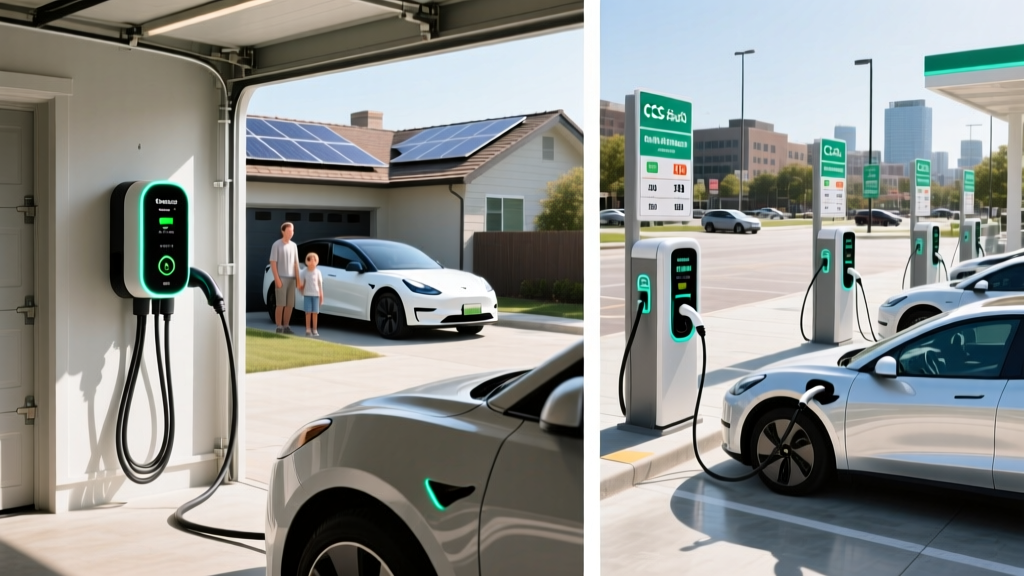
Charging Levels Explained: kW, Miles Per Hour, and Real Charge Times
The single most important distinction in EV charging is between kW (kilowatts) and kWh (kilowatt-hours). kW measures power — how fast energy flows into your battery, like water pressure from a hose. kWh measures energy — the total amount stored, like gallons in a tank. A 250 kW Supercharger delivers energy at a rate of 250 kWh per hour (though no session lasts a full hour at peak rate).
| Level | Voltage / Amps | Max Power (kW) | Miles of Range Added Per Hour | Typical Use Case |
|---|---|---|---|---|
| Level 1 | 120V / 12A | 1.4 kW | 3–5 mi/hr | Emergency / overnight trickle |
| Level 2 (Home) | 240V / 32–48A | 7.7–11.5 kW | 25–44 mi/hr | Daily home charging |
| Level 2 (Public) | 240V / 48–80A | 11.5–19.2 kW | 37–60 mi/hr | Workplace, hotels, shopping |
| DC Fast (CCS/NACS) | 400–800V DC | 50–350 kW | 150–1,200+ mi/hr (peak) | Road trips, quick top-ups |
Those "miles per hour" figures assume roughly 3–4 miles per kWh of efficiency (typical for a mid-size crossover EV like the Tesla Model Y or Hyundai Ioniq 5). A heavier truck like the Rivian R1T or Ford F-150 Lightning will add fewer miles per hour at the same kW rate because it consumes more energy per mile.
Tesla Supercharger Charge Time: Real Numbers by Vehicle
Tesla's Supercharger network in 2026 includes V3 stalls (250 kW peak), V4 stalls (up to 325 kW for compatible vehicles), and legacy V2 stalls (150 kW). Here's what 10–80% charge times actually look like for popular models, based on Tesla's published specs and independent testing:
| Vehicle | Battery (kWh usable) | Peak Charge Rate | 10–80% Time | Miles Added in 15 Min |
|---|---|---|---|---|
| Model 3 Long Range (2026) | ~75 kWh (NMC) | 250 kW | ~25–28 min | ~175 mi |
| Model Y Long Range (2026) | ~75 kWh (NMC) | 250 kW | ~27–30 min | ~162 mi |
| Model 3 RWD (LFP) | ~57.5 kWh (LFP) | 170 kW | ~30–35 min | ~130 mi |
| Cybertruck AWD | ~123 kWh (NMC) | 250 kW (800V arch) | ~35–40 min | ~150 mi |
| Non-Tesla (e.g., Ioniq 5 via NACS adapter) | ~77.4 kWh (NMC) | 250 kW (vehicle-limited) | ~18–22 min | ~185 mi |
Understanding the Charge Curve
A Supercharger doesn't deliver peak kW for the entire session. A Model 3 Long Range might pull 250 kW from 10–30% SoC, then step down to ~180 kW through 50%, ~120 kW through 70%, and ~50 kW approaching 80%. This "charge curve taper" is managed by the battery management system to protect cell longevity. The published 10–80% time accounts for this taper, but the "miles in 15 minutes" figure captures only the peak-rate window.
Home Level 2 Installation: What It Costs and What You Need
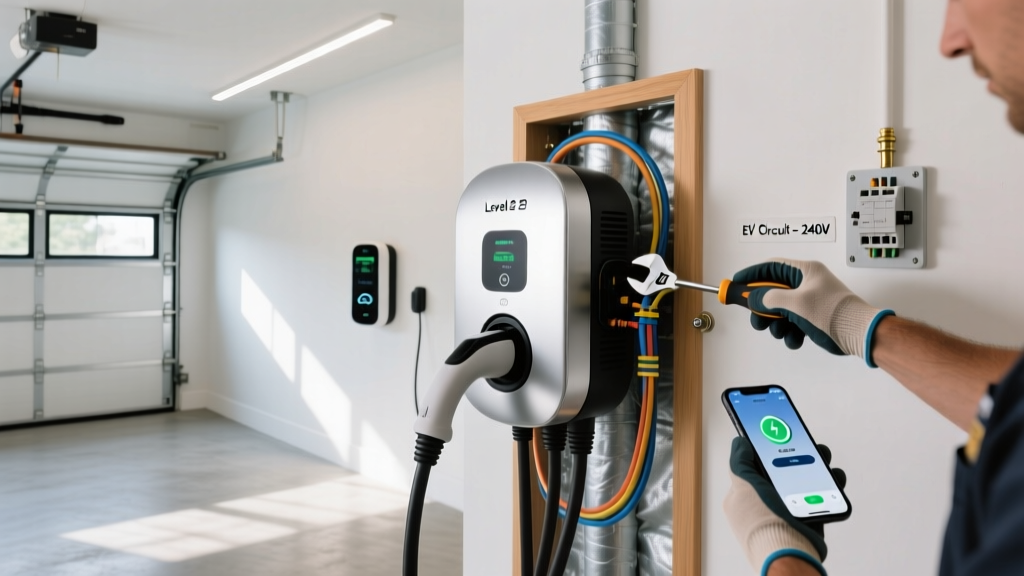
Most EV owners do 80–90% of their charging at home on a Level 2 charger. A proper installation involves more than plugging into a dryer outlet. Here's the full breakdown.
Electrical Requirements
A standard home Level 2 charger requires a 240V dedicated circuit on a double-pole breaker. The most common configurations:
- 40A circuit / 32A continuous charge = 7.7 kW (most common, sufficient for overnight charging)
- 50A circuit / 40A continuous = 9.6 kW (faster, good for larger batteries)
- 60A circuit / 48A continuous = 11.5 kW (Tesla Wall Connector max, fastest residential single-phase)
The National Electrical Code (NEC) requires that continuous loads (like EV charging, which runs for 3+ hours) use only 80% of a circuit's rated capacity. That's why a 60A breaker supports only 48A of continuous charging.
Panel Upgrade: The Hidden Cost
Many homes built before 2000 have 100A or 150A main electrical panels. Adding a 60A EV circuit may exceed the panel's available capacity, especially if you also run electric dryers, ovens, and HVAC. An electrician will perform a load calculation to determine if your panel can handle the additional circuit. If not, a panel upgrade to 200A typically costs $1,500–$3,500 before the charger circuit itself.
| Component | Low Estimate | High Estimate | Notes |
|---|---|---|---|
| Level 2 Charger Equipment | $300 | $750 | Hardwired or NEMA 14-50 plug; smart vs. dumb |
| Electrician Labor (circuit + outlet/hardwire) | $500 | $2,000 | Depends on run length from panel to garage |
| Permit & Inspection | $50 | $300 | Required in most jurisdictions; varies by municipality |
| Panel Upgrade (if needed) | $1,500 | $3,500 | 200A service upgrade; not always required |
| Total (no panel upgrade) | $850 | $3,050 | |
| Total (with panel upgrade) | $2,350 | $6,550 |
The IRS §30D tax credit does not cover home charging equipment directly, but the separate Residential Clean Energy Credit (§25D) and the now-expired §30C Alternative Fuel Infrastructure credit have historically offered partial offsets. Check current IRS guidance and consult a tax professional for eligibility.
Connector Compatibility: NACS, CCS1, CHAdeMO, and Adapters
As of 2026, the North American Charging Standard (NACS) — originally Tesla's proprietary connector — has become the dominant standard. Nearly every major automaker (Ford, GM, Rivian, Hyundai/Kia, BMW, and others) has adopted NACS on new vehicles starting with 2025–2026 model years. But millions of CCS1-equipped EVs remain on the road.
| Connector | Brands Using It (New Vehicles) | DC Fast Charge Availability | Adapter Needed For |
|---|---|---|---|
| NACS (Tesla) | Tesla, Ford, GM, Rivian, Hyundai, Kia, BMW, Mercedes, Volvo, Polestar | Tesla Superchargers + NACS-equipped public DCFC | CCS1 vehicles need a NACS-to-CCS adapter (~$200–$250) |
| CCS1 | Legacy models (pre-2025 VW ID.4, older Bolt, etc.) | Electrify America, EVgo, ChargePoint DCFC | Tesla Supercharger access requires CCS-to-NACS adapter |
| CHAdeMO | Nissan Leaf (discontinued after 2025 MY), Mitsubishi Outlander PHEV | Limited; mostly legacy stations | No practical adapter to NACS/CCS for DCFC |
Cost to Charge: Per-Mile Breakdown vs. Gasoline
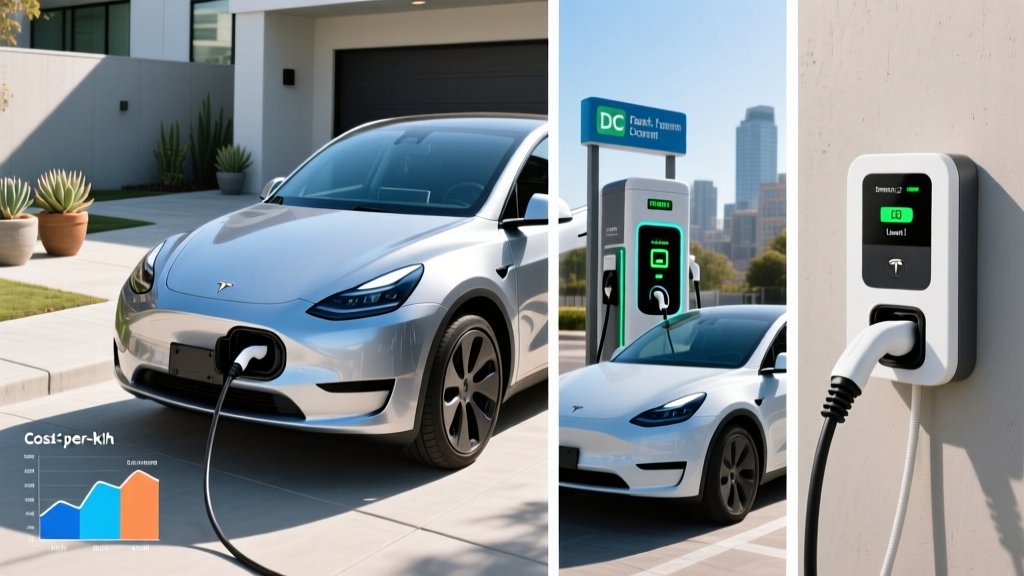
Charging cost varies enormously depending on where and when you charge. Here's a realistic comparison using a 2026 Tesla Model Y Long Range (~3.5 mi/kWh efficiency) and a comparable gas crossover at 28 MPG combined.
| Charging Scenario | Cost per kWh | Cost Per Mile (Model Y) | Equivalent Gas Price at 28 MPG |
|---|---|---|---|
| Home (off-peak utility rate) | $0.08–$0.14 | $0.023–$0.040 | $0.64–$1.12/gal |
| Home (standard residential rate) | $0.14–$0.20 | $0.040–$0.057 | $1.12–$1.60/gal |
| Public Level 2 (workplace/shopping) | $0.20–$0.35 | $0.057–$0.100 | $1.60–$2.80/gal |
| Tesla Supercharger (V3/V4) | $0.28–$0.48 | $0.080–$0.137 | $2.24–$3.84/gal |
| Electrify America / EVgo DCFC | $0.35–$0.58 | $0.100–$0.166 | $2.80–$4.64/gal |
At the national average gas price of roughly $3.30/gallon in early 2026 (per EIA data), the gas crossover costs about $0.118/mile. Home Level 2 charging at off-peak rates delivers fuel savings of 65–80%. Even at DC fast-charger rates, EV per-mile costs are competitive with or cheaper than gasoline — though the gap narrows significantly on the most expensive public networks.
Recommended Home Level 2 Chargers for 2026
Based on power output, reliability, connector options, and smart features, here are the top home chargers available in 2026:
Tesla Wall Connector (Gen 4)
- Power: Up to 11.5 kW (48A on 60A circuit)
- Connector: NACS native; J1772 adapter included
- Cable Length: 24 ft
- Smart Features: Wi-Fi, OTA updates, load sharing between multiple units, Tesla app integration
- Price: ~$475
- Best For: Tesla owners; NACS-adopted EVs (Ford, GM, Rivian)
ChargePoint Home Flex (2nd Gen)
- Power: Up to 11.5 kW (48A, configurable via DIP switch)
- Connector: J1772 (NACS adapter available)
- Cable Length: 23 ft
- Smart Features: Wi-Fi, scheduling, energy tracking, Alexa integration, UL-listed
- Price: ~$550–$650
- Best For: Non-Tesla EVs with J1772/CCS; multi-EV households
Emporia Level 2 EV Charger
- Power: Up to 11.5 kW (48A)
- Connector: J1772 (NACS version available)
- Cable Length: 24 ft
- Smart Features: Wi-Fi, energy monitoring via Emporia Vue panel integration, solar-aware scheduling
- Price: ~$400
- Best For: Budget-conscious buyers; solar homeowners
Grizzl-E Smart (United Chargers)
- Power: Up to 10 kW (40A on 50A circuit)
- Connector: J1772 or NACS (select at purchase)
- Cable Length: 24 ft
- Smart Features: OCPP-compatible, adjustable amperage, outdoor-rated (NEMA 4), built in Canada
- Price: ~$450–$550
- Best For: Cold-climate outdoor installs; rugged durability
Safety, Code, and Installation Best Practices
EV charging is a high-draw, long-duration electrical load — treat it seriously. Key safety and code requirements:
- Dedicated circuit: Your Level 2 charger must be on its own dedicated double-pole breaker. Sharing a circuit with other appliances is a code violation and a fire risk.
- GFCI protection: NEC 2020 and later require GFCI protection for all 125V and 250V receptacles used for EV charging in garages and outdoors. Hardwired installations may have different requirements — your electrician will advise based on local code amendments.
- Outdoor rating: If your charger is mounted outside, it must carry a NEMA 4 or NEMA 4X rating (weatherproof). All recommended chargers above meet this standard.
- Permit and inspection: Most jurisdictions require an electrical permit for a new 240V circuit. The inspection verifies proper wire gauge, breaker sizing, grounding, and GFCI compliance. Skipping the permit risks insurance coverage denial if a fire occurs.
- Wire gauge: A 60A circuit typically requires 6 AWG copper wire (THHN in conduit or NM-B rated for 55A minimum). Your electrician will size wire based on run length and local code.
Frequently Asked Questions
How much does it cost to install a home EV charger?
A typical Level 2 home installation (equipment + electrician + permit) costs $850–$3,050 if your electrical panel has sufficient capacity. If a panel upgrade to 200A service is needed, total cost rises to $2,350–$6,550. The biggest variables are the distance from your panel to the charger location and whether conduit must be run through walls or underground.
How fast will each charging level add range?
Level 1 (120V) adds roughly 3–5 miles of range per hour — essentially an overnight trickle. Level 2 (240V, 32–48A) adds 25–44 miles per hour, fully recharging most EVs overnight in 6–10 hours. DC fast charging at a Tesla Supercharger or equivalent station adds 150–1,200+ miles per hour at peak rate, though the actual session takes 20–40 minutes for a 10–80% charge due to the taper curve.
Which connector or charger is compatible with my EV?
If you drive a 2025–2026 model from Tesla, Ford, GM, Rivian, Hyundai, Kia, or BMW, your vehicle almost certainly has a NACS charge port. Older CCS1-equipped EVs (2024 and earlier from VW, older Chevy Bolt, etc.) can access Tesla Superchargers via a CCS-to-NACS adapter ($200–$250). CHAdeMO vehicles (Nissan Leaf) have the most limited fast-charging options and no practical DC adapter to NACS. For home Level 2 charging, any J1772 or NACS charger will work with any EV using the appropriate adapter.
How much does charging cost per mile compared to gas?
Home charging at off-peak utility rates ($0.08–$0.14/kWh) costs roughly $0.023–$0.040 per mile in a mid-size EV — equivalent to paying $0.64–$1.12 per gallon of gas. Even at Tesla Supercharger rates ($0.28–$0.48/kWh), per-mile cost is $0.080–$0.137, still competitive with or cheaper than gasoline at $3.30/gal in a 28 MPG crossover. The biggest savings come from consistent home charging; frequent reliance on expensive public DCFC narrows the cost advantage.
What electrical upgrades might I need?
The most common upgrade is a panel capacity increase from 100A or 150A to 200A service, costing $1,500–$3,500. Other potential upgrades include: replacing a Federal Pacific or Zinsco panel (known fire hazards, $2,000–$4,000 to replace); running new conduit for long wire runs from panel to garage ($5–$15 per linear foot); or installing a sub-panel in a detached garage ($800–$2,000). Always get a load calculation from a licensed electrician before committing to a charger amperage.
Does Tesla Supercharger speed vary by location?
Yes. V3 Superchargers deliver up to 250 kW. V4 Superchargers, expanding through 2026, can deliver up to 325 kW to compatible vehicles (Cybertruck and future 800V-architecture models). Legacy V2 stalls are limited to 150 kW and are increasingly rare. Additionally, stalls shared between two vehicles ("stalls A and B") on older V2 sites split power when both are in use — a factor that doesn't apply to V3/V4 sites with individual power cabinets. The Tesla app and in-car navigation show each station's maximum kW rating.