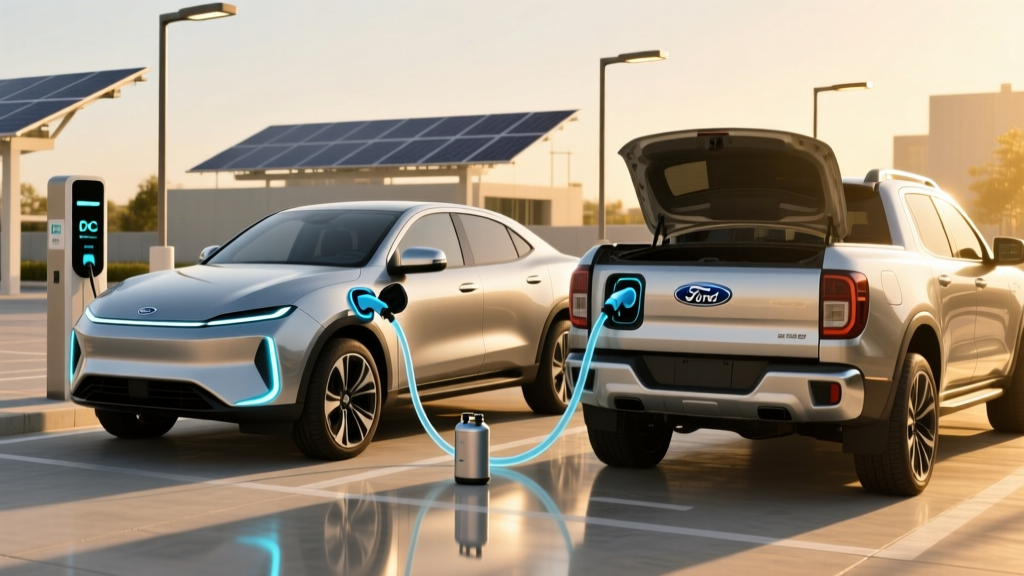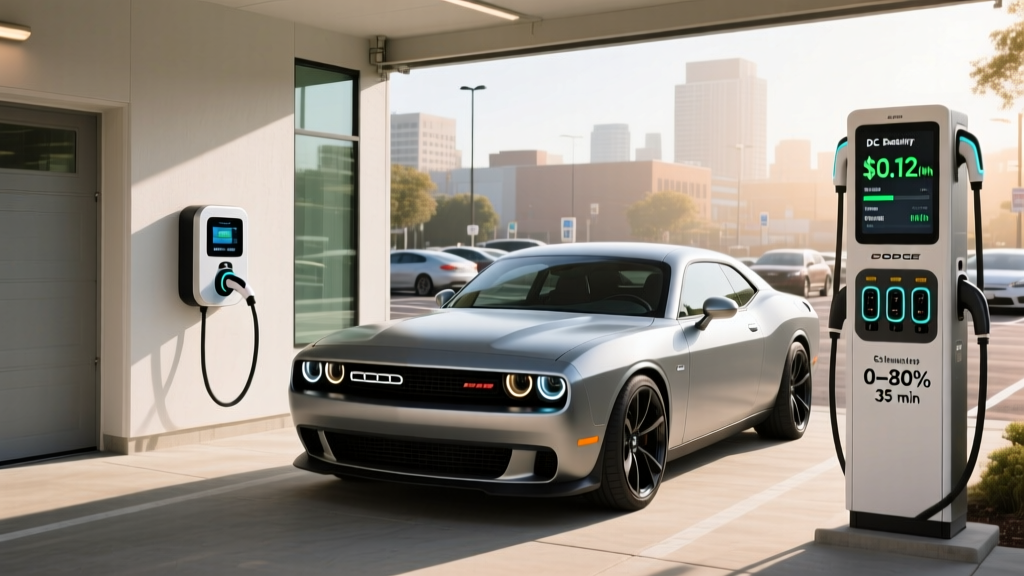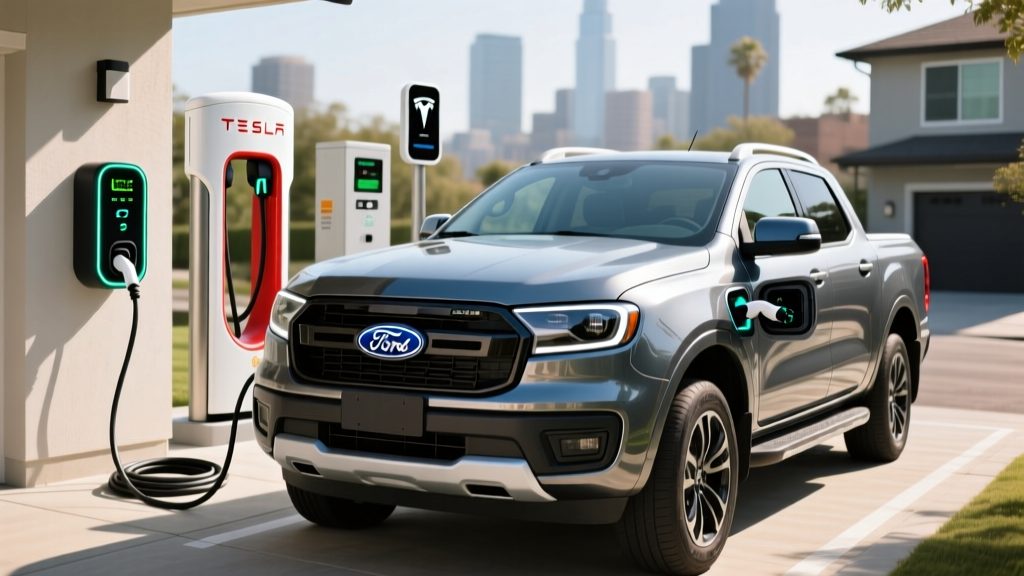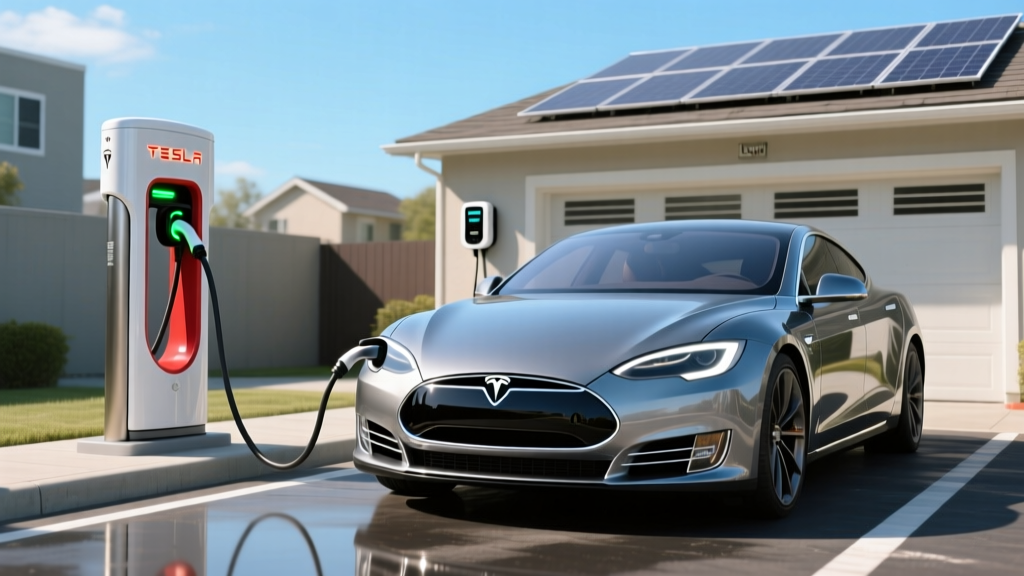
Tesla's decision to open its Supercharger network to non-Tesla EVs (via the NACS standard) created a ripple effect far beyond charging convenience — it spawned a new commercial real estate play: Tesla Supercharger business sales and site-hosting partnerships. Property owners, fleet operators, and commercial landlords are now evaluating whether hosting a Supercharger stall (or building out private DC fast-charging infrastructure) makes financial sense. At the same time, the backbone of practical EV ownership remains home Level 2 charging. This guide covers both angles: the commercial opportunity and the residential essentials.
How Tesla Supercharger Business Sales and Site Hosting Work
Tesla does not sell individual Supercharger units directly to businesses the way a fuel company might sell a gas pump. Instead, the company pursues site-host partnerships and, increasingly, destination and commercial charging programs. Here's how the landscape breaks down in 2026:
- Site-Host Model: A business (hotel, shopping center, retail plaza) provides the real estate and often covers electrical infrastructure costs. Tesla installs, owns, operates, and maintains the Supercharger hardware. Revenue sharing varies by contract but typically involves a per-kWh or per-session split, or a fixed lease arrangement.
- Tesla Destination Charging: Businesses can purchase or lease Tesla Wall Connectors (Level 2, up to 11.5 kW / 48A) for customer and employee use. This is an outright equipment purchase, not a Supercharger.
- Commercial Fleet Charging: Tesla offers Megacharger (for Semi) and commercial-grade Wall Connector deployments for fleet depots. These involve direct equipment sales and installation contracts.
- NACS-Open Superchargers: With the North American Charging Standard now the dominant connector, Tesla has opened many Supercharger stalls to CCS-equipped EVs via built-in adapters or Magic Dock hardware. This expands the revenue base for site hosts.
If you're a commercial property owner evaluating Tesla Supercharger business sales or hosting inquiries, the first step is submitting a proposal through Tesla's official Supercharger Host portal. Selection depends on traffic patterns, grid capacity, proximity to existing stations, and local EV adoption rates.
Charging Levels Explained: Level 1, Level 2, and DC Fast
Whether you're evaluating a commercial deployment or a home setup, understanding charging levels — and the critical difference between kW (power, or the rate of energy delivery) and kWh (energy, or the battery's capacity) — is non-negotiable.
| Level | Voltage | Power (kW) | Miles of Range Added per Hour | Typical Use |
|---|---|---|---|---|
| Level 1 | 120V AC | 1.0–1.4 kW | 3–5 miles/hr | Overnight trickle, PHEVs, emergencies |
| Level 2 | 240V AC | 3.3–19.2 kW | 12–75 miles/hr | Home daily charging, workplaces, destinations |
| DC Fast Charging | 400–900V DC | 50–350+ kW | 150–1,200+ miles/hr (peak) | Highway road trips, commercial fleets, Superchargers |
Real-world context: A Tesla Model Y Long Range (75 kWh usable battery, EPA 310 miles) charging on a Level 2 circuit at 11.5 kW will add roughly 44 miles of range per hour, reaching 10–80% in approximately 5 hours. On a V3 Supercharger peaking at 250 kW, that same 10–80% session takes about 15–18 minutes — though the charge curve tapers significantly above 80%, which is why fast charging targets 80% rather than 100%.
Home Level 2 Charger Installation: Electrical Requirements and Costs
Installing a home Level 2 charger is the single highest-impact upgrade an EV owner can make. Here's what's involved electrically and financially.
Electrical Requirements
- Circuit: A dedicated 240V circuit, typically 40A, 50A, or 60A, depending on the charger's max draw.
- Continuous load rule: The National Electrical Code (NEC) requires EV chargers to be treated as continuous loads, meaning the circuit must be rated at 125% of the charger's max amperage. A 48A charger requires a 60A circuit.
- Wire gauge: 6 AWG copper for 50A circuits; 4 AWG for 60A circuits (varies by run length and local code).
- Panel capacity: Your main service panel must have sufficient amperage headroom. A 200A panel is standard for modern homes; older homes with 100A or 150A service may need a panel upgrade or a load-management device.
Panel Upgrade Reality
This is the most overlooked cost. If your panel is at or near capacity, adding a 60A EV circuit may require a service upgrade from 100A/150A to 200A, which typically costs $1,500–$4,000 depending on your utility and local requirements. In some cases, an automated load-management system (like the Span smart panel or Emporia load shed) can avoid a full upgrade by dynamically reducing charger draw when other loads spike.
Installation Cost Breakdown
| Component | Low End | High End | Notes |
|---|---|---|---|
| Level 2 Charger (Equipment) | $350 | $750 | 32A–48A smart chargers |
| Electrician Labor | $500 | $2,000 | Depends on panel proximity, wall/ceiling runs |
| Electrical Permit | $50 | $300 | Varies by municipality |
| Panel Upgrade (if needed) | $1,500 | $4,000 | 100A → 200A service upgrade |
| Total (no panel upgrade) | $900 | $3,050 | Most common scenario |
| Total (with panel upgrade) | $2,400 | $7,050 | Older homes |
The IRS Residential Clean Energy Credit (§25C) covers up to 30% of home charger equipment and installation costs (capped at $1,000 annually) through 2032. Eligibility depends on your tax liability and specific requirements — consult a tax professional.
Connector Compatibility: NACS, CCS1, and CHAdeMO
The connector landscape has consolidated significantly since Tesla's NACS (North American Charging Standard) was adopted by nearly every major automaker starting in 2024–2025.
| Connector | Brands Using It (Native) | Adapter Needed For |
|---|---|---|
| NACS (Tesla) | Tesla, Ford, GM, Rivian, Volvo, Polestar, Nissan (2025+), Honda (2025+), Fisker, Lucid (2025+) | Older CCS-equipped EVs at Tesla Superchargers (Magic Dock or third-party adapter) |
| CCS1 | Hyundai, Kia, BMW, VW, Audi, Mercedes, Stellantis (legacy models) | Tesla Superchargers (via adapter); most public DC networks |
| CHAdeMO | Nissan Leaf (legacy), Mitsubishi Outlander PHEV (legacy) | Phasing out; limited new infrastructure |
For home Level 2 charging: All EVs sold in the US use the J1772 connector for AC charging — except Tesla, which uses a proprietary connector that is physically part of the NACS standard. Tesla includes a J1772 adapter in the glovebox, and universal Level 2 chargers with J1772 plugs work on Teslas via that adapter. Starting in 2025, some new NACS-native EVs from Ford and GM ship with NACS charge ports for both AC and DC, meaning you'll need a NACS-equipped home charger or a J1772-to-NACS adapter.
Cost to Charge: Home vs. Public vs. Gas
Charging economics vary dramatically by location, time of day, and charging level. Here's a realistic comparison using a 2026 Tesla Model Y Long Range (75 kWh battery, EPA 310 miles, ~3.5 miles/kWh efficiency) as the baseline.
| Scenario | Rate | Cost for 75 kWh (Full Battery) | Cost per Mile (310-mi range) |
|---|---|---|---|
| Home (off-peak utility rate) | $0.08–$0.14/kWh | $6.00–$10.50 | $0.019–$0.034 |
| Home (standard residential avg) | $0.16/kWh | $12.00 | $0.039 |
| Public Level 2 (workplace/retail) | $0.20–$0.35/kWh | $15.00–$26.25 | $0.048–$0.085 |
| DC Fast (Tesla Supercharger avg) | $0.28–$0.42/kWh | $21.00–$31.50 | $0.068–$0.102 |
| DC Fast (Electrify America / EVgo) | $0.35–$0.55/kWh | $26.25–$41.25 | $0.085–$0.133 |
| Gasoline (28 MPG avg ICE at $3.30/gal) | — | $36.53 (8.5 gal equivalent) | $0.118 |
Key takeaway: Home off-peak charging delivers fuel costs at roughly one-quarter to one-third the cost of gasoline per mile. Even public DC fast charging is generally cheaper per mile than gas — but the savings narrow significantly if you rely exclusively on expensive public chargers. According to fueleconomy.gov, the average EV driver pays the equivalent of $1.20–$1.50 per gallon when charging primarily at home.
Equipment Recommendations: Best Home Level 2 Chargers
Below are proven Level 2 chargers suited for residential installation in 2026, with exact specs and pricing.
Tesla Wall Connector (Gen 4)
- Max Power: 11.5 kW (48A on a 60A circuit)
- Connector: NACS native; J1772 adapter included
- Cable Length: 24 feet
- Smart Features: Wi-Fi, OTA updates, access control, power sharing (link up to 6 units on one circuit), scheduled charging
- Price: ~$475
- Best For: Tesla owners and NACS-native EVs; multi-EV households
ChargePoint Home Flex
- Max Power: 12 kW (50A, configurable down to 16A via DIP switch)
- Connector: J1772 (NACS adapter available separately)
- Cable Length: 23 feet
- Smart Features: Wi-Fi, app-based scheduling, Alexa integration, energy reporting, flexible amperage for older panels
- Price: ~$550
- Best For: Non-Tesla EVs; homes with limited panel capacity (can be set to 32A/40A)
Emporia Vue Level 2 Charger
- Max Power: 11.5 kW (48A on a 60A circuit)
- Connector: J1772
- Cable Length: 24 feet
- Smart Features: Wi-Fi, integration with Emporia home energy monitor, solar-aware charging, load management
- Price: ~$400
- Best For: Budget-conscious buyers; solar-panel households wanting EV + energy integration
Grizzl-E Smart
- Max Power: 10 kW (40A on a 50A circuit)
- Connector: J1772
- Cable Length: 24 feet
- Smart Features: Wi-Fi, OCPP compatibility, adjustable amperage (16A–40A), extreme cold rating (-40°C)
- Price: ~$450
- Best For: Cold-climate garages and outdoor installations; ruggedness priority
Safety, Electrical Code, and Permit Considerations
EV charging installation must comply with the National Electrical Code (NEC Article 625) and your local jurisdiction's amendments. Key requirements include:
- Dedicated circuit: Your EV charger must be on its own breaker — no shared circuits with other appliances.
- GFCI protection: NEC 2020 and later requires GFCI (ground-fault circuit interrupter) protection for all EV charging outlets. Many hardwired chargers have built-in GFCI; receptacle-based installations need a GFCI breaker.
- Outdoor rating: If mounted outdoors, the charger must carry a NEMA 4 or NEMA 4X rating for weather resistance. All chargers listed above meet this standard.
- Permit and inspection: Virtually all jurisdictions require an electrical permit for new 240V circuits. The inspection ensures proper wire gauge, breaker sizing, grounding, and bonding. Budget $50–$300 for the permit.
- Utility notification: Some utilities require notification before adding a significant new load. This is especially important if your home has a 100A service — the utility may need to verify transformer capacity on your street.
Always hire a licensed electrician experienced with EV charger installations. Ask for a load calculation before work begins to confirm your panel can handle the new circuit. The National Fire Protection Association publishes the NEC standards that govern this work.
Charging Time Examples for Common EV Battery Sizes
Charge times depend on battery capacity (kWh), the charger's power output (kW), and the vehicle's onboard charger limit. Below are 10–80% charge times for popular 2026 models on various charger types:
| Vehicle | Battery (kWh usable) | Level 2 @ 11.5 kW | DC Fast (Peak kW) | DC 10–80% Time |
|---|---|---|---|---|
| Tesla Model Y LR | 75 kWh (NMC) | ~4.6 hours | 250 kW (V3 Supercharger) | ~15–18 min |
| Hyundai Ioniq 5 | 77.4 kWh (NMC) | ~4.7 hours | 235 kW (800V architecture) | ~18 min |
| Ford F-150 Lightning Ext. | 131 kWh (NMC) | ~8.0 hours | 150 kW | ~40–45 min |
| Chevrolet Equinox EV | 85 kWh (NMC) | ~5.2 hours | 150 kW | ~28–32 min |
| BMW i4 eDrive40 | 81.5 kWh (NMC) | ~5.0 hours | 200 kW | ~22–26 min |
Charge curve reality: Peak DC fast-charging rates (e.g., 250 kW) are only sustained at low states of charge — typically between 10% and 40%. Above 60%, the rate tapers to protect the battery, and above 80% it slows dramatically. This is why 10–80% is the standard benchmark rather than 0–100%. On a road trip, plan stops around the 10–80% window for the fastest overall journey time.
Frequently Asked Questions
How much does it cost to install a home EV charger?
A typical Level 2 home charger installation costs $900–$3,050 when no panel upgrade is needed (equipment: $350–$750, electrician: $500–$2,000, permit: $50–$300). If your home requires a service panel upgrade from 100A to 200A, add $1,500–$4,000, bringing the total to $2,400–$7,050. The federal §25C credit may offset up to $1,000 (30% of costs).
How fast will each charging level add range?
Level 1 (120V) adds 3–5 miles per hour. Level 2 (240V, 11.5 kW typical) adds 30–44 miles per hour depending on vehicle efficiency. DC fast charging at 150–250 kW can add 150–400+ miles in a 20–30 minute session, though the rate tapers significantly above 80% state of charge.
Which connector/charger is compatible with my EV?
All US-market EVs use J1772 for Level 1 and Level 2 AC charging, except Tesla (NACS). For DC fast charging, most new EVs from 2025 onward use NACS, while legacy models may use CCS1 or CHAdeMO. Check your vehicle's charge port and consult the connector compatibility table above. For home charging, a J1772 charger works with nearly every EV; Tesla owners use the included J1772 adapter or a native NACS Wall Connector.
How much does charging cost per mile vs. gas?
Home charging at average residential rates ($0.16/kWh) costs roughly $0.039 per mile for a typical EV. Gasoline at $3.30/gallon in a 28 MPG vehicle costs about $0.118 per mile. That makes home EV charging approximately one-third the cost of gasoline per mile. Public DC fast charging ($0.28–$0.55/kWh) costs $0.07–$0.13 per mile — still cheaper than gas in most cases, but the savings gap narrows.
What electrical upgrades might I need?
The most common upgrade is a panel capacity increase if your home has 100A or 150A service and limited spare breaker slots. A licensed electrician will perform a load calculation per NEC Article 220. Alternatives to a full panel upgrade include installing a lower-amperage charger (32A instead of 48A), using a smart load-management device that dynamically sheds EV load when other appliances cycle on, or adding a dedicated sub-panel. Always get the load calculation before committing to equipment.
Can businesses actually purchase Tesla Superchargers?
Not in the traditional sense. Tesla's primary commercial model remains site hosting — the business provides land and electrical infrastructure, and Tesla installs and operates the equipment. Businesses interested in Tesla Supercharger business sales opportunities should apply through Tesla's host portal. For private commercial deployments (fleet depots, employee parking), Tesla sells Wall Connectors and Megachargers directly, and third-party DC fast chargers from companies like BTC Power, Tritium, and ABB are also options for multi-standard commercial sites.