Charging Speeds Decoded: Level 1, Level 2, and DC Fast Charging
Before comparing a Tesla Supercharger 250 kW stall to your garage wall connector, you need the three charging tiers mapped in real numbers. Power is measured in kW (kilowatts) — the rate energy flows — while battery capacity is measured in kWh (kilowatt-hours), the total energy stored. Confusing the two is the single most common EV mistake; a 250 kW charger does not deliver 250 kWh into your battery.
| Level | Voltage / Amps | Max Power (kW) | Miles of Range Added per Hour | Typical Use Case |
|---|---|---|---|---|
| Level 1 | 120V / 12A | ~1.4 kW | 3–5 mi/hr | Overnight trickle, PHEVs, emergencies |
| Level 2 | 240V / 32–48A | 7.7–11.5 kW | 25–44 mi/hr | Home daily charging, workplace |
| DC Fast (CCS/NACS) | 400–800V DC | 50–350 kW | 150–1,000+ mi/hr (peak) | Road trips, corridor travel |
| Tesla Supercharger V3 | NACS DC | 250 kW peak | ~75 mi in 5 min (peak) | Tesla network, now open to NACS-equipped EVs |
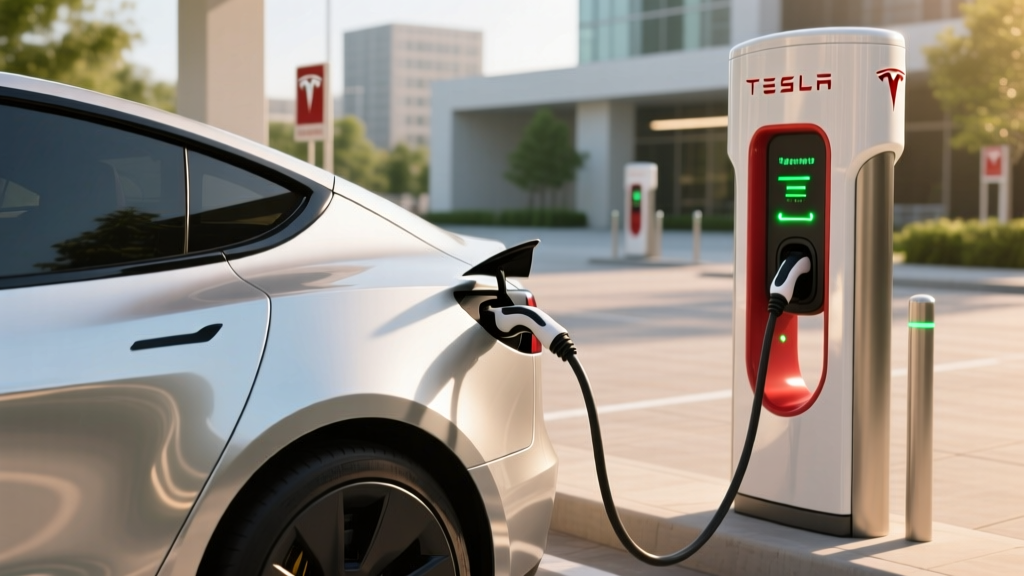
A Tesla Supercharger 250 kW V3 stall can peak at 250 kW on vehicles with compatible battery architectures (Model 3 Long Range, Model Y, Cybertruck). However, that peak only holds between roughly 10% and 30% State of Charge (SoC). By 50% SoC the curve tapers to ~100 kW, and above 80% it drops below 40 kW to protect the cells. Real-world 10–80% session time on a Model Y Long Range (75 kWh usable battery) is roughly 25–28 minutes on a V3 stall, not the 15 minutes marketing sometimes implies.
Home Level 2 Installation: Electrical Requirements and Real Costs
Most EV owners do 80%+ of their charging at home on Level 2. A proper installation requires a dedicated 240V circuit, typically 40A to 60A, wired with copper conductors sized to code (6 AWG for 60A circuits, 8 AWG for 40A). The National Electrical Code (NEC) requires the continuous load to be no more than 80% of the breaker rating, so a 48A charger needs a 60A breaker.
What Electrical Upgrades Might You Need?
Homes built before 2000 often have 100A or 150A main service panels that may lack spare capacity for a 60A EV circuit. A licensed electrician will perform a load calculation (NEC Article 220) to verify headroom. If your panel is maxed out, expect one of these paths:
- Main panel upgrade (200A service): $2,000–$5,000 depending on utility requirements and trenching.
- Sub-panel install: $800–$1,800 if the main has capacity but no physical breaker spaces.
- Load-management device (e.g., Emporia, Wallbox Power Meter): $250–$500 added to the charger circuit, avoids a panel upgrade by dynamically throttling charger amps when household load spikes.
| Line Item | Low-End | High-End | Notes |
|---|---|---|---|
| Level 2 EVSE hardware | $350 | $750 | 32A–48A hardwired units |
| Electrician labor (2–6 hrs) | $400 | $1,800 | Varies with run length, conduit, attic/crawlspace |
| Materials (wire, conduit, breaker) | $150 | $500 | Long runs (>50 ft) push copper cost up |
| Permit & inspection | $75 | $350 | Municipality-dependent; required for code compliance |
| Panel upgrade (if needed) | $2,000 | $5,000 | 100A → 200A service, only ~25% of homes need this |
| Total (no panel upgrade) | $975 | $3,400 | Most 200A-panel homes land in $1,200–$2,200 range |
The federal residential clean energy credit (IRS §25C/25E as of 2026) and many utility rebates can offset $300–$1,000 of hardware and install costs — check your local utility and a tax professional for eligibility specifics, as income caps and equipment qualifications apply.
Connector Compatibility: NACS, CCS1, and CHAdeMO in 2026
The connector landscape consolidated dramatically after 2023. Tesla's North American Charging Standard (NACS) is now the dominant DC fast-charging connector for new vehicles sold in North America. Here is the current compatibility picture:
| Connector | Brands Using It Natively | Access to Tesla Superchargers |
|---|---|---|
| NACS (Tesla) | Tesla, Ford, GM, Rivian, Volvo, Polestar, Mercedes, Nissan (2025+), Honda (2026+), Hyundai/Kia (2026+) | Direct — no adapter needed |
| CCS1 | Legacy VW ID.4 (pre-2026), BMW iX/i4 (pre-NACS), older Ford/GM EVs | Requires CCS-to-NACS adapter ($150–$250) for Tesla Superchargers with Magic Dock |
| CHAdeMO | Nissan Leaf (discontinued), Mitsubishi Outlander PHEV (older) | Limited; CHAdeMO stalls declining, no direct Supercharger access |
If you own a CCS1-equipped EV and want Supercharger access, Tesla sells an official CCS-to-NACS adapter, and third-party options from brands like Lectron are available. Verify your vehicle's firmware supports Supercharger handshaking before purchasing. The Tesla CCS adapter page lists compatible vehicles.
Cost to Charge: Home vs Public vs Tesla Supercharger 250 kW
Electricity pricing varies enormously by region, time of day, and charging tier. Below are representative 2026 scenarios for a 75 kWh battery (Model Y Long Range class):
| Scenario | $/kWh | Cost for 10–80% (52.5 kWh) | Cost per Mile | vs Gasoline (30 MPG, $3.50/gal) |
|---|---|---|---|---|
| Home off-peak (utility TOU rate) | $0.09 | $4.73 | $0.018 | 84% cheaper |
| Home standard rate | $0.16 | $8.40 | $0.032 | 72% cheaper |
| Public Level 2 (ChargePoint, EVgo L2) | $0.28 | $14.70 | $0.056 | 52% cheaper |
| Tesla Supercharger 250 kW (member rate) | $0.32 | $16.80 | $0.064 | 45% cheaper |
| Non-Tesla DC fast (Electrify America) | $0.48 | $25.20 | $0.096 | 17% cheaper |
The takeaway is unambiguous: home charging is 3–5× cheaper than DC fast charging. Supercharging at 250 kW on a road trip costs roughly $0.06–$0.07 per mile for a Model Y, still meaningfully less than a 30 MPG gas car at $0.12/mile — but habitual reliance on public DC fast charging erodes the EV cost advantage. If you cannot charge at home, a PHEV or a workplace-charging arrangement may deliver better economics.
Charging Time Examples: 10–80% for Common Battery Sizes
Session time depends on battery capacity (kWh), peak charge rate (kW), and the vehicle's charge curve. Here are realistic 10–80% times for popular 2026 EVs on a Tesla Supercharger 250 kW V3 stall and on a 48A Level 2 home charger:
| Vehicle | Battery (kWh usable) | Peak DC kW | 10–80% at 250 kW Supercharger | 10–80% on 48A Level 2 (11.5 kW) |
|---|---|---|---|---|
| Tesla Model 3 Long Range | 75 kWh (NMC) | 250 kW | ~25 min | ~4 hr 30 min |
| Tesla Model Y Long Range | 75 kWh (NMC) | 250 kW | ~27 min | ~4 hr 30 min |
| Ford F-150 Lightning Ext. Range | 131 kWh (NMC) | ~170 kW sustained | ~45 min | ~8 hr |
| Hyundai Ioniq 5 (NACS, 2026) | 84 kWh (NMC) | ~240 kW | ~22 min | ~5 hr |
| Chevrolet Equinox EV | 85 kWh (NMC) | ~175 kW | ~32 min | ~5 hr 15 min |
Note that vehicles with 800V architectures (Hyundai/Kia E-GMP, Porsche Taycan) sustain higher charge rates deeper into the session, narrowing the gap to Tesla's 250 kW peak even when their headline number is similar. Cold weather (below 32°F) adds 15–30% to these times unless the battery is preconditioned via the vehicle's navigation-routed charging feature.
Recommended Home Charging Equipment for 2026
Below are three Level 2 EVSE picks that balance reliability, smart features, and value. All support NACS natively or via adapter and are UL-listed for safety compliance.
Tesla Wall Connector (Gen 4)
- Power output: 48A / 11.5 kW (hardwired, 60A breaker)
- Connector: NACS native; includes J1772 adapter in box
- Cable length: 24 ft
- Smart features: Wi-Fi OTA updates, Tesla app scheduling, load sharing between two units, Powerwall integration
- Price: ~$475
- Best for: Tesla owners and NACS-native vehicles; tight integration with Tesla ecosystem
Emporia Vue Level 2 Charger
- Power output: 48A / 11.5 kW (hardwired) or 40A (plug-in NEMA 14-50)
- Connector: J1772 native; NACS adapter available
- Cable length: 24 ft
- Smart features: Real-time energy monitoring, solar-aware charging, load management with Emporia Vue panel monitor, TOU scheduling
- Price: ~$399 (hardwired)
- Best for: Homes with solar panels or tight electrical capacity; load management avoids panel upgrades
ChargePoint Home Flex (2nd Gen)
- Power output: Configurable 16A–50A (up to 12 kW hardwired)
- Connector: J1772 native; NACS pigtail available
- Cable length: 23 ft
- Smart features: Alexa/Google Home integration, detailed app with session history, flexible amperage dial for older panels
- Price: ~$549
- Best for: Homes with limited panel capacity (dial down to 32A/24A without rewiring); non-Tesla EVs
Safety, Code, and Installation Best Practices
EV charging is a continuous high-draw load — your charger may run at full power for 6+ hours. Cutting corners on installation invites fire risk, insurance claim denials, and failed home inspections. Follow these non-negotiables:
- Dedicated circuit only. Never share the EV circuit with other appliances. NEC 625.40 requires a dedicated branch circuit for EVSE.
- GFCI protection. NEC 2023+ requires GFCI breakers for outdoor receptacles (NEMA 14-50). Hardwired EVSE installations bypass this requirement and are generally preferred for reliability — GFCI nuisance trips on 50A circuits are a known issue.
- Outdoor rating. If your charger is exterior-mounted, confirm the EVSE carries a NEMA 4 or IP65 rating. All three units above meet this standard.
- Permit and inspect. Skipping permits voids homeowner insurance coverage for electrical fires and creates disclosure issues at sale. Typical permit fees are $75–$350.
- Avoid NEMA 14-50 receptacle pitfalls. Residential-grade 14-50 outlets are not rated for daily plug/unplug cycles over years. If you want plug-in flexibility, specify an industrial-grade Hubbell or Bryant 14-50R (~$85 vs $15 for a builder-grade outlet).
- Use a licensed electrician. Verify they carry EVSE installation experience — ask about load calculations, wire gauge, and whether they pull permits. The National Electrical Code (NFPA 70) Article 625 governs EV charging circuits.
Frequently Asked Questions
How much does it cost to install a home EV charger?
For a typical 200A-panel home with the charger within 30 feet of the panel, expect $1,200–$2,200 all-in (hardware, labor, materials, permit). Homes needing a panel upgrade can see $3,500–$7,000 total. Utility rebates and federal credits can offset $300–$1,000 of this cost.
How fast will each charging level add range?
Level 1 (120V) adds 3–5 miles per hour — adequate only for PHEVs or low-mileage drivers. Level 2 (240V, 48A) adds 30–44 miles per hour, fully recharging most EVs overnight. A Tesla Supercharger 250 kW DC fast stall adds up to 75 miles in 5 minutes at peak, tapering as the battery fills.
Which connector/charger is compatible with my EV?
If your EV is a 2025+ Tesla, Ford, GM, Rivian, Volvo, or 2026+ Hyundai/Kia/Honda/Nissan, it has NACS natively and plugs directly into Tesla Wall Connectors and Superchargers. Older CCS1 vehicles need a CCS-to-NACS adapter ($150–$250) for Supercharger access. CHAdeMO vehicles (Nissan Leaf) have no practical Supercharger path.
How much does charging cost per mile vs gas?
Home off-peak charging averages $0.02–$0.03 per mile, compared to $0.12/mile for a 30 MPG gas car at $3.50/gallon — a 75–85% savings. Tesla Supercharger 250 kW sessions cost ~$0.06–$0.07/mile, still about 45% cheaper than gas. Public DC fast charging at $0.48/kWh narrows the gap to ~17% savings.
What electrical upgrades might I need?
If your home has a 100A or 150A main panel, or if the panel is near capacity with existing loads (HVAC, electric range, dryer), you may need a panel upgrade to 200A ($2,000–$5,000) or a load-management device ($250–$500) that dynamically throttles charger draw. An electrician's load calculation will determine which path is required. Homes with 200A service and gas appliances rarely need an upgrade.
Can non-Tesla EVs use Tesla Supercharger 250 kW stalls?
Yes. As of 2026, any NACS-equipped EV can use Tesla Superchargers directly. CCS1 vehicles can access select Supercharger stalls equipped with Tesla's Magic Dock (a built-in CCS adapter) or use a third-party CCS-to-NACS adapter. Pricing for non-Tesla vehicles is typically $0.04–$0.08/kWh higher than Tesla member rates.