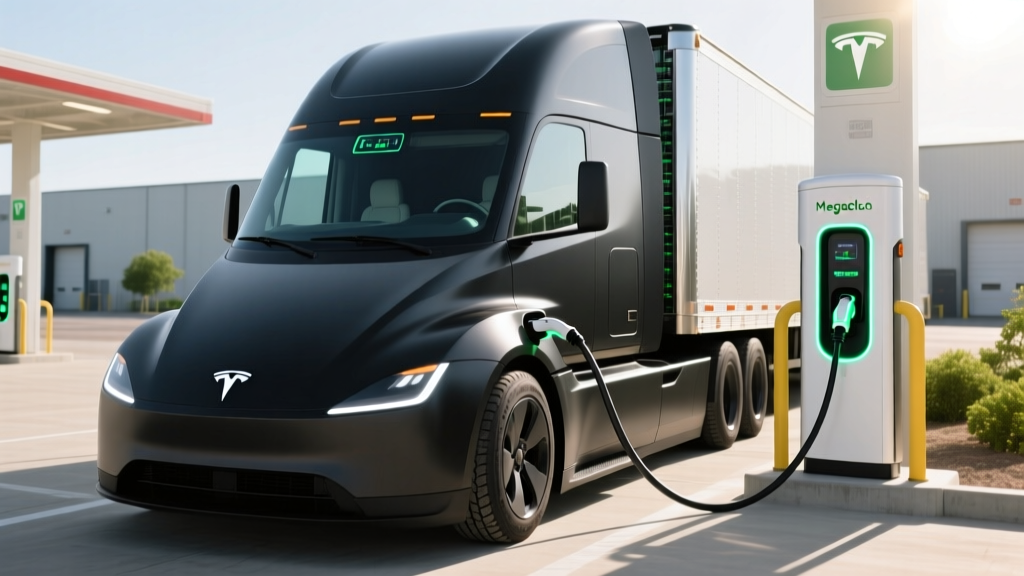
The Tesla Semi promises to reshape long-haul trucking with a claimed 500-mile range and Class 8 performance. But for fleet operators and logistics planners, the critical question isn't just how far it goes — it's how fast it recharges and what infrastructure that demands. The Tesla Semi truck charge time hinges on a new tier of charging hardware called Megachargers, which deliver power at a scale that dwarfs passenger EV infrastructure. This guide breaks down the real numbers behind Tesla Semi charging, compares it to other Class 8 electric truck platforms, and explains what fleet charging infrastructure actually costs and requires.
Tesla Semi Battery Capacity and Energy Demands
Before analyzing charge times, you need to understand the energy storage involved. Tesla has not published an official kWh figure for the Semi's battery pack, but teardown analysis and energy consumption data point to a usable capacity between 500 kWh and 900 kWh depending on the range variant. The 500-mile version is estimated at roughly 850–900 kWh of usable capacity, while the 300-mile variant likely sits around 500–550 kWh.
For context, that's approximately 10 to 12 times the battery capacity of a Tesla Model Y (75 kWh usable). The Semi consumes roughly 1.7 kWh per mile under loaded highway conditions (82,000 lbs GVW), which Tesla has confirmed in public statements. That consumption figure is the backbone of all charge-time math that follows.
kW (kilowatts) = the rate of power delivery — how fast energy flows into the battery. Think of it as the diameter of a water hose.
kWh (kilowatt-hours) = total energy stored or delivered — the actual amount of electricity. Think of it as gallons of water in a tank.
A 1.2 MW (1,200 kW) Megacharger can theoretically deliver 1,200 kWh in one hour — enough to fully charge a Semi in under an hour if sustained, which in practice it isn't due to charge-curve tapering.
Tesla Semi Truck Charge Time: Megacharger Speeds Explained
Tesla's stated benchmark for the Semi is 70% range recovery in 30 minutes using a Megacharger. For the 500-mile variant, that translates to roughly 350 miles of range added in half an hour. Here's how that breaks down across charging tiers:
| Charging Level | Power Output | Miles of Range per Hour | Estimated 10–80% Time | Use Case |
|---|---|---|---|---|
| Level 2 (AC, depot) | 40–80 kW | ~24–47 mi/hr | 12–18 hours | Overnight depot charging |
| DC Fast (CCS/MCS adapter) | 150–350 kW | ~88–206 mi/hr | 2.5–5 hours | Public truck-stop charging |
| Megacharger (DC, Tesla) | ~1,200 kW (1.2 MW) | ~700 mi/hr (peak) | ~30–45 minutes | Dedicated corridor fast-charging |
The Megacharger's 1.2 MW peak rate is roughly 4.8 times faster than the quickest passenger-car DC fast chargers (250 kW Tesla V3 Superchargers). However, the Semi's battery will not sustain peak charge rate for the entire session. Lithium-ion charge curves taper significantly above 50–60% state of charge (SoC) to protect cell longevity and manage thermal loads. Expect the sustained average rate across a 10–80% session to land closer to 800–900 kW, which still delivers that ~30-minute benchmark.
The Charge Curve Reality: Why Peak kW Is Not Sustained kW
Fleet planners making route-scheduling decisions need to understand charge-curve tapering. A Megacharger rated at 1.2 MW does not deliver 1.2 MW for the full session. Here's what a realistic Megacharger session looks like for a 500-mile Semi variant (~875 kWh usable):
- 10–30% SoC: Peak rate near 1,100–1,200 kW; ~10 minutes, ~175 kWh added (~100 miles)
- 30–50% SoC: Rate holds at ~900–1,000 kW; ~10 minutes, ~160 kWh added (~94 miles)
- 50–70% SoC: Rate tapers to ~600–750 kW; ~12 minutes, ~140 kWh added (~82 miles)
- 70–80% SoC: Significant taper to ~350–500 kW; ~10 minutes, ~70 kWh added (~41 miles)
Total 10–80%: ~42 minutes, ~545 kWh added (~317 miles of range). Tesla's marketing claim of "70% in 30 minutes" likely refers to a 0–70% session under optimal thermal conditions, but real-world scheduling should budget 40–50 minutes for a 10–80% fill.
Megacharger vs. CCS and MCS: Connector Compatibility for Class 8 Trucks
The Tesla Semi uses a proprietary Tesla connector designed for Megacharger power levels. The broader commercial EV industry is converging on the Megawatt Charging System (MCS), developed by CharIN, which targets up to 3.75 MW (3,000A at 1,250V) for heavy-duty vehicles. Here's how the connector landscape looks for fleet operators:
| Connector Standard | Max Power | Compatible Vehicles | Availability (2026) |
|---|---|---|---|
| Tesla Megacharger (proprietary) | ~1.2 MW | Tesla Semi | Limited; Tesla-deployed corridors |
| MCS (Megawatt Charging System) | Up to 3.75 MW | Freightliner eCascadia, Volvo VNR Electric, Peterbilt 579EV | Growing; WattEV, TeraWatt, utility pilots |
| CCS1 (DC fast, passenger-scale) | Up to 350 kW | All CCS EVs; Semi with adapter (limited utility) | Widespread but insufficient for Semi |
| NACS (Tesla passenger) | Up to 250–350 kW | Tesla passenger vehicles, Ford, GM, Rivian, others | Widespread; not rated for Semi power needs |
The key takeaway: the Tesla Semi cannot use standard CCS or NACS chargers at anything close to its designed charge rate. A 350 kW CCS charger would take 2+ hours to fill a 500-mile Semi from 10–80%. The Semi is effectively tethered to Tesla's Megacharger network for practical en-route charging, which is a significant fleet-planning constraint until adapters or network expansion evolve. According to the U.S. Department of Energy, MCS infrastructure deployment is accelerating but remains concentrated in California, Texas, and select freight corridors.
Fleet Depot Charging: Electrical Requirements and Installation Costs
Most fleet operators will rely on overnight depot charging rather than en-route Megachargers for daily operations. Depot charging for a fleet of Tesla Semis requires serious electrical infrastructure. Here's what a single Semi charging stall demands:
- Voltage: 480V three-phase (commercial)
- Amperage: 100–200A per stall (depending on charger power)
- Circuit: Dedicated breaker per stall with disconnect switch
- Conductor: Copper or aluminum rated for continuous load + 125% NEC safety factor
- Service panel: Most fleet depots require a new or upgraded 2,000–4,000A service to support 5–10 trucks simultaneously
| Component | Estimated Cost Range | Notes |
|---|---|---|
| DC fast charger unit (50–180 kW commercial) | $40,000–$120,000 | Price varies by power rating and vendor |
| Electrical infrastructure (transformer, conduit, wiring) | $25,000–$80,000 | Higher if new service or transformer needed |
| Permitting and utility interconnection | $5,000–$20,000 | Utility demand charges and study fees |
| Electrician labor (commercial, licensed) | $15,000–$40,000 | Varies by region and site complexity |
| Total per stall | $85,000–$260,000 | Fleet-scale installs may reduce per-unit cost 15–20% |
For a 10-truck fleet depot, total infrastructure investment can range from $850,000 to $2.6 million before any utility rebates or federal incentives. The IRS Commercial Clean Vehicle Credit (§45W) provides up to $40,000 per qualifying commercial EV, and the Alternative Fuel Infrastructure Tax Credit covers up to 30% of charging equipment costs (capped at $100,000 per item). Fleet operators should consult a tax professional to confirm eligibility, as rules around census-tract qualifications and domestic-content requirements apply.
Charging Cost per Mile: Tesla Semi vs. Diesel
The operating-cost argument for the Tesla Semi centers on energy cost per mile. Here's how it compares to diesel across different charging scenarios:
| Scenario | Energy Cost | Cost per Mile | Annual Cost (100k mi) |
|---|---|---|---|
| Tesla Semi — depot charging (off-peak commercial rate) | $0.08–$0.12/kWh | $0.14–$0.20 | $14,000–$20,000 |
| Tesla Semi — Megacharger (public/rate negotiated) | $0.20–$0.35/kWh | $0.34–$0.60 | $34,000–$60,000 |
| Diesel Class 8 truck (6.5 MPG, $3.80/gal) | $3.80/gallon | $0.58 | $58,000 |
| Diesel Class 8 truck (6.5 MPG, $4.50/gal) | $4.50/gallon | $0.69 | $69,000 |
At depot off-peak rates, the Tesla Semi delivers a 65–75% fuel cost reduction versus diesel. Even at Megacharger public rates, the Semi can undercut diesel when rates stay below $0.30/kWh. However, utility demand charges — fees based on peak power draw, not energy consumed — can significantly inflate depot charging costs for fleets that charge multiple trucks simultaneously. Some utilities offer EV-specific tariffs that mitigate this, but fleet operators must negotiate these rates proactively.
Comparing Tesla Semi Charge Time to Competing Class 8 Electric Trucks
The Tesla Semi doesn't exist in a vacuum. Here's how its charging profile compares to other Class 8 electric trucks currently in production or early deployment:
| Vehicle | Battery (kWh) | Range (mi) | Max DC Charge Rate | 10–80% Time | Connector |
|---|---|---|---|---|---|
| Tesla Semi (500 mi) | ~875 (est.) | 500 | ~1,200 kW | ~30–45 min | Tesla Megacharger |
| Freightliner eCascadia | 291–438 | 155–230 | 250 kW (MCS ready) | ~90–120 min | CCS/MCS |
| Volvo VNR Electric | 264–565 | 150–275 | 250 kW | ~70–90 min | CCS |
| Peterbilt 579EV | 267–396 | 150–200 | 150–250 kW | ~80–120 min | CCS |
The Semi's combination of range and charge speed is unmatched in the segment, but that advantage depends entirely on Megacharger availability. The eCascadia and VNR Electric can use the growing MCS/CCS public charging network being built by companies like WattEv and TeraWatt Infrastructure — an ecosystem the Semi currently cannot access without Tesla-specific infrastructure.
Safety, Code, and Thermal Management for Megawatt Charging
Charging a 900 kWh battery at 1.2 MW generates enormous thermal loads. Both the vehicle battery management system (BMS) and the charging hardware must manage heat aggressively. Key safety and code considerations for fleet installations:
- NEC Article 625: All EV charging equipment must comply with National Electrical Code Article 625, including proper grounding, GFCI protection for outdoor installations, and listed/labeled equipment (UL or equivalent).
- Liquid-cooled cables: Megacharger cables use active liquid cooling to handle 1,200 kW without cable diameters becoming impractical. These require periodic coolant maintenance.
- Battery thermal management: The Semi's BMS actively circulates coolant through the pack during fast charging. If cell temperatures exceed safe thresholds, the system will throttle charge rate automatically.
- Fire suppression: Fleet depots with multiple high-power chargers should evaluate fire suppression upgrades. Lithium-ion thermal runaway events, while rare, require Class D or specialized suppression systems — not standard sprinklers.
- Ventilation: Indoor charging areas require adequate ventilation per NFPA and local fire codes, particularly for hydrogen off-gassing risk during high-rate charging.
- Utility coordination: Any installation above 500 kW typically requires a utility interconnection study, dedicated transformer, and potentially a new medium-voltage service drop — plan 12–18 months ahead.
The National Fire Protection Association (NFPA 70, the NEC) continues to update EV charging provisions, and local jurisdictions may have additional requirements. Always engage a licensed electrical contractor experienced with commercial EV infrastructure.
Practical Fleet Route Planning with Tesla Semi Charge Times
For a 500-mile route with a loaded Tesla Semi, here's what a realistic trip looks like when accounting for charging:
- Departure: Leave depot at 95% SoC (~475 miles range)
- First leg: Drive ~350 miles (accounting for real-world highway efficiency loss of ~15% from EPA estimate under loaded conditions)
- Charge stop: Megacharger session, 10–80%, ~40 minutes (adds ~317 miles)
- Second leg: Complete remaining ~150 miles to destination
- Arrival: ~45% SoC remaining; begin overnight depot charge
Total en-route downtime: ~40 minutes for a 500-mile loaded trip. That's competitive with a diesel truck's mandatory 30-minute HOS (hours of service) rest break, meaning the charge stop can overlap with driver rest requirements — a crucial operational advantage.
Frequently Asked Questions
How long does it take to charge a Tesla Semi from 0 to 100%?
At a Megacharger (1.2 MW), a full 0–100% session would take approximately 60–75 minutes. However, charging above 80% slows dramatically due to cell-balancing and taper, so fleet operators should plan around 10–80% sessions (~40 minutes) for efficiency. Overnight depot charging at 80 kW takes roughly 10–12 hours for a full charge.
Can the Tesla Semi use regular Tesla Superchargers?
No. Tesla Superchargers (V3 at 250 kW or V4 at ~350 kW) use NACS connectors rated for passenger vehicles. The Semi requires a Megacharger with a higher-current connector and 480V+ three-phase supply. The physical connector and power delivery protocol are different.
How much does a Tesla Megacharger cost to install?
Tesla has not published public pricing for Megacharger installations. Industry estimates for megawatt-class DC chargers range from $200,000 to $500,000+ per stall including equipment, electrical infrastructure, utility interconnection, and permitting. Tesla typically deploys Megachargers at its own sites or in partnership with fleet customers.
Does the Tesla Semi support MCS (Megawatt Charging System)?
As of 2026, Tesla has not announced MCS compatibility for the Semi. The truck uses Tesla's proprietary Megacharger connector. This is a notable risk for fleet operators who want interoperability with the broader public heavy-duty charging network being built around the MCS standard.
What is the Tesla Semi's energy consumption per mile?
Tesla has stated the Semi consumes less than 2 kWh per mile. Real-world testing and fleet data suggest ~1.7 kWh/mile under typical loaded highway conditions (82,000 lbs GVW, flat terrain, moderate temperatures). Hilly routes, extreme cold, or high-speed operation can push consumption to 2.0–2.3 kWh/mile.
How does cold weather affect Tesla Semi charging and range?
Cold temperatures (below 32°F / 0°C) reduce lithium-ion charge acceptance rates and increase cabin/battery heating loads. Expect 10–20% range reduction and 15–25% longer charge times in freezing conditions. The Semi's heat pump and route-aware preconditioning mitigate but do not eliminate these losses.