Quick Verdict: Is the Tesla Semi's Range Enough for Real Freight?
The Tesla Semi enters 2026 as the most scrutinized Class 8 electric truck on the road. With an official EPA-estimated range of 500 miles (loaded at 82,000 lbs GVWR) for the long-range variant and 300 miles for the standard variant, it targets regional and short-haul drayage where diesel costs dominate operating budgets. But fleet operators need more than a headline number — they need to understand charging infrastructure, depot electrical requirements, energy consumption per mile, and whether the Tesla Semi range holds up under real-world freight conditions.
Tesla Semi Specifications: Battery, Range, and Efficiency
Tesla has not published the exact usable battery capacity of the Semi, but teardown analyses and energy consumption data point to a pack in the 800–900 kWh range for the 500-mile variant. The truck consumes approximately 1.7 kWh per mile under the EPA test cycle — a remarkable figure for a Class 8 vehicle, achieved through the tri-motor powertrain, regenerative braking, and an aerodynamic drag coefficient significantly lower than conventional diesel cabovers.
| Spec | Standard Range | Long Range |
|---|---|---|
| EPA-Est. Range (loaded) | 300 mi | 500 mi |
| Est. Battery Capacity | ~500 kWh | ~850 kWh |
| Energy Consumption | ~1.7 kWh/mi | ~1.7 kWh/mi |
| Powertrain | Tri-Motor AWD | Tri-Motor AWD |
| 0-60 mph (loaded) | ~20 sec | ~20 sec |
| Max Grade | Sustained 65 mph at 5% grade | Sustained 65 mph at 5% grade |
| Base MSRP (est.) | $250,000 | $290,000 |
Sources: Tesla Semi product page, EPA. Pricing is estimated based on reservation disclosures; final MSRP subject to change.
Charging the Tesla Semi: Megacharger, DC Fast, and Depot Levels
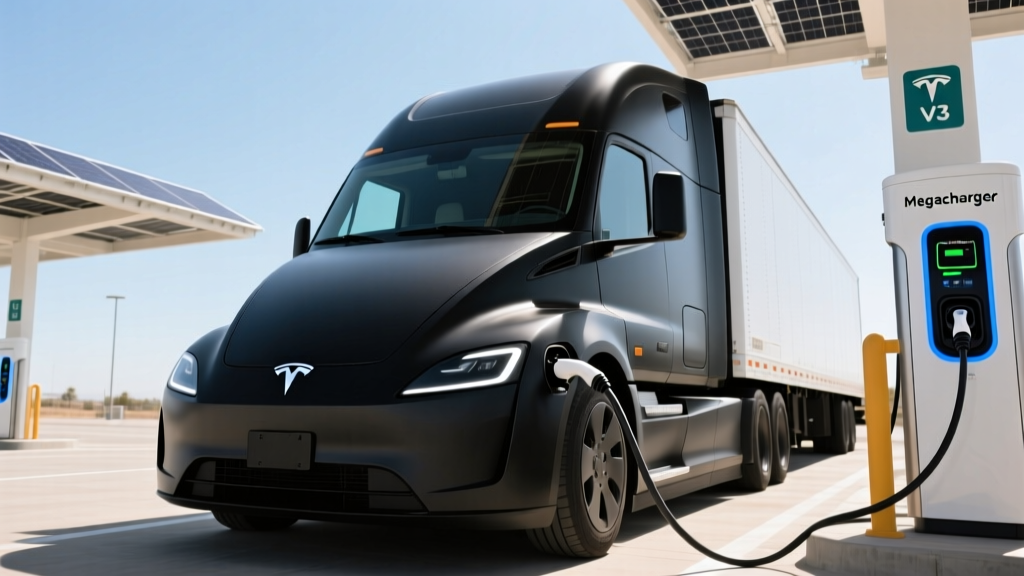
Charging a battery pack this large requires infrastructure far beyond passenger EV norms. The Semi uses the Megacharging standard — a proprietary Tesla connector delivering up to ~1.2 MW (1,200 kW) of peak DC power. This is roughly four times the peak rate of a consumer Tesla Supercharger V4 stall.
Understanding charging levels for a Class 8 EV requires thinking in different terms than a sedan. Here's how the tiers break down for the Tesla Semi:
| Level | Power (kW) | Miles Added/Hour | 10–80% Time (500-mi) | Use Case |
|---|---|---|---|---|
| Level 2 (Depot AC) | 19.2–40 kW | 11–24 mi/hr | 24–48+ hours | Overnight/top-off only |
| DC Fast (CCS/MCS) | 150–350 kW | 88–206 mi/hr | 2–5 hours | Opportunity charging |
| Megacharger (Tesla) | Up to 1,200 kW | ~700 mi/hr | ~30 min | Primary fast charge |
Critical distinction: kW (kilowatts) measures power — the rate of energy delivery. kWh (kilowatt-hours) measures energy — the total capacity of the battery. A 1,200 kW Megacharger delivers energy at a rate that can add roughly 700 miles of range per hour to the Semi's ~850 kWh pack, but the charge curve tapers significantly above 80% State of Charge to protect battery health.
Depot Charging Infrastructure: Electrical Requirements and Installation Costs
For fleet operators, the Tesla Semi's charging needs translate into significant depot electrical upgrades. A single Megacharger stall drawing 1.2 MW requires medium-voltage utility service — typically a dedicated transformer and switchgear rated for 480V three-phase power at 1,500+ amps. Most commercial depots will need a utility upgrade, new pad-mounted transformer, and potentially a new service drop from the local grid.
For operators using DC fast chargers from third-party networks (using the CharIN MCS connector standard or CCS adapters), a single 350 kW stall requires 480V three-phase at approximately 500 amps.
| Component | Megacharger (per stall) | 350 kW DC Fast (per stall) |
|---|---|---|
| Charger Equipment | $150,000–$250,000 | $80,000–$150,000 |
| Utility Service Upgrade | $200,000–$500,000+ | $50,000–$200,000 |
| Electrical Contractor | $100,000–$200,000 | $30,000–$80,000 |
| Permits & Engineering | $20,000–$50,000 | $10,000–$30,000 |
| Total Per Stall | $470,000–$1,000,000 | $170,000–$460,000 |
These costs scale non-linearly: adding 4–8 stalls may share a single transformer and trench, reducing per-stall cost. Utility demand charges (often $10–$25 per peak kW per month) can add $12,000–$30,000/month to operating costs for a multi-stall depot. Fleet operators should engage with their utility early — some offer EV infrastructure make-ready programs that cover a portion of the utility-side costs.
Connector Compatibility: Megacharging, MCS, and CCS
The Tesla Semi uses a proprietary Megacharging connector that is physically larger than the NACS (North American Charging Standard) connector used on Tesla passenger vehicles. As of 2026, the Megacharging connector is not compatible with public CCS or NACS networks without adapters, and Tesla has not broadly licensed the Megacharging standard to third-party charger manufacturers.
| Connector | Max Power | Compatible Vehicles | Network Availability |
|---|---|---|---|
| Tesla Megacharger | ~1,200 kW | Tesla Semi only | Tesla depot/route-specific |
| MCS (Megawatt Charging System) | Up to 3,750 kW (spec) | Freightliner eCascadia, Volvo VNR Electric, future HD trucks | Emerging; WattEV, TeraWatt, PACCAR |
| CCS1 (DC) | Up to 350 kW | Light/medium-duty EVs, some Class 8 via adapter | Widespread public |
| NACS | Up to 250–350 kW | Tesla passenger, Ford, GM, Rivian, others | Tesla Supercharger + open networks |
Fleet operators running mixed fleets (Tesla Semi alongside Freightliner eCascadia or Volvo VNR Electric) will need separate charging infrastructure or invest in the emerging MCS standard, which aims to become the universal heavy-duty connector. The MCS connector, developed by CharIN, supports up to 1,250A at 3,000V DC, but as of 2026, most public MCS installations are pilot-stage.
Cost to Charge: Per-Mile Economics vs. Diesel
The primary economic argument for the Tesla Semi is fuel-cost savings. At 1.7 kWh per mile, electricity costs per mile depend heavily on where and when you charge:
| Scenario | Rate ($/kWh) | Cost/Mile | vs. Diesel ($4.20/gal, 6.5 mpg) |
|---|---|---|---|
| Depot Off-Peak (utility rate) | $0.06–$0.10 | $0.10–$0.17 | Save $0.48–$0.55/mi |
| Depot On-Peak | $0.12–$0.20 | $0.20–$0.34 | Save $0.31–$0.45/mi |
| Public DC Fast | $0.30–$0.50 | $0.51–$0.85 | Save $0.00–$0.14/mi (or lose) |
| Diesel Baseline | — | $0.65 | — |
At 100,000 miles per year, depot off-peak charging saves a fleet roughly $48,000–$55,000 annually in fuel alone per truck. However, relying on public DC fast charging at $0.40+/kWh erases much of the advantage. Fleet economics demand depot charging — the Semi's business case collapses without it.
Demand charges complicate the picture further. A depot pulling 2 MW during peak hours in a utility territory with $20/kW demand charges faces $40,000/month in demand fees alone. Battery energy storage systems (BESS) and smart charge management software (like managed charging solutions) are essential to control these costs.
Equipment Recommendations for Fleet Depot Charging
While Tesla's Megacharger is the primary solution for Tesla Semi operators, fleets may need supplemental or mixed-fleet equipment. Here are current heavy-duty-capable options:
Tesla Megacharger
- Power: Up to 1,200 kW DC
- Connector: Proprietary Megacharging
- Cable: Integrated, liquid-cooled
- Smart Features: Fleet API, remote scheduling, OTA updates
- Price: Not sold separately; bundled with Semi purchase agreements
- Availability: Tesla-direct only; route-specific installations
ABB Terra 360 (HD Config)
- Power: Up to 360 kW DC
- Connector: CCS1 (MCS adapter in development)
- Cable: 25 ft, liquid-cooled
- Smart Features: ABB Ability cloud, load management
- Price: $120,000–$180,000 (equipment only)
- Best For: Mixed-fleet opportunity charging
ChargePoint Express Plus (HD)
- Power: Up to 400 kW DC (modular)
- Connector: CCS1, MCS-ready
- Cable: 25 ft, liquid-cooled
- Smart Features: ChargePoint Cloud, fleet dashboard, dynamic power sharing
- Price: $130,000–$200,000 (equipment only)
- Best For: Scalable multi-stall depot
Safety, Code, and Permit Considerations
Heavy-duty EV charging installations are governed by NEC Article 625 (Electric Vehicle Charging Equipment) and local amendments. Key requirements for Tesla Semi depot installations include:
- Dedicated circuits: Each Megacharger or DC fast charger requires its own dedicated breaker and disconnect, sized to 125% of continuous load per NEC 210.20.
- Ground-fault protection: GFCI protection is required for all outdoor receptacles and is strongly recommended for hardwired HD installations, even where not strictly mandated by code.
- Outdoor rating: All outdoor equipment must carry a NEMA 3R or NEMA 4 enclosure rating. Megacharger stalls are rated for outdoor operation but require concrete pads with proper drainage.
- Ventilation and thermal management: Liquid-cooled chargers generate significant heat in power electronics cabinets. Indoor installations require mechanical ventilation rated to the charger's BTU output.
- Utility interconnection: Any installation above 500 kW typically triggers a utility interconnection study, which can take 6–18 months. Begin this process during vehicle lead time.
- Emergency shutoff: A clearly labeled, accessible emergency disconnect is required within sight of the charging equipment per NEC 625.40.
Always engage a licensed electrical contractor experienced with medium-voltage commercial work. The final installation spec must comply with your local AHJ (Authority Having Jurisdiction) and utility requirements.
Frequently Asked Questions
What is the real-world Tesla Semi range under a full load?
The EPA-estimated range is 500 miles for the long-range variant at 82,000 lbs GVWR. In real-world highway operation at sustained speeds with a full 80,000-lb payload, expect 375–425 miles. Cold weather, mountain grades, and high-speed operation reduce this further. Stop-and-go drayage with heavy regenerative braking can sometimes exceed EPA estimates due to energy recovery.
How much does it cost to install depot charging for a Tesla Semi?
A single Megacharger stall fully installed ranges from $470,000 to over $1,000,000, depending on utility service availability. A 350 kW DC fast charger costs $170,000–$460,000 installed. The dominant cost variable is the utility service upgrade — if your depot already has 480V three-phase with sufficient spare capacity, costs drop dramatically. Always get a utility feasibility study before committing.
How fast does a Megacharger add range to the Tesla Semi?
At peak power (~1,200 kW), a Megacharger adds approximately 700 miles of range per hour, enabling a 10–80% charge in roughly 30 minutes on the 500-mile variant. However, the charge curve tapers above 60–80% SoC, so a full 10–95% session takes closer to 45–60 minutes. Battery preconditioning is critical for achieving peak rates.
Can I charge a Tesla Semi at a public Supercharger or CCS station?
No. The Tesla Semi uses the proprietary Megacharging connector, which is incompatible with NACS Superchargers or public CCS1 stations. The Semi requires Megacharger infrastructure or future MCS-compatible heavy-duty chargers. This is a significant operational constraint for long-haul routes lacking Tesla-installed Megacharger corridors.
How does the Tesla Semi's energy cost compare to diesel per mile?
At 1.7 kWh/mile and depot off-peak rates of $0.06–$0.10/kWh, the Semi costs $0.10–$0.17 per mile in electricity. A comparable diesel truck at 6.5 mpg and $4.20/gal costs ~$0.65/mile. The savings are $0.48–$0.55 per mile — but only with depot charging. Public DC fast charging at $0.30–$0.50/kWh erases most of the advantage.
What electrical upgrades does a depot need for Semi charging?
Most depots require a new utility service drop (480V three-phase, 1,500+ amps for multiple Megachargers), a pad-mounted transformer, new switchgear, and trenching for conduit runs. The utility interconnection process alone can take 6–18 months. Some fleets install battery energy storage to reduce demand charges and buffer peak loads.