The 2026 Tesla Model Y Performance remains one of the most popular electric vehicles on the road, combining a blistering 3.5-second 0-60 mph time with practical daily range. But as more EV owners explore using their car battery to power home devices or even run a house during outages, a critical question has emerged: does the Model Y Performance support bidirectional charging, and what does a full home charging setup look like in 2026?
This guide covers everything you need to know — from the current state of Tesla's bidirectional capability to exact home charger installation costs, charging speeds at every level, and the electrical upgrades your panel may require.
Tesla Model Y Performance: Does It Support Bidirectional Charging?
As of the 2026 model year, the Tesla Model Y Performance does not natively support bidirectional charging — neither Vehicle-to-Home (V2H) nor Vehicle-to-Load (V2L). Tesla's North American vehicles currently charge in one direction only: from the grid or solar into the battery, and from the battery into the drivetrain.
This stands in contrast to competitors like the Ford F-150 Lightning (which offers Pro Power Onboard with up to 9.6 kW V2L and full V2H via the Charge Station Pro), the Hyundai Ioniq 5 (V2L via the internal port and adapter), and the GMC Sierra EV. Tesla has hinted at future bidirectional support in regulatory filings and CEO commentary, but no hardware retrofit or OTA enablement has been announced for existing Model Y vehicles.
| Specification | Value |
|---|---|
| Battery Capacity (usable) | ~78 kWh (NMC chemistry) |
| EPA Range | 277 miles |
| Real-World Highway Range | ~230–250 miles (70+ mph, moderate temps) |
| Max DC Fast Charge Rate | 250 kW (peak) |
| 10–80% DC Fast Charge Time | ~27 minutes (at V3/V4 Supercharger) |
| Level 2 AC Charge Rate | 11.5 kW (48A onboard charger) |
| Level 2 Time (10–80%) | ~5.5 hours at 48A / ~8 hours at 32A |
| Bidirectional (V2H / V2L) | Not supported (2026 model year) |
| Connector | NACS (native Tesla) |
| 0–60 mph | 3.5 seconds |
| Horsepower | ~456 hp (dual motor) |
| Base MSRP | $52,490 (before incentives) |
Sources: fueleconomy.gov, Tesla Model Y specs
Charging Levels Explained: Speeds, kW, and Miles Per Hour
Understanding EV charging requires keeping two units straight: kW (kilowatts) measures power — how fast energy flows into your car. kWh (kilowatt-hours) measures energy — how much the battery holds. Think of kW as the speed of water flowing through a hose, and kWh as the size of the bucket.
| Level | Voltage | Power (kW) | Miles of Range Added Per Hour | Best Use Case |
|---|---|---|---|---|
| Level 1 (120V outlet) | 120V | 1.2–1.4 kW | ~3–5 miles/hr | Emergency/overnight trickle |
| Level 2 (240V home/public) | 240V | 7.2–11.5 kW | ~25–44 miles/hr | Daily home charging |
| DC Fast Charging | 400–800V DC | 50–250 kW | ~200–1,000+ miles/hr (peak) | Road trips, quick top-ups |
The Model Y Performance's onboard AC charger maxes out at 11.5 kW (48 amps). Even if you connect a 19.2 kW Level 2 charger, the car will only draw 11.5 kW. This matters when choosing home equipment — spending extra on a charger rated above 48A provides no benefit for this vehicle.
On DC fast charging, the Model Y Performance can peak at 250 kW on a V3 or V4 Tesla Supercharger. However, peak rate is not sustained rate. The charging curve tapers significantly above 50–60% state of charge. A 10–80% session takes roughly 27 minutes under ideal conditions (battery preconditioned, warm ambient temperature). From 80–100%, expect an additional 20–25 minutes due to the taper.
Home Charger Installation: Electrical Requirements and Costs
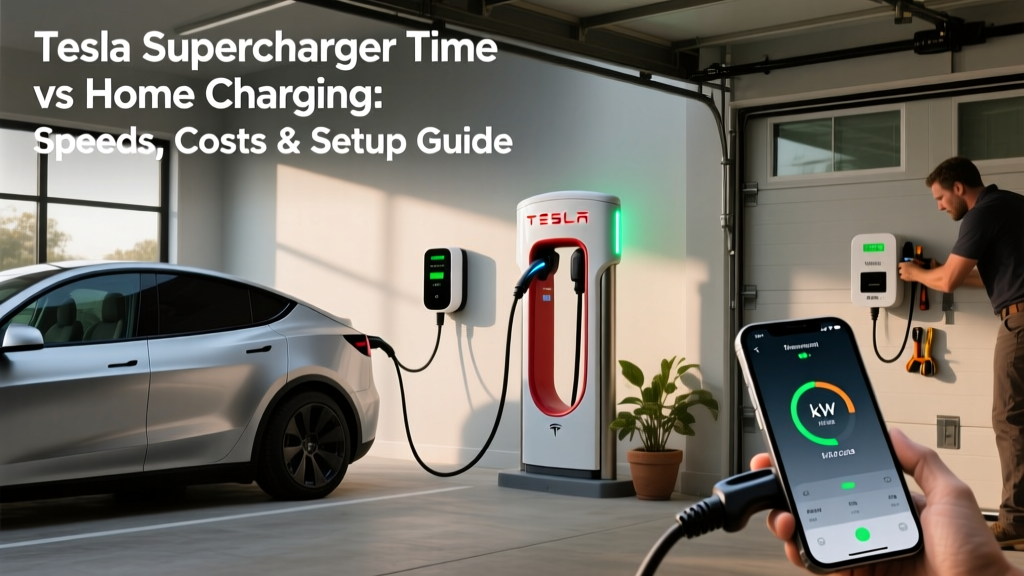
Installing a Level 2 home charger is the single biggest ownership upgrade for any EV driver. For the Model Y Performance, you want a 240V circuit capable of delivering at least 48 amps to match the car's 11.5 kW onboard charger.
Electrical Requirements
- Circuit: Dedicated 60-amp breaker (for continuous 48A draw — NEC requires circuits rated at 125% of continuous load)
- Wire: 6 AWG copper (or 4 AWG aluminum) for a 60A circuit
- Outlet vs. hardwired: NEMA 14-50 outlet (50A circuit) is common and allows charger portability; hardwired is required for full 60A/48A continuous operation and is generally safer for high-amperage setups
- Panel capacity: Most modern 200-amp panels can accommodate a 60A EV circuit. Older 100-amp panels almost certainly need an upgrade.
Do You Need a Panel Upgrade?
This is the cost variable that catches many homeowners off guard. If your home has a 100-amp service panel, or if your panel is near capacity with existing loads (electric range, dryer, HVAC, water heater), adding a 60A EV circuit may require a panel upgrade to 200 amps — or, in some cases, a full service upgrade from the utility.
A licensed electrician will perform a load calculation per NEC Article 220 to determine if your panel can handle the additional draw. Don't skip this step — overloading a panel is a fire hazard.
| Component | Typical Cost Range | Notes |
|---|---|---|
| Level 2 Charger (Equipment) | $350–$750 | 40A–48A Wi-Fi-enabled units |
| Electrician Labor | $500–$2,000 | Depends on run length, wall type, conduit |
| Electrical Permit | $50–$250 | Varies by municipality |
| Panel Upgrade (if needed) | $1,500–$4,000 | 200A upgrade from 100A service |
| Utility Service Upgrade (if needed) | $3,000–$8,000+ | Rare; older homes with 60–100A service |
| Total (no panel upgrade) | $900–$3,000 | Most common scenario |
| Total (with panel upgrade) | $2,400–$7,000 | Older homes |
Federal incentive: The Alternative Fuel Vehicle Refueling Property Credit (IRS Form 8911) may cover up to 30% of home charger equipment and installation costs (capped at $1,000) if you live in an eligible census tract. Check IRS guidance for current-year eligibility.
Connector Compatibility: NACS, CCS, and Adapters
The 2026 Model Y Performance ships with a native NACS (North American Charging Standard) port — Tesla's proprietary connector, now adopted industry-wide. This means you can plug directly into any Tesla Supercharger or Destination Charger without an adapter.
With the broader industry transition to NACS, most new public DC fast chargers installed in 2025–2026 now include NACS connectors alongside or in place of CCS1. However, older CCS-only stations still exist, and Tesla sells a CCS-to-NACS adapter (~$175) for compatibility.
| Connector Type | Native Support? | Adapter Needed? | Where You'll Find It |
|---|---|---|---|
| NACS (Tesla) | Yes — native | No | Tesla Superchargers, new public DCFC, home chargers |
| CCS1 | No | Yes — Tesla CCS Adapter (~$175) | Older Electrify America, EVgo, ChargePoint stations |
| CHAdeMO | No | Third-party adapters exist but uncommon | Largely legacy; Nissan Leaf, older stations |
| J1772 (Level 2 AC) | No (NACS port) | Yes — J1772-to-NACS adapter (included with car) | Public Level 2, non-Tesla home chargers |
The Model Y ships with a J1772-to-NACS adapter in the glovebox, so you can use any public Level 2 charger. For home, Tesla's Wall Connector uses NACS natively, so no adapter is needed.
Cost to Charge: Home vs. Public vs. Gas
One of the strongest economic arguments for the Model Y Performance is fuel cost savings — but the numbers depend heavily on where and when you charge.
| Scenario | Rate | Cost Per Mile | Annual Cost (12,000 mi) |
|---|---|---|---|
| Home (off-peak utility rate) | $0.12/kWh | $0.034 | $408 |
| Home (average US rate) | $0.17/kWh | $0.048 | $576 |
| Public Level 2 (network rate) | $0.30/kWh | $0.085 | $1,020 |
| DC Fast Charging (Supercharger/EA) | $0.38/kWh | $0.108 | $1,296 |
| Gas equivalent (25 MPG, $3.50/gal) | $3.50/gallon | $0.140 | $1,680 |
Calculation basis: Model Y Performance consumes approximately 28 kWh/100 miles (3.57 miles/kWh) in mixed driving per EPA data.
At home off-peak rates, the Model Y Performance costs roughly $0.03–$0.05 per mile to "fuel" — about one-quarter the cost of a comparable gas performance SUV. Even exclusive DC fast charging at $0.38/kWh still undercuts gasoline on a per-mile basis, though the gap narrows significantly.
Pro tip: If your utility offers time-of-use (TOU) rates, schedule charging between 10 PM and 6 AM for the lowest per-kWh cost. The Tesla app and most smart chargers support scheduled charging natively.
Recommended Home Chargers for the Model Y Performance
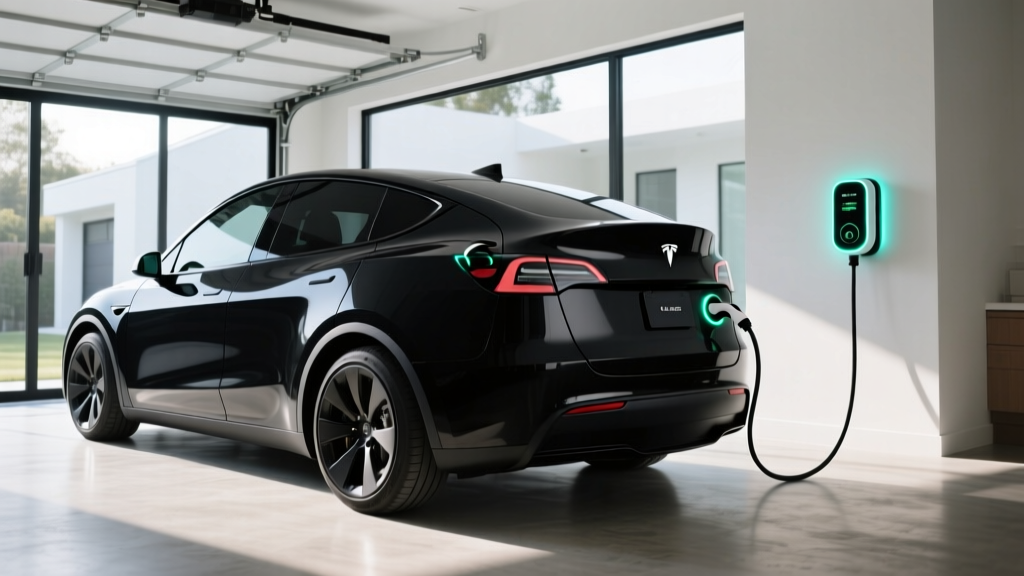
Since the Model Y's onboard charger tops out at 11.5 kW (48A), the ideal home charger delivers 48A on a hardwired 60A circuit. Here are three top picks for 2026:
Tesla Wall Connector (Gen 4)
- Power Output: 11.5 kW (48A)
- Connector: NACS (native — no adapter)
- Cable Length: 24 feet
- Smart Features: Wi-Fi, OTA updates, Tesla app integration, load sharing with Powerwall, access control
- Price: ~$475
- Verdict: The default choice for Tesla owners. Seamless integration, clean aesthetics, and the only charger that can communicate directly with the Tesla app for charge scheduling and history.
ChargePoint Home Flex (NACS)
- Power Output: Up to 12 kW (50A, adjustable down to 16A)
- Connector: NACS (2025+ models) or J1772 with adapter
- Cable Length: 23 feet
- Smart Features: Wi-Fi, ChargePoint app, Alexa integration, flexible amperage for panel-constrained homes
- Price: ~$599
- Verdict: Best for multi-EV households (Tesla + non-Tesla) or homes where you may want to adjust amperage without an electrician visit.
Emporia Vue Smart EV Charger
- Power Output: 11.5 kW (48A)
- Connector: NACS (2025+ models) or J1772
- Cable Length: 24 feet
- Smart Features: Wi-Fi, energy monitoring via Emporia Vue panel integration, solar-aware charging, scheduling
- Price: ~$399
- Verdict: Best budget smart charger with energy monitoring. Ideal if you have solar panels and want to charge only from excess solar production.
Safety, Code, and Installation Best Practices
EV charging draws sustained high current for hours — this is fundamentally different from intermittent loads like a dryer or oven. Proper installation is non-negotiable for safety.
- Dedicated circuit: Your EV charger must be on its own dedicated breaker. Sharing a circuit with other appliances violates NEC and creates a fire risk.
- GFCI protection: NEC 2020 and later require GFCI (Ground Fault Circuit Interrupter) protection for outdoor receptacles. Hardwired chargers may be exempt depending on jurisdiction — ask your electrician.
- Outdoor rating: If mounting outside, ensure the charger is NEMA 4 rated (weatherproof). The Tesla Wall Connector and ChargePoint Home Flex both carry NEMA 4 ratings.
- Permit and inspection: Most jurisdictions require an electrical permit for EV charger installation. The inspection ensures code compliance and is often required to claim the federal refueling property credit.
- Wire gauge: Undersized wire on a 60A circuit causes overheating. Your electrician should pull 6 AWG copper minimum — never accept 8 AWG on a 60A breaker.
Bidirectional Charging: When Will Tesla Add It?
Tesla has acknowledged bidirectional charging development, and the Cybertruck was initially expected to support V2L. However, as of early 2026, no Tesla production vehicle offers consumer-accessible bidirectional capability.
The technical barriers are not insurmountable — Tesla's vehicles already have large NMC batteries capable of delivering substantial power. The limitations appear to be strategic rather than technical: Tesla may be prioritizing its Powerwall home battery ecosystem over vehicle-based backup power, or waiting for regulatory and interconnection standards to mature.
If bidirectional charging is a dealbreaker for your purchase decision, the Ford F-150 Lightning (V2H via Ford Charge Station Pro + Home Integration System), Hyundai Ioniq 5 (V2L via internal port), and Kia EV9 (V2L) currently offer the capability. For the Model Y Performance, you'll need a separate home battery like the Tesla Powerwall 3 ($9,200+ installed) for backup power.
Frequently Asked Questions
How much does it cost to install a home EV charger for a Tesla Model Y?
Expect $900–$3,000 for a standard installation (equipment + electrician + permit) if your electrical panel has sufficient capacity. If a panel upgrade from 100A to 200A is needed, add $1,500–$4,000. The Tesla Wall Connector costs ~$475, and electrician labor typically runs $500–$2,000 depending on the wire run distance from your panel to the garage.
How fast will each charging level add range to my Model Y Performance?
Level 1 (120V standard outlet) adds roughly 3–5 miles per hour — only practical for overnight trickle charging. Level 2 (240V, 48A) adds approximately 44 miles per hour, fully replenishing the battery overnight. DC fast charging at 250 kW can add up to 200 miles in about 15 minutes at peak rate, though the curve tapers above 50–60% SoC.
Which connector does the 2026 Model Y Performance use?
It uses the NACS (North American Charging Standard) connector natively. This plugs directly into all Tesla Superchargers and the growing number of NACS-equipped public chargers. For CCS-only stations, you'll need Tesla's CCS-to-NACS adapter (~$175). A J1772-to-NACS adapter is included with the car for public Level 2 chargers.
How much does charging cost per mile vs. gas?
At home off-peak rates ($0.12/kWh), the Model Y Performance costs about $0.034 per mile — roughly $408 per year for 12,000 miles. A comparable gas SUV at 25 MPG and $3.50/gallon costs $0.14/mile or $1,680 annually. Even exclusive DC fast charging ($0.38/kWh) at $0.108/mile still beats gasoline.
What electrical upgrades might I need for a home charger?
If your home has a 200-amp panel with available capacity, you likely need only a new 60A breaker and wire run. Homes with 100-amp panels, or panels already near capacity, will need a service upgrade ($1,500–$4,000+). A licensed electrician must perform a NEC Article 220 load calculation to determine your specific needs — never guess on this.
Can I use my Model Y Performance to power my home during an outage?
No. The 2026 Model Y Performance does not support V2H (Vehicle-to-Home) or V2L (Vehicle-to-Load) bidirectional charging. For home backup power, you'll need a separate battery system such as the Tesla Powerwall 3 or a generator. Competitors like the Ford F-150 Lightning do offer V2H capability.