The Tesla Model Y Long Range remains one of the most popular electric vehicles on the road, and for good reason: a 4.8-second 0-60 mph time, an EPA-estimated 320 miles of range, and access to the most reliable DC fast-charging network in North America. But owning a Model Y Long Range is only half the equation. How you charge it at home — and what that setup actually costs — determines whether your EV ownership experience is seamless or a daily frustration.
This guide walks through every charging layer relevant to the 2026 Tesla Model Y Long Range, from the electrical panel in your garage to the NACS connector on the car, with exact numbers on cost, speed, and installation requirements.
Tesla Model Y Long Range: The Charging-Relevant Specs
Before sizing a home charger, you need to know what the car can accept. The 2026 Model Y Long Range AWD uses a 78.1 kWh usable battery pack (NMC chemistry), EPA-rated at 320 miles. Here are the numbers that matter for charging infrastructure:
| Spec | 2026 Model Y Long Range AWD |
|---|---|
| EPA Range | 320 miles |
| Real-World Highway Range | ~265–285 mi (70+ mph, moderate temps) |
| Real-World Cold-Weather Range | ~220–250 mi (below 32°F) |
| Battery (Usable) | 78.1 kWh, NMC |
| Max AC Charge Rate (Level 2) | 11.5 kW (48A) |
| Max DC Fast Charge Rate | 250 kW (peak) |
| 10–80% DC Fast Charge Time | ~27 minutes (at V3 Supercharger) |
| Onboard Charger | 11.5 kW / 48A max |
| Connector | NACS (native Tesla) |
| 0–60 mph | 4.8 seconds |
| Horsepower | 384 hp |
| Base MSRP | $44,990 (before incentives) |
| Federal Tax Credit (§30D) | Up to $7,500 (point-of-sale); subject to income, MSRP cap, and battery-sourcing rules — verify at IRS.gov |
| Battery Warranty | 8 years / 120,000 miles (≥70% retention) |
Charging Levels Explained: kW, Speed, and What Each Adds
A critical distinction every EV owner must internalize: kW (kilowatts) measures power — how fast energy flows into the car. kWh (kilowatt-hours) measures energy — the total capacity of the battery. Think of kW as the width of a hose and kWh as the size of the bucket. A wider hose (higher kW) fills the bucket (kWh) faster.
The Model Y Long Range's 78.1 kWh battery is the bucket. The charger's kW output determines how long filling takes.
| Level | Voltage | Max kW | Miles Added per Hour | Full Charge Time (0–100%) |
|---|---|---|---|---|
| Level 1 (Standard 120V Outlet) | 120V / 12A | ~1.4 kW | ~3–5 mi/hr | ~55–70 hours |
| Level 2 (240V Home Charger) | 240V / 48A | 11.5 kW | ~37–44 mi/hr | ~7–8 hours |
| DC Fast Charge (V3 Supercharger) | 400V DC | 250 kW (peak) | ~1,000+ mi/hr (peak) | 10–80% in ~27 min |
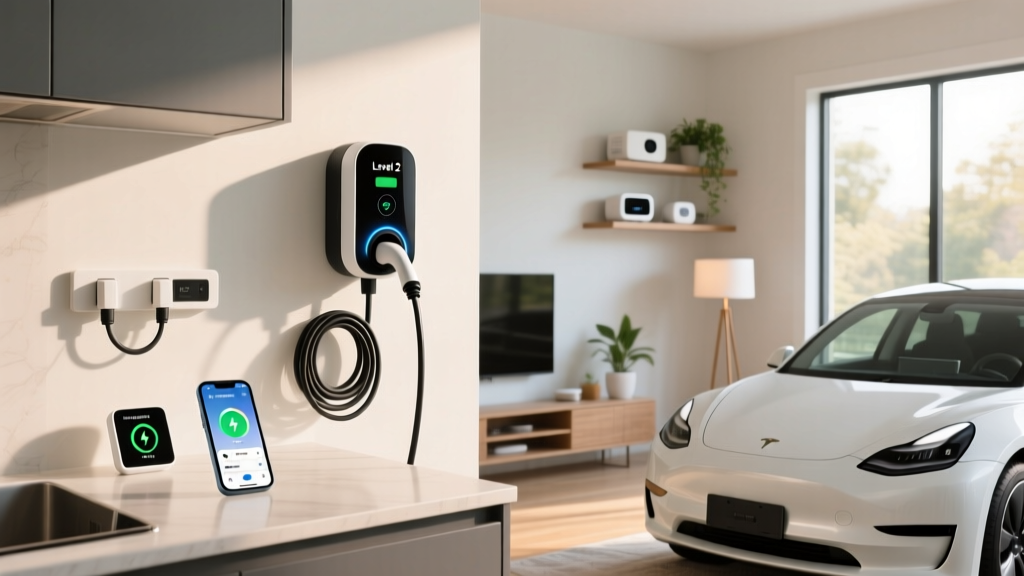
For daily driving, Level 2 at home is the backbone. A 48A, 11.5 kW charger replenishes roughly 40 miles of range per hour plugged in. If your daily commute is 40–60 miles round-trip, plugging in overnight fully restores your battery every night. Level 1 is a backup option — useful for emergencies or very low-mileage drivers, but painfully slow for regular use.
How Much Does It Cost to Install a Home EV Charger?
Home charger installation cost varies enormously based on your electrical panel's capacity, the distance from the panel to the charging location, and local permit requirements. Here's a realistic breakdown for a typical 240V / 48A Level 2 installation:
| Component | Typical Cost Range | Notes |
|---|---|---|
| Level 2 Charger (Hardware) | $400–$750 | 48A smart charger, 24ft cable, NACS |
| Electrician Labor | $500–$2,000 | Depends on run length, conduit, wall type |
| Electrical Permit | $50–$300 | Varies by municipality |
| Panel Upgrade (if needed) | $1,500–$4,000 | Required if panel is maxed at 100A or lacks spare slots |
| Total (no panel upgrade) | $950–$3,050 | Most homes with 200A service |
| Total (with panel upgrade) | $2,450–$7,050 | Older homes with 100A service |
What Electrical Upgrades Might I Need?
A 48A Level 2 charger requires a dedicated 60A circuit (the National Electrical Code requires circuits to be rated at 125% of continuous load, so 48A × 1.25 = 60A breaker). Your home needs:
- 200A electrical service (standard in most homes built after 2000; older homes may have 100A)
- Two adjacent breaker slots in your panel for a 240V double-pole breaker
- Sufficient panel headroom — if your existing loads (HVAC, dryer, oven, water heater) already consume 160A+ of your 200A service, an electrician may recommend a panel upgrade or a load-management device
If your panel is maxed out, options include upgrading to a 200A or 400A panel, or installing an automatic load-management system (like the Emporia Load Management or Span smart panel) that throttles the charger when other high-draw appliances kick on. This avoids a full panel upgrade and can save $2,000+.
The U.S. Department of Energy recommends getting at least two quotes from licensed electricians and confirming they have EV charger installation experience.
NACS, CCS, and CHAdeMO: Connector Compatibility for Your EV
The 2026 Tesla Model Y Long Range comes with a native NACS (North American Charging Standard) port — Tesla's proprietary connector, now adopted by Ford, GM, Rivian, Hyundai, and most major automakers. This means:
- At home: You plug directly into any NACS-equipped Level 2 charger — no adapter needed.
- At Tesla Superchargers: Direct plug-in, no adapter. Over 25,000 V3/V4 stalls across North America.
- At CCS-equipped public chargers (Electrify America, EVgo): You'll need a CCS-to-NACS adapter (~$150–$250). Tesla sells an official adapter, and third-party options from Lectron and A2Z are available.
| Connector | Used By | Model Y Compatibility |
|---|---|---|
| NACS (Tesla) | Tesla, Ford, GM, Rivian, Hyundai, Kia (2025+) | Native — no adapter |
| CCS1 | Most non-Tesla EVs (pre-2025), Electrify America stations | Requires CCS-to-NACS adapter |
| CHAdeMO | Nissan Leaf (legacy), Mitsubishi Outlander PHEV | Not compatible — no adapter available |
| J1772 (Level 2) | All non-Tesla EVs for AC charging | Tesla includes J1772-to-NACS adapter in-box |
For home charging, buy a NACS-native Level 2 charger. This eliminates adapter clutter and ensures the most reliable connection. The J1772 adapter Tesla includes is useful for public Level 2 chargers at hotels, workplaces, and shopping centers.
Cost to Charge: Per-Mile Economics vs. Gasoline
One of the strongest ownership arguments for the Model Y Long Range is fuel cost savings — but the math depends entirely on where and when you charge.
| Charging Scenario | $/kWh | Cost to Add 200 Miles | Cost per Mile |
|---|---|---|---|
| Home (off-peak utility rate) | $0.08–$0.12 | $5.60–$8.40 | $0.028–$0.042 |
| Home (average U.S. rate) | $0.16 | $11.20 | $0.056 |
| Public Level 2 (ChargePoint, etc.) | $0.25–$0.40 | $17.50–$28.00 | $0.088–$0.140 |
| DC Fast Charge (Supercharger avg.) | $0.28–$0.36 | $19.60–$25.20 | $0.098–$0.126 |
| DC Fast Charge (Electrify America) | $0.36–$0.52 | $25.20–$36.40 | $0.126–$0.182 |
| Gasoline Equivalent (25 MPG, $3.40/gal) | — | $27.20 | $0.136 |
The Model Y Long Range achieves approximately 3.57 miles per kWh (based on its EPA combined rating of 28 kWh/100mi, per fueleconomy.gov). At a national average residential electricity rate of ~$0.16/kWh, home charging costs roughly $0.045/mile — about one-third the cost of gasoline in a comparable 25 MPG compact SUV.
If your utility offers time-of-use (TOU) rates and you charge overnight at $0.08–$0.10/kWh, the per-mile cost drops to $0.028–$0.035. Over 15,000 annual miles, that's $420–$525 in electricity vs. $2,040 in gasoline — a savings of ~$1,500/year.
Best Level 2 Home Chargers for the Tesla Model Y Long Range (2026 Picks)
Since the Model Y accepts up to 11.5 kW (48A), you want a charger that can deliver that full rate. A 40A charger caps at 9.6 kW and leaves ~15% of charging speed on the table. Here are top-performing NACS-native chargers matched to the Model Y's capabilities:
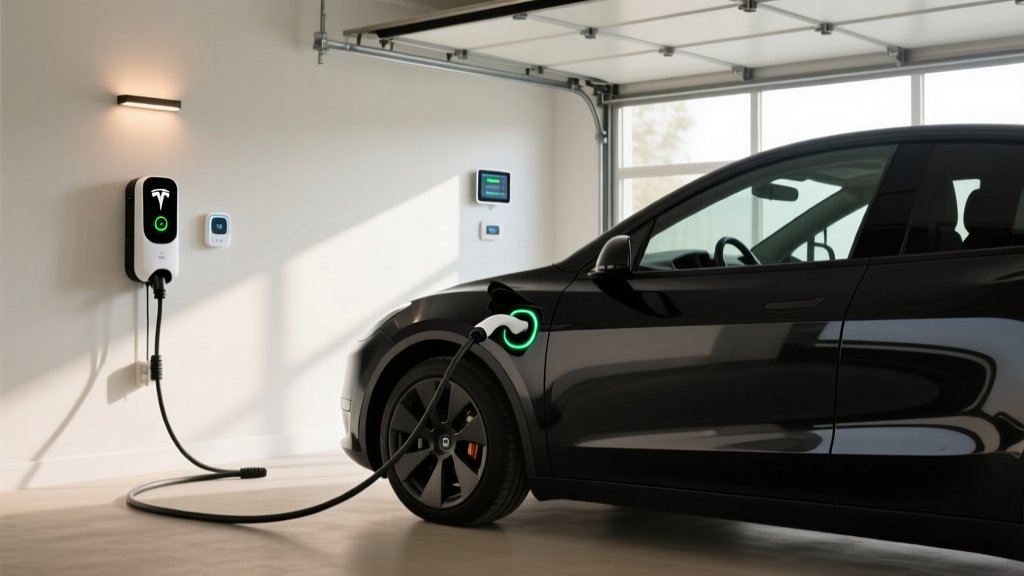
Tesla Wall Connector (Gen 4)
- Power: 48A / 11.5 kW (240V)
- Connector: NACS native
- Cable: 24 feet
- Smart Features: Wi-Fi, OTA updates, Power Share (load balancing with 2nd unit), Tesla app integration
- Outdoor Rating: NEMA 4 (indoor/outdoor)
- Price: ~$475
Verdict: The default choice for Tesla owners. Seamless integration, reliable hardware, and Power Share lets you run two chargers on a single 60A circuit. No adapter clutter.
Emporia Vue Level 2 EV Charger
- Power: 48A / 11.5 kW (240V)
- Connector: NACS (2025+ model) or J1772 with adapter
- Cable: 24 feet
- Smart Features: Wi-Fi, scheduling, solar integration, energy monitoring via Emporia app, load management with Emporia panel sensor
- Outdoor Rating: NEMA 4
- Price: ~$399
Verdict: Best value with energy monitoring. If you have solar panels, Emporia's EV charger can automatically charge only on excess solar production — effectively free fuel.
ChargePoint Home Flex (NACS)
- Power: Up to 50A / 12 kW (240V, configurable 16–50A)
- Connector: NACS (2025+ model)
- Cable: 23 feet
- Smart Features: Wi-Fi, Alexa/Google Home, scheduling, flexible amperage setting to match circuit
- Outdoor Rating: NEMA 4
- Price: ~$599
Verdict: Flexible amperage is the standout feature. If your panel can only support a 40A circuit, dial the Flex down to 32A (7.7 kW) without buying different hardware.
Wallbox Pulsar Plus (48A, NACS)
- Power: 48A / 11.5 kW (240V)
- Connector: NACS (2025+ model)
- Cable: 25 feet (longest in class)
- Smart Features: Wi-Fi + Bluetooth, Power Boost (dynamic load management), myWallbox app
- Outdoor Rating: NEMA 4
- Price: ~$549
Verdict: The 25-foot cable is the longest available — critical if your parking spot is far from the charger mount. Power Boost avoids panel upgrades by throttling charge when household demand spikes.
Safety, Electrical Code, and Installation Best Practices
EV charging is a high-draw, continuous electrical load — it runs at maximum amperage for hours at a time. This makes proper installation non-negotiable. Key requirements and best practices:
- Dedicated circuit: Your Level 2 charger must be on its own dedicated 240V circuit. It cannot share with a dryer, oven, or any other appliance.
- Breaker sizing: NEC Article 625 requires a breaker rated at 125% of the charger's max amperage. A 48A charger requires a 60A breaker. A 40A charger requires a 50A breaker.
- GFCI protection: NEC 2020 and later requires GFCI protection for all EV charging outlets (if using a receptacle). Hardwired installations may be exempt in some jurisdictions — confirm with your local inspector.
- Outdoor rating: If your charger is mounted outside or in an unsealed garage, it must carry a NEMA 4 (or IP65+) rating to withstand rain and dust.
- Wire gauge: A 60A circuit typically requires 6 AWG copper wire (THHN in conduit) or 4 AWG aluminum. Your electrician will size this based on run length and local code.
- Permit and inspection: Most jurisdictions require an electrical permit and a post-installation inspection. Skipping this can void homeowner's insurance coverage for electrical fires and create problems during a home sale.
Hardwired installations (no plug) are generally preferred for 48A chargers — they eliminate the NEMA 14-50 receptacle as a potential failure point and avoid the NEC GFCI requirement for receptacles, which can cause nuisance trips on some older panels.
Frequently Asked Questions
How much does it cost to install a home EV charger for a Tesla Model Y?
For a typical 48A / 11.5 kW Level 2 charger on a 200A panel with a short wire run, expect $950–$3,050 total (hardware + electrician + permit). If your home has a 100A panel and needs an upgrade to 200A, add $1,500–$4,000. Get at least two quotes from licensed electricians who have EV charger experience.
How fast will each charging level add range to my Model Y Long Range?
Level 1 (120V) adds roughly 3–5 miles per hour — about 30–50 miles overnight. Level 2 (240V, 48A) adds 37–44 miles per hour, fully replenishing the 78.1 kWh battery in about 7–8 hours. DC fast charging at a V3 Supercharger adds up to 200 miles in approximately 15 minutes (peak rate, preconditioned battery, 10–50% SoC window).
Which connector is compatible with my Tesla Model Y Long Range?
The 2026 Model Y Long Range uses a native NACS connector. For home Level 2 charging, buy a NACS-equipped charger (Tesla Wall Connector, Emporia, ChargePoint NACS, or Wallbox NACS). For non-Tesla public DC fast chargers with CCS1 cables, you'll need a CCS-to-NACS adapter (~$150–$250). Tesla includes a J1772-to-NACS adapter in the vehicle for non-Tesla Level 2 public chargers.
How much does charging the Model Y cost per mile vs. gas?
At a national average home electricity rate of $0.16/kWh, the Model Y Long Range costs about $0.045/mile to charge. A comparable gasoline SUV at 25 MPG with $3.40/gallon fuel costs ~$0.136/mile. If you charge on off-peak utility rates ($0.08–$0.10/kWh), the EV cost drops to $0.028–$0.035/mile — roughly 75% cheaper than gasoline per mile driven.
What electrical upgrades might my home need for a Level 2 charger?
The most common upgrade is a panel capacity increase from 100A to 200A, costing $1,500–$4,000. You'll also need two adjacent breaker slots for a 240V double-pole breaker. If your panel is full, a sub-panel or tandem breakers may be options. For homes where a panel upgrade is cost-prohibitive, load-management devices (like Wallbox Power Boost or Emporia's smart sensor) dynamically reduce charging amperage when other appliances draw power, letting you install a charger on an existing 100A or 150A panel without overload risk.
Should I charge my Model Y Long Range to 100% every night?
Tesla recommends setting the daily charge limit to 80–90% for NMC battery packs to maximize long-term battery health. Charge to 100% only before long road trips and plan to depart shortly after reaching full charge. The NMC chemistry in the Long Range degrades faster when held at 100% SoC for extended periods. Following this practice, combined with the 8-year/120,000-mile battery warranty (guaranteeing ≥70% capacity retention), should yield minimal noticeable degradation over a decade of ownership.