Why Tesla Model Y Cold Charging Slows Down in Winter
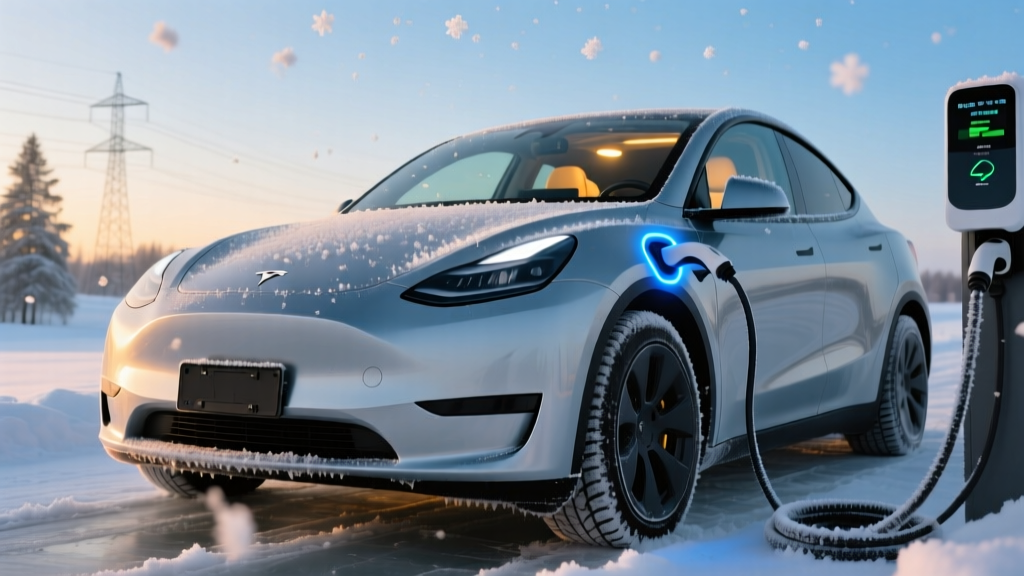
Cold weather doesn't just reduce your Tesla Model Y's range — it fundamentally changes how fast the battery can accept a charge. If you've ever pulled up to a Supercharger in sub-freezing temperatures and watched the charge rate crawl, you've experienced the physics of lithium-ion chemistry at low temperatures. The Model Y's battery management system (BMS) deliberately restricts charging power when cell temperatures drop below roughly 50°F (10°C) to prevent lithium plating, a phenomenon that can cause permanent capacity loss.
At 32°F (0°C), expect DC fast charging speeds to drop to 40–60% of the Model Y's peak 250 kW capability — meaning you might see 100–150 kW instead of the rated maximum. Below 10°F (-12°C), the restriction can be even more severe, with initial charge rates as low as 30–50 kW until the battery warms. This is not a defect; it's protective engineering shared across nearly all EVs using NMC (nickel manganese cobalt) or NCA (nickel cobalt aluminum) chemistry, including the Model Y's 2170-cell or 4680-cell battery packs.
Charging Levels Explained: Speeds in kW and Miles Per Hour
Before we break down cold-weather specifics, let's establish what each charging level delivers under ideal conditions. Remember: kW (kilowatts) measures power — how fast energy flows. kWh (kilowatt-hours) measures energy — the total capacity stored. A 250 kW charger doesn't deliver 250 kWh; it delivers energy at a rate of 250 kW, filling a 75 kWh battery in roughly 18 minutes at peak (though the charge curve tapers well before 100%).
| Level | Voltage / Amps | Power (kW) | Miles of Range Per Hour | Typical Use Case |
|---|---|---|---|---|
| Level 1 | 120V / 12A | ~1.4 kW | 3–5 mi/hr | Emergency / overnight trickle |
| Level 2 (Home) | 240V / 32–48A | 7.7–11.5 kW | 25–44 mi/hr | Daily home charging |
| DC Fast (Supercharger) | 400V+ DC | 150–250 kW | 200–1,000+ mi/hr (peak) | Road trips, rapid top-ups |
For the Model Y Long Range AWD with ~75 kWh usable battery and roughly 3.8–4.0 mi/kWh efficiency, a Level 2 home charger at 11.5 kW (48A) adds about 44 miles of range per hour in mild weather. In cold conditions, that miles-per-hour figure drops because the car uses some of that incoming power to heat the battery and cabin rather than storing it.
How Fast Will Each Charging Level Add Range in Cold Weather?
Cold weather affects all three charging levels, but the impact is most dramatic at DC fast chargers where the BMS restricts power aggressively. Here's what to expect with a Model Y in winter conditions:
Level 1 (120V): Cold impact is minimal because the charge rate is already so low. You'll still get roughly 3–5 miles per hour, though some energy diverts to battery warming. A full overnight session (10 hours) might add only 25–35 miles of usable range in deep cold.
Level 2 (240V, 48A / 11.5 kW): Expect a 10–20% reduction in effective miles-per-hour in freezing weather. Instead of 44 mi/hr, plan on 35–40 mi/hr. The onboard charger still delivers full power, but thermal management consumes some energy. Over an 8-hour overnight session, that's roughly 280–320 miles added in winter versus 350+ in summer.
DC Fast Charging (250 kW Supercharger): This is where cold has the most visible impact. Without preconditioning, initial charge rates can be severely limited. With proper preconditioning (navigating to the Supercharger in the Tesla app or in-car nav), the battery preheats en route and you'll reach peak or near-peak speeds within a few minutes. The 10–80% charge time shifts from roughly 25 minutes (warm) to 35–50 minutes (cold, depending on starting battery temperature).
| Condition | 10–80% Charge Time (Approx.) | Peak kW Observed |
|---|---|---|
| 70°F, preconditioned | 25–27 min | ~250 kW |
| 32°F, preconditioned | 30–35 min | ~200–230 kW |
| 20°F, preconditioned | 35–45 min | ~150–200 kW |
| 10°F, NOT preconditioned | 50–65+ min | ~50–100 kW (initially) |
Preconditioning: The Key to Tesla Model Y Cold Charging Speed
The single most effective action you can take for faster cold-weather charging is preconditioning. When you set a Supercharger as your destination in the Model Y's navigation (or via the Tesla app), the vehicle begins heating the battery pack 10–30 minutes before arrival, depending on ambient temperature and distance. This brings cell temperatures into the optimal charging window (roughly 70–95°F internally) so the BMS allows maximum charge rates.
Without preconditioning, a cold-soaked battery in 20°F weather might accept only 30–50 kW for the first 10–15 minutes of a charging session, gradually ramping up as resistive heating and charge current warm the cells. That initial slow phase can add 15–20 minutes to your stop. With preconditioning, the Model Y typically reaches 150+ kW within 2–5 minutes of plugging in, even in deep cold.
Pro tip: If you're charging at a non-Tesla DC fast charger using a NACS-to-CCS adapter (or at a CCS station with the Model Y's native CCS port on newer vehicles), preconditioning may not activate automatically because the car doesn't recognize the destination as a charger. Workaround: set the nearest Tesla Supercharger as your nav destination to trigger preconditioning, then divert to your actual charger upon arrival.
How Much Does It Cost to Install a Home EV Charger?
For most Model Y owners, a Level 2 home charger is the backbone of daily charging — and it's where cold-weather charging is most manageable, since you can schedule charging during off-peak hours and precondition while plugged in (using grid power rather than battery energy for heating). Here's a realistic cost breakdown for a 240V / 48A home charging setup in 2026:
| Component | Typical Cost Range | Notes |
|---|---|---|
| Level 2 Charger (Hardware) | $300–$700 | Tesla Wall Connector, ChargePoint, Emporia |
| Electrician Labor | $500–$2,000 | Depends on run length, wall type, conduit |
| Electrical Permit | $50–$200 | Varies by municipality |
| Panel Upgrade (if needed) | $1,500–$3,500 | 100A → 200A service upgrade |
| Total (no panel upgrade) | $850–$2,900 | Most homes with 200A service |
| Total (with panel upgrade) | $2,350–$6,400 | Older homes with 100A or less |
Electrical requirements for a 48A Level 2 charger: You need a dedicated 60A circuit (NEC code requires circuits rated at 125% of continuous load, so 48A continuous = 60A breaker). The circuit requires 6 AWG copper wire (or 4 AWG aluminum) for runs up to about 50 feet; longer runs may need thicker wire to prevent voltage drop. Your electrical panel must have two adjacent breaker slots available on a 240V leg.
Panel upgrade reality: Homes built before 1990 often have 100A electrical service. Adding a 60A EV circuit to a 100A panel may exceed the panel's capacity, especially if you're running electric HVAC, a dryer, and an oven simultaneously. A licensed electrician will perform a load calculation per NEC Article 220. If an upgrade is needed, budget $1,500–$3,500 for a 200A service upgrade, which includes a new panel, utility coordination, and inspection. Some utilities offer rebates of $200–$500 for panel upgrades paired with EV charger installation.
Home Charger Equipment Recommendations for the Model Y
The Model Y uses the NACS (North American Charging Standard) connector natively. Here are purpose-built Level 2 chargers that pair well with Tesla vehicles, including cold-weather considerations like cable flexibility and smart scheduling:
Tesla Wall Connector (Gen 4)
- Power: Up to 11.5 kW (48A at 240V)
- Connector: NACS (native Tesla)
- Cable Length: 24 feet
- Smart Features: Wi-Fi, OTA updates, load sharing, scheduled charging, power sharing between two units
- Price: ~$475
- Cold-Weather Note: Cable remains reasonably flexible down to ~0°F; indoor-rated enclosure but outdoor-rated cable
Emporia Vue Level 2 Charger
- Power: Up to 11.5 kW (48A) — configurable down to 32A or 40A for smaller circuits
- Connector: J1772 (requires Tesla J1772 adapter, included with Model Y) or NACS version available
- Cable Length: 24 feet
- Smart Features: Energy monitoring, solar integration, time-of-use scheduling, app control
- Price: ~$399
- Cold-Weather Note: Robust outdoor enclosure (NEMA 4 rated); cable slightly stiffer in deep cold
ChargePoint Home Flex
- Power: Up to 12 kW (50A at 240V) — configurable 16A–50A via DIP switches
- Connector: J1772 (use Tesla adapter) or NACS pigtail version
- Cable Length: 23 feet
- Smart Features: Wi-Fi, Alexa/Google integration, scheduling, charging history
- Price: ~$599
- Cold-Weather Note: UL-listed for outdoor use; cable management reel helps prevent ground contact in snow
For cold-climate installations, prioritize a charger with a NEMA 4 (outdoor/watertight) rating and a cable holster to keep the connector off the ground and out of snow/ice. The Tesla Wall Connector is the most seamless choice for Model Y owners due to native NACS compatibility, automatic vehicle recognition, and integrated load sharing if you add a second unit.
Connector Compatibility: NACS, CCS, and Adapters
The Tesla Model Y sold in North America uses the NACS connector for both AC Level 2 and DC fast charging. As of 2026, most non-Tesla DC fast charging networks (Electrify America, EVgo, ChargePoint) have deployed NACS cables alongside legacy CCS1 connectors, but some stations — particularly older installations — remain CCS-only. Here's the compatibility landscape:
| Connector | Model Y Compatibility | Adapter Needed? | Availability (2026) |
|---|---|---|---|
| NACS (Tesla) | Native | None | Tesla Superchargers (20,000+ stalls), growing non-Tesla networks |
| CCS1 | Via adapter | CCS-to-NACS adapter (~$150–$250) | Electrify America, EVgo, many public stations |
| CHAdeMO | Via adapter | CHAdeMO-to-NACS (~$300+) | Limited; mostly Nissan Leaf legacy stations |
| J1772 (Level 2 AC) | Via adapter | J1772-to-NACS (included with Model Y) | Universal for AC Level 2 public charging |
Tesla also sells a CCS-to-NACS adapter (approximately $175 on the Tesla shop) that enables Model Y vehicles to charge at CCS stations. Newer Model Y vehicles (2025+) may include a CCS charge port door with a NACS inlet, simplifying adapter use. Always verify your adapter supports the full DC fast charge rate — some third-party adapters are limited to 50 kW or 150 kW.
How Much Does Charging Cost Per Mile vs. Gas?
One of the strongest ownership arguments for the Model Y is the fuel-cost advantage, even accounting for cold-weather efficiency losses. Here's a cost-per-mile breakdown using 2026 average electricity and gasoline prices:
| Scenario | Cost Per kWh / Gallon | Cost Per Mile (Model Y AWD) | Cost Per Mile (Gas SUV, 25 MPG) |
|---|---|---|---|
| Home, off-peak utility rate | $0.12/kWh | $0.030 | $0.132 ($3.30/gal) |
| Home, average utility rate | $0.17/kWh | $0.043 | $0.132 ($3.30/gal) |
| Public Level 2 (network) | $0.28/kWh | $0.070 | $0.132 ($3.30/gal) |
| DC Fast (Supercharger avg.) | $0.32/kWh | $0.080 | $0.132 ($3.30/gal) |
| DC Fast (peak pricing) | $0.48/kWh | $0.120 | $0.132 ($3.30/gal) |
At the Model Y's average efficiency of roughly 3.8–4.0 miles per kWh (or about 25–26 kWh/100mi as reported on fueleconomy.gov), home charging at $0.12/kWh costs approximately 3 cents per mile — roughly one-quarter the cost of a comparable gas SUV getting 25 MPG at $3.30/gallon. Even at DC fast charger peak pricing, the Model Y remains cost-competitive with gasoline on a per-mile basis.
Cold weather caveat: In sustained below-freezing driving, the Model Y's efficiency drops 20–35%, from roughly 25 kWh/100mi to 32–38 kWh/100mi, because energy goes to cabin heating, battery warming, and increased rolling resistance. This raises your effective cost-per-mile by the same proportion. Using a heat pump (standard on Model Y since 2021) significantly reduces cabin-heating energy draw compared to resistive heating, but the efficiency hit is still measurable.
Safety and Electrical Code Considerations
Home EV charger installation must comply with the National Electrical Code (NEC) and local building codes. Key requirements for a safe, code-compliant Model Y charging setup include:
- Dedicated circuit: A Level 2 charger requires its own dedicated double-pole breaker — it cannot share a circuit with other appliances. A 48A charger needs a 60A breaker; a 32A charger needs a 40A breaker.
- GFCI protection: NEC 2020 and later require GFCI (ground-fault circuit interrupter) protection for outdoor receptacles used for EV charging. Hardwired installations (recommended for 48A+) bypass the receptacle and typically satisfy GFCI requirements through the charger's internal protection.
- Outdoor rating: If installing outdoors, the charger must carry a NEMA 4 or NEMA 4X rating for weather resistance. The Tesla Wall Connector is rated for outdoor use. Ensure the cable holster is positioned to prevent the connector from resting in standing water or snow.
- Wire gauge: 6 AWG copper for 60A circuits up to ~50 feet; 4 AWG for longer runs. Aluminum wire (cheaper but thicker) requires 4 AWG for 60A.
- Permit and inspection: Virtually all jurisdictions require an electrical permit for a new 240V circuit. The inspection verifies wire gauge, breaker sizing, grounding, and GFCI compliance. Budget $50–$200 for the permit and schedule the inspection before closing up any walls.
Never use an extension cord for EV charging — even heavy-duty 240V cords introduce resistance, heat buildup, and code violations. If your parking spot is far from the panel, invest in a longer cable run with proper conduit rather than a cord workaround.
Frequently Asked Questions
How much does it cost to install a home EV charger for a Tesla Model Y?
A typical Level 2 home charger installation costs $850–$2,900 if your electrical panel has sufficient capacity (200A service with available breaker slots). If your home needs a panel upgrade from 100A to 200A service, total costs range from $2,350–$6,400. The Tesla Wall Connector hardware runs ~$475, electrician labor is typically $500–$2,000 depending on wire run length, and permits cost $50–$200 depending on your municipality.
How fast will each charging level add range in winter?
Level 1 (120V) adds 3–5 miles per hour regardless of temperature. Level 2 (240V, 48A) adds roughly 35–44 mi/hr, dropping to 28–38 mi/hr in deep cold as some power diverts to battery and cabin heating. DC fast charging (250 kW Supercharger) adds 200–1,000+ mi/hr at peak, but cold weather reduces peak power by 30–60%, extending a 10–80% charge from ~25 minutes to 35–50+ minutes depending on battery temperature and preconditioning.
Which connector is compatible with the Tesla Model Y?
The Model Y uses the NACS connector natively for both AC and DC charging. Tesla Superchargers use NACS exclusively. For CCS1 stations (Electrify America, EVgo), you'll need a CCS-to-NACS adapter (~$175 from Tesla). For J1772 Level 2 public chargers, the Model Y ships with a J1772-to-NACS adapter. CHAdeMO is largely obsolete but usable with a third-party adapter.
How much does charging cost per mile vs. gas?
At home off-peak rates (~$0.12/kWh), the Model Y costs roughly $0.03/mile — about 75% less than a 25 MPG gas SUV at $3.30/gallon ($0.132/mile). At average Supercharger pricing (~$0.32/kWh), cost rises to ~$0.08/mile, still about 40% cheaper than gasoline. Even peak-rate DC fast charging at $0.48/kWh ($0.12/mile) remains slightly cheaper than gas. Cold weather raises electricity consumption 20–35%, narrowing but not eliminating the cost gap.
What electrical upgrades might I need for a home charger?
If your home has a 200A electrical panel with two available breaker slots, you likely need only a new 60A double-pole breaker and a wire run to the charger location. If your panel is 100A or lacks available slots, you'll need a panel upgrade ($1,500–$3,500). Homes with older knob-and-tube or aluminum branch wiring may need additional upgrades. A licensed electrician will perform a NEC Article 220 load calculation to determine your panel's actual capacity. Some utilities and states offer rebates of $200–$1,000 for panel upgrades paired with EV charger installs — check IRS §30D and local utility programs for current incentives. Note that the federal §30D clean vehicle credit applies to the vehicle purchase, while the Residential Clean Energy Credit (§25D) may cover 30% of home charger installation costs through 2032, subject to income and eligibility rules.
Does cold weather permanently damage the Model Y battery?
No — cold weather causes temporary range loss and slower charging, but the BMS prevents permanent damage by restricting charge rates and activating battery heating. The real risk is charging a cold battery at high power without preconditioning, which can cause lithium plating. Tesla's software prevents this automatically, which is why charge speeds are throttled. Long-term degradation for the Model Y's NMC/NCA battery is typically 8–12% over 100,000 miles, with Tesla's battery warranty covering capacity below 70% for 8 years or 120,000 miles (Long Range) per Tesla's warranty documentation.