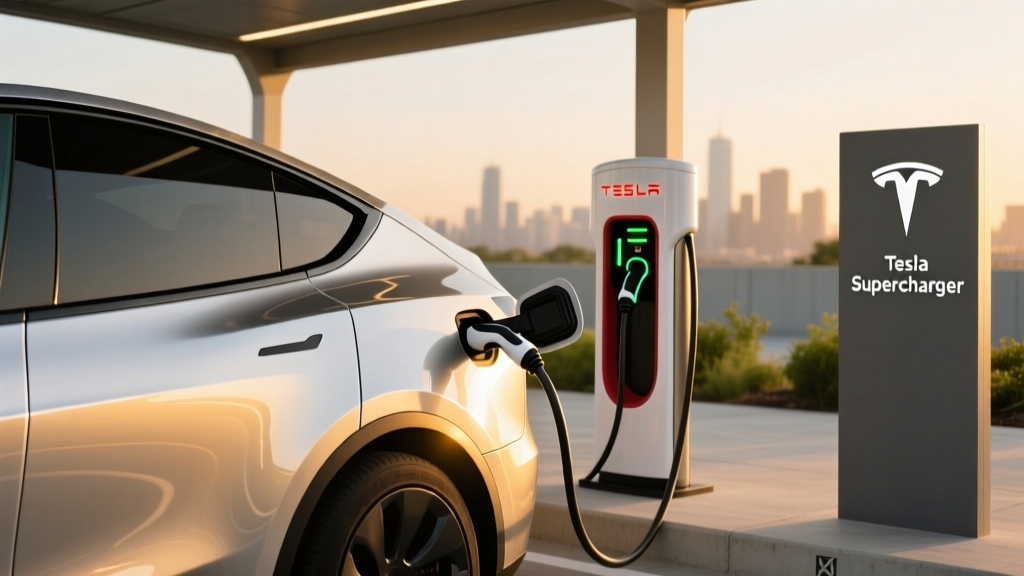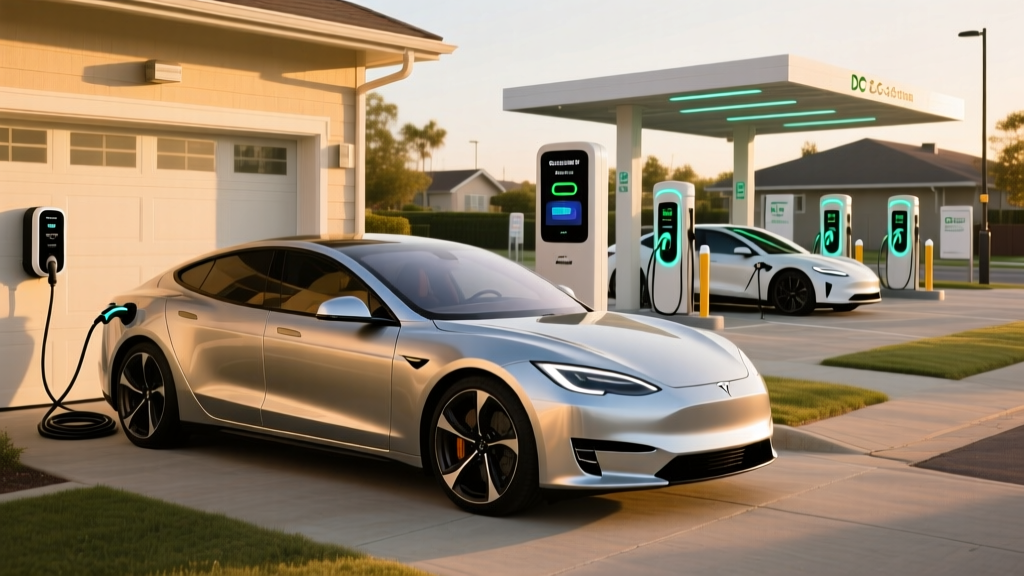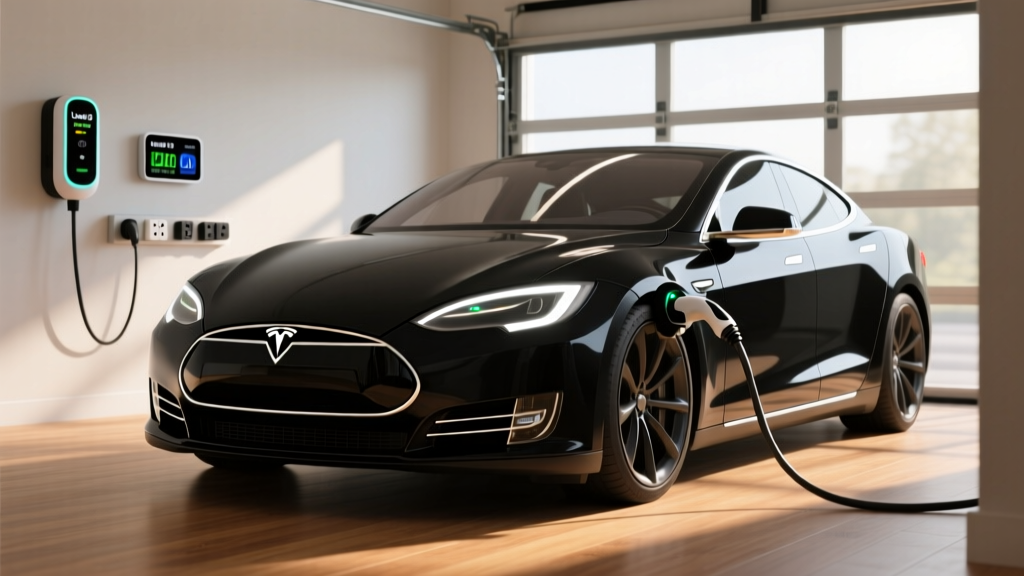
If you own or are considering a Tesla Model S, understanding how its battery capacity—measured in kilowatt-hours (kWh)—translates into real charging times, costs, and home electrical requirements is essential. The current Model S uses a ~100 kWh battery pack, but knowing that number alone doesn't tell you how long a charge takes, what it costs, or whether your garage's electrical panel can support it. This guide breaks down the full charging picture for the Tesla Model S, from Level 1 trickle charging to Supercharger DC fast stops, plus exactly what you need to install a home Level 2 charger.
kW vs kWh: The Single Most Important Distinction
Before anything else, let's nail down the terminology that trips up most new EV owners:
- kWh (kilowatt-hour) = energy capacity. Think of it as the size of your fuel tank. The Tesla Model S has a ~100 kWh usable battery pack.
- kW (kilowatt) = power, or the rate at which energy flows. Think of it as the diameter of the fuel hose. A 48-amp Level 2 charger delivers up to 11.5 kW; a Supercharger can deliver up to 250 kW.
Charging time is simply kWh ÷ kW (with real-world tapering). A 100 kWh battery charging at 11.5 kW takes roughly 8.7 hours from 0–100% in ideal conditions. At 250 kW peak, that same battery adds energy dramatically faster—but only until the charge curve tapers above ~80% state of charge (SoC).
Battery capacity: ~100 kWh usable (NMC chemistry, dual-motor/Plaworth trims)
EPA range: 402 miles (Model S Long Range, 2025/2026)
Real-world highway range: expect ~320–350 miles at 70 mph; ~270–300 miles in freezing weather
Efficiency: ~120 MPGe combined / 28 kWh per 100 miles
Connector: NACS (native Tesla), no adapter needed for Superchargers or Tesla Wall Connector
Source: fueleconomy.gov
Charging Levels Explained: How Fast Will Each Add Range?
The Tesla Model S can accept energy at three distinct charging levels, each with dramatically different speeds. Here's how they stack up:
| Level | Voltage / Amperage | Max Power (kW) | Miles of Range Added per Hour | 0–80% Time (Model S ~100 kWh) |
|---|---|---|---|---|
| Level 1 (120V outlet) | 120V / 12A | ~1.4 kW | 3–5 mi/hr | ~57+ hours (impractical for full charge) |
| Level 2 (240V home/public) | 240V / 48A | ~11.5 kW | 30–40 mi/hr | ~7–8 hours (overnight full charge) |
| DC Fast (Tesla Supercharger V3) | 400V+ architecture | Peak 250 kW | Up to ~1,000 mi/hr at peak | ~25–30 min (10–80%) |
Real-world charge curve reality: The Model S will hit 250 kW only at low SoC (roughly 5–30%). By 50% SoC, expect ~150 kW; by 80%, it drops to ~60–70 kW. This is why manufacturers quote 10–80% times rather than 0–100%—the last 20% can take nearly as long as the first 70%.
For daily driving, Level 2 at home is the sweet spot. You plug in overnight, and the car adds 200+ miles of range in 5–6 hours—more than enough to replenish any day's driving. Reserve DC fast charging for road trips.
Home Level 2 Charger Installation: Electrical Requirements and Costs
Installing a Level 2 home charger for your Model S is the single best upgrade for EV ownership convenience. But costs vary enormously depending on your home's electrical infrastructure.
Electrical Requirements
A 48-amp Level 2 charger (the recommended spec for Tesla owners) requires:
- A dedicated 60-amp circuit on your electrical panel (NEC code requires circuits be rated 125% above the continuous load, so 48A × 1.25 = 60A breaker)
- 240V supply (same as a dryer or oven outlet)
- 6-gauge copper wire (or 4-gauge aluminum) for runs up to ~100 feet
- A NEMA 14-60 receptacle or direct hardwired connection (hardwired is preferred for 48A+ chargers and often required by code)
What If My Panel Can't Handle It?
Homes built before 1990 often have 100-amp main panels. Adding a 60-amp EV circuit to an already-loaded panel may require a panel upgrade to 200 amps, which costs $1,500–$3,500 on top of the charger installation. Even some 200-amp panels lack spare breaker slots or have maxed-out bus bars. A licensed electrician will perform a load calculation before recommending a circuit size.
| Item | Low-End Cost | High-End Cost | Notes |
|---|---|---|---|
| Level 2 charger equipment (Tesla Wall Connector or equivalent) | $400 | $650 | 48A, 24ft cable, Wi-Fi |
| Electrician labor + materials (wire, conduit, breaker) | $600 | $2,000 | Depends on run length, wall type |
| Electrical permit | $50 | $200 | Varies by municipality |
| Panel upgrade (if needed) | $1,500 | $3,500 | 100A → 200A service upgrade |
| Total (no panel upgrade) | $1,050 | $2,850 | Most homes with 200A panels |
| Total (with panel upgrade) | $2,550 | $6,350 | Older homes with 100A service |
Federal incentive note: The Alternative Fuel Vehicle Refueling Property Credit (§30C) may cover up to 30% of home charger installation costs (max $1,000), but only in eligible census tracts. Check IRS guidelines for current eligibility maps and requirements. This is separate from the §30D new EV purchase credit.
Connector Compatibility: NACS, CCS, and Adapter Needs
The Tesla Model S uses the North American Charging Standard (NACS) connector natively. As of 2025–2026, NACS has been adopted by Ford, GM, Rivian, Volvo, Hyundai, and most major automakers, making it the de facto North American standard. Here's what that means for your charging options:
| Connector / Network | Model S Compatible? | Adapter Needed? | Notes |
|---|---|---|---|
| Tesla Supercharger (NACS) | ✅ Native | No | 250 kW V3, 100 kW V2 stations |
| Tesla Wall Connector (home) | ✅ Native | No | 48A, NACS plug included |
| CCS1 public DC fast chargers (EA, EVgo) | ⚠️ With adapter | CCS-to-NACS adapter (~$175–$250) | Needed for non-Tesla DC networks |
| CHAdeMO (Nissan Leaf-era) | ❌ No | No reliable adapter available | Network is effectively deprecated |
| J1772 Level 2 public chargers | ✅ With adapter | J1772-to-NACS (included with Tesla) | Tesla ships a J1772 adapter with each car |
Practical takeaway: For home and Supercharger use, you'll never need an adapter. The only scenario requiring one is using a non-Tesla DC fast charger (like Electrify America), which is rare given Tesla's 6,000+ Supercharger stalls across the U.S. Keep the included J1772 adapter in your frunk for public Level 2 destinations like hotels and workplaces.
Charging Cost per Mile: Model S vs Gas Equivalent
One of the strongest economic arguments for the Model S is the per-mile fuel cost. Let's compare the Model S Long Range against a gas-powered luxury sedan achieving 25 MPG combined (like a BMW 5 Series) using national average energy prices:
| Scenario | Rate | Model S Cost/Mile | Gas Sedan (25 MPG) Cost/Mile | Annual Savings (12,000 mi/yr) |
|---|---|---|---|---|
| Home charging (off-peak utility rate) | $0.13/kWh | $0.036 | $0.136 (at $3.40/gal) | ~$1,200 |
| Home charging (standard rate) | $0.18/kWh | $0.050 | $0.136 | ~$1,030 |
| Tesla Supercharger (avg) | $0.32/kWh | $0.090 | $0.136 | ~$550 |
| Public DC fast (Electrify America) | $0.48/kWh | $0.134 | $0.136 | ~$24 (negligible) |
The math: The Model S consumes roughly 28 kWh per 100 miles (per EPA data). At a national average residential rate of $0.13/kWh for off-peak charging, that's $3.64 per 100 miles—or 3.6 cents per mile. A 25-MPG gas car at $3.40/gallon burns $13.60 per 100 miles. The savings are dramatic when you charge at home, which is where 85%+ of EV charging actually happens.
Even exclusive Supercharger use (at ~$0.32/kWh average) still undercuts gasoline by roughly 30%. The only scenario where EV charging approaches gas costs is expensive public DC fast charging at $0.48+/kWh—another reason home Level 2 installation pays for itself quickly.
Recommended Level 2 Chargers for the Model S
These are the chargers we recommend based on power output, cable length, smart features, and NACS compatibility. All deliver the 48 amps needed for ~11.5 kW charging:
Tesla Wall Connector (Best Overall)
- Power: 48A / 11.5 kW (240V)
- Connector: NACS native (no adapter)
- Cable: 24 feet
- Smart features: Wi-Fi, OTA firmware updates, load sharing with second unit, power-sharing across multiple Wall Connectors on one circuit
- Outdoor rated: Yes (NEMA 4)
- Price: ~$425
- Why: Seamless Tesla integration, cleanest install, no adapter friction. Power-sharing lets you install two units on a single 60A circuit.
ChargePoint Home Flex (Best Universal)
- Power: Up to 50A / 12 kW (configurable 16–50A)
- Connector: NACS (2025+ models) or J1772 with adapter
- Cable: 23 feet
- Smart features: Wi-Fi, app scheduling, energy tracking, Alexa integration, amperage configurable via dip switches to match your circuit
- Outdoor rated: Yes (NEMA 4)
- Price: ~$550–$650
- Why: Configurable amperage is ideal if your panel can't support a full 60A circuit—set it to 32A or 40A without swapping hardware.
Emporia Vue Level 2 (Budget Smart Pick)
- Power: 48A / 11.5 kW
- Connector: NACS (2025+ models)
- Cable: 24 feet
- Smart features: Wi-Fi, app with real-time cost tracking, solar integration for homes with panels, scheduling
- Outdoor rated: Yes
- Price: ~$400
- Why: Best value for smart features; solar-aware charging can prioritize excess solar production.
Grizzl-E Smart (Rugged / Cold Climate)
- Power: 40A / 9.6 kW
- Connector: NACS (2025+ models)
- Cable: 24 feet
- Smart features: Wi-Fi, OCPP compatible, adjustable amperage
- Outdoor rated: Yes (IP67, rated to -40°F)
- Price: ~$450
- Why: Built in Canada, extreme cold-rated. Slightly lower 40A output still adds ~28 mi/hr.
Safety, Electrical Code, and Installation Best Practices
EV charging is a continuous high-amperage load that runs for hours—more demanding than most household appliances. Cutting corners here risks fire, failed inspections, or voided insurance. Here's what proper installation requires:
- Dedicated circuit: Your Level 2 charger must have its own breaker—never shared with other outlets or appliances.
- GFCI protection: NEC 2020 and later require GFCI protection for all EV charging receptacles. Hardwired installations may be exempt in some jurisdictions; check local code.
- Outdoor rating: If your charger is mounted outside or in an open carport, it must carry at minimum a NEMA 4 (weather-resistant) or IP65 rating.
- Permit and inspection: Virtually all jurisdictions require an electrical permit for a new 240V circuit. The inspection ensures wire gauge, breaker size, and grounding meet code. Skipping this can void homeowner's insurance in the event of an electrical fire.
- Wire gauge: For 48A continuous load on a 60A breaker, use 6 AWG copper (THHN in conduit) or 4 AWG aluminum for runs up to ~100 feet. Longer runs require upsizing to prevent voltage drop.
- Load management: If your panel is near capacity, consider a smart panel-level load manager (like the Emporia VUE with smart breaker) that dynamically limits charger amperage when other high-draw appliances are running.
Charging Time Examples: How Long Does the Model S Take?
Using the Model S's ~100 kWh battery, here are realistic charging times across common scenarios. These account for the charge curve taper (charging slows significantly above 80% SoC to protect battery health):
| Scenario | Power (kW) | Energy Added | Time | Range Gained |
|---|---|---|---|---|
| Overnight home charge (Level 2, 8 hours) | 11.5 kW | ~92 kWh | 8 hrs | ~370 miles (full 0→100%) |
| Supercharger road trip stop (10–80%) | Peak 250 kW (avg ~130 kW) | ~70 kWh | ~27 min | ~280 miles |
| Supercharger top-up (50–80%) | Avg ~95 kW | ~30 kWh | ~18 min | ~120 miles |
| Destination Level 2 (4 hours at hotel) | 7.2–11.5 kW | ~29–46 kWh | 4 hrs | ~115–185 miles |
| 120V emergency trickle (overnight, 10 hours) | 1.4 kW | ~14 kWh | 10 hrs | ~40–50 miles |
Cold weather caveat: In sub-freezing temperatures, expect 10–30% longer charge times at DC fast stations unless you precondition the battery (navigate to a Supercharger in the Tesla nav, and the car automatically warms the pack). Cold batteries accept charge more slowly due to lithium plating protection protocols.
Frequently Asked Questions
How much does it cost to install a home EV charger for a Tesla Model S?
Expect $1,050–$2,850 for a standard installation in a home with an adequate 200-amp panel (equipment + electrician + permit). If your home has an older 100-amp panel requiring a service upgrade, total costs can reach $2,550–$6,350. Get at least three quotes from licensed electricians and confirm they perform a NEC-compliant load calculation before recommending a circuit size.
How fast will each charging level add range to the Model S?
Level 1 (120V) adds roughly 3–5 miles per hour—only practical for overnight trickle charging or PHEVs. Level 2 (240V, 48A) adds 30–40 miles per hour, easily replenishing a full day's driving overnight. DC fast charging (Tesla Supercharger V3 at 250 kW peak) can add up to 200 miles in about 15 minutes at low SoC, with 10–80% taking approximately 25–30 minutes.
Which connector and charger is compatible with the Tesla Model S?
The Model S uses the NACS connector natively. This means direct compatibility with all Tesla Superchargers, Tesla Wall Connectors, and the growing network of NACS-equipped public chargers from other providers. For non-Tesla DC fast chargers using CCS1, you'll need a CCS-to-NACS adapter ($175–$250). Tesla includes a J1772-to-NACS adapter for public Level 2 stations.
How much does charging the Model S cost per mile compared to gas?
At a national average residential electricity rate of $0.13/kWh, the Model S costs about 3.6 cents per mile to fuel. A comparable 25-MPG gas sedan at $3.40/gallon costs 13.6 cents per mile—nearly 4× more. Even exclusive Supercharger use (~$0.32/kWh) costs about 9 cents per mile, still a meaningful savings. Over 12,000 miles per year, home charging saves roughly $1,000–$1,200 annually versus gasoline.
What electrical upgrades might I need for a Level 2 charger?
The most common upgrade is running a new dedicated 240V/60A circuit from your panel to the garage. Homes with 200-amp panels and spare breaker capacity typically need only this circuit addition. Homes with older 100-amp panels, maxed-out bus bars, or long wire runs (detached garages) may need a panel upgrade ($1,500–$3,500), a service lateral upgrade from the utility, or trenching for conduit. A licensed electrician's load calculation will determine what's needed before any work begins.
Should I charge my Model S to 100% every night?
No. Tesla recommends setting the daily charge limit to 80–90% for routine use to preserve long-term battery health (the NMC chemistry in the Model S degrades faster at sustained high SoC). Set it to 100% only when you need maximum range for a road trip, and try to begin driving shortly after it reaches full charge rather than letting it sit at 100% for hours. The car's built-in battery management system (BMS) handles the rest.
Sources: EPA fuel economy data via fueleconomy.gov; IRS Alternative Fuel Vehicle Refueling Property Credit via irs.gov; Tesla Model S specifications via tesla.com. Pricing and incentive rules reflect 2025–2026 model year and current tax year; verify eligibility with a tax professional before purchase.