If you own or are considering a used Tesla Model 3 Standard Range Plus (SR+), you likely have two questions: how far does it actually go on a charge, and what does it take to keep it fueled at home and on the road? The SR+ was Tesla's volume-selling variant from 2018 through 2021, and while Tesla has since restructured the Model 3 lineup (the current 2025-2026 base model is the Rear-Wheel Drive with an LFP battery and 272 miles EPA), hundreds of thousands of SR+ units remain on US roads. This guide gives you the exact numbers — EPA range, real-world expectations, charging speeds at every level, home installation costs, and per-mile economics — so you can plan ownership with confidence.
Tesla Model 3 Standard Range Plus Range: EPA vs. Real World
The Tesla Model 3 Standard Range Plus carried a 50 kWh usable battery pack (NMC chemistry in early models, transitioning to LFP in later 2021 production) and was EPA-rated at 263 miles for the 2021 model year and 250 miles for the 2020 model year, per fueleconomy.gov. Those numbers are a starting point, not a guarantee.
- EPA sticker: 263 miles
- Mixed driving (city/highway, moderate climate): 230–250 miles
- Sustained highway (70-80 mph): 210–230 miles
- Cold weather (below 30°F, cabin heat): 175–210 miles
- With battery degradation (3-5 years old): subtract 5–10% from above figures
Highway speeds, cold temperatures, and battery age all reduce range. Preconditioning the battery before driving in cold weather recovers some of that loss by warming the pack for more efficient discharge.
For context, the current 2026 Tesla Model 3 Rear-Wheel Drive uses a 57.5 kWh LFP battery and achieves 272 miles EPA — a modest bump driven by larger capacity and improved efficiency. If you're shopping used SR+ models, budget your daily driving around 200 usable miles to maintain a comfort buffer.
Charging Levels Explained: kW, Speed, and Miles Per Hour
Before we break down charging for the Model 3 SR+, let's clarify the most common point of confusion in EV ownership: kW (kilowatts) measures power — how fast energy flows into the car. kWh (kilowatt-hours) measures energy — how much the battery holds. Think of kW as the flow rate of a hose and kWh as the size of the bucket. A 50 kWh battery charged at 10 kW takes roughly 5 hours (minus taper at the top).
| Level | Voltage | Max Power (kW) | Miles of Range Added Per Hour | Typical Use Case |
|---|---|---|---|---|
| Level 1 | 120V AC | 1.0–1.4 kW | 3–5 mi/hr | Overnight trickle; emergency top-ups |
| Level 2 | 240V AC | 7.2–19.2 kW | 25–70 mi/hr | Home daily charging; workplace; public AC |
| DC Fast Charge | 400V+ DC | 50–250 kW | 150–750 mi/hr (peak) | Road trips; rapid top-ups |
The Model 3 SR+ accepts up to 11.5 kW on Level 2 (its onboard charger limit) and peaks at approximately 170 kW on DC fast charging at a Supercharger V3 or equivalent CCS station. Note that peak kW is not sustained — the charge curve tapers significantly above 60% state of charge (SoC), and charging from 10–80% is the practical window for road-trip stops.
Charging Times for the Model 3 SR+ (50 kWh Battery)
Here's how long a 10–80% session takes at each level — the standard benchmark because charging above 80% slows dramatically to protect battery health:
- Level 1 (120V, ~1.2 kW): Not practical for 10–80% — would take roughly 29+ hours. Adds ~4 miles per hour, suitable only for topping off.
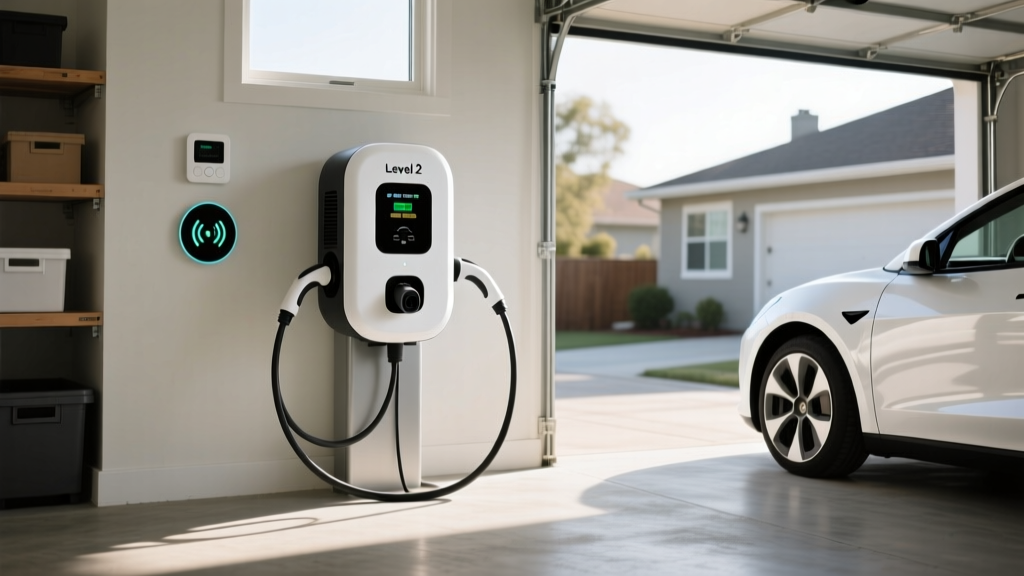
- Level 2 (240V, 32A / 7.7 kW): ~4.5 hours from 10–80%. This is a typical NEMA 14-50 outlet or basic wall connector setup.
- Level 2 (240V, 48A / 11.5 kW): ~3 hours from 10–80%. This maxes out the SR+'s onboard charger. Ideal for hardwired Tesla Wall Connector.
- DC Fast Charge (Supercharger V3, peak 170 kW): ~25 minutes from 10–80%. The SR+ charge curve peaks around 150–170 kW up to ~40% SoC, then tapers to ~60 kW above 70%.
- DC Fast Charge (50 kW CCS public station): ~50 minutes from 10–80%. Common at older Electrify America or EVgo sites.
For daily driving, Level 2 at home is the standard. Most SR+ owners plug in each evening and wake up with a full charge — the car replenishes 200+ miles overnight at 11.5 kW, well within an 8-hour sleep window.
Home Charger Installation: Electrical Requirements & Cost Breakdown
Installing a Level 2 home charger for your Model 3 SR+ requires a dedicated 240V circuit. The two most common configurations:
- NEMA 14-50 outlet (50A circuit, 40A continuous): Delivers up to 9.6 kW. Uses a plug-in charger — portable and transferable if you move.
- Hardwired 60A circuit (48A continuous): Delivers up to 11.5 kW, maxing out the SR+'s onboard charger. Requires a hardwired unit like the Tesla Wall Connector.
What Electrical Upgrades Might You Need?
Not every home can support a 50A or 60A EV circuit without upgrades. Key considerations:
- Panel capacity: Most modern homes have a 200A main panel. Adding a 50–60A EV circuit is usually feasible, but older homes with 100A or 150A panels may need a panel upgrade ($1,500–$3,500) to accommodate the additional load alongside existing appliances.
- Wire run distance: If your panel is far from the garage or parking spot, longer wire runs (especially 6 AWG or 4 AWG copper) add $5–$15 per linear foot in materials and labor.
- Permit: Most jurisdictions require an electrical permit for a new 240V circuit. Costs range from $50–$250 depending on your city or county.
- GFCI breaker: The 2020 NEC (National Electrical Code) requires GFCI protection for outlets used for EV charging in garages. A 50A GFCI breaker adds $80–$150 to material costs. Hardwired installations may not require GFCI in all jurisdictions — confirm with your electrician.
- Outdoor rating: If your charger is installed outdoors, ensure the unit carries a NEMA 4 or IP65 weather rating. The Tesla Wall Connector and ChargePoint Home Flex both meet this standard.
How Much Does It Cost to Install a Home EV Charger?
| Cost Component | Basic Install (NEMA 14-50, short run) | Standard Install (Hardwired 60A, moderate run) | Complex Install (panel upgrade + long run) |
|---|---|---|---|
| EVSE Equipment (charger) | $0–$400 (use Mobile Connector) | $400–$700 | $400–$700 |
| Electrical Materials (wire, breaker, conduit) | $150–$350 | $300–$600 | $500–$1,000 |
| Electrician Labor (licensed) | $300–$600 | $600–$1,200 | $1,200–$2,500 |
| Permit | $50–$150 | $75–$200 | $100–$250 |
| Panel Upgrade (if needed) | — | — | $1,500–$3,500 |
| Total Estimated Range | $500–$1,500 | $1,375–$2,700 | $3,700–$7,950 |
Always get at least two quotes from licensed electricians. Some utilities offer rebates of $250–$1,000 for EV charger installations — check with your local provider. The federal Residential Clean Energy Credit (IRS §25D) may cover 30% of charger equipment and installation costs up to $1,000 through 2032, subject to eligibility.
Connector Compatibility: NACS, CCS, and Adapters for the Model 3 SR+
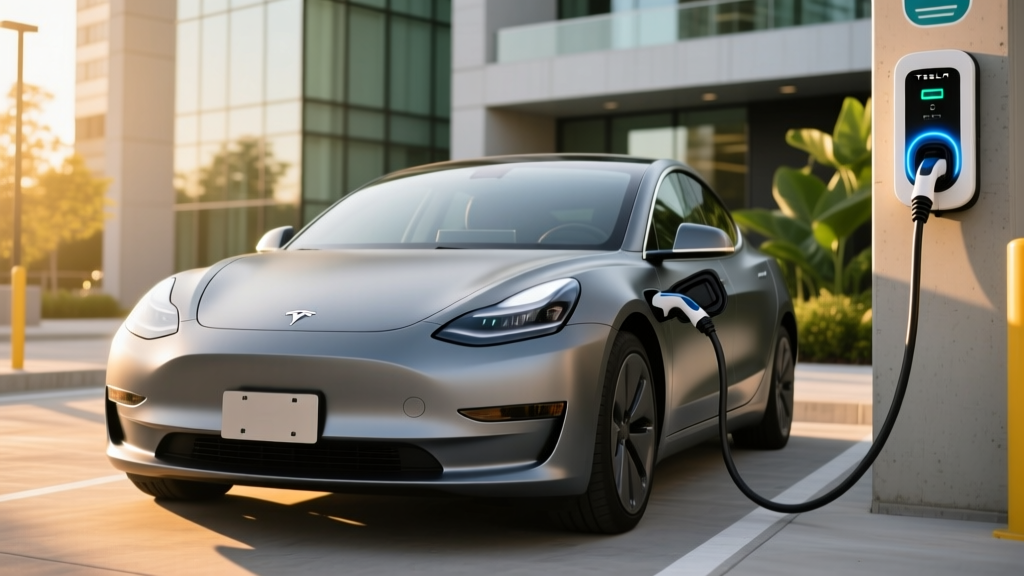
The Tesla Model 3 SR+ was built with Tesla's proprietary connector (now standardized as NACS — North American Charging Standard). Here's how that maps to today's charging infrastructure:
| Connector | Native on Model 3 SR+? | Adapter Needed? | Network Access |
|---|---|---|---|
| NACS (Tesla) | Yes — native port | No | Tesla Supercharger network (17,000+ stalls in US), Tesla Destination Chargers |
| CCS1 | No | Yes — Tesla CCS Adapter (~$175–$250) | Electrify America, EVgo, ChargePoint DC, and other CCS networks |
| CHAdeMO | No | Yes — third-party adapter (expensive, ~$400+) | Limited; being phased out in the US |
| J1772 (Level 2 public) | No | Yes — included with Tesla Mobile Connector | Public Level 2 stations, workplace chargers |
Practical recommendation: For daily charging, the Tesla Supercharger network is the most reliable option. For road trips through areas with limited Supercharger coverage, the Tesla CCS Adapter unlocks thousands of additional DC fast chargers. Tesla sells the adapter directly, and it works with the SR+ via a software update (ensure your vehicle firmware is current).
Cost to Charge: Home vs. Public vs. Gas Comparison
One of the strongest ownership arguments for the Model 3 SR+ is fuel cost. Here's what charging actually costs per mile compared to a comparable gas sedan:
| Scenario | Price per kWh | Cost for Full Charge (50 kWh) | Cost Per Mile (at 4 mi/kWh) |
|---|---|---|---|
| Home — off-peak utility rate | $0.08–$0.13 | $4.00–$6.50 | $0.02–$0.033 |
| Home — standard utility rate | $0.14–$0.20 | $7.00–$10.00 | $0.035–$0.05 |
| Public Level 2 (ChargePoint, etc.) | $0.20–$0.35 | $10.00–$17.50 | $0.05–$0.088 |
| DC Fast — Tesla Supercharger | $0.25–$0.40 | $12.50–$20.00 | $0.063–$0.10 |
| DC Fast — Electrify America | $0.35–$0.55 | $17.50–$27.50 | $0.088–$0.138 |
| Gas sedan (30 MPG, $3.50/gal) | — | — | $0.117 |
Bottom line: Charging at home on off-peak rates costs roughly $0.02–$0.03 per mile, making the Model 3 SR+ about 4–5x cheaper to fuel than a 30 MPG gas car at $3.50/gallon. Even at Supercharger pricing ($0.06–$0.10/mi), you're still saving significantly. The Model 3 SR+ achieves approximately 4 miles per kWh (146 MPGe combined, per fueleconomy.gov), which is among the most efficient EVs on the road.
Recommended Home Charging Equipment for the Model 3 SR+
The SR+'s 11.5 kW onboard charger means you benefit from a 48A hardwired charger — anything above that won't charge the car faster, but anything below leaves performance on the table. Here are three strong options:
Tesla Wall Connector (Gen 3)
- Power output: Up to 11.5 kW (48A, hardwired on 60A circuit)
- Connector: NACS (native Tesla — no adapter needed)
- Cable length: 24 ft
- Smart features: Wi-Fi, over-the-air updates, power-sharing with second unit, load management
- Price: ~$450
- Best for: Tesla-only households wanting maximum simplicity and fastest Level 2 charge for the SR+
ChargePoint Home Flex
- Power output: Up to 12 kW (50A, configurable from 16A–50A via DIP switches)
- Connector: NACS or J1772 (select at purchase)
- Cable length: 23 ft
- Smart features: Wi-Fi, ChargePoint app scheduling, Alexa integration, energy reports
- Price: ~$550–$650
- Best for: Multi-EV households or those wanting detailed energy tracking
Emporia Level 2 EV Charger
- Power output: Up to 11.5 kW (48A, hardwired or NEMA 14-50 plug)
- Connector: J1772 (use Tesla's included J1772 adapter) or NACS (2025+ model)
- Cable length: 24 ft
- Smart features: Wi-Fi, Emporia app, solar integration, time-of-use scheduling
- Price: ~$350–$400
- Best for: Budget-conscious buyers or homes with Emporia whole-home energy monitoring
All three units carry NEMA 4 outdoor ratings and UL listing. For the Model 3 SR+ specifically, the Tesla Wall Connector is the most frictionless choice — native NACS plug, no adapter, and full 11.5 kW output matching the car's onboard charger limit.
Safety, Code, and Best Practices
EV charging involves sustained high-current draw — often for hours at a time. This places demands on your home electrical system that differ from typical appliance use. Key safety points:
- Dedicated circuit: Your EV charger must be on its own dedicated breaker — never shared with other appliances. A 50A circuit for a NEMA 14-50 outlet or a 60A circuit for a hardwired unit.
- Continuous load derating: The NEC requires that EV chargers (a continuous load, defined as running 3+ hours) use only 80% of the circuit's rated capacity. A 50A breaker delivers 40A continuous; a 60A breaker delivers 48A continuous. This is why a "50A outlet" yields 40A to the car.
- GFCI protection: Required for receptacle-based (outlet) installations in garages per NEC 2020 and later. Hardwired units may be exempt in some jurisdictions.
- Wire gauge: 6 AWG copper for 50A circuits; 4 AWG copper for 60A circuits. Longer runs may require upsizing to compensate for voltage drop.
- Do not use extension cords: Never use a household extension cord between your outlet and EV charger. If you need more reach, buy a charger with a longer cable or relocate the outlet.
- Professional installation only: A licensed electrician should perform all work, pull the required permit, and schedule the municipal inspection. DIY 240V work carries fire and shock risk and may void your homeowner's insurance coverage.
Frequently Asked Questions
How much does it cost to install a home EV charger for a Tesla Model 3 SR+?
A straightforward installation (NEMA 14-50 outlet, short wire run, adequate panel capacity) costs $500–$1,500 including equipment, materials, labor, and permit. A hardwired 60A setup with a moderate wire run typically runs $1,375–$2,700. If your home needs an electrical panel upgrade, add $1,500–$3,500. Always get quotes from licensed electricians and check for utility rebates.
How fast will each charging level add range to my Model 3 SR+?
Level 1 (120V) adds roughly 3–5 miles per hour. Level 2 (240V) adds 25–45 miles per hour depending on amperage (32A yields ~32 mi/hr; 48A yields ~45 mi/hr). DC fast charging at a Supercharger V3 can add up to 150+ miles in 15 minutes at peak rate, though the charge curve tapers above 60% SoC.
Which connector and charger is compatible with my Model 3 SR+?
The Model 3 SR+ uses the NACS (Tesla) connector natively. It works directly with Tesla Superchargers and the Tesla Wall Connector. For CCS public chargers (Electrify America, EVgo), you need the Tesla CCS Adapter (~$175–$250). For Level 2 public stations with J1772 connectors, Tesla includes a J1772 adapter with the vehicle.
How much does charging cost per mile compared to gas?
At home on off-peak electricity ($0.10/kWh), the Model 3 SR+ costs about $0.025 per mile — roughly 4–5x cheaper than a 30 MPG gas car at $3.50/gallon ($0.117/mi). Even on public DC fast chargers at $0.35/kWh, you're paying ~$0.088/mi, still below gas. The SR+'s high efficiency (~4 mi/kWh) makes it one of the cheapest EVs to fuel.
What electrical upgrades might I need for a home charger?
The most common upgrade is a panel replacement — if your home has a 100A or 150A panel, adding a 50–60A EV circuit may exceed capacity, requiring a $1,500–$3,500 upgrade to 200A. Other potential needs include a longer wire run (adds $5–$15/ft), a GFCI breaker ($80–$150), or relocating the outlet for convenience. A licensed electrician can assess your panel load calculation during a site visit.
Does the Tesla Model 3 SR+ qualify for any federal tax credits?
The Model 3 SR+ is no longer sold new, so the new-vehicle §30D credit does not apply. However, if you're purchasing a used SR+, the Used Clean Vehicle Credit (§25E) offers up to $4,000 (30% of sale price, capped) for eligible buyers purchasing from a dealer. Income caps apply: $75,000 single / $150,000 joint filers. The vehicle must be at least two model years old and sell for $25,000 or less. Consult a tax professional for your specific eligibility.