Quick Verdict: Is the Blink Level 2 Charger Right for Your Garage?
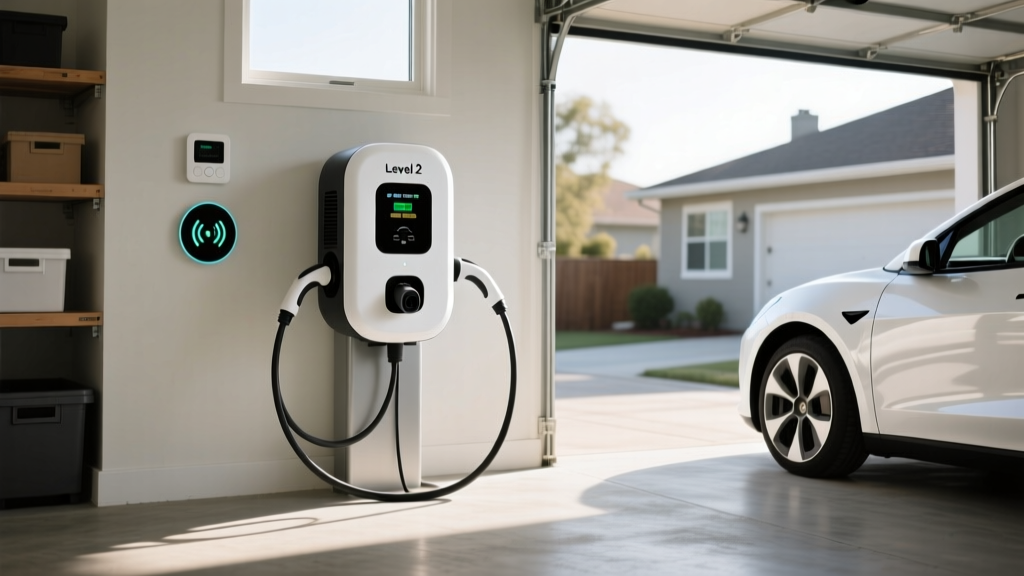
The Blink HQ 200 is a Wi-Fi-enabled, 32-amp Level 2 home charger delivering up to 7.7 kW (roughly 25–30 miles of range per hour for most EVs). Priced around $499 for the hardware, it sits in the mid-tier of the residential charging market — cheaper than a ChargePoint Home Flex but above Amazon's Basics smart charger. For most EV owners with a 60–100 kWh battery, the Blink Level 2 charger will replenish a full day's driving overnight in 6–8 hours, making it a practical daily-driver solution if your electrical panel can support a dedicated 40-amp circuit.
But hardware price is only half the equation. Installation, permitting, and potential panel upgrades frequently exceed the cost of the charger itself. Below, we break down the full economics — from the Blink's charge curve behavior to the real cost of getting 240V wired to your garage.
Charging Levels Explained: kW, Miles Per Hour, and What They Mean
Before evaluating the Blink Level 2 charger specifically, it helps to frame where it sits in the broader charging ecosystem. Power is measured in kW (kilowatts — the rate of energy flow), while your battery stores energy in kWh (kilowatt-hours — the total capacity). A 7.7 kW charger adds 7.7 kWh of energy per hour of charging.
| Level | Voltage | Max Power (kW) | Miles of Range Added/Hour | Typical Use Case |
|---|---|---|---|---|
| Level 1 | 120V AC | 1.4–1.9 kW | 3–5 mi/hr | Overnight trickle; PHEVs, low-mileage drivers |
| Level 2 (Blink HQ 200) | 240V AC | 7.7 kW (32A) | 25–30 mi/hr | Daily home charging; most EVs fully overnight |
| Level 2 (48A models) | 240V AC | 11.5 kW (48A) | 35–44 mi/hr | Larger batteries (100+ kWh), faster turnaround |
| DC Fast Charge | 400–800V DC | 50–350 kW | 150–1,000+ mi/hr | Road trips; 10–80% in 15–40 min |
The Blink HQ 200's 7.7 kW output is the practical ceiling for most residential 40A circuits (the National Electrical Code requires the continuous load to be 80% of breaker rating, so a 40A breaker yields 32A usable). If your EV has a larger onboard charger — the Ford F-150 Lightning Extended Range accepts 19.2 kW AC, for example — a 7.7 kW unit won't max out its capability. But for a Tesla Model 3 (which accepts up to 11.5 kW AC) or a Hyundai Ioniq 5 (10.9 kW AC), 7.7 kW still covers daily needs comfortably.
- Tesla Model Y Long Range (75 kWh usable, 0→100%): ~10 hours
- Chevrolet Equinox EV (85 kWh usable, 0→100%): ~11 hours
- Hyundai Ioniq 5 (77.4 kWh usable, 10→80%): ~7 hours
- Toyota RAV4 Prime PHEV (18.1 kWh usable, 0→100%): ~2.5 hours
Home Installation: Electrical Requirements, Panel Upgrades, and Costs
This is where many buyers get surprised. The Blink Level 2 charger itself runs about $499, but a safe, code-compliant installation typically costs between $450 and $2,200 on top of that — and potentially much more if your home's electrical panel needs an upgrade.
What the Blink HQ 200 Requires Electrically
- Voltage: 240V (hardwired or NEMA 14-50 outlet)
- Circuit breaker: 40A dedicated (for 32A continuous draw)
- Wire gauge: 6 AWG copper (or 4 AWG aluminum for longer runs)
- Connection type: Hardwired version requires a junction box; plug-in version needs a NEMA 14-50 receptacle
The hardwired variant is generally preferred for permanent installations — it avoids the NEC 2026 requirement for GFCI breakers on receptacles, which can nuisance-trip with some EVSE units. If you choose the plug-in model, factor in a GFCI breaker (~$50–$120 extra).
Do You Need a Panel Upgrade?
Most homes built after 1990 have a 200-amp main panel, which can usually accommodate a 40A EV circuit if you have spare breaker slots and sufficient remaining capacity. Homes with 100-amp service (common in pre-1980 construction) or panels already near capacity (electric range, dryer, HVAC, water heater all running) may need a service upgrade to 200A, which costs $1,500–$4,000 depending on your utility and local labor rates.
A licensed electrician will perform a load calculation per NEC Article 220 to determine if your panel can handle the additional draw. Don't skip this step — overloading a panel is a fire hazard.
| Item | Low Estimate | High Estimate | Notes |
|---|---|---|---|
| Blink HQ 200 (hardware) | $449 | $549 | Hardwired vs. plug-in; retailer variation |
| Electrician labor (simple run) | $300 | $800 | Panel to garage ≤30 ft, drywall access |
| Electrician labor (complex run) | $800 | $1,800 | Long wire runs, attic/crawlspace, conduit |
| Permit & inspection | $50 | $250 | Varies by municipality |
| NEMA 14-50 receptacle + GFCI breaker | $80 | $170 | Only for plug-in model |
| Panel upgrade (100A → 200A) | $1,500 | $4,000 | Only if required by load calculation |
| Total (no panel upgrade) | $879 | $2,569 | Most typical scenario |
| Total (with panel upgrade) | $2,379 | $6,569 | Older homes |
Federal incentive note: The IRS residential clean energy credit does not cover EV chargers after 2023 under current §25C/§25E rules. Some states and utilities still offer rebates of $200–$750 for Level 2 equipment and installation — check your utility's website or the AFDC state incentive database.
Connector Compatibility: Will the Blink Work With Your EV?
As of 2025–2026, the North American charging connector landscape has shifted significantly. Most automakers have adopted the NACS (North American Charging Standard) connector pioneered by Tesla, while legacy vehicles still use CCS1. A few older Nissan Leaf and Mitsubishi models use CHAdeMO.
The Blink HQ 200 ships with a J1772 connector (the legacy Level 2 standard). Here's what that means for your vehicle:
| Your EV's Port | Direct Plug? | Adapter Needed | Adapter Cost |
|---|---|---|---|
| J1772 (older Chevy Bolt, VW ID.4 pre-2025, Rivian) | Yes — direct | None | $0 |
| NACS (Tesla Model 3/Y, Ford F-150 Lightning, GM Ultium 2025+) | No | J1772-to-NACS adapter | $50–$150 |
| CCS1 (2024 and earlier most non-Tesla) | Yes (Level 2 portion is J1772) | None | $0 |
| CHAdeMO (Nissan Leaf) | Yes (Level 2 portion is J1772) | None | $0 |
The key point: every CCS1 vehicle has a J1772 upper section, so the Blink plugs in directly. NACS-equipped vehicles need a simple adapter (Tesla sells one for ~$95; third-party options from Lectron and others run $50–$80). This is a minor inconvenience, not a dealbreaker.
Cost to Charge: Home vs. Public vs. Gas — The Real Math
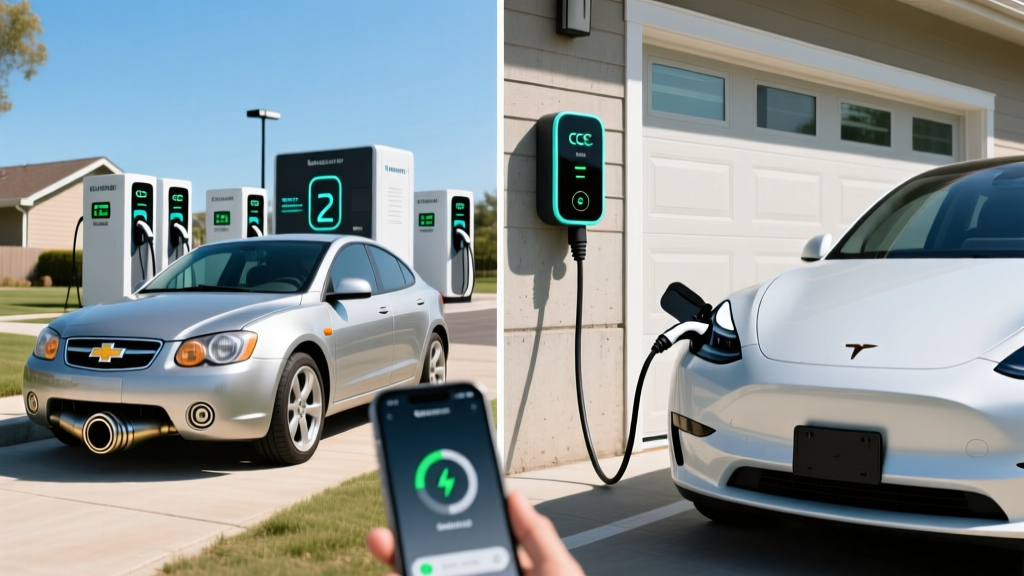
The financial case for home Level 2 charging hinges on your local electricity rates and how they compare to gasoline. Here's the math using 2026 national averages:
| Scenario | Rate | Cost per Mile (250 Wh/mi EV) | Annual Cost (12,000 mi) |
|---|---|---|---|
| Home — off-peak utility rate | $0.10/kWh | $0.025 | $300 |
| Home — average blended rate | $0.16/kWh | $0.040 | $480 |
| Public Level 2 (Blink network) | $0.39–$0.59/kWh | $0.10–$0.15 | $1,200–$1,800 |
| DC Fast Charge (Electrify America) | $0.48–$0.65/kWh | $0.12–$0.16 | $1,440–$1,920 |
| Gasoline (30 MPG, $3.40/gal) | $3.40/gallon | $0.113 | $1,360 |
At home off-peak rates, the Blink Level 2 charger delivers fuel at roughly $0.03 per mile — about one-quarter the cost of gasoline. Even at a blended residential rate of $0.16/kWh, you're paying $0.04/mile. The savings evaporate if you rely exclusively on public Blink network chargers at $0.49+/kWh, which is why home installation is the financial priority.
Blink HQ 200 vs. Competitors: How It Stacks Up
The Blink Level 2 charger competes in a crowded market. Here's how it compares to other popular home units:
Blink HQ 200
- Max output: 7.7 kW (32A)
- Cable length: 18–23 ft (varies by model)
- Smart features: Wi-Fi, Blink app, scheduling, energy tracking
- Connector: J1772
- Indoor/outdoor: NEMA 4 rated (outdoor OK)
- Warranty: 1 year
- Price: ~$449–$549
ChargePoint Home Flex
- Max output: 12 kW (50A) — configurable down to 16A
- Cable length: 23 ft
- Smart features: Wi-Fi, app, Alexa, scheduling, amperage adjustable
- Connector: J1772 (NACS adapter included 2025+)
- Indoor/outdoor: NEMA 4
- Warranty: 3 years
- Price: ~$599–$699
Tesla Wall Connector
- Max output: 11.5 kW (48A)
- Cable length: 24 ft
- Smart features: Wi-Fi, OTA updates, power sharing (multiple units), no app scheduling (basic)
- Connector: NACS native (J1772 adapter available)
- Indoor/outdoor: NEMA 4
- Warranty: 4 years
- Price: ~$475
Emporia Vue Level 2
- Max output: 11.5 kW (48A)
- Cable length: 24 ft
- Smart features: Wi-Fi, app, solar integration, load management, scheduling
- Connector: J1772
- Indoor/outdoor: NEMA 4
- Warranty: 3 years
- Price: ~$399
Where the Blink Wins and Falls Short
Strengths: The Blink HQ 200 is straightforward, UL-listed, and backed by one of the largest public charging networks in the U.S. (useful if you travel and want app familiarity). The 18–23 ft cable is adequate for most single-car garages.
Weaknesses: At 32A / 7.7 kW, it's the lowest-output unit in this comparison — fine for a 75 kWh battery, but slow for a 100+ kWh truck or SUV. The 1-year warranty is notably shorter than competitors (ChargePoint offers 3 years, Tesla 4 years). And the Blink app, while functional, draws mixed user reviews for occasional connectivity issues.
Safety, Code, and Installation Best Practices
EV charging is a high-draw, continuous electrical load — safety shortcuts are dangerous and illegal. Here's what your installation must satisfy:
- Dedicated circuit: The 40A breaker must serve only the EVSE. No shared outlets on the same breaker.
- Hardwired preferred: Hardwired installations avoid the NEC 2026 GFCI breaker requirement for receptacles. GFCI nuisance tripping is a documented issue with some plug-in EVSEs on 240V circuits.
- NEMA 4 rating: If mounting outdoors or in an unsealed garage, the unit must be rated for weather exposure. The Blink HQ 200 carries a NEMA 4 rating — it can handle rain and dust.
- Permit required: Virtually all jurisdictions require an electrical permit for a new 240V circuit. Your electrician pulls this; the inspection ensures code compliance and protects your home insurance coverage.
- Wire sizing: 6 AWG copper minimum for 40A. Longer runs (>50 ft) may require 4 AWG to prevent voltage drop. Your electrician calculates this.
- No extension cords: Never use an extension cord with a Level 2 EVSE. If the cable doesn't reach, relocate the charger or get a longer-cable model.
Frequently Asked Questions
How much does it cost to install a Blink Level 2 charger at home?
Expect $879–$2,569 total (hardware + electrician + permit) for a typical installation without a panel upgrade. If your home needs a 100A-to-200A service upgrade, add $1,500–$4,000. Get at least three quotes from licensed electricians — prices vary dramatically based on wire run length and access difficulty.
How fast will the Blink Level 2 charger add range to my EV?
At 7.7 kW, expect 25–30 miles of range per hour of charging for an average EV consuming 250–300 Wh/mile. A Tesla Model Y (75 kWh battery, ~310 miles EPA range) charges from empty to full in roughly 10 hours. For a 10–80% top-up (the typical daily charging window), plan on about 7 hours.
Is the Blink Level 2 charger compatible with Tesla vehicles?
Yes, but you'll need a J1772-to-NACS adapter (approximately $50–$95) since Tesla vehicles use the NACS port. The adapter is small, lives in your trunk, and takes 5 seconds to connect. Every other non-Tesla EV with a CCS1 or J1772 port plugs directly into the Blink without an adapter.
How does charging cost per mile compare to gasoline?
At a typical residential rate of $0.16/kWh and an EV efficiency of 3–4 miles per kWh, you'll pay roughly $0.04 per mile — compared to $0.11 per mile for a 30 MPG gas car at $3.40/gallon. That's a 60–65% fuel cost reduction, saving about $880 per year over 12,000 miles of driving.
What electrical upgrades might my home need for a Level 2 charger?
The most common upgrade is adding a 40A double-pole breaker and running 6 AWG wire from your panel to the garage. If your panel lacks spare slots or has insufficient capacity (a load calculation determines this), you may need a panel upgrade from 100A to 200A service — a $1,500–$4,000 job. Homes with existing 200A panels and open slots typically need no upgrade beyond the new circuit.
Can I use the Blink app to schedule charging for off-peak rates?
Yes. The Blink app supports scheduled charging sessions, so you can plug in when you arrive home and set charging to begin during your utility's off-peak window (typically 11 PM–6 AM). This can cut your per-kWh cost by 40–60% compared to peak rates.
Does the Blink HQ 200 work outdoors?
Yes — it carries a NEMA 4 enclosure rating, meaning it's protected against splashing water, rain, and dust. It can be mounted on an exterior wall or a freestanding post. Just ensure the connector holster is positioned to prevent the plug from sitting in standing water or accumulating debris.