Why Your Charging Setup Directly Impacts Model 3 Range Miles
The Tesla Model 3 Long Range AWD delivers an EPA-estimated 341 miles of range (2025 model year), while the Performance variant returns 315 miles. The base Rear-Wheel Drive model achieves 272 miles EPA. But those sticker numbers only tell part of the story. How you charge — the speed, the frequency, the state-of-charge targets — directly shapes your daily usable range and long-term battery health.
A Model 3 owner who relies on DC fast charging exclusively and routinely charges to 100% will experience measurably faster battery degradation than one who uses a home Level 2 charger and keeps daily charges between 20–80%. Over five years, that difference can mean 15–30 fewer usable miles on a full charge. Your charging infrastructure isn't just a convenience — it's a range-preservation strategy.
- Mixed city/highway (65–75 mph, 70°F): ~290–310 miles
- Sustained highway (80 mph, 70°F): ~260–280 miles
- Cold weather (30°F, highway): ~220–250 miles
- Cold weather + cabin heat + 80 mph: ~200–230 miles
Source: fueleconomy.gov and independent real-world testing. The Model 3's heat pump (standard since 2021) significantly reduces cold-weather range loss compared to resistive heating systems.
Charging Levels Explained: How Fast Each Adds Range to Your Model 3
Understanding the three charging tiers is essential. The key distinction: kW (kilowatts) measures power — how fast energy flows into the battery. kWh (kilowatt-hours) measures energy — the battery's total capacity. The Model 3 Long Range has an ~82 kWh battery pack (usable capacity ~75 kWh). Charging speed in kW determines how quickly you refill those kWh.
| Level | Power (kW) | Voltage / Amperage | Miles of Range Added per Hour | Typical Use Case |
|---|---|---|---|---|
| Level 1 (120V) | 1.4–1.9 kW | 120V / 12–16A | 3–5 mi/hr | Overnight top-off, emergency |
| Level 2 (240V) | 7.2–11.5 kW | 240V / 30–48A | 24–44 mi/hr | Home daily charging, workplace |
| DC Fast Charging | 50–250 kW | 400V+ DC | 150–1,000+ mi/hr (peak) | Road trips, rapid top-ups |
Charging curve reality check: The Model 3 Long Range can accept up to 250 kW peak at a Tesla V3 Supercharger. However, that peak rate only holds between roughly 10–30% state of charge (SoC). By 50% SoC, the rate tapers to ~150 kW. By 80%, it drops to ~75 kW. A realistic 10–80% charge takes approximately 25–30 minutes at a V3 Supercharger. Charging from 80–100% can take an additional 20+ minutes due to cell-balancing — which is why Superchargers discourage charging above 80% during peak hours.
At a 48A Level 2 home charger (11.5 kW), a full 10–80% charge (adding ~52.5 kWh to the pack) takes roughly 4.5–5 hours. Plug in at 10 PM, and you'll have a full daily charge by 3 AM — more than enough for any commute.
Home Charger Installation: Electrical Requirements, Panel Upgrades, and Costs
Installing a Level 2 home charger is the single highest-impact upgrade for preserving your Model 3's range miles over time. Consistent Level 2 charging at moderate SoC targets is gentler on the battery than frequent DC fast charging, and it eliminates the range compromise of partial public charges.
Electrical Requirements for a Model 3 Home Charger
The Tesla Wall Connector supports up to 48 amps, requiring a 60-amp dedicated circuit on a 240V line (electrical code requires circuits to be rated at 125% of the continuous load: 48A × 1.25 = 60A). If your electrical panel doesn't have capacity for a 60A breaker, you can configure the Wall Connector to 40A (requiring a 50A circuit) or 32A (40A circuit) with a proportional reduction in charging speed.
Panel upgrade considerations: Homes with a 100-amp main panel frequently need a service upgrade to 200 amps before adding a 60A EV circuit — especially if you already have electric range, dryer, and HVAC loads. A licensed electrician will perform a load calculation per NEC Article 220 to determine if your panel can accommodate the charger. Panel upgrades are the single largest variable in installation cost.
| Component | Simple Install (panel nearby, no upgrade) | Complex Install (long run or panel upgrade) |
|---|---|---|
| Charger equipment (Tesla Wall Connector or equivalent) | $400–$475 | $400–$475 |
| Electrician labor (2–4 hrs simple / 6–12 hrs complex) | $300–$800 | $1,200–$3,000 |
| Electrical permit | $50–$200 | $50–$200 |
| Panel upgrade (if needed: 100A → 200A) | N/A | $1,500–$4,000 |
| Conduit, wiring (6 AWG copper for 60A), misc. materials | $100–$300 | $300–$800 |
| Total Estimated Cost | $850–$1,775 | $3,450–$8,475 |
Federal incentive: The IRS Residential Clean Energy Credit (IRC §25D) covers 30% of the cost of EV charging equipment and installation, up to $1,000 annually, through 2032. This applies to the charger hardware and the electrical work, but not to panel upgrades that serve the whole home. Consult a tax professional for your specific eligibility. Some utilities also offer rebates of $250–$500 for Level 2 installations — check with your local provider.
Charging Cost Per Mile: Model 3 vs. Gasoline Equivalent
The Model 3 Long Range achieves an EPA-rated 132 MPGe combined (approximately 25 kWh per 100 miles). That efficiency figure lets us calculate real charging costs across different scenarios.
| Charging Scenario | Cost per kWh | Cost per 100 Miles | Cost per Mile |
|---|---|---|---|
| Home (off-peak utility rate) | $0.10–$0.14 | $2.50–$3.50 | $0.025–$0.035 |
| Home (standard residential rate) | $0.15–$0.20 | $3.75–$5.00 | $0.038–$0.050 |
| Public Level 2 (ChargePoint, EVgo L2) | $0.25–$0.40 | $6.25–$10.00 | $0.063–$0.100 |
| DC Fast Charging (Supercharger, Electrify America) | $0.30–$0.50 | $7.50–$12.50 | $0.075–$0.125 |
| Gasoline sedan (30 MPG, $3.40/gal) | — | $11.33 | $0.113 |
Even at peak DC fast charging rates, the Model 3 costs roughly the same per mile as a 30 MPG gas car. At home off-peak rates, it costs roughly one-quarter to one-third what a gasoline car costs per mile. Over 15,000 annual miles, a home-charged Model 3 saves approximately $1,200–$1,500 per year in fuel costs versus a comparable gas sedan — a meaningful factor in total cost of ownership.
Connector Compatibility: NACS, CCS, and Adapter Requirements
All 2025–2026 Tesla Model 3 vehicles ship with the North American Charging Standard (NACS) connector — the native Tesla plug. This gives Model 3 owners direct access to the Tesla Supercharger network (over 25,000 stalls in North America as of early 2026) without any adapter.
However, the broader public charging landscape includes CCS1-equipped stations (Electrify America, EVgo, many ChargePoint locations). Here's the compatibility picture:
| Connector Type | Native Support? | Adapter Required? | Network Access |
|---|---|---|---|
| NACS (Tesla) | Yes — native | No | Tesla Superchargers, Destination Chargers |
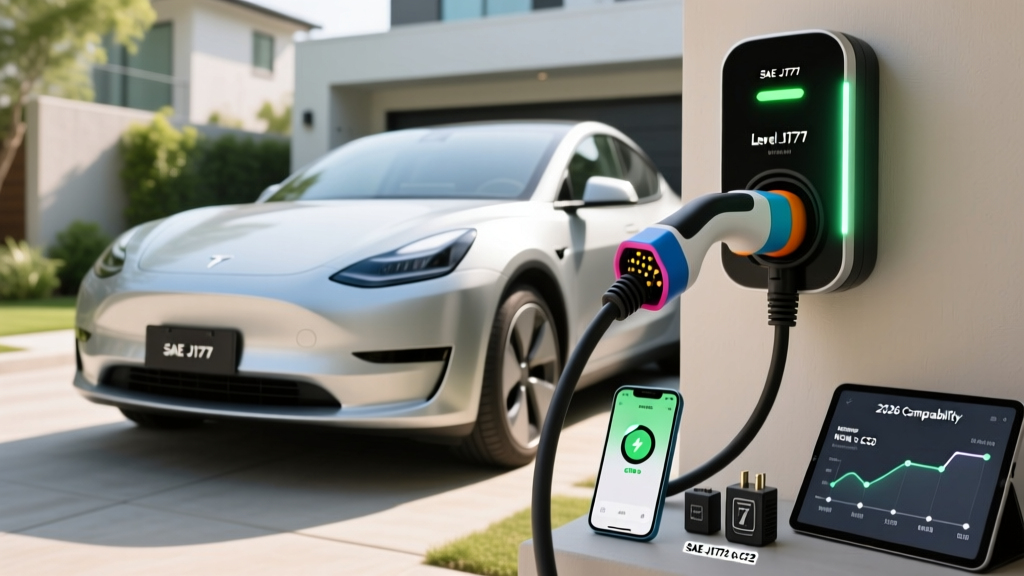
| J1772 (Level 2 public) | No | Yes — Tesla ships a J1772 adapter | ChargePoint, public L2 stations |
| CCS1 (DC fast) | No | Yes — Tesla CCS Adapter (~$175–$250) | Electrify America, EVgo, Ionity |
| CHAdeMO | No | Third-party adapters available but uncommon | Limited legacy stations |
Practical recommendation: Carry the included J1772 adapter for public Level 2 stations and purchase the Tesla CCS Adapter if you plan to use non-Tesla DC fast chargers on road trips. The CCS adapter supports up to 250 kW, so you won't sacrifice charging speed at compatible stations.
Recommended Home Chargers for the Model 3
These chargers pair well with the Model 3's onboard charger (which accepts up to 11.5 kW / 48A on Level 2):
Tesla Wall Connector (Gen 3)
- Max output: 11.5 kW (48A)
- Connector: NACS native — no adapter needed
- Cable length: 24 ft
- Smart features: Wi-Fi, OTA updates, Tesla app integration, load sharing (pair two units on one circuit), access control
- Price: ~$475
- Best for: Tesla-exclusive households wanting seamless integration
ChargePoint Home Flex
- Max output: 12 kW (50A) — configurable down to 16A
- Connector: J1772 (use Tesla's included adapter) or NACS version available
- Cable length: 23 ft
- Smart features: Wi-Fi, ChargePoint app, Alexa integration, scheduling, energy tracking
- Price: ~$550–$650
- Best for: Multi-EV households (non-Tesla + Tesla) wanting one universal charger
Emporia Vue Level 2 Charger
- Max output: 11.5 kW (48A)
- Connector: J1772 or NACS
- Cable length: 24 ft
- Smart features: Wi-Fi, Emporia app, solar integration, scheduled charging, energy monitoring with whole-home panel integration
- Price: ~$400–$500
- Best for: Solar-panel owners wanting to charge from excess generation
Safety, Code Compliance, and Installation Best Practices
EV charging is a continuous high-amperage load — unlike a dryer that cycles on and off, a charger may draw maximum current for 4–8 hours straight. This demands proper installation:
- Dedicated circuit: Your Level 2 charger must have its own dedicated breaker — never share a circuit with other appliances.
- GFCI protection: NEC 2020 and later requires GFCI protection for all EV charging outlets. Hardwired installations (like the Tesla Wall Connector) may be exempt depending on local code, but GFCI breakers are recommended for outdoor installations.
- Outdoor rating: If installing outside, ensure the charger carries a NEMA 4 (weatherproof) rating. The Tesla Wall Connector and ChargePoint Home Flex are both NEMA 4 rated.
- Wire gauge: A 60A circuit requires 6 AWG copper wire (THHN in conduit) or 4 AWG aluminum. Your electrician will size wire based on run length and local code.
- Permit and inspection: Most jurisdictions require an electrical permit for EV charger installation. The inspection ensures the circuit, grounding, and overcurrent protection meet NEC standards. Skipping permits risks insurance claim denials if an electrical fire occurs.
Frequently Asked Questions
How much does it cost to install a home EV charger for my Model 3?
A straightforward installation with an adequate electrical panel typically costs $850–$1,775 total (charger + electrician + permit). If your home needs a panel upgrade from 100A to 200A service, expect $3,450–$8,475. The IRS §25D credit covers 30% of equipment and installation up to $1,000, and many utilities offer additional rebates.
How fast will each charging level add range to a Model 3?
Level 1 (120V standard outlet) adds roughly 3–5 miles per hour — enough only for overnight top-offs if you drive under 40 miles daily. Level 2 (240V, 48A) adds approximately 44 miles per hour, fully replenishing a daily commute in 1–2 hours. DC fast charging at a V3 Supercharger adds up to 170 miles in 15 minutes at peak rate, though the charge curve tapers significantly above 50% SoC.
Which connector and charger are compatible with my Model 3?
The 2025–2026 Model 3 uses the NACS connector natively. For home charging, the Tesla Wall Connector plugs directly in. For public Level 2 stations with J1772 connectors, use the adapter Tesla includes with the car. For non-Tesla DC fast chargers (CCS1), purchase the Tesla CCS Adapter. CHAdeMO stations are increasingly rare and not practically supported.
How much does charging a Model 3 cost per mile vs. gas?
At home off-peak rates ($0.10–$0.14/kWh), a Model 3 Long Range costs roughly $0.025–$0.035 per mile. At standard residential rates, it's $0.038–$0.050. A comparable 30 MPG gasoline sedan at $3.40/gallon costs $0.113 per mile. Home charging saves approximately 60–75% on fuel costs. Even public DC fast charging at $0.40/kWh ($0.10/mile) remains competitive with gasoline.
What electrical upgrades might I need for a Level 2 charger?
Homes with a 200-amp panel and available breaker spaces usually need only a new 60A circuit and conduit run. Homes with a 100-amp panel — common in houses built before 1990 — often require a full service upgrade to 200A, costing $1,500–$4,000. If your panel is full but rated at 200A, a sub-panel installation ($500–$1,200) may suffice. A licensed electrician's load calculation determines the exact requirement.
Does frequent DC fast charging reduce my Model 3's range over time?
Yes, modestly. Tesla's battery management system actively mitigates degradation through thermal management and charge-rate limiting, but data from high-mileage Model 3 fleets shows that vehicles charged predominantly via DC fast charging experience approximately 2–4% more degradation over 100,000 miles compared to those charged primarily on Level 2. For optimal long-term range retention, use Level 2 for daily charging and reserve DC fast charging for road trips.