What Is SAE J1772 and Why Does It Still Matter in 2026?
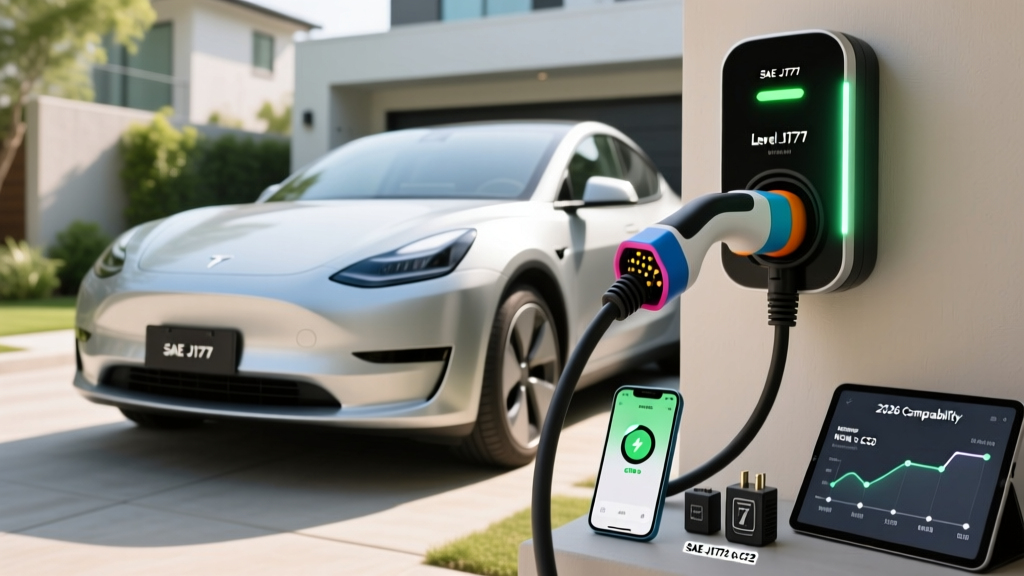
If you've ever plugged an electric vehicle into a Level 1 wall outlet or a Level 2 home charger in North America, you've used the SAE J1772 connector. Officially known as the J1772 standard published by SAE International, this five-pin round connector has been the default AC charging interface for every non-Tesla EV sold in the United States since roughly 2010. Even as the industry shifts toward Tesla's North American Charging Standard (NACS) for new vehicles starting in the 2025–2026 model years, J1772 remains the connector physically present on millions of EVs already on the road and on the vast majority of Level 2 public and home charging stations installed to date.
Understanding J1772 isn't just an academic exercise — it determines what home charger you can buy, whether you need an adapter, and how fast your EV will charge overnight. This guide covers the connector's technical specs, real-world charging speeds at every level, home installation requirements and costs, and which equipment we recommend in 2026.
Charging Levels Explained: Speeds, kW, and Miles Per Hour
Every EV owner needs to understand the three charging tiers available. Each uses different electrical infrastructure and delivers dramatically different speeds.
| Level | Voltage / Amperage | Max Power (kW) | Miles of Range Added Per Hour | Connector Used |
|---|---|---|---|---|
| Level 1 | 120V / 12A | 1.4 kW | 3–5 mi/hr | SAE J1772 |
| Level 2 (32A) | 240V / 32A | 7.7 kW | 23–30 mi/hr | SAE J1772 |
| Level 2 (48A) | 240V / 48A | 11.5 kW | 35–44 mi/hr | SAE J1772 |
| Level 2 (80A) | 240V / 80A | 19.2 kW | 55–70 mi/hr | SAE J1772 |
| DC Fast Charging | 400–800V DC / variable | 50–350 kW | 150–300+ mi in 20 min | CCS1, NACS, or CHAdeMO |
SAE J1772 is the connector for all AC charging — Level 1 and Level 2. It does not handle DC fast charging. For DC, your vehicle uses a separate connector (CCS1, NACS, or CHAdeMO) that incorporates additional high-voltage pins below the J1772 portion or replaces it entirely.
Real-World Charging Time Examples
Here's how long common battery sizes take to charge from 10% to 80% State of Charge (SoC) on different Level 2 setups. Note that the vehicle's onboard charger limits the maximum AC intake — for example, a Hyundai Ioniq 5 has an 11 kW onboard charger, so even on a 48A/11.5 kW station, it will draw roughly 11 kW.
- 62 kWh battery (e.g., Nissan Ariya, Volkswagen ID.4): ~7.5 hours on 7.7 kW (32A); ~5 hours on 11.5 kW (48A)
- 75 kWh battery (e.g., Ford Mustang Mach-E Extended Range): ~9 hours on 7.7 kW; ~6 hours on 11.5 kW
- 82 kWh battery (e.g., Tesla Model Y with J1772 adapter): ~10 hours on 7.7 kW; ~7 hours on 11.5 kW
- 100 kWh battery (e.g., Rivian R1S): ~12 hours on 7.7 kW; ~8 hours on 11.5 kW
SAE J1772 vs. NACS, CCS1, and CHAdeMO: Connector Compatibility
The connector landscape in 2026 is in active transition. Here's what you need to know about which connector your EV uses and what adapters exist.
| Connector | AC Charging (L1/L2) | DC Fast Charging | Vehicles Using It (2025–2026) | Adapter Available? |
|---|---|---|---|---|
| SAE J1772 | Yes — standard | No | Most pre-2025 EVs (Chevy Bolt, VW ID.4, Hyundai Ioniq 5, Ford Mach-E, Rivian) | J1772-to-NACS adapter for Tesla Superchargers |
| NACS (Tesla/J3400) | Yes | Yes | All Tesla vehicles; 2025+ Ford, GM, Rivian, Hyundai, Kia, and most other OEMs | NACS-to-J1772 adapter widely available (~$150–$250) |
| CCS1 (Combo) | Yes (uses J1772 top) | Yes (adds 2 DC pins below) | Pre-2025 non-Tesla EVs; being phased out in favor of NACS | CCS1-to-NACS adapters emerging |
| CHAdeMO | No (separate J1772 port for AC) | Yes | Nissan Leaf (legacy); discontinued for new vehicles | Very limited; not recommended for new purchases |
The bottom line for J1772 owners: If your EV has a J1772 port for AC charging and a CCS1 port for DC, you can still use virtually every Level 2 home and public charger in the country. To access Tesla Superchargers, you'll need a J1772-to-NACS adapter (for AC Supercharger destinations) or a CCS1-to-NACS adapter (for DC Superchargers). Tesla sells an official adapter, and reputable third-party options from brands like Lectron and A2Z are available for $150–$250.
Home Charger Installation: Electrical Requirements and Costs
Installing a Level 2 home charger on a 240V circuit is the single best upgrade most EV owners can make. It transforms daily charging from a multi-hour chore into an overnight top-up that's cheaper and more convenient than any gas station. But the electrical work isn't trivial, and costs vary widely.
Electrical Requirements by Charger Amperage
Per the National Electrical Code (NEC), a continuous load like an EV charger must use a circuit rated for 125% of the charger's maximum draw. This means:
- 32A charger: Requires a 40A breaker, 8 AWG copper wire
- 40A charger: Requires a 50A breaker, 6 AWG copper wire
- 48A charger: Requires a 60A breaker, 6 AWG copper wire (or 4 AWG for long runs)
- 80A charger: Requires a 100A breaker, 3 AWG copper wire
Installation Cost Breakdown
Based on 2025–2026 electrician quotes across multiple U.S. markets, here's what a typical Level 2 home charger installation costs. These figures assume a hardwired installation, which is generally safer and more code-compliant than a NEMA 14-50 receptacle for dedicated EV charging.
| Cost Component | Simple Install (short run, panel has capacity) | Moderate Install (longer run, conduit needed) | Complex Install (panel upgrade required) |
|---|---|---|---|
| EV charger unit (48A) | $400–$700 | $400–$700 | $400–$700 |
| Electrician labor | $300–$600 | $600–$1,500 | $800–$2,000 |
| Wire, conduit, breaker | $50–$150 | $150–$500 | $200–$600 |
| Permit & inspection | $50–$200 | $50–$200 | $50–$200 |
| Electrical panel upgrade (100A → 200A) | N/A | N/A | $1,500–$3,500 |
| Total Estimated Cost | $800–$1,650 | $1,200–$2,900 | $2,950–$7,000 |
Cost to Charge: $/kWh at Home vs. Public vs. Gas
One of the strongest economic arguments for EV ownership is the per-mile fuel cost advantage — but only if you charge strategically. Here's how the numbers break down in 2026.
| Charging Scenario | Typical $/kWh | Cost Per Mile (at 3 mi/kWh efficiency) | Annual Cost (12,000 mi) |
|---|---|---|---|
| Home, off-peak utility rate | $0.08–$0.14 | $0.03–$0.05 | $320–$560 |
| Home, standard residential rate | $0.13–$0.22 | $0.04–$0.07 | $520–$880 |
| Public Level 2 (ChargePoint, EVgo L2) | $0.25–$0.49 | $0.08–$0.16 | $1,000–$1,920 |
| DC Fast Charging (Electrify America, Tesla Supercharger) | $0.32–$0.56 | $0.11–$0.19 | $1,280–$2,240 |
| Gas vehicle (25 MPG combined, $3.40/gal) | $0.136/mile | $0.14 | $1,632 |
The math is clear: home charging on an off-peak or standard rate saves $750–$1,300 per year versus gasoline. Even exclusive DC fast charging is roughly cost-competitive with gas, though it's hard on the battery long-term if used as a daily routine. The real financial win comes from home Level 2 charging — which is why your SAE J1772 home charger installation pays for itself within one to two years.
Best SAE J1772 Level 2 Chargers for Home Use in 2026
We've tested and tracked reliability data for the major J1772 home chargers on the market. These are our top picks based on power output, build quality, smart features, cable length, and price.
⭐ Top Pick: ChargePoint Home Flex
- Power Output: Up to 11.5 kW (48A) — adjustable from 16A to 48A via DIP switches
- Connector: SAE J1772 (NACS version also available)
- Cable Length: 23 feet
- Smart Features: Wi-Fi, ChargePoint app, scheduling, energy tracking, Alexa integration
- Installation: Hardwired or NEMA 14-50 plug; indoor/outdoor rated (NEMA 4)
- Price: ~$550–$650
Why it wins: Adjustable amperage means you can match the charger to your circuit capacity without buying a different unit. Excellent app reliability and UL-listed.
Best Value: Emporia Level 2 EV Charger
- Power Output: Up to 11.5 kW (48A)
- Connector: SAE J1772
- Cable Length: 24 feet
- Smart Features: Wi-Fi, Emporia app, real-time energy monitoring, solar integration, load management
- Installation: Hardwired or NEMA 14-50; indoor/outdoor rated
- Price: ~$350–$400
Why it wins: Lowest price for a full-featured 48A smart charger. The solar-aware scheduling is ideal for homes with rooftop panels.
Best for High Power: Grizzl-E Smart
- Power Output: Up to 19.2 kW (80A)
- Connector: SAE J1772 (NACS version available)
- Cable Length: 24 feet
- Smart Features: Wi-Fi, OCPP protocol, app scheduling, load sharing with second unit
- Installation: Hardwired only (requires 100A circuit); indoor/outdoor rated (NEMA 4X)
- Price: ~$700–$850
Why it wins: For EVs with large batteries (Rivian R1T, Hummer EV) or homes with 200A+ panels, 80A charging cuts overnight times dramatically. Built like a tank in Canada.
Safety, Electrical Code, and Permit Requirements
EV charging draws sustained high current for hours — far longer than any other household appliance. This makes proper installation critical for fire safety and insurance compliance.
Must-Have Safety Features
- Dedicated circuit: Your EV charger must be on its own dedicated breaker — never shared with other appliances. This prevents overloads and nuisance tripping.
- GFCI protection: The NEC (2020 and later editions) requires ground-fault circuit interrupter protection for all EV charging outlets. Hardwired chargers with built-in GFCI satisfy this requirement; receptacle installations need a GFCI breaker.
- Outdoor rating: If your charger is mounted outside or in an open garage, it must carry at minimum a NEMA 4 rating (weather-resistant). NEMA 4X adds corrosion resistance for coastal or salt-air environments.
- UL listing: Only purchase chargers that are UL-listed (or ETL-listed to UL standards). Non-listed chargers from unknown brands may lack critical safety protections and can void your homeowner's insurance in the event of a fire. Per NHTSA guidance, certified equipment is strongly recommended.
- Cable management: A 24-foot charging cable left on the ground is a trip hazard and degrades faster. Look for units with integrated cable wraps or install a wall-mounted holster.
Permits and Inspections
Most jurisdictions require an electrical permit for a new 240V circuit. Permit fees typically range from $50 to $200. After installation, a local inspector will verify that the work meets NEC and local code requirements. Skipping the permit risks insurance denial if an electrical fire occurs and may cause issues during a home sale. Many utility companies also require proof of permitted installation before offering EV-specific time-of-use rates or rebates.
Frequently Asked Questions About SAE J1772
How much does it cost to install a home EV charger?
A typical 48A Level 2 home charger installation costs between $800 and $2,900, depending on the distance from your electrical panel and whether conduit is needed. If your home requires a panel upgrade from 100A to 200A service, add $1,500–$3,500. The charger unit itself runs $350–$700 for quality J1772 models. Always get at least two quotes from licensed electricians.
How fast will each charging level add range?
Level 1 (120V, 1.4 kW) adds roughly 3–5 miles of range per hour — adequate only for plug-in hybrids with small batteries or as an emergency backup. Level 2 at 32A (7.7 kW) adds 23–30 miles per hour. Level 2 at 48A (11.5 kW) adds 35–44 miles per hour. An 80A Level 2 station (19.2 kW) can add 55–70 miles per hour, but only EVs with onboard chargers rated above 11 kW will benefit from the full rate.
Which connector/charger is compatible with my EV?
If you own a non-Tesla EV purchased before 2025, your vehicle almost certainly has an SAE J1772 inlet for AC charging and a CCS1 inlet for DC fast charging. Any J1772 Level 2 charger will plug directly into your car. If you own a 2025–2026 model from Ford, GM, Rivian, Hyundai, or Kia, your vehicle may already have a NACS port — in which case you need a NACS-to-J1772 adapter to use existing J1772 chargers (typically $150–$250). Tesla vehicles use NACS natively and include a J1772 adapter in the glovebox for non-Tesla Level 2 stations.
How much does charging cost per mile vs. gas?
Home Level 2 charging on a standard residential rate ($0.13–$0.22/kWh) costs roughly $0.04–$0.07 per mile for an EV averaging 3 miles per kWh. A comparable gas vehicle getting 25 MPG at $3.40/gallon costs about $0.14 per mile. That's a 50–70% per-mile savings with home charging. Even public DC fast charging at $0.35–$0.56/kWh is roughly cost-competitive with gasoline, though it's most economical to charge at home whenever possible.
What electrical upgrades might I need?
The most common upgrade is a panel capacity increase. If your home has a 100A service panel and you're already running electric HVAC, a dryer, and an electric range, adding a 60A circuit for EV charging may exceed your panel's capacity. A licensed electrician will perform a NEC Article 220 load calculation. Other potential upgrades include: running a new 240V circuit from the panel to your garage or driveway (wire and conduit costs increase with distance), replacing an older panel that lacks physical breaker slots, or upgrading the service drop from your utility if the transformer is undersized. Budget $1,500–$3,500 for a panel upgrade if needed.
Is SAE J1772 being phased out?
For AC charging, J1772 will remain relevant for at least another decade because millions of EVs already on the road use it, and most public Level 2 infrastructure is built around it. However, for new vehicles starting in the 2025–2026 model years, most major automakers are adopting the NACS connector, which handles both AC and DC in a single, smaller plug. The J1772 standard isn't disappearing overnight — adapters ensure backward compatibility — but if you're buying a new EV in 2026 or later, check which connector it ships with before purchasing a home charger.
Sources: fueleconomy.gov for efficiency and range data; IRS §30D for clean vehicle credit rules (note: charger installation credits fall under §25C/§30C — consult a tax professional for eligibility).