If you own or are shopping for a Tesla Model 3, understanding how to charge it efficiently is just as important as knowing its EPA-estimated range. The 2025 Tesla Model 3 Long Range Rear-Wheel Drive delivers an EPA-estimated 363 miles of range from its ~75 kWh (usable) LFP or NMC battery pack, while the Performance variant offers 315 miles. But those numbers assume optimal conditions. Real-world highway driving at 75 mph, cold weather, and aggressive acceleration can reduce that figure by 15–30%.
The good news? A well-designed home charging setup eliminates most range stress. This guide walks through every charging tier, what electrical work your home may need, exactly what it costs per mile, and which equipment delivers the best value in 2026.
Real-World Range vs. the EPA Sticker
EPA Range: 363 miles
Real-World Highway (75 mph, 70°F): ~290–310 miles
Cold Weather Highway (30°F): ~240–270 miles
Mixed City/Highway Commute: ~320–340 miles
Source: fueleconomy.gov
The Model 3's efficiency — roughly 25–27 kWh/100 mi on the combined cycle — is among the best in its class. But efficiency drops at sustained highway speeds because aerodynamic drag increases with the square of velocity. Cold temperatures add cabin heating load and increase battery internal resistance, reducing both range and regenerative braking effectiveness.
Charging Levels Explained: kW, Miles Per Hour, and When to Use Each
Before comparing chargers, a critical distinction: kW (kilowatts) measures charging power — how fast energy flows. kWh (kilowatt-hours) measures battery energy capacity — how much the battery holds. A 75 kWh battery charged at 7.2 kW takes roughly 10 hours from empty to full. Think of kW as the width of the pipe, kWh as the size of the tank.
| Level | Voltage / Amps | Power (kW) | Miles Added/Hour | Best For |
|---|---|---|---|---|
| Level 1 | 120V / 12A | ~1.4 kW | ~3–5 mi/hr | Overnight top-off, low-mileage days |
| Level 2 (Home) | 240V / 32–48A | 7.7–11.5 kW | ~25–44 mi/hr | Daily home charging, full overnight refill |
| Level 2 (Public) | 208–240V / 32–80A | 6.6–19.2 kW | ~22–70 mi/hr | Workplace, shopping, destination charging |
| DC Fast (V3 Supercharger) | 400V DC | Up to 250 kW | ~1,000+ mi/hr (peak) | Road trips, 10–80% in ~25 min |
| DC Fast (V4 Supercharger) | 800V capable | Up to 350 kW | Variable | Newer stations; Model 3 limited by 400V architecture |
For the Model 3, the practical DC fast-charging peak is ~170–250 kW depending on trim and battery temperature, with a 10–80% charge taking approximately 25–30 minutes at a V3 Supercharger. The charge curve tapers significantly above 80% SoC — charging from 80–100% can take as long as 10–80%. This is why road-trip strategy focuses on the 10–80% window.
Home Charger Installation: Electrical Requirements and Costs
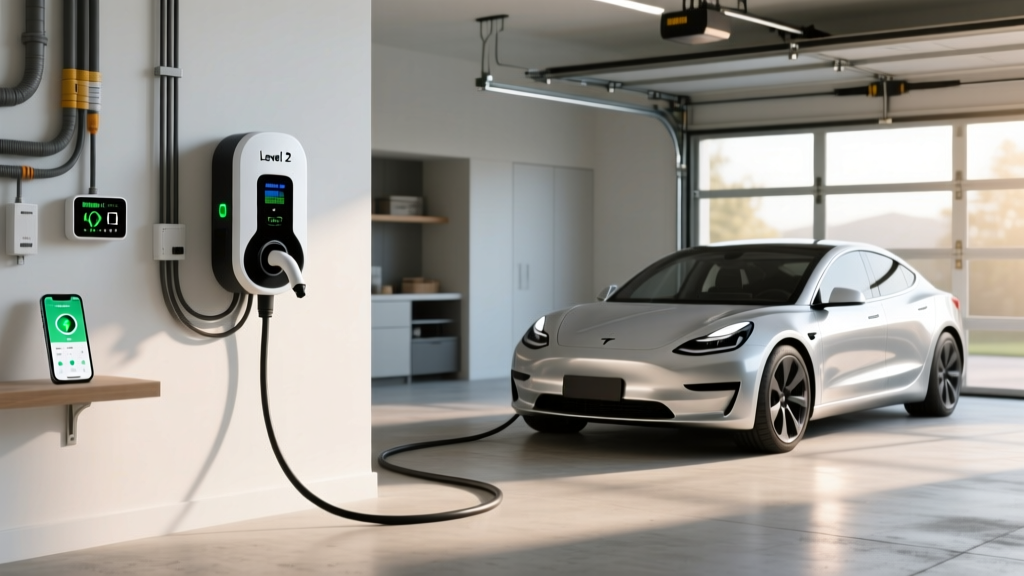
A Level 2 home charger is the single most impactful upgrade for daily EV ownership. For a Tesla Model 3, a 240V / 48A circuit (delivering up to 11.5 kW continuously) will add roughly 44 miles of range per hour of charging — enough to fully replenish a depleted Long Range battery overnight in about 8–9 hours.
Electrical Requirements
- Circuit: Dedicated 60A breaker (for continuous 48A draw — NEC requires 125% headroom)
- Wire: 6 AWG copper (or 4 AWG aluminum) for runs up to ~50 ft; thicker for longer runs
- Outlet vs. hardwired: NEMA 14-50 outlet offers portability; hardwired avoids GFCI nuisance trips and is preferred by most electricians for EVSE
- Panel capacity: Your main panel must have room for a 60A double-pole breaker and sufficient load capacity (a licensed electrician will perform a load calculation per NEC Article 220)
Do You Need a Panel Upgrade?
Homes with 100A service or older panels (common in pre-1990 construction) may not have capacity for a 60A EV circuit. A panel upgrade to 200A typically costs $1,500–$3,500 and may be the single largest line item in your installation. Homes with modern 200A panels and available breaker slots usually avoid this cost.
| Item | Low Estimate | High Estimate | Notes |
|---|---|---|---|
| Level 2 Charger (Equipment) | $350 | $650 | Wall Connector, ChargePoint, Emporia |
| Electrician Labor (basic install) | $400 | $1,200 | Depends on wire run length, wall type |
| Permit & Inspection | $50 | $250 | Varies by municipality |
| Panel Upgrade (if needed) | $1,500 | $3,500 | 100A → 200A service upgrade |
| Total (no panel upgrade) | $800 | $2,100 | Typical scenario for modern homes |
| Total (with panel upgrade) | $2,300 | $5,600 | Older homes with limited service |
Some utilities and states offer rebates of $200–$1,000 for Level 2 equipment and installation. Check your local utility's EV program before scheduling work.
Connector Compatibility: NACS, CCS, and Adapter Realities
The Tesla Model 3 uses the North American Charging Standard (NACS) connector natively — the same compact plug now adopted by Ford, GM, Rivian, Hyundai, and most major automakers starting in 2025. This means Model 3 owners have the widest charging network access in North America without adapters.
| Connector | Native to Model 3? | Network Access | Adapter Needed? |
|---|---|---|---|
| NACS (Tesla) | Yes | Tesla Superchargers (20,000+ stalls), many new third-party networks | None |
| CCS1 | No | Electrify America, EVgo, ChargePoint DC stations | Tesla CCS Adapter (~$175) |
| CHAdeMO | No | Limited legacy stations (declining) | Third-party adapter (~$400); not recommended |
| J1772 (Level 2) | No | Public Level 2 stations, non-Tesla destination chargers | Tesla J1772 Adapter (included with vehicle) |
The Tesla CCS Adapter is worth purchasing if you plan road trips through areas where Electrify America or EVgo stations outnumber Superchargers. It enables DC fast charging at up to ~150 kW on CCS stations — slower than V3 Superchargers but valuable as a backup network.
Cost Per Mile: Charging vs. Gasoline
One of the strongest ownership arguments for the Model 3 is fuel cost. Here's how charging scenarios compare against a gasoline sedan averaging 30 MPG combined at $3.50/gallon:
| Scenario | Rate | Cost per kWh | Cost per Mile (Model 3 at 26 kWh/100mi) | vs. Gas Sedan (30 MPG, $3.50/gal) |
|---|---|---|---|---|
| Home Off-Peak (TOU plan) | $0.08–$0.12/kWh | $0.10 avg | $0.026 | Gas: $0.117/mi — 78% savings |
| Home Standard Rate | $0.13–$0.18/kWh | $0.15 avg | $0.039 | Gas: $0.117/mi — 67% savings |
| Public Level 2 | $0.25–$0.49/kWh | $0.35 avg | $0.091 | Gas: $0.117/mi — 22% savings |
| Tesla Supercharger (V3) | $0.25–$0.40/kWh | $0.32 avg | $0.083 | Gas: $0.117/mi — 29% savings |
| Electrify America DC | $0.32–$0.48/kWh | $0.40 avg | $0.104 | Gas: $0.117/mi — 11% savings |
At 12,000 miles/year with 80% home charging on a time-of-use plan, a Model 3 owner spends roughly $400–$550/year on electricity for driving. The equivalent gasoline cost is $1,400/year. That's nearly $1,000 in annual fuel savings — and the gap widens if gas prices rise.
Recommended Level 2 Chargers for Tesla Model 3 Owners
Tesla Wall Connector (Gen 3)
- Power Output: Up to 11.5 kW (48A on 240V/60A circuit)
- Connector: NACS native — no adapter needed
- Cable Length: 24 ft
- Smart Features: Wi-Fi, OTA updates, Power Sharing (link up to 6 units on one circuit), access control
- Price: ~$420
- Best For: Tesla-only households wanting seamless integration
Emporia Vue Level 2 EV Charger
- Power Output: Up to 11.5 kW (48A) or 9.6 kW (40A configurable)
- Connector: J1772 (use included Tesla adapter) or NACS version available
- Cable Length: 24 ft
- Smart Features: Energy monitoring, solar integration, scheduling, load management
- Price: ~$399
- Best For: Solar-panel owners wanting to charge on excess production
ChargePoint Home Flex
- Power Output: Up to 12 kW (50A on 240V/60A circuit) — configurable down to 16A
- Connector: J1772 (NACS adapter needed for Model 3) or NACS pigtail version
- Cable Length: 23 ft
- Smart Features: App scheduling, Alexa integration, flexible amperage for older panels
- Price: ~$550–$650
- Best For: Multi-EV households (non-Tesla + Tesla) and flexible amperage needs
For a Tesla-only household, the Tesla Wall Connector is the clear choice: native NACS plug, competitive price, and Power Sharing lets you add a second unit later without upgrading the circuit. For mixed-brand garages, the ChargePoint Home Flex with its adjustable amperage is the most versatile option.
Safety, Code Compliance, and Installation Best Practices
EV charging places a sustained high-current load on your home's electrical system — unlike any other appliance. Follow these guidelines:
- Dedicated circuit: Your EVSE must be on its own dedicated breaker — never shared with other loads
- Hardwired vs. outlet: Hardwired installations eliminate the NEMA 14-50 GFCI requirement that has caused nuisance trips in several jurisdictions; discuss with your electrician
- Outdoor rating: If mounting outdoors, confirm the unit carries a NEMA 4 or IP55+ rating for weather resistance
- Permit and inspection: Most jurisdictions require an electrical permit for new 240V circuits — skipping this can void homeowner's insurance claims related to electrical fires
- Wire gauge: Undersized wire on long runs causes voltage drop and heat buildup; your electrician should calculate per NEC Table 310.15
- Utility notification: Some utilities require notification before adding a Level 2 charger and may offer a dedicated TOU meter at reduced cost
Tesla Model 3 Range & Charging FAQ
How much does it cost to install a home EV charger for a Tesla Model 3?
A typical Level 2 home installation with a Tesla Wall Connector costs $800–$2,100 when no panel upgrade is needed (equipment $420 + electrician $400–$1,200 + permit $50–$250). If your home requires a 200A panel upgrade, add $1,500–$3,500. Always get a load calculation from a licensed electrician before committing.
How fast will each charging level add range to my Model 3?
Level 1 (120V) adds about 3–5 miles per hour — suitable only for overnight trickle-charging. Level 2 (240V/48A) adds approximately 44 miles per hour, fully recharging a Long Range model overnight. DC fast charging at a V3 Supercharger peaks at ~250 kW, adding up to 175 miles in 15 minutes, with a 10–80% charge in roughly 25–30 minutes.
Which connector is compatible with the Tesla Model 3?
The Model 3 uses the NACS connector natively, giving direct access to Tesla Superchargers and the growing network of third-party NACS stations. For CCS-based public DC chargers (Electrify America, EVgo), the $175 Tesla CCS Adapter is needed. A J1772 adapter is included with the vehicle for public Level 2 stations.
How much does charging a Model 3 cost per mile compared to gas?
Charging at home on a time-of-use plan costs approximately $0.026 per mile, compared to $0.117 per mile for a 30 MPG gas car at $3.50/gallon — a 78% savings. Even at Supercharger rates (~$0.32/kWh), the Model 3 costs about $0.083 per mile, still 29% less than gasoline.
What electrical upgrades might I need for a Level 2 charger?
The most common upgrade is a 200A panel replacement for homes with older 100A service ($1,500–$3,500). If your panel has capacity but lacks physical breaker slots, a sub-panel ($300–$600) may suffice. Long wire runs over 50 feet require thicker gauge wire, adding $200–$500 in materials. A licensed electrician's load calculation determines what's needed.
Should I charge my Model 3 to 100% every night?
It depends on battery chemistry. Model 3 Long Range AWD models with NMC batteries should be charged to 80% daily and 100% only before long trips to minimize degradation. Model 3 RWD models with LFP batteries can and should be charged to 100% regularly — Tesla recommends at least once per week for LFP packs to maintain accurate state-of-charge calibration.
For the latest Tesla Model 3 specifications and EPA data, consult fueleconomy.gov. For federal tax credit eligibility on new EV purchases, review current IRS §30D guidelines, as income caps, MSRP limits, and battery-sourcing requirements apply and change annually.