Before You Drive Off the Lot: Understanding Model 3 Long Range Charging
You've been searching for a Tesla Model 3 Long Range for sale, and you've finally found one — maybe a 2025 refresh with the Highland styling, or a well-maintained 2024 listing. The EPA rates the current Model 3 Long Range at 363 miles of range from its 79 kWh (usable) LFP/NMC battery pack, and it can peak at 250 kW on a V3 Supercharger. But those spec-sheet numbers only matter if you have a real plan for keeping that battery full.
Charging an EV is fundamentally different from filling a gas tank. You need to understand three things before taking delivery: what charging levels exist and how fast each adds range, what your home electrical panel can support, and what the actual per-mile cost looks like compared to gasoline. This guide breaks down every number you need.
Charging Levels Explained: How Fast Each Adds Range
EV charging happens at three distinct levels. The critical distinction every new owner must internalize: kW (kilowatts) measures power — how fast energy flows into the car. kWh (kilowatt-hours) measures energy — how much the battery holds. Think of kW as the width of the hose and kWh as the size of the bucket. A 79 kWh battery charged at 11.5 kW takes roughly 7 hours from empty; at 1.4 kW it takes nearly 3 days.
| Level | Voltage | Max Power (kW) | Miles of Range Added/Hour | Best Use Case |
|---|---|---|---|---|
| Level 1 | 120V AC | 1.4 kW | 3–5 mi/hr | Overnight trickle; emergency backup |
| Level 2 | 240V AC | 7.2–19.2 kW | 25–65 mi/hr | Daily home/work charging |
| DC Fast Charge | 400V+ DC | 50–250+ kW | 150–1,000+ mi/hr | Road trips; quick top-ups |
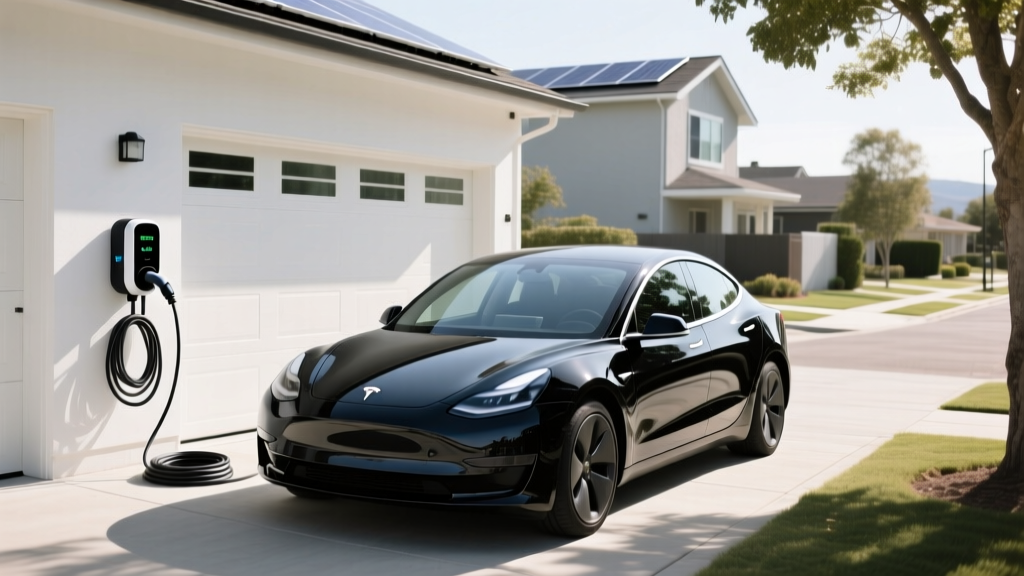
For the Model 3 Long Range, the onboard charger accepts up to 11.5 kW on Level 2 (48 amps). That means a full charge from 10% to 100% at home takes about 7 hours — perfectly suited for overnight charging. On a Tesla V3 Supercharger (250 kW DC), the car can add roughly 175 miles in 15 minutes, though the charge curve tapers significantly above 80% state of charge.
Home Charger Installation: Electrical Requirements and True Costs
This is where most first-time EV buyers get surprised. The charger unit itself is only part of the expense. Professional installation, potential panel upgrades, and permitting often exceed the hardware cost — especially in homes built before 2000.
What Your Electrical Panel Needs to Support
A Level 2 charger delivering 11.5 kW to a Model 3 Long Range requires a 240-volt, 60-amp dedicated circuit (the National Electrical Code requires circuits to be rated at 125% of the continuous load, so a 48-amp charger needs a 60-amp breaker). If your home has a 200-amp main panel with available capacity, the installation is straightforward. If you have a 100-amp panel — common in older homes — you'll likely need a panel upgrade to 200 amps, which adds significant cost.
A licensed electrician will perform a load calculation to determine whether your panel can handle the additional draw. Don't skip this step. Overloading a panel creates a fire hazard and will fail inspection.
| Cost Component | Typical Range | Notes |
|---|---|---|
| Level 2 Charger Hardware | $400–$750 | Tesla Wall Connector, ChargePoint, Emporia |
| Electrician Labor (standard install) | $500–$1,500 | Depends on run length from panel to garage |
| Permit & Inspection | $50–$300 | Required by most jurisdictions; varies by locality |
| Panel Upgrade (if needed) | $1,500–$3,500 | 100A → 200A upgrade; not always necessary |
| Total (no panel upgrade) | $950–$2,550 | Most homes with 200A service |
| Total (with panel upgrade) | $2,450–$6,050 | Older homes with 100A service |
Some utilities offer rebates of $250–$500 for Level 2 charger installation, and the federal Alternative Fuel Vehicle Refueling Property Credit (IRC §30C) can cover up to 30% of installation costs, capped at $1,000, for eligible installations in qualifying census tracts. Check your eligibility with a tax professional before filing.
Which Connectors and Chargers Are Compatible with the Model 3?
Every Tesla Model 3 sold in North America uses the NACS (North American Charging Standard) connector natively. This is the same physical plug used at all Tesla Superchargers and Destination Chargers. As of 2025–2026, Ford, GM, Rivian, Volvo, and several other automakers have adopted NACS, making it the dominant standard in the U.S.
| Connector Type | Native to Model 3? | Where You'll Find It | Adapter Needed? |
|---|---|---|---|
| NACS (Tesla) | Yes — built-in | Superchargers, Destination Chargers, home Wall Connector | No |
| CCS1 | No | Electrify America, EVgo, many non-Tesla public stations | Tesla CCS Adapter (~$175) |
| CHAdeMO | No | Older Nissan Leaf stations; increasingly rare | Third-party adapter (limited availability) |
| J1772 (Level 2) | No | Public Level 2 stations, workplaces, hotels | Tesla J1772 Adapter (included with car) |
The Model 3 ships with a J1772 adapter in the glovebox, which covers most public Level 2 stations. For DC fast charging on non-Tesla networks, the Tesla CCS adapter is a worthwhile $175 purchase — it unlocks Electrify America's 350 kW stalls and EVgo's growing network, giving you backup options when Superchargers are occupied or out of service.
Charging Cost Per Mile: Home Electricity vs. Gasoline
One of the strongest arguments for buying a Tesla Model 3 Long Range is the fuel-cost advantage. Here's how the math works with real numbers from the U.S. Department of Energy.
| Scenario | Cost per kWh | Model 3 LR Efficiency | Cost per Mile |
|---|---|---|---|
| Home Off-Peak (national avg.) | $0.13/kWh | 25 kWh/100 mi | $0.033/mi |
| Home Peak Rate | $0.28/kWh | 25 kWh/100 mi | $0.070/mi |
| Public Level 2 (ChargePoint avg.) | $0.35/kWh | 25 kWh/100 mi | $0.088/mi |
| Tesla Supercharger (avg.) | $0.35/kWh | 25 kWh/100 mi | $0.088/mi |
| Non-Tesla DC Fast (EA, EVgo) | $0.48/kWh | 25 kWh/100 mi | $0.120/mi |
| Gas Car (30 MPG, $3.40/gal) | — | — | $0.113/mi |
At home off-peak rates, the Model 3 Long Range costs roughly 3.3 cents per mile — about a third of what a 30-MPG gas car costs. Even at Supercharger prices, you're still slightly ahead of gasoline. The savings compound: driving 12,000 miles per year at home rates saves roughly $960 annually versus gasoline.
Pro tip: Set your Model 3 to charge during off-peak hours using the Scheduled Charging feature in the car's settings or via your utility's time-of-use plan. This single habit can cut your annual charging cost by 40–50%.
Best Level 2 Chargers for Your Model 3 Long Range
Not all Level 2 chargers are equal. Here are three proven options that pair well with the Model 3 Long Range's 11.5 kW onboard charger, each with different strengths:
Tesla Wall Connector (Gen 3)
- Power Output: Up to 11.5 kW (48 amps)
- Connector: NACS (native — no adapter needed)
- Cable Length: 24 feet
- Smart Features: Wi-Fi firmware updates, load sharing with multiple units, power-sharing across up to 6 connectors
- Price: ~$475
- Best For: Tesla-only households wanting seamless integration and max charge speed
Emporia Vue Level 2 EV Charger
- Power Output: Up to 11.5 kW (48 amps)
- Connector: J1772 (use Tesla's included adapter)
- Cable Length: 24 feet
- Smart Features: Energy monitoring, solar integration, scheduled charging, EMPoria app with detailed kWh tracking
- Price: ~$400
- Best For: Solar-panel owners and multi-EV households wanting granular energy data
ChargePoint Home Flex
- Power Output: Configurable 16–50 amps (up to 12 kW on 50A circuit)
- Connector: J1772 or NACS (select at purchase)
- Cable Length: 23 feet
- Smart Features: Alexa integration, ChargePoint app, flexible amperage dial for panel-limited homes
- Price: ~$699
- Best For: Homes with limited panel capacity — you can dial down amps to match your circuit
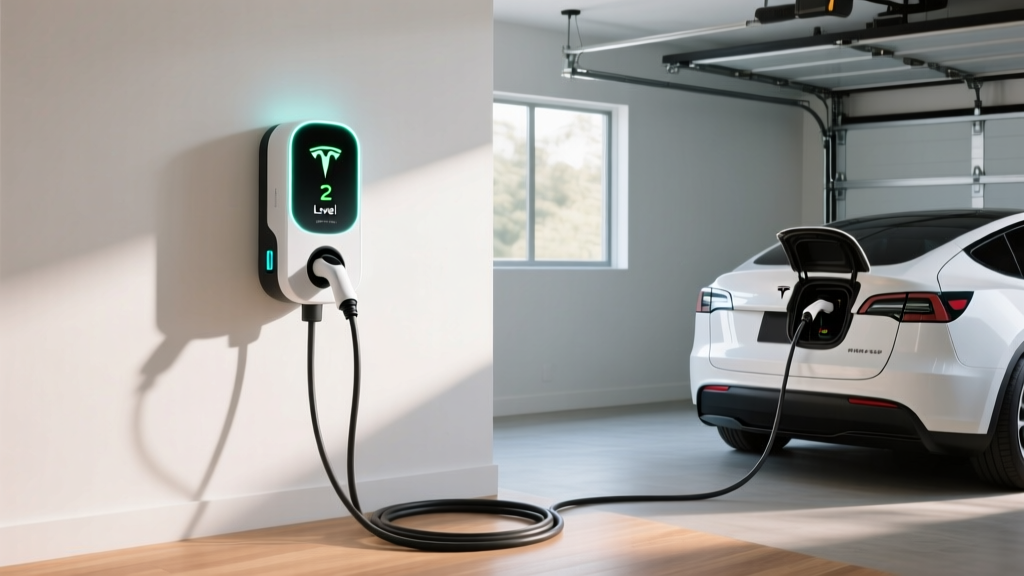
For a dedicated Tesla garage, the Tesla Wall Connector is the obvious pick — no adapter friction, full 11.5 kW output, and the lowest price. If you anticipate owning a non-Tesla EV in the future, the ChargePoint Home Flex in J1772 configuration gives you flexibility across brands with the included Tesla adapter.
Safety, Electrical Code, and Installation Gotchas
EV charging draws sustained high current for hours — unlike a dryer or oven that cycles on and off. This makes proper installation non-negotiable.
- Dedicated circuit: Your Level 2 charger must have its own dedicated breaker — it cannot share a circuit with other appliances. A 60-amp breaker for a 48-amp charger is the standard configuration for the Model 3 Long Range.
- GFCI protection: The 2020 NEC requires GFCI protection for outdoor receptacles. Hardwired chargers (like the Tesla Wall Connector) typically don't require an external GFCI breaker since the unit includes internal ground-fault protection. Confirm with your electrician and local inspector.
- Outdoor rating: If installing outside, ensure the charger carries a NEMA 4 rating (weatherproof). The Tesla Wall Connector and ChargePoint Home Flex are both rated for outdoor use.
- Wire gauge: A 60-amp circuit requires 6 AWG copper wire for runs up to 50 feet. Longer runs may require 4 AWG to prevent voltage drop. Your electrician will calculate this.
- Permit: Most municipalities require an electrical permit for Level 2 charger installation. The permit ensures the work is inspected and meets code. Skipping the permit can void your homeowner's insurance in the event of an electrical fire.
DC Fast Charging on Road Trips: What to Expect
The Model 3 Long Range supports DC fast charging at up to 250 kW on Tesla V3 Superchargers. In practice, you'll see peak speeds of 240–250 kW between 10–30% state of charge, with a steady taper as the battery fills. Here's what a typical road-trip stop looks like:
- 10% to 50%: ~12 minutes at sustained 180–250 kW
- 50% to 80%: ~10 minutes at 100–150 kW (tapering)
- 80% to 100%: ~20+ minutes at under 50 kW (significant taper — avoid charging above 80% on road trips)
- Total 10–80%: ~22–25 minutes
The charge curve taper above 80% is a battery-protection feature, not a defect. Lithium-ion cells experience stress at high state of charge, and the battery management system (BMS) reduces current to prevent degradation. On road trips, plan to charge from 10–80% and drive on — it's faster than waiting for a full charge.
Always use the Model 3's built-in navigation to route to Superchargers. The car will precondition the battery (warm it to optimal temperature) during the final miles of approach, which can improve charge speeds by 20–30% in cold weather. Without preconditioning, a cold battery at 30°F might peak at only 90–120 kW instead of 250 kW.
Frequently Asked Questions
How much does it cost to install a home EV charger for a Tesla Model 3?
Expect $950–$2,550 total for a standard installation (charger hardware + electrician labor + permit) in a home with a 200-amp panel and a short wire run to the garage. If your home needs a panel upgrade from 100A to 200A, add $1,500–$3,500. Get at least two quotes from licensed electricians — prices vary significantly by region and job complexity.
How fast will each charging level add range to the Model 3 Long Range?
Level 1 (120V): about 3–5 miles per hour. Level 2 (240V, 48A): about 44 miles per hour. DC Fast (250 kW Supercharger): about 175 miles in 15 minutes during the peak portion of the charge curve. Level 2 is the practical daily standard; DC fast charging is for road trips.
Which connector does the Tesla Model 3 Long Range use?
The Model 3 uses the NACS connector natively — no adapter needed for Superchargers or the Tesla Wall Connector. For public Level 2 stations using J1772, use the adapter included in the car. For non-Tesla DC fast chargers (Electrify America, EVgo), purchase the Tesla CCS adapter ($175).
How much does charging the Model 3 cost per mile compared to gas?
At home off-peak rates ($0.13/kWh), the Model 3 Long Range costs roughly $0.033 per mile. A comparable 30-MPG gas car at $3.40/gallon costs about $0.113 per mile. That's a savings of roughly $960 per year at 12,000 miles driven annually. Even at Supercharger prices ($0.35/kWh), the Model 3 costs about $0.088/mile — still cheaper than gas.
What electrical upgrades might I need before installing a Level 2 charger?
The most common upgrade is a panel upgrade from 100 amps to 200 amps, needed in older homes where the existing panel lacks spare capacity. Your electrician will perform a load calculation considering all existing circuits (HVAC, dryer, oven, water heater). If the calculation shows you're near capacity, a panel upgrade is required. Some utilities offer rebates for panel upgrades tied to EV adoption — check with your provider.
Does the Tesla Model 3 Long Range qualify for the federal tax credit?
The Model 3 Long Range is eligible for up to $7,500 under IRC §30D, but eligibility depends on your modified adjusted gross income (caps: $150K single / $300K joint), the vehicle's MSRP (must be under $55,000 for sedans), and battery component and critical mineral sourcing requirements that tighten annually. As of 2026, the credit can be transferred to the dealer at point of sale for an instant price reduction. Verify current eligibility on IRS.gov or consult a tax professional before relying on the credit in your purchase decision.