If you own or are considering a Tesla Model 3, understanding exactly how long it takes to charge — and what it costs — is the difference between seamless EV ownership and daily frustration. The 2026 Tesla Model 3 comes in two main battery configurations: the Standard Range (Rear-Wheel Drive) with approximately 60 kWh of usable battery capacity (LFP chemistry), and the Long Range All-Wheel Drive with roughly 79 kWh usable (NMC chemistry). Those different packs charge at different speeds, accept different power levels, and behave differently in cold weather. This guide breaks down every charging scenario with exact numbers.
How Long Does It Take to Charge a Tesla Model 3?
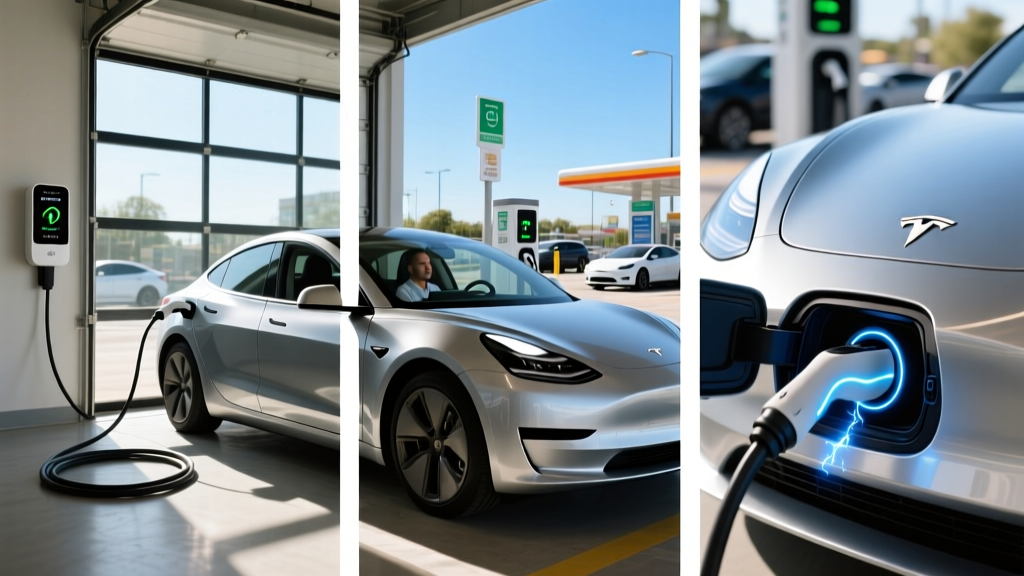
The answer depends entirely on which charging level you're using. The term "charge time" covers everything from a trickle charge on a standard household outlet to a 250 kW DC fast charger on a road trip. Before we get into the numbers, a critical distinction: kW (kilowatts) measures power — how fast energy flows into the battery. kWh (kilowatt-hours) measures energy — the total capacity of the battery. Think of kW as the flow rate of a hose and kWh as the size of the bucket.
| Charging Level | Power (kW) | Voltage / Amperage | Miles of Range Added per Hour | 10–80% Charge Time (Long Range, ~79 kWh) | 10–80% Charge Time (Standard Range, ~60 kWh) |
|---|---|---|---|---|---|
| Level 1 (Standard 120V Outlet) | 1.0–1.4 kW | 120V / 12A | 3–5 mi/hr | ~45–55 hours | ~35–42 hours |
| Level 2 (Home / Public 240V) | 7.2–11.5 kW | 240V / 32–48A | 25–44 mi/hr | ~5.5–8 hours | ~4–6 hours |
| DC Fast Charging (Tesla Supercharger V3) | Up to 250 kW peak | 400V+ DC | Up to ~1,000 mi/hr (peak) | ~25–30 minutes | ~22–28 minutes |
| DC Fast Charging (Tesla Supercharger V4) | Up to 350 kW peak (future-capable; Model 3 currently limited to ~250 kW) | 800V+ DC | Up to ~1,000+ mi/hr (peak) | ~25–30 minutes (vehicle-limited) | ~22–28 minutes (vehicle-limited) |
A few real-world caveats: The 10–80% DC fast charging times assume you've preconditioned the battery (the car does this automatically when you navigate to a Supercharger). Without preconditioning, especially in cold weather, peak charge rates can be cut in half for the first several minutes. Also, the LFP battery in the Standard Range model can be charged to 100% regularly without degradation concerns — Tesla recommends this. The NMC Long Range battery is best kept between 20–80% for daily use, charging to 100% only before road trips.
Home Charger Installation: What It Actually Costs
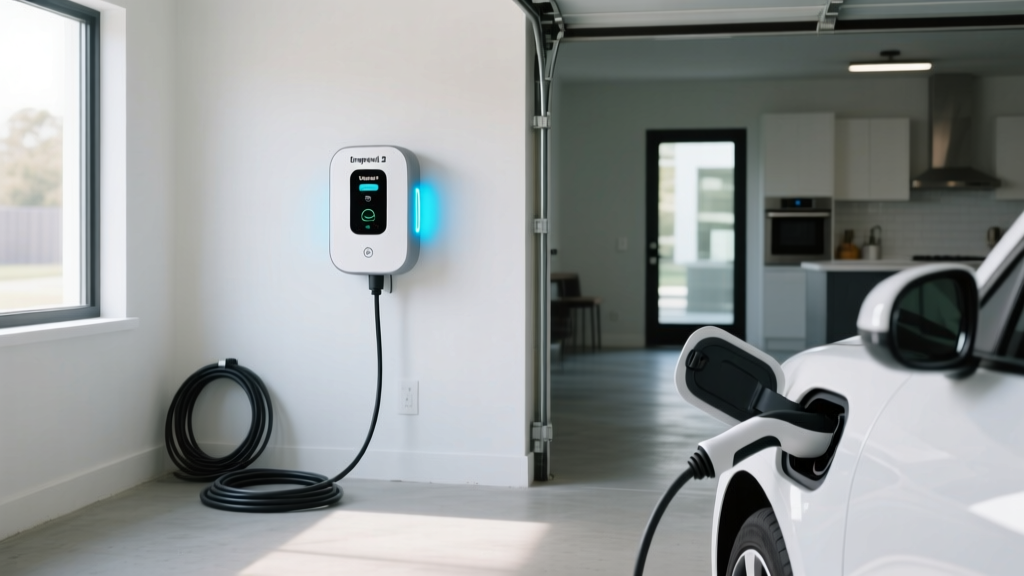
Charging at home is where the vast majority of Tesla Model 3 owners do their charging — typically 80–90% of all charging happens at home, according to industry surveys. But installing a Level 2 home charger isn't as simple as plugging in a lamp. Here's what's involved electrically and financially.
Electrical Requirements for a Tesla Wall Connector
The Tesla Wall Connector (Gen 3) supports up to 48 amps continuous draw on a 60-amp dedicated circuit at 240 volts. That delivers up to 11.5 kW to the vehicle. The Model 3's onboard charger accepts up to 11.5 kW (48A), so this is the optimal home setup. You can also install it on a 50-amp circuit (40A continuous, ~9.6 kW) or a 40-amp circuit (32A continuous, ~7.7 kW) if your electrical panel doesn't have the headroom for 60 amps.
Key electrical requirements:
- Dedicated circuit: The charger must be on its own breaker — not shared with other appliances.
- Panel capacity: Most modern homes with 200-amp service can accommodate a 60-amp EV circuit. Older homes with 100-amp service may need a panel upgrade.
- GFCI protection: NEC 2020 and later requires GFCI protection for EV charging outlets (though hardwired Wall Connectors have built-in ground fault protection).
- Outdoor rating: The Tesla Wall Connector is rated NEMA 4 (indoor/outdoor). If installing outdoors, ensure the conduit and wiring are rated for wet locations.
- Permit: Most jurisdictions require an electrical permit for a new 240V circuit. Your electrician typically pulls this.
Do You Need a Panel Upgrade?
This is the biggest variable in home charger installation cost. If your home has a 100-amp panel and it's already near capacity (electric dryer, electric range, central A/C), adding a 60-amp EV circuit may exceed the panel's rated capacity. A licensed electrician will perform a load calculation per NEC Article 220 to determine this. If an upgrade is needed, going from 100A to 200A service typically costs $1,500–$3,500 depending on your utility, local labor rates, and whether new conduit from the meter is required.
| Cost Component | Simple Install (Panel Has Capacity) | Complex Install (Panel Upgrade Needed) |
|---|---|---|
| Charger Equipment (Tesla Wall Connector) | $475 | $475 |
| Electrician Labor (2–4 hours typical) | $400–$800 | $800–$1,500 |
| Materials (conduit, wire, breaker) | $100–$300 | $200–$500 |
| Electrical Permit | $50–$200 | $50–$200 |
| Panel Upgrade (100A → 200A, if needed) | $0 | $1,500–$3,500 |
| Total Estimated Cost | $1,025–$1,775 | $3,025–$6,175 |
Some utilities and states offer rebates for home charger installation — check with your local utility and the IRS Residential Clean Energy Credit (which covers 30% of charger equipment and installation costs, up to $1,000, through 2032, subject to eligibility).
Connector Compatibility: NACS, CCS, and Adapters
The 2026 Tesla Model 3 comes equipped with the NACS (North American Charging Standard) connector — Tesla's proprietary plug that has now been adopted by nearly every major automaker. This means the Model 3 plugs directly into Tesla Superchargers and a growing number of non-Tesla DC fast chargers that have added NACS cables.
| Connector Type | Native Compatibility? | Adapter Needed? | Where You'll Find It |
|---|---|---|---|
| NACS (Tesla) | Yes — native | No | Tesla Superchargers, Electrify America (select), EVgo, ChargePoint (select new stations) |
| CCS1 | No — requires adapter | Tesla CCS Adapter (~$175) or third-party | Electrify America, EVgo, ChargePoint, most non-Tesla DC fast chargers |
| CHAdeMO | No — requires adapter | Third-party CHAdeMO-to-NACS adapter (~$200–$350) | Limited and declining — mostly older Nissan Leaf stations |
| J1772 (Level 2 public) | No — requires adapter | Tesla J1772 Adapter (included with vehicle) | Public Level 2 chargers, workplace chargers, hotels |
| NEMA 14-50 (240V outlet) | Yes — via Tesla Mobile Connector | No (Mobile Connector + NEMA 14-50 adapter included) | Home garages, RV parks, campgrounds |
Practical tip: Keep the Tesla J1772 adapter in your car at all times — it's the most common public Level 2 connector you'll encounter at workplaces, shopping centers, and hotels. The CCS adapter is worth purchasing if you frequently road-trip through areas with limited Supercharger coverage.
Charging Cost: Home vs. Public vs. Gas Comparison
One of the strongest arguments for the Model 3 is the cost-per-mile advantage over gasoline. But the savings vary dramatically depending on where and when you charge.
| Charging/Fueling Scenario | Cost per kWh or Gallon | Cost per Mile (Model 3 LR, ~4 mi/kWh) | Cost per Mile (Gas Sedan, 30 MPG) |
|---|---|---|---|
| Home Charging (Off-Peak / Time-of-Use) | $0.08–$0.12/kWh | $0.02–$0.03 | $0.12 (at $3.50/gal) |
| Home Charging (Standard Rate) | $0.13–$0.18/kWh | $0.03–$0.05 | $0.12 (at $3.50/gal) |
| Public Level 2 (ChargePoint, etc.) | $0.20–$0.35/kWh | $0.05–$0.09 | $0.12 (at $3.50/gal) |
| Tesla Supercharger (V3/V4) | $0.25–$0.40/kWh | $0.06–$0.10 | $0.12 (at $3.50/gal) |
| Public DC Fast (Electrify America, peak) | $0.35–$0.55/kWh | $0.09–$0.14 | $0.12 (at $3.50/gal) |
What this means in practice: A Model 3 Long Range owner who charges 80% at home (off-peak) and 20% on Superchargers will pay roughly $0.03–$0.04 per mile on average. A comparable gas sedan at 30 MPG and $3.50/gallon costs about $0.12 per mile. Over 15,000 miles per year, that's roughly $450–$600/year for electricity vs. $1,750/year for gas — a savings of $1,150–$1,300 annually.
However, if you rely entirely on public DC fast charging at $0.40–$0.55/kWh, your cost per mile can approach or even exceed that of a fuel-efficient gas car. Home charging access is the economic linchpin of EV ownership.
Best Home Chargers for the Tesla Model 3
While the Tesla Wall Connector is the obvious default, several third-party chargers also work well with the Model 3 (via the J1772 adapter or, increasingly, with native NACS cables). Here are our top picks based on power output, reliability, smart features, and value.
Tesla Wall Connector (Gen 3) — Best Overall
- Power Output: Up to 11.5 kW (48A, 240V)
- Connector: Native NACS — no adapter needed
- Cable Length: 24 feet
- Smart Features: Wi-Fi enabled, over-the-air updates, power sharing (pair two units on one circuit), Tesla app integration
- Price: ~$475
- Verdict: The best choice for any Tesla owner. Seamless integration, no adapter hassle, and power sharing lets you install two connectors on a single 60A circuit — ideal for two-car garages.
ChargePoint Home Flex — Best Third-Party Option
- Power Output: Up to 12 kW (50A, 240V) — configurable from 16A to 50A
- Connector: J1772 (use Tesla adapter) or NACS (new 2025+ models)
- Cable Length: 23 feet
- Smart Features: Wi-Fi, ChargePoint app, Alexa integration, scheduling, energy tracking
- Price: ~$550–$650
- Verdict: Excellent if you also own a non-Tesla EV. The adjustable amperage is great for homes with limited panel capacity — set it to 32A or 40A without changing the breaker.
Emporia Level 2 EV Charger — Best Budget Pick
- Power Output: Up to 11.5 kW (48A, 240V)
- Connector: J1772 (use Tesla adapter) or NACS (newer versions)
- Cable Length: 24 feet
- Smart Features: Wi-Fi, Emporia app, real-time energy monitoring, solar integration
- Price: ~$350–$400
- Verdict: Outstanding value. Matches the Tesla Wall Connector on power output at a lower price. The energy monitoring is excellent for solar-panel owners who want to charge on excess production.
DC Fast Charging on Road Trips: What to Expect
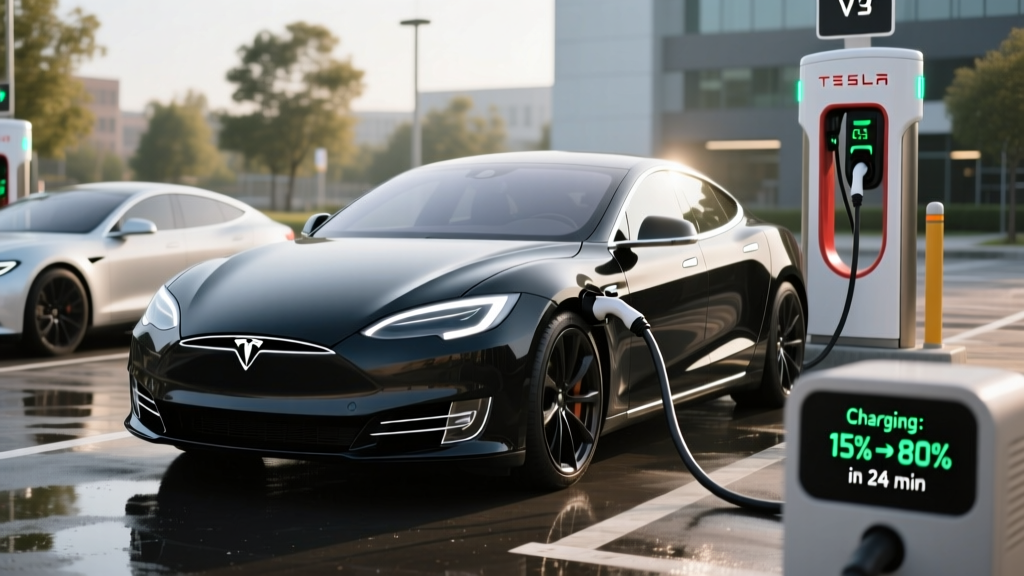
The Tesla Supercharger network remains the gold standard for road-trip charging reliability. As of 2026, Tesla operates over 20,000 Supercharger stalls across North America, with V3 stalls delivering up to 250 kW and newer V4 stalls capable of up to 350 kW (though the Model 3's charge acceptance is currently limited to ~250 kW).
Real-world Supercharger experience for the Model 3 Long Range:
- 10–80% charge: ~25–30 minutes (with battery preconditioned)
- Peak charge rate: ~250 kW, sustained for roughly the first 15–20% of the session (from ~10% SoC to ~30% SoC)
- Charge curve taper: Above 50% SoC, the rate drops to ~100–120 kW. Above 80%, it drops further to ~40–60 kW. This is why you'll see experienced EV road-trippers charging from 10–80% and then moving on — the last 20% takes nearly as long as the first 60%.
- Cold weather impact: In sub-freezing temperatures, preconditioning is essential. Without it, the battery may accept only 50–80 kW initially, extending a 10–80% session to 40–50 minutes. Navigate to the Supercharger using the car's built-in navigation, and it will automatically begin preconditioning the battery 10–20 minutes before arrival.
For non-Tesla DC fast chargers (Electrify America, EVgo), you'll need the CCS adapter or seek out stations with NACS cables. Charge rates on these networks are comparable but reliability can be inconsistent — a J.D. Power EV Experience Index study consistently shows Tesla Superchargers outperforming third-party networks in uptime and satisfaction.
Tesla Model 3 Charging FAQ
How much does it cost to install a home EV charger for a Tesla Model 3?
A straightforward installation with an existing 200-amp panel and short conduit run typically costs $1,025–$1,775 (equipment, labor, permit). If your home needs a panel upgrade from 100A to 200A, expect $3,025–$6,175 total. Always get a load calculation from a licensed electrician before committing.
How fast will each charging level add range to my Model 3?
Level 1 (120V) adds 3–5 miles per hour — fine for PHEVs but impractical as the sole charging method for a BEV. Level 2 (240V, 48A) adds roughly 35–44 miles per hour, fully replenishing a Long Range battery overnight. DC fast charging at 250 kW can add up to 175+ miles in 15 minutes at peak rate.
Which connector is compatible with the 2026 Tesla Model 3?
The 2026 Model 3 uses the NACS connector natively. It plugs directly into Tesla Superchargers and an expanding number of NACS-equipped public chargers. For CCS1 stations, you'll need the Tesla CCS Adapter (~$175). A J1772 adapter (included with the car) handles public Level 2 chargers.
How much does charging a Tesla Model 3 cost per mile vs. gas?
Home charging at off-peak rates ($0.08–$0.12/kWh) costs roughly $0.02–$0.03 per mile — about 4–5x cheaper than a 30 MPG gas car at $3.50/gallon ($0.12/mile). Even Supercharger pricing ($0.25–$0.40/kWh) typically undercuts gas at $0.06–$0.10 per mile.
What electrical upgrades might I need for a home charger?
The most common upgrade is a panel capacity increase from 100A to 200A service ($1,500–$3,500). You may also need a new conduit run from the panel to the garage if the distance is long, or a sub-panel if the main panel is on the opposite side of the house. A licensed electrician will determine this during a load calculation.
Should I charge my Model 3 to 100% every night?
It depends on your battery. The Standard Range (LFP) battery can and should be charged to 100% regularly — Tesla recommends it for accurate state-of-charge calibration. The Long Range (NMC) battery is best kept at 80% for daily use, charging to 100% only before long trips. This practice helps maximize long-term battery health.
Can I use a regular 120V outlet to charge my Tesla Model 3?
Yes, using the Tesla Mobile Connector with the included NEMA 5-15 adapter. However, you'll only gain 3–5 miles of range per hour, meaning a full charge from 10% to 80% takes roughly 35–55 hours depending on the battery pack. This is viable as a supplement or for emergencies, but not practical as a primary charging strategy for daily driving.