If you own or are shopping for a Tesla Model 3 2018 Long Range, you already know it's one of the most efficient electric vehicles ever sold. With an EPA-rated 310 miles of range and a usable battery capacity of approximately 75 kWh (NMC chemistry), this car set the benchmark for mass-market EVs. But owning one means understanding exactly how to charge it — at home, on road trips, and in daily life — without leaving money or time on the table.
This guide covers every charging scenario for the 2018 Model 3 Long Range: the real charge speeds you'll see, what home installation actually costs, which adapters you need in 2026, and how your per-mile fuel cost compares to a gas car. We'll also get specific about equipment picks and electrical requirements, because vague advice doesn't help when you're writing a check to an electrician.
Charging Levels Explained: Speeds in kW and Miles Per Hour
The single most important distinction in EV charging is kW vs. kWh. Kilowatts (kW) measure power — how fast energy flows into your battery. Kilowatt-hours (kWh) measure energy — the total capacity of your battery. Think of kW as the width of a hose and kWh as the size of the bucket. Your 2018 Model 3 Long Range has roughly a 75 kWh bucket. The hose size determines how fast you fill it.
The 2018 Model 3 Long Range uses Tesla's proprietary connector (now standardized as NACS — North American Charging Standard). It supports AC charging up to 11.5 kW onboard and DC fast charging up to approximately 150 kW peak. Here's what each level delivers in real-world terms:
| Level | Voltage | Max Power (kW) | Miles of Range Added Per Hour | Typical Use Case |
|---|---|---|---|---|
| Level 1 (120V) | 120V AC | ~1.4 kW | ~3–5 mi/hr | Overnight top-up, emergencies |
| Level 2 (240V) | 240V AC | Up to 11.5 kW | ~30–44 mi/hr | Daily home & workplace charging |
| DC Fast Charging | 400V+ DC | ~150 kW peak | ~170–250 mi/hr (at peak) | Road trips, Superchargers |
Home Charging Installation: Electrical Requirements and Costs
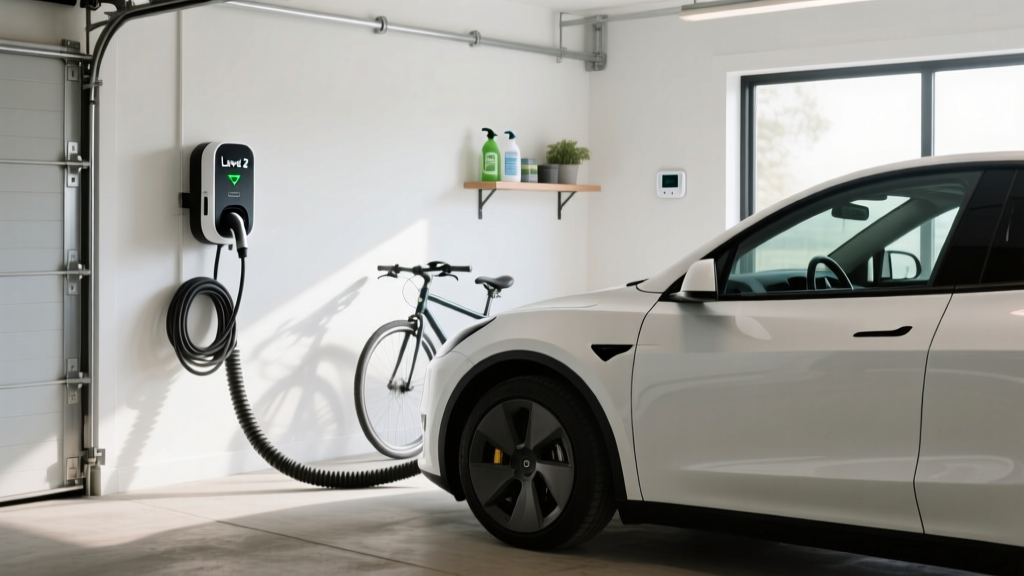
For a 2018 Model 3 Long Range, home Level 2 charging is where you'll do 85–95% of your charging. The car's onboard charger can accept up to 11.5 kW (48 amps) on a 240V circuit, meaning you can fully replenish the 75 kWh battery in roughly 7–8 hours — ideal for overnight charging.
To achieve that maximum 48A/11.5 kW rate, you need a 60-amp dedicated circuit (EV chargers are considered continuous loads under NEC Article 625, so the circuit must be rated 125% above the charger's max draw: 48A × 1.25 = 60A). Many homeowners opt for a 40A circuit with a 32A charger instead, which still delivers ~23–28 miles of range per hour — more than enough for most daily needs.
What Electrical Upgrades Might You Need?
Before you buy any equipment, have a licensed electrician assess your main electrical panel. Here's what determines your installation complexity:
- Panel capacity: Most modern homes have a 200-amp main panel. If you already have electric heating, an electric oven, and a dryer running simultaneously, adding a 60A EV circuit may push you close to capacity. Older homes with 100A panels will almost certainly need a panel upgrade ($1,500–$3,000+) or a load-management device.
- Available breaker slots: You need two adjacent slots for a 240V double-pole breaker.
- Wire run distance: Longer runs from panel to garage/driveway require thicker-gauge wire (e.g., 4 AWG for 60A at short runs, 2 AWG for longer runs), which increases material cost.
- Permitting: Most jurisdictions require an electrical permit for new 240V circuits. Your electrician pulls this; cost varies by municipality ($50–$250 typical).
| Component | Simple Install (short run, 200A panel) | Complex Install (long run, panel upgrade) |
|---|---|---|
| Level 2 Charger Equipment | $400–$700 | $400–$700 |
| Electrician Labor (2–6 hours) | $300–$800 | $800–$2,000 |
| Electrical Permit | $50–$150 | $50–$250 |
| Panel Upgrade (if needed) | $0 | $1,500–$3,500 |
| Conduit & Wiring Materials | $100–$200 | $200–$500 |
| Total Estimated Cost | $850–$1,850 | $2,950–$6,950 |
Connector Compatibility: NACS, CCS, and Adapter Requirements
The 2018 Model 3 Long Range was built with Tesla's proprietary connector, which in late 2022 was renamed NACS (North American Charging Standard) and subsequently adopted by nearly every major automaker for 2025+ models. This is excellent news for you: the Tesla/NACS ecosystem remains the most reliable public charging network in North America.
However, you may encounter non-Tesla public chargers — particularly at destinations with Electrify America, EVgo, or ChargePoint stations that were built with CCS1 connectors before 2024. Here's your adapter situation in 2026:
| Connector Type | Native Support? | Adapter Needed? | Notes |
|---|---|---|---|
| NACS (Tesla) | Yes — native | None | All Tesla Superchargers and Destination Chargers |
| CCS1 | No | Tesla CCS Adapter (~$175–$250) | Required for Electrify America, some ChargePoint/EVgo stations |
| CHAdeMO | No | Third-party adapter (~$300–$450) | Rarely needed — CHAdeMO infrastructure is declining in the US |
| J1772 (Level 2 public) | No | Tesla J1772 Adapter (included with car or ~$95) | Common at public Level 2 locations (hotels, malls, workplaces) |
Our recommendation: Buy the official Tesla CCS adapter and keep the J1772 adapter in your frunk at all times. These two adapters give you access to virtually every public charger in the US. Skip CHAdeMO — the network is shrinking, and the adapter cost is hard to justify.
Level 2 Home Charger Recommendations for the 2018 Model 3
Since the 2018 Model 3 Long Range can accept up to 11.5 kW (48A), the ideal home charger is a hardwired 48A unit on a 60A circuit. Hardwired units avoid the NEMA 14-50 receptacle, which is limited to 40A continuous draw under NEC rules (meaning a max of 32A/7.7 kW via plug-in). Here are our top picks:
Tesla Wall Connector (Gen 3)
- Power: Up to 11.5 kW (48A hardwired)
- Connector: NACS (native Tesla)
- Cable length: 24 feet
- Smart features: Wi-Fi updates, load sharing between multiple units, access control
- Price: ~$475
- Best for: Tesla-only households wanting max charge rate
ChargePoint Home Flex
- Power: Up to 12 kW (50A hardwired) or 32A via NEMA 14-50
- Connector: J1772 (use Tesla adapter) or NACS pigtail option
- Cable length: 23 feet
- Smart features: App scheduling, Alexa/Google integration, energy tracking
- Price: ~$550–$700
- Best for: Multi-EV households (non-Tesla + Tesla)
Emporia Level 2 EV Charger
- Power: Up to 11.5 kW (48A hardwired)
- Connector: J1772 or NACS variant available
- Cable length: 24 feet
- Smart features: Solar integration, real-time energy monitoring via Emporia VUE
- Price: ~$400–$500
- Best for: Solar-equipped homes wanting to charge on excess production
Grizzl-E Smart
- Power: Up to 10 kW (40A) on 50A circuit
- Connector: J1772 or NACS
- Cable length: 24 feet
- Smart features: OCPP-compatible, adjustable amperage, extreme cold rated (-40°C)
- Price: ~$450–$550
- Best for: Cold-climate owners, budget-conscious installs on 50A circuits
Cost to Charge: Home vs. Public vs. Gas Comparison
The 2018 Model 3 Long Range achieves an EPA-rated 130 MPGe combined, which translates to roughly 26 kWh per 100 miles driven (per fueleconomy.gov). In real-world highway driving at 70+ mph, expect closer to 28–30 kWh/100mi. In cold weather (below 30°F), efficiency can drop to 32–35 kWh/100mi due to battery heating and cabin climate demands.
Let's translate that into dollars per mile across common charging scenarios:
| Scenario | Cost per kWh | Cost per 100 Miles | Cost per Mile |
|---|---|---|---|
| Home (off-peak utility rate) | $0.08–$0.12 | $2.08–$3.12 | $0.02–$0.03 |
| Home (standard residential rate) | $0.13–$0.18 | $3.38–$4.68 | $0.03–$0.05 |
| Tesla Supercharger V2/V3 (2026 avg) | $0.28–$0.38 | $7.28–$9.88 | $0.07–$0.10 |
| Electrify America / CCS public DC | $0.35–$0.48 | $9.10–$12.48 | $0.09–$0.12 |
| Gas car (30 MPG avg, $3.40/gal) | — | $11.33 | $0.11 |
The takeaway: Home charging is where the economics shine. At off-peak rates, you're paying roughly 2.5 cents per mile — about a quarter of what a 30 MPG gas car costs. Even at Supercharger rates, the Model 3 Long Range competes with or beats gas on per-mile cost. The savings compound: driving 12,000 miles per year at home rates saves approximately $900–$1,200 annually versus gasoline.
Charging Times for the 2018 Model 3 Long Range: Real Numbers
Here are charge times based on the 75 kWh usable battery and typical charge curves. Note that the charge rate is not linear — it's fastest at low SoC and tapers significantly above 80% to protect battery longevity.
| Charging Method | Power (kW) | 10–80% Time | Full 0–100% Time |
|---|---|---|---|
| Level 1 (120V/12A) | ~1.4 kW | ~40+ hours | ~55+ hours |
| Level 2 (240V/32A) | ~7.7 kW | ~7 hours | ~10 hours |
| Level 2 (240V/48A) | ~11.5 kW | ~5 hours | ~7 hours |
| DC Fast (V2 Supercharger) | ~150 kW peak | ~30–35 min | ~55–65 min |
| DC Fast (V3 Supercharger) | ~170 kW peak* | ~25–30 min | ~50–60 min |
*The 2018 Model 3 Long Range cannot accept the full 250 kW that V3 Superchargers can deliver. Its peak DC charge rate is approximately 150–170 kW, tapering quickly. You'll see a benefit from V3 stations at lower SoC but not the dramatic speed advantage that newer Model 3/Y vehicles enjoy.
Safety, Electrical Code, and Best Practices
EV charging involves sustained high-current draw — more like running an electric furnace than plugging in a lamp. Safety and code compliance are non-negotiable:
- Dedicated circuit: Your Level 2 charger must be on its own dedicated circuit. No sharing with other outlets or appliances.
- GFCI protection: NEC 2020 and later require GFCI protection for all EV charging outlets. Hardwired units may be exempt depending on local code, but GFCI breakers add a layer of safety, especially for outdoor installations.
- Outdoor rating: If your charger is mounted outside (driveway or exterior wall), ensure the unit carries a NEMA 4 or IP65 rating. All chargers recommended above are outdoor-rated.
- Cable management: Use a holster or cable organizer to keep the cord off the ground. Tripping hazards and cable damage from vehicles running over them are the most common home-charging incidents.
- Permit and inspection: Always pull a permit. The inspection ensures your electrician's work meets code and protects your home insurance coverage. Unpermitted work can void claims in the event of an electrical fire.
Frequently Asked Questions
How much does it cost to install a home EV charger for my 2018 Model 3?
For a straightforward installation with a 200A panel and a short wire run, expect $850–$1,850 total (charger + electrician + permit). If your home needs a panel upgrade or has a long wire run from panel to garage, costs can reach $3,000–$7,000. Always get 2–3 quotes from licensed electricians who have specific EV charger installation experience.
How fast will each charging level add range to my 2018 Model 3 Long Range?
Level 1 (120V) adds about 3–5 miles per hour — barely enough for daily commuting. Level 2 (240V at 48A) adds approximately 35–44 miles per hour, easily replenishing a full day's driving overnight. DC fast charging at a Supercharger can add up to 170 miles in 30 minutes during the peak portion of the charge curve.
Which charger connector is compatible with the 2018 Tesla Model 3?
The 2018 Model 3 uses the Tesla/NACS connector natively. This connects directly to all Tesla Superchargers and Destination Chargers. For non-Tesla public chargers, you'll need a Tesla CCS adapter (for DC fast chargers) and a J1772 adapter (for public Level 2 stations). Both fit in the frunk and weigh less than a pound each.
How much does charging a Model 3 cost per mile versus gas?
At home off-peak rates ($0.08–$0.12/kWh), the 2018 Model 3 Long Range costs approximately 2–3 cents per mile. A comparable 30 MPG gas car at $3.40/gallon costs about 11 cents per mile. Even at public DC fast charger rates ($0.28–$0.48/kWh), the Model 3 costs 7–12 cents per mile — competitive with or cheaper than gasoline. Over 12,000 annual miles, home charging saves $900–$1,200.
What electrical upgrades might I need for a Level 2 home charger?
The most common upgrade is a panel capacity assessment. If you have a 100A panel, you'll likely need an upgrade to 200A ($1,500–$3,500). You also need two adjacent breaker slots for a 240V double-pole breaker and a wire run from panel to charger location. Homes built after 2000 with 200A panels typically need no upgrade — just the new circuit, wiring, and permit.
Does the 2018 Model 3 Long Range support V3 Superchargers at full speed?
Partially. V3 Superchargers can deliver up to 250 kW, but the 2018 Model 3 Long Range peaks at approximately 150–170 kW due to its battery management system and cell configuration. You'll still charge faster on V3 than on older V2 stations (especially at low SoC), but you won't see the 15-minute 10–80% times that newer Model 3 Highland models achieve. Expect 25–30 minutes for 10–80% on V3 hardware.
Should I charge my 2018 Model 3 to 100% daily?
No. The 2018 Model 3 Long Range uses NMC (nickel manganese cobalt) battery chemistry, which degrades faster when held at high or low states of charge for extended periods. Tesla recommends setting the daily charge limit to 80% and only charging to 100% when you need the full range for a road trip. This simple habit can significantly extend your battery's useful life and maintain its State of Health (SoH) over years of ownership. The battery and drive unit carry an 8-year/120,000-mile warranty with a minimum 70% capacity retention threshold.
Sources: EPA fuel economy data from fueleconomy.gov; Tesla Model 3 specifications from Tesla Support; NEC electrical code requirements per NFPA 70 Article 625; IRS §30D alternative fuel vehicle refueling property credit rules from irs.gov.