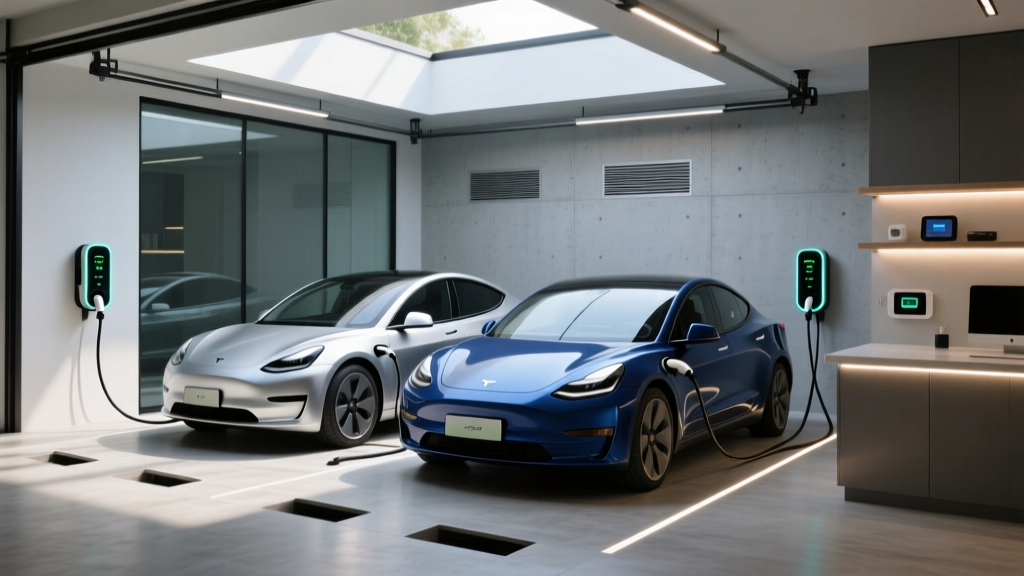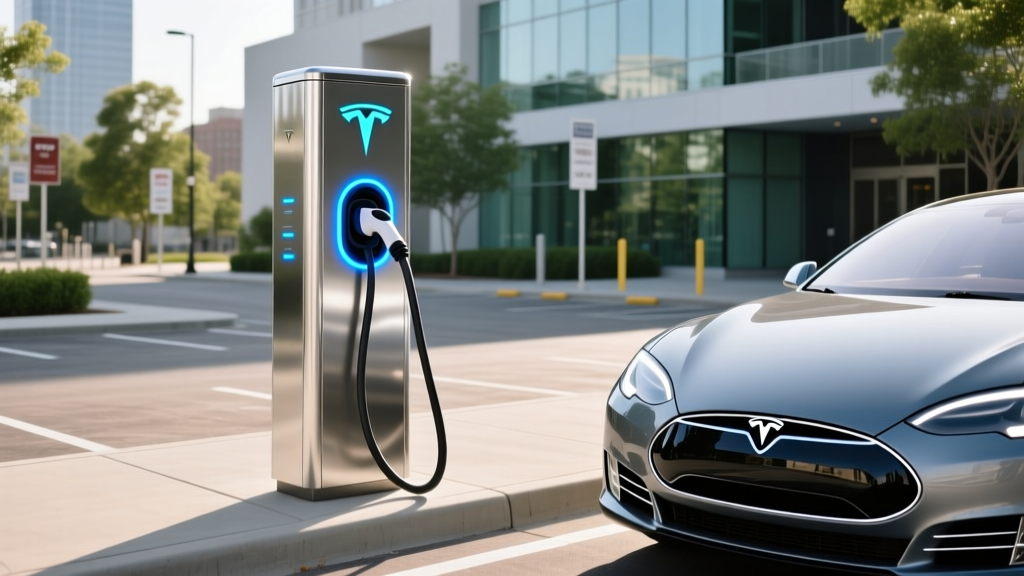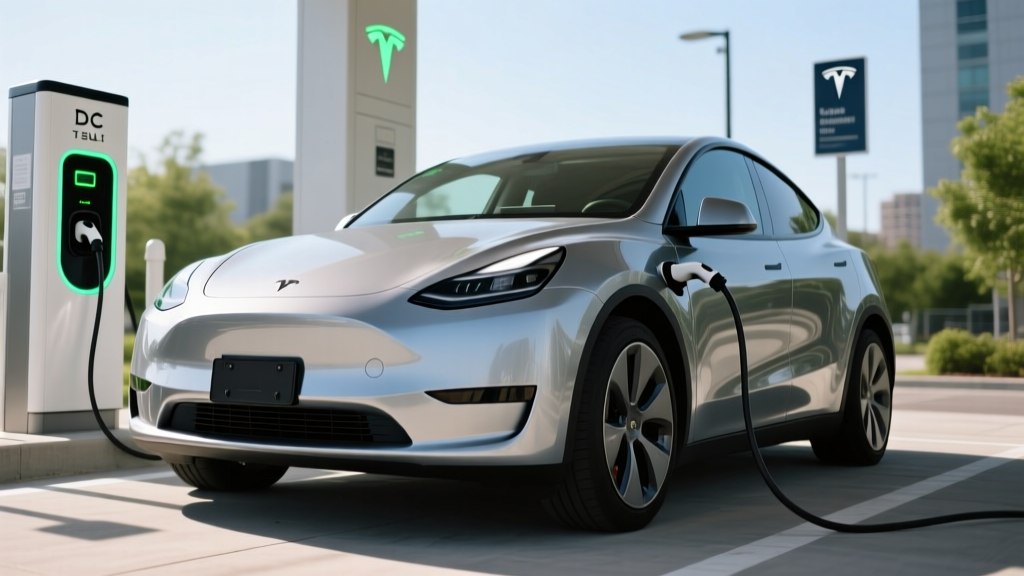
If you own a Tesla—or are about to buy one—the single most important efficiency metric isn't 0-60 time or horsepower. It's Tesla miles per kilowatt hour (mi/kWh). This figure tells you exactly how far you can drive on a unit of electricity, determines your real-world range, and directly controls how much you'll spend to charge at home or on the road.
Yet most buyers confuse kW (kilowatts — the rate of power flow, like water pressure in a hose) with kWh (kilowatt-hours — the total energy stored or consumed, like gallons in a tank). A Tesla Model 3 Long Range has an 82 kWh battery (usable ~79 kWh). A Level 2 home charger might deliver 11.5 kW of power. Understanding this distinction is the foundation of smart EV ownership.
This guide covers Tesla's real-world efficiency across the current 2026 lineup, how fast each charging level adds range, what a home installation actually costs, and how charging expenses compare to gasoline.
Tesla Efficiency by Model: Real-World Miles Per kWh
The EPA rates efficiency in Wh/mi (watt-hours per mile) and MPGe. For practical use, we convert to miles per kWh — the EV equivalent of MPG. Higher is better.
| Model / Trim | Battery (kWh usable) | EPA Range | EPA Efficiency (Wh/mi) | Miles per kWh | MPGe |
|---|---|---|---|---|---|
| Model 3 RWD | 57.5 | 272 mi | 248 | 4.0 | 134 |
| Model 3 Long Range AWD | 79 | 363 mi | 243 | 4.1 | 137 |
| Model 3 Performance | 79 | 315 mi | 280 | 3.6 | 119 |
| Model Y Long Range AWD | 79 | 330 mi | 269 | 3.7 | 125 |
| Model Y Performance | 79 | 303 mi | 297 | 3.4 | 113 |
| Model S Long Range | 100 | 402 mi | 274 | 3.6 | 122 |
| Model X Long Range | 100 | 335 mi | 335 | 3.0 | 100 |
- Highway (70+ mph): subtract 10–15% from EPA range (aerodynamic drag dominates at speed)
- Cold weather (below 32°F): subtract 20–35% depending on cabin heating and battery preconditioning
- Best-case (city, mild weather, regen braking): you may match or slightly exceed EPA range
Charging Levels Explained: kW, Miles Per Hour & Charge Times
Charging speed is measured in kW (power). The miles of range added per hour depends on your Tesla's efficiency (mi/kWh). Here's how each level performs:
| Level | Voltage / Amps | Power (kW) | Miles of Range Per Hour (Model 3 LR @ 4.1 mi/kWh) | 10–80% Charge Time (79 kWh battery) |
|---|---|---|---|---|
| Level 1 (standard outlet) | 120V / 12A | 1.4 kW | ~5–6 mi/hr | ~40+ hours (not practical) |
| Level 2 (home / destination) | 240V / 48A | 11.5 kW | ~44–47 mi/hr | ~5–5.5 hours |
| Level 2 (Tesla Wall Connector) | 240V / 48A | 11.5 kW | ~44–47 mi/hr | ~5–5.5 hours |
| DC Fast (Tesla V3 Supercharger) | 400V DC | Up to 250 kW | ~1,000+ mi/hr (peak) | ~25–30 min |
| DC Fast (Tesla V4 Supercharger) | 800V DC | Up to 350 kW | ~1,300+ mi/hr (peak) | ~15–20 min |
How this works in practice: A Level 2 charger delivering 11.5 kW to a Model 3 Long Range (4.1 mi/kWh) adds roughly 11.5 × 4.1 = 47 miles of range per hour. Plug in at 9 PM with 20% battery, and you'll wake up at 7 AM with 100%.
DC fast charging taper reality: A V3 Supercharger peaks at 250 kW, but only up to ~30–40% state of charge. The charge curve then tapers — dropping to ~100 kW around 60% and ~40 kW above 85%. The advertised "10–80% in 25 minutes" reflects this taper. Charging from 80–100% on DC fast charging can take nearly as long as 10–80%, which is why Tesla recommends charging to 80% at Superchargers for speed and battery longevity.
Home Charger Installation: Requirements, Costs & Panel Upgrades
Installing a Level 2 home charger is the single best upgrade for EV ownership. But costs vary enormously depending on your home's electrical infrastructure.
Electrical Requirements
A Tesla Wall Connector or equivalent Level 2 charger requires a dedicated 240V circuit, typically 60A (which delivers up to 48A continuous to the vehicle, per NEC 80% rule). Some installations use a 50A breaker (40A continuous, ~9.6 kW). Your home's electrical panel must have:
- Sufficient amperage capacity (most modern homes have 200A service; older homes may have 100A)
- Two adjacent breaker slots for a double-pole breaker
- Adequate wire gauge (6 AWG copper for 60A circuits, 8 AWG for 50A)
Panel Upgrade Reality
If your home has a 100A panel — common in houses built before 1990 — adding a 60A EV circuit may require a panel upgrade to 200A. This is the single largest variable in installation cost. A panel upgrade adds $1,500–$3,500 and may take 1–3 days. Homes with 200A service but no spare breaker slots may need a sub-panel ($500–$1,200).
| Component | Simple Install (panel has capacity, short run) | Complex Install (panel upgrade, long wire run) |
|---|---|---|
| Level 2 Charger (equipment) | $400–$600 | $400–$600 |
| Electrical permit | $50–$150 | $50–$200 |
| Electrician labor (2–4 hrs) | $400–$800 | $1,200–$3,000 |
| Panel upgrade (if needed) | $0 | $1,500–$3,500 |
| Wire & conduit (materials) | $100–$300 | $300–$800 |
| Total | $950–$1,850 | $3,450–$8,100 |
The IRS offers a residential clean energy credit (§25C/§25E) that can cover up to 30% of home charger equipment and installation costs (up to $1,000 annually for the charger itself). Always confirm current-year eligibility at irs.gov, as rules and caps change.
Connector Compatibility: NACS, CCS & Adapters
As of 2026, Tesla's NACS (North American Charging Standard) has become the dominant connector in North America. All current Tesla vehicles ship with a native NACS port. Most other automakers — Ford, GM, Rivian, Hyundai, Kia, Volvo, BMW, and others — have adopted NACS on new vehicles or provide CCS-to-NACS adapters for Supercharger access.
| Connector | Native Vehicles | DC Fast Charge Access | Adapter Needed? |
|---|---|---|---|
| NACS (Tesla) | All Tesla models; Ford, GM, Rivian, Volvo 2025+ models | Tesla Supercharger network; Electrify America (select stations) | None for Teslas; CCS vehicles need NACS adapter |
| CCS1 | Hyundai, Kia, BMW, VW, legacy Ford/GM | Electrify America, EVgo, ChargePoint DC | NACS-to-CCS adapter for Supercharger access (Tesla sells one for ~$250) |
| CHAdeMO | Nissan Leaf (legacy); being phased out | Limited — fewer stations each year | CHAdeMO-to-NACS adapters rare and expensive |
For Tesla owners charging non-Tesla EVs at home (e.g., a household with a Tesla and a Hyundai Ioniq 5), the Tesla Wall Connector includes a NACS plug. You'll need a CCS adapter for the non-Tesla vehicle, or install a universal J1772 charger with a J1772-to-NACS adapter for the Tesla.
Charging Cost Per Mile: Home vs. Public vs. Gasoline
How much does it actually cost to drive a Tesla per mile? The answer depends entirely on where you charge.
| Charging Scenario | $/kWh | Cost Per Mile (Tesla) | Cost Per Mile (Gas @ $3.50/gal, 30 MPG) |
|---|---|---|---|
| Home (off-peak utility rate) | $0.08–$0.12 | $0.020–$0.029 | $0.117 |
| Home (average US rate) | $0.16 | $0.039 | $0.117 |
| Home (peak / high-cost state like CA) | $0.28–$0.35 | $0.068–$0.085 | $0.117 |
| Tesla Supercharger (avg) | $0.28–$0.36 | $0.068–$0.088 | $0.117 |
| Public Level 2 (ChargePoint, etc.) | $0.20–$0.40 | $0.049–$0.098 | $0.117 |
| Non-Tesla DC Fast (Electrify America) | $0.35–$0.55 | $0.085–$0.134 | $0.117 |
The bottom line: If you charge at home on off-peak rates, a Tesla costs roughly $0.02–$0.04 per mile — about one-quarter the fuel cost of a 30-MPG gas car. At $0.03/mile, driving 12,000 miles per year costs ~$360 in electricity vs. ~$1,400 in gasoline. That's over $1,000 in annual fuel savings.
However, if you rely exclusively on DC fast charging at $0.40+/kWh, your per-mile cost can approach or even exceed gasoline. Home charging access is the economic foundation of EV ownership.
Best Level 2 Home Chargers for Tesla Owners (2026)
Tesla Wall Connector
- Power: Up to 11.5 kW (48A @ 240V)
- Connector: NACS (native Tesla plug)
- Cable length: 24 ft
- Smart features: Wi-Fi, OTA updates, power sharing (link up to 6 units on one circuit), load management
- Price: ~$475
- Best for: Tesla-only households; cleanest integration with Tesla app
ChargePoint Home Flex
- Power: Up to 12 kW (50A @ 240V)
- Connector: J1772 (use J1772-to-NACS adapter for Tesla) or NACS version available
- Cable length: 24 ft
- Smart features: Wi-Fi, ChargePoint app scheduling, Alexa integration, adjustable amperage (16–50A)
- Price: ~$550–$650
- Best for: Multi-EV households; flexible amperage for older panels
Emporia Vue EV Charger
- Power: Up to 11.5 kW (48A @ 240V)
- Connector: J1772 (NACS adapter included) or NACS native
- Cable length: 24 ft
- Smart features: Integration with Emporia energy monitoring, solar-aware scheduling, load management
- Price: ~$400–$500
- Best for: Solar owners; budget-conscious buyers who want energy monitoring
Safety, Code & Installation Best Practices
EV charging draws sustained high current for hours — unlike any other household appliance. Proper installation isn't optional.
- Dedicated circuit: Your Level 2 charger must have its own dedicated double-pole breaker. Never share a circuit with other high-draw appliances.
- GFCI protection: NEC 2023/2026 requires GFCI protection for outdoor EV receptacles (NEMA 14-50). Hardwired Wall Connectors have built-in ground-fault protection.
- Outdoor rating: If installing outside, ensure the charger carries a NEMA 4 (weatherproof) rating. The Tesla Wall Connector is rated for indoor and outdoor use.
- Hardwired vs. plug: Hardwired installations (no plug) avoid the GFCI nuisance-tripping issues common with NEMA 14-50 receptacles and allow 48A continuous charging. Plug-in setups (14-50 outlet) are limited to 40A continuous and offer portability.
- Permit & inspection: Most jurisdictions require an electrical permit and post-installation inspection. Skipping this can void your homeowner's insurance coverage for electrical fires.
- Use a licensed electrician: EV charging circuits involve sustained high-load operation that standard residential wiring isn't always designed for. A qualified electrician will verify wire gauge, breaker sizing, and thermal management.
Frequently Asked Questions
How much does it cost to install a home EV charger?
A straightforward Level 2 installation (200A panel with spare capacity, short wire run) typically costs $950–$1,850 including equipment, labor, and permits. If your home needs a panel upgrade from 100A to 200A, total costs can reach $3,450–$8,100. Always get at least two quotes from licensed electricians.
How fast will each charging level add range to my Tesla?
Level 1 (120V outlet) adds about 5–6 miles per hour — enough for overnight top-ups on low-mileage days. Level 2 (240V, 48A) adds roughly 44–47 miles per hour on a Model 3 Long Range, fully replenishing a depleted battery overnight. DC fast charging (Supercharger) adds up to 200 miles in 15 minutes at peak rate, though the charge curve tapers significantly above 80%.
Which connector and charger is compatible with my Tesla?
All current Tesla vehicles use the NACS connector natively. The Tesla Wall Connector is the simplest home solution. If you also own a non-Tesla EV with a CCS port, consider a universal charger like the ChargePoint Home Flex and use the appropriate adapter for each vehicle. For Supercharger access, non-Tesla EVs need a CCS-to-NACS adapter.
How much does charging cost per mile compared to gas?
At home on average US electricity rates (~$0.16/kWh), a Tesla Model 3 Long Range costs about $0.039/mile — roughly one-third the cost of a 30-MPG gas car at $3.50/gallon ($0.117/mile). Off-peak home rates can drop this to $0.02–$0.03/mile. Exclusive reliance on DC fast charging ($0.35–$0.55/kWh) can raise costs to $0.09–$0.13/mile, approaching gas parity.
What electrical upgrades might I need for a home charger?
The most common upgrade is a panel capacity increase from 100A to 200A, required when your existing panel can't support a dedicated 60A circuit alongside your home's other loads. You may also need a sub-panel if there are no spare breaker slots, or a service mast upgrade if your utility drop is undersized. A licensed electrician will perform a load calculation per NEC Article 220 to determine what's required. Expect the assessment to be free or included in the installation quote.