What It Takes to Charge a Tesla Long Range in 2026
If you own or are shopping for a Tesla Model 3 Long Range (EPA 363 miles) or Model Y Long Range (EPA 320 miles), you already have one of the most efficient EVs on the road. But real-world charging convenience depends less on the sticker range and more on your home electrical setup, the charger you install, and how you use the Supercharger network. This guide breaks down every charging scenario for Tesla Long Range models — from a standard 120V outlet to a 250 kW DC fast charger — with exact numbers for speed, cost, and installation.
We'll also clear up the single most common confusion in EV charging: kW (kilowatts) measures power — how fast energy flows into your car. kWh (kilowatt-hours) measures energy — how much your battery holds. A Tesla Model Y Long Range has roughly 75 kWh of usable battery capacity. Charging it at 11.5 kW (a typical Level 2 home charger) means a full charge takes about 6.5 hours. Charging at 250 kW on a Supercharger doesn't mean 18 minutes for a full charge — the rate tapers as the battery fills.
Charging Levels Explained: Speeds in kW and Miles Per Hour
Every Tesla Long Range owner will use a mix of three charging levels. Here's how each one performs with the ~75 kWh battery pack found in current Model 3 and Model Y Long Range trims.
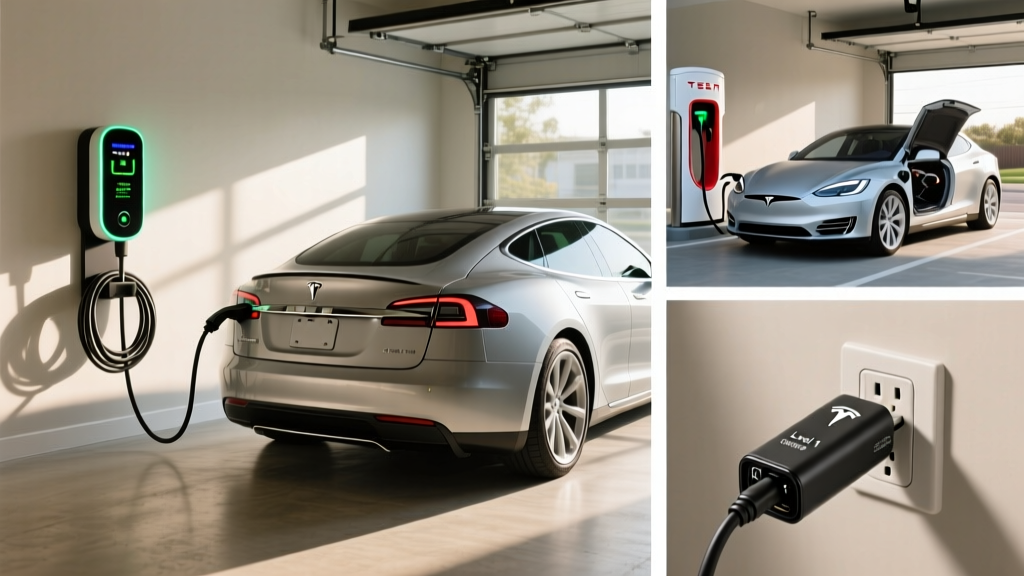
| Level | Voltage / Amps | Power (kW) | Miles of Range Per Hour | 10–80% Time (est.) |
|---|---|---|---|---|
| Level 1 (120V outlet) | 120V / 12A | ~1.4 kW | 3–5 mi/hr | ~40+ hours |
| Level 2 (240V home/public) | 240V / 32–48A | 7.7–11.5 kW | 25–44 mi/hr | 5–7 hours |
| DC Fast (Supercharger V3/V4) | DC / up to 250 kW | Peak 250 kW | Up to ~1,000 mi/hr (peak) | ~25–30 min |
Real-world note: The 250 kW peak on a V3 Supercharger only sustains at low states of charge (roughly 10–30% SoC). Above 50%, the charge curve tapers significantly — you might see 70–90 kW, and above 80% it drops further to protect the battery. That 10–80% time of ~25–30 minutes assumes you've preconditioned the battery by navigating to the Supercharger in the car's navigation system, which warms the pack for optimal charge acceptance.
Home Charger Installation: Electrical Requirements and Costs
For daily charging, a Level 2 home setup is the standard. Tesla's onboard charger in the Long Range models accepts up to 11.5 kW (48 amps) on a 240V circuit. To get that full rate, you need a 60-amp dedicated breaker (EVSE must be rated at 80% of breaker capacity per the National Electrical Code).
Electrical requirements for maximum Level 2 speed:
- Voltage: 240V (same as a dryer or oven circuit)
- Breaker: 60A dedicated (for 48A continuous charging)
- Wire gauge: 6 AWG copper (or 4 AWG aluminum for longer runs)
- Panel capacity: At least 60A of spare capacity on your main service panel
If your home has a 100-amp main panel that's already near capacity, you may need a panel upgrade to 200 amps — a significant added cost. Homes built after 2000 typically have 200A service with enough headroom, but older homes often require this upgrade.
Installation Cost Breakdown
| Component | Low Estimate | High Estimate |
|---|---|---|
| Level 2 EVSE equipment (Tesla Wall Connector or equivalent) | $400 | $650 |
| Electrician labor (standard install, short wire run) | $500 | $1,200 |
| Permit and inspection fees | $50 | $250 |
| Panel upgrade (if needed — 200A service) | $1,500 | $3,500 |
| Total (without panel upgrade) | $950 | $2,100 |
| Total (with panel upgrade) | $2,450 | $5,600 |
Always hire a licensed electrician and pull a permit. The 2023 NEC (National Electrical Code), adopted in most states by 2026, requires GFCI protection for outdoor EV receptacles and dedicated circuits for continuous loads like EV charging. Skipping the permit risks insurance claim denials if an electrical fire occurs.
What Electrical Upgrades Might I Need?
Beyond the panel upgrade, watch for these potential costs:
- Long wire runs: If your panel is far from the garage, wire cost rises ($8–$15/ft for 6 AWG).
- Conduit requirements: Some jurisdictions require metal conduit in garages, adding $200–$400.
- Smart panel or load management: If your panel is tight on capacity but you don't want a full upgrade, devices like the Emporia Smart Panel or Tesla's built-in load-sharing can manage charging around other household loads ($200–$500 extra).
- Outdoor-rated installation: If your charger mounts outside, ensure NEMA 4 (weatherproof) rating and an in-use cover for the connector.
Connector Compatibility: NACS, CCS, and Adapters
All current Tesla Long Range vehicles (Model 3, Model Y, Model S, Model X) use the North American Charging Standard (NACS) connector natively. As of 2025–2026, most major automakers — Ford, GM, Rivian, Hyundai, BMW, and others — have adopted NACS on new vehicles or provide adapters. This means the Tesla Supercharger network, now with over 30,000 stalls in North America, is increasingly open to non-Tesla EVs, while Tesla owners retain native access.
| Connector | Tesla Long Range (native) | Non-Tesla EVs (2025+) | Adapter Needed? |
|---|---|---|---|
| NACS (Tesla) | Yes — built in | Yes (Ford, GM, Rivian, etc.) | No (native) or OEM adapter |
| CCS1 | No — adapter required | Yes (older Hyundai, VW, BMW) | Tesla CCS Adapter (~$175) |
| CHAdeMO | No — adapter required | Legacy Nissan Leaf | Aftermarket (rare, ~$400) |
| J1772 (Level 2 public) | No — adapter included with car | Yes (all non-Tesla EVs) | Tesla includes J1772 adapter |
Which connector/charger is compatible with my Tesla Long Range? Your Tesla comes with a NACS charge port and a J1772 adapter in the glovebox or frunk for public Level 2 stations that use the J1772 connector. For CCS1 public DC fast chargers (Electrify America, some EVgo stations), Tesla sells an official CCS adapter. However, with Tesla's Supercharger network covering most major routes, the CCS adapter is only necessary if you frequently travel in areas with limited Supercharger coverage.
Cost to Charge: Home vs. Public vs. Gas
Electricity costs vary dramatically depending on where and when you charge. Here's a realistic breakdown for a Tesla Model Y Long Range (75 kWh usable battery, 320 EPA miles, ~3.5 miles/kWh real-world efficiency).
| Scenario | Rate ($/kWh) | Cost for 75 kWh (10–100%) | Cost Per Mile |
|---|---|---|---|
| Home off-peak (utility time-of-use) | $0.08–$0.12 | $6.00–$9.00 | $0.023–$0.034 |
| Home standard rate (national avg.) | $0.16 | $12.00 | $0.046 |
| Public Level 2 (ChargePoint, etc.) | $0.25–$0.49 | $18.75–$36.75 | $0.072–$0.141 |
| Tesla Supercharger V3/V4 | $0.28–$0.45 | $21.00–$33.75 | $0.081–$0.130 |
| Gas equivalent (25 MPG avg. sedan @ $3.50/gal) | — | $44.80 | $0.140 |
How much does charging cost per mile vs. gas? Charging at home on off-peak rates costs roughly $0.03 per mile — about one-quarter the cost of gasoline at $3.50/gallon in a 25 MPG car. Even at Supercharger rates ($0.08–$0.13/mile), you're still saving versus gas. The savings compound: driving 12,000 miles per year, home charging saves approximately $1,200–$1,400 annually compared to gasoline. According to fueleconomy.gov, the Tesla Model Y Long Range achieves 111 MPGe combined, making it one of the most efficient all-wheel-drive vehicles available.
Pro tip: Many utilities offer EV-specific time-of-use plans that drop rates to $0.06–$0.10/kWh overnight (typically 11 PM – 6 AM). Setting your Tesla to charge only during off-peak hours via the car's scheduled charging feature maximizes savings.
Recommended Home Chargers for Tesla Long Range
You have three strong options for Level 2 home charging, each with different trade-offs in price, features, and ecosystem lock-in.
Tesla Wall Connector (Gen 3)
- Power output: Up to 11.5 kW (48A)
- Connector: NACS (native Tesla)
- Cable length: 24 feet
- Smart features: Wi-Fi, OTA updates, load sharing with multiple Wall Connectors, power-level adjustment via app
- Price: ~$475
- Best for: Tesla-only households wanting maximum charge speed and seamless integration
ChargePoint Home Flex
- Power output: Up to 12 kW (50A, configurable down to 16A)
- Connector: J1772 (NACS adapter needed for Tesla) or NACS version available
- Cable length: 23 feet
- Smart features: Wi-Fi, Alexa integration, scheduling, energy tracking, flexible amperage for older panels
- Price: ~$550–$650
- Best for: Multi-EV households or homes needing adjustable amperage to avoid panel upgrades
Emporia Level 2 EV Charger
- Power output: Up to 11.5 kW (48A)
- Connector: J1772 (NACS adapter included in some bundles)
- Cable length: 24 feet
- Smart features: Wi-Fi, solar integration, energy monitoring via Emporia app, load management with Vue panel monitor
- Price: ~$399–$450
- Best for: Budget-conscious buyers or homes with solar panels wanting integrated energy management
For a Tesla-only household, the Tesla Wall Connector is the obvious pick: native NACS, no adapter needed, and it delivers the full 11.5 kW your Long Range can accept. If you have a mixed-brand garage or want the flexibility to adjust amperage down to 32A (avoiding a panel upgrade), the ChargePoint Home Flex is the more versatile choice.
Safety, Code, and Installation Best Practices
EV charging is a continuous high-draw electrical load — running at near-maximum circuit capacity for hours. Proper installation isn't optional. Here's what the National Electrical Code and best practices require:
- Dedicated circuit: Your Level 2 charger must be on its own dedicated breaker. Sharing a circuit with other appliances risks tripping or overheating.
- 80% rule: A 60A breaker supports 48A continuous draw. Never set your EVSE to draw more than 80% of the breaker rating.
- GFCI protection: Required for outdoor receptacles (NEMA 14-50 outlets) per NEC 2023. Hardwired EVSE units typically don't require an additional GFCI breaker since they include internal ground-fault protection.
- Hardwired vs. plug-in: Hardwired installations (no outlet) are generally preferred for reliability and safety — they eliminate the risk of a loose plug connection overheating. Plug-in (NEMA 14-50) offers portability but requires a GFCI breaker for outdoor use.
- Outdoor rating: If mounted outside, the EVSE must carry a NEMA 4 or NEMA 4X rating for weather resistance.
- Permit and inspection: Required in virtually all jurisdictions. The inspector will verify wire gauge, breaker size, grounding, and GFCI compliance. Typical permit cost: $50–$250.
Never use an extension cord or adapter to plug a Level 2 charger into an undersized circuit. This is a fire hazard and will void your EVSE warranty. If your electrician suggests a lower amperage than you expected (say, 32A instead of 48A), it likely means your panel can't safely support the higher load — trust their assessment.
Public Charging and Supercharger Tips for Tesla Long Range
Tesla's Supercharger network remains the most reliable DC fast-charging ecosystem in North America. For Long Range owners, here's how to optimize road-trip charging:
- Precondition the battery: Always navigate to a Supercharger using the car's built-in navigation. This triggers battery preconditioning, warming the pack to optimal temperature for faster charge acceptance. Without preconditioning, your first 5–10 minutes at the stall may be significantly slower.
- Charge to 80%, not 100%: The charge curve tapers sharply above 80% SoC. Charging from 80% to 100% can take as long as 10% to 80%. On road trips, hop between Superchargers at 10–80% for the fastest travel times.
- V3 vs. V4 stalls: V3 Superchargers deliver up to 250 kW. V4 Superchargers, rolling out through 2025–2026, offer similar peak rates but with improved cable management and, at some locations, a CCS cable for non-Tesla vehicles. Both use NACS for Tesla vehicles.
- Destination Chargers: These are Level 2 Tesla Wall Connectors at hotels, restaurants, and shopping centers. They typically deliver 7–11 kW — ideal for overnight stops or multi-hour visits but not for quick top-ups.
For charging away from Superchargers, your included J1772 adapter lets you use any public Level 2 station (ChargePoint, Blink, EVgo Level 2). Speeds will be limited to 7–11 kW depending on the station's output. Use apps like PlugShare or A Better Routeplanner to find compatible stations along your route.
Frequently Asked Questions
How much does it cost to install a home EV charger for my Tesla Long Range?
Expect $950–$2,100 for a standard installation (equipment + electrician + permit) if your electrical panel has enough spare capacity. If you need a panel upgrade from 100A to 200A service, add $1,500–$3,500. Get at least two quotes from licensed electricians — prices vary significantly by region and wire-run complexity.
How fast will each charging level add range to a Tesla Long Range?
Level 1 (120V): about 3–5 miles of range per hour — fine for overnight top-ups if you drive less than 40 miles daily. Level 2 (240V, 48A): about 44 miles per hour — fully replenishes a Long Range battery overnight. DC Fast Charging (Supercharger): up to 200 miles in 15 minutes at peak rates, with a typical 10–80% session taking 25–30 minutes.
Can I use non-Tesla public chargers with my Tesla Long Range?
Yes. Your Tesla includes a J1772 adapter for public Level 2 stations. For CCS1 DC fast chargers (Electrify America, some EVgo locations), Tesla sells an official CCS adapter for approximately $175. However, with the expanding Supercharger network and NACS adoption by other networks, most Tesla owners rarely need the CCS adapter.
How much does charging a Tesla Long Range cost per mile vs. a gas car?
Home charging at the national average rate of $0.16/kWh costs about $0.046 per mile. Off-peak utility rates drop this to $0.02–$0.03 per mile. A comparable 25 MPG gasoline car at $3.50/gallon costs $0.14 per mile. Over 12,000 miles annually, that's a savings of $1,100–$1,400 per year with home charging, per data from fueleconomy.gov.
Do I need to upgrade my electrical panel to charge a Tesla at home?
Not always. If your home has a 200-amp panel with 60A or more of unused capacity, you're likely fine. Homes with 100-amp service or panels already near capacity (common with electric heat, A/C, and an electric oven) may need an upgrade. Your electrician will calculate your existing load using a NEC Article 220 load calculation to determine if an upgrade is required.
Should I charge my Tesla Long Range to 100% every night?
Tesla Long Range models use NMC (nickel manganese cobalt) battery chemistry, which degrades faster when held at 100% SoC for extended periods. Tesla recommends setting the daily charge limit to 80–90% and only charging to 100% when you need the full range for a road trip. This practice can meaningfully extend long-term battery health over the 8-year/120,000-mile battery warranty period.
What is the battery warranty on a Tesla Long Range?
Tesla covers the Long Range battery and drive unit for 8 years or 120,000 miles (whichever comes first), with a minimum 70% capacity retention guarantee over that period. If your battery degrades below 70% of its original capacity within the warranty window, Tesla will repair or replace it. According to Tesla's impact reports and third-party fleet data, most Long Range packs retain 85–90% capacity at 100,000 miles under normal use.
For the latest federal EV tax credit rules that may apply to your Tesla purchase or home charging installation, consult the IRS Clean Vehicle Credit page or speak with a tax professional. Home charger equipment may also qualify for the Alternative Fuel Vehicle Refueling Property Credit (up to $1,000 for residential installations), subject to income and census-tract eligibility.