What Is Tesla kWh Per Mile and Why It Matters
Efficiency in an electric vehicle is measured in kilowatt-hours (kWh) per mile — or, as the EPA reports it, the inverse as miles per kWh. If you're searching for Tesla kWh per mile, you're asking one of the most practical questions an EV owner can ask: how much energy does this car actually consume to move down the road, and what does that translate to in real dollars?
The short answer: most current Tesla models consume between 0.24 and 0.32 kWh per mile in mixed real-world driving. That's roughly 3.1 to 4.2 miles per kWh. But the exact figure depends heavily on the model, trim, wheel size, driving speed, ambient temperature, and whether you're using a heat pump in winter.
Understanding your Tesla's kWh/mile efficiency is the foundation for three critical ownership calculations: your true cost per mile to charge, the size of home solar or electrical service you might need, and how far you'll actually go on a charge versus the EPA sticker.
A kilowatt (kW) is a unit of power — how fast energy flows. Think of it as the speed of water through a hose. A kilowatt-hour (kWh) is a unit of energy — how much total electricity was consumed over time. Your Tesla's battery capacity is measured in kWh (e.g., 75 kWh usable). Your charger's output is measured in kW (e.g., 11.5 kW). Efficiency is measured in kWh per mile or miles per kWh. Never use these interchangeably.
Tesla Efficiency by Model: kWh Per Mile Breakdown
Below is a model-by-model breakdown using EPA combined efficiency data from fueleconomy.gov, paired with real-world highway and cold-weather adjustments based on extensive owner testing.
| Model / Trim | Battery (kWh usable) | EPA Range (mi) | EPA Combined (kWh/mi) | Real-World Highway (kWh/mi) | Cold Weather Est. (kWh/mi) |
|---|---|---|---|---|---|
| Model 3 RWD | 57.5 | 272 | 0.24 | 0.28–0.30 | 0.32–0.36 |
| Model 3 Long Range AWD | 75.0 | 341 | 0.25 | 0.28–0.31 | 0.33–0.37 |
| Model 3 Performance | 75.0 | 315 | 0.28 | 0.31–0.34 | 0.37–0.41 |
| Model Y Long Range AWD | 75.0 | 320 | 0.28 | 0.31–0.34 | 0.37–0.42 |
| Model Y Performance | 75.0 | 293 | 0.30 | 0.33–0.36 | 0.39–0.44 |
| Model S Long Range | 95.0 | 402 | 0.26 | 0.29–0.32 | 0.35–0.39 |
| Model X Long Range | 95.0 | 335 | 0.31 | 0.35–0.38 | 0.42–0.47 |
EPA range is a laboratory-derived combined-cycle estimate. On sustained highway driving at 70–80 mph, expect to lose 10–15% of EPA range. In freezing temperatures (below 32°F / 0°C) with cabin heating, range loss can reach 20–30%. A Model Y Long Range with an EPA rating of 320 miles may deliver 250–270 miles on a cold-weather highway trip. Plan road trips around the lower figure.
Charging Levels Explained: Speeds in kW and Miles Per Hour
There are three tiers of EV charging, each with distinct power delivery, infrastructure requirements, and use cases. Here's how they break down for Tesla vehicles specifically.
| Level | Voltage | Max Power (kW) | Miles of Range Per Hour | Typical Use | Connector |
|---|---|---|---|---|---|
| Level 1 | 120V AC | 1.0–1.4 kW | 3–5 mi/hr | Overnight trickle, emergencies | NACS (Tesla) / J1772 (w/ adapter) |
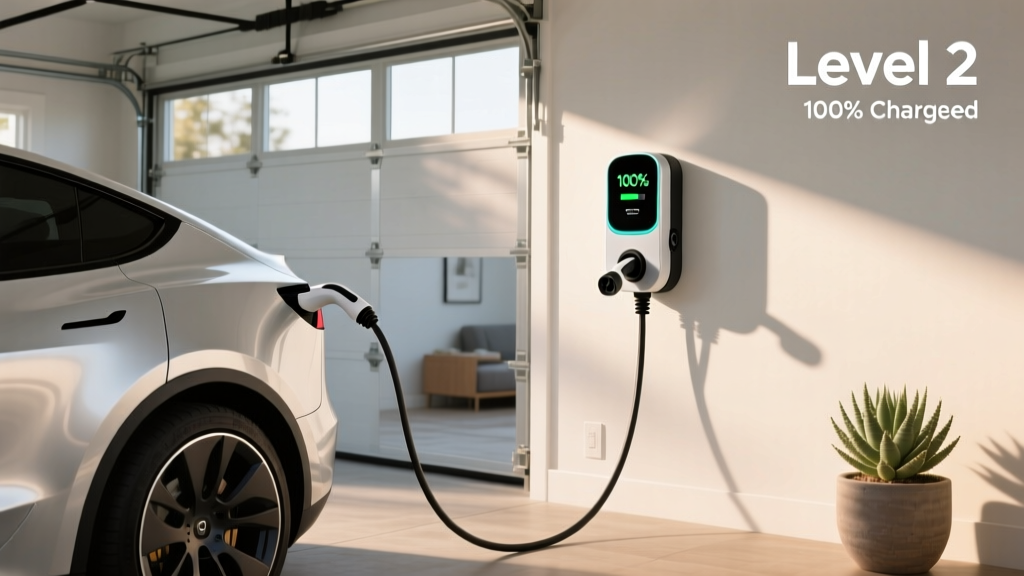
| Level 2 | 240V AC | 7.2–19.2 kW | 22–56 mi/hr | Home daily charging, workplace | NACS / J1772 (w/ adapter) |
| DC Fast Charge | 400–800V DC | 50–350 kW | 150–1,000+ mi/hr | Road trips, rapid top-ups | NACS (Tesla Supercharger) / CCS1 (w/ adapter) |
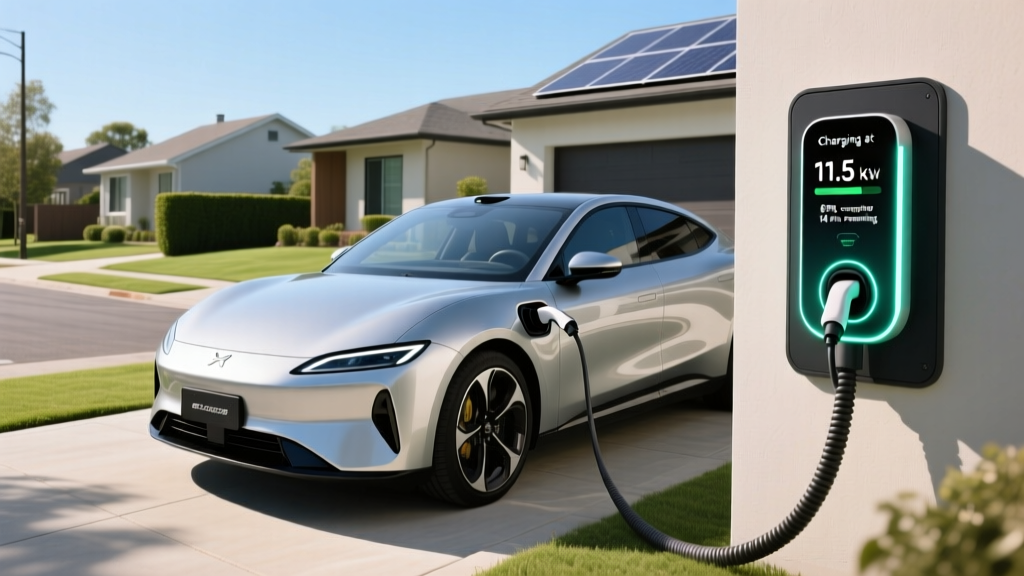
For a Tesla Model Y consuming roughly 0.30 kWh/mi, a Level 2 charger delivering 11.5 kW (the output of a Tesla Wall Connector on a 60A circuit) adds approximately 38 miles of range per hour. A full charge from 10% to 80% on that same 75 kWh battery takes roughly 4.5 to 5 hours at Level 2.
On a V3 Tesla Supercharger (peak 250 kW), the same Model Y can recover 10% to 80% in approximately 25–30 minutes, though the charge curve tapers significantly above 60% state of charge (SoC). Peak charge rates are only sustained at low SoC — expect the average rate over a 10–80% session to be closer to 100–130 kW, not the 250 kW peak.
How Much Does It Cost to Install a Home EV Charger?
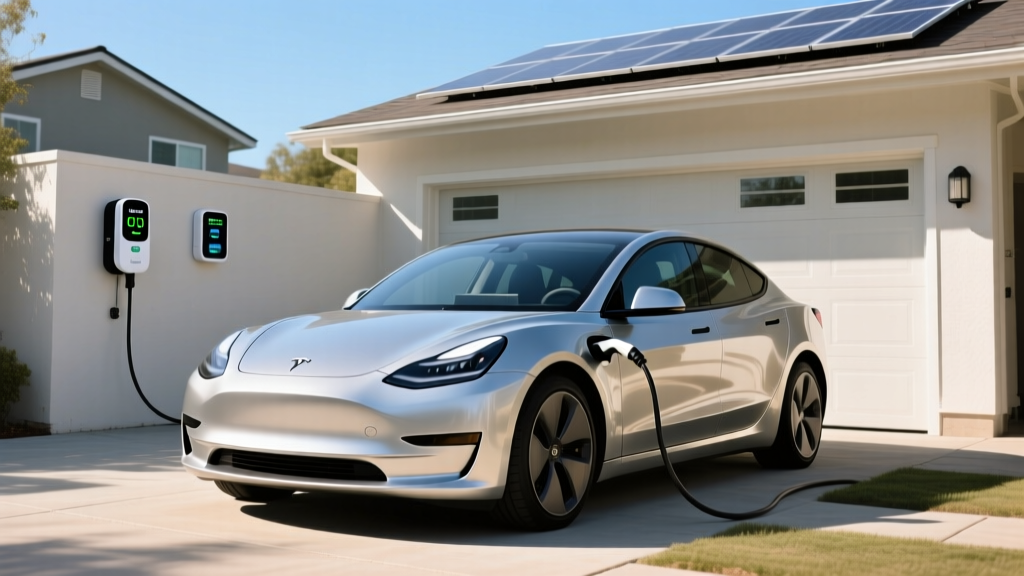
Home Level 2 charging is where most Tesla owners do 85–95% of their charging. The total cost to install depends on your existing electrical panel capacity, the distance from panel to charger location, and local permit requirements. Here's a realistic breakdown for a 240V / 48A (60A circuit) Tesla Wall Connector installation in 2026.
| Component | Low Estimate | High Estimate | Notes |
|---|---|---|---|
| Tesla Wall Connector (hardware) | $400 | $475 | Gen 3, 24ft cable, Wi-Fi enabled |
| Electrician labor (standard install) | $600 | $1,500 | Assumes panel is nearby, conduit run <30ft |
| Permit fee | $50 | $300 | Varies by municipality |
| Electrical panel upgrade (if needed) | $1,500 | $3,500 | 100A to 200A service upgrade for older homes |
| Conduit/wiring (long runs) | $200 | $800 | >30ft from panel or underground trenching |
| Total (no panel upgrade) | $1,050 | $3,075 | Most homes with 200A service |
| Total (with panel upgrade) | $2,550 | $6,575 | Older homes with 100A or 150A service |
Panel upgrade reality check: Homes built before 1990 frequently have 100A or 150A main service panels. Adding a 60A dedicated circuit for EV charging may require a panel upgrade to 200A. This is a significant cost, but it also increases your home's electrical capacity for future needs (heat pumps, solar, etc.). Always have a licensed electrician perform a load calculation per NEC Article 220 before assuming your panel has adequate headroom.
Electrical requirements for a Tesla Wall Connector at full power:
- 240V split-phase AC (standard US residential)
- 60A dedicated breaker (delivers up to 48A continuous to the vehicle)
- 6 AWG copper wire (THHN in conduit) or 4 AWG for runs over 50ft
- NEMA 14-50 outlet or hardwired connection (hardwired preferred for reliability)
- GFCI protection required by NEC 2020+ for outdoor receptacles; hardwired units have integrated ground-fault protection
Charging Cost Per Mile: Tesla vs Gas
This is where EV ownership economics become concrete. Let's calculate the actual cost to drive one mile in a Tesla under different charging scenarios, then compare it to a gas-powered equivalent.
| Scenario | Price | Tesla Model Y LR (0.30 kWh/mi) | RAV4 AWD (28 MPG combined) |
|---|---|---|---|
| Home charging (national avg $0.16/kWh) | $0.16/kWh | $0.048/mi | — |
| Home off-peak (utility TOU rate $0.09/kWh) | $0.09/kWh | $0.027/mi | — |
| Public Level 2 (avg $0.35/kWh) | $0.35/kWh | $0.105/mi | — |
| Tesla Supercharger V3 (avg $0.32/kWh) | $0.32/kWh | $0.096/mi | — |
| Non-Tesla DC fast charger (avg $0.48/kWh) | $0.48/kWh | $0.144/mi | — |
| Gasoline (national avg $3.40/gal) | $3.40/gal | — | $0.121/mi |
At home on a time-of-use off-peak rate, a Tesla Model Y costs roughly 2.7 cents per mile — about 4.5x cheaper than a comparable gas SUV at $3.40/gallon. Even at public DC fast-charging prices, the Tesla is typically cheaper per mile than gasoline, though the gap narrows.
The key variable is your home electricity rate. According to the U.S. Energy Information Administration, the national average residential rate hovers around $0.16/kWh, but rates range from $0.10/kWh in parts of the Southeast to $0.30+/kWh in California and the Northeast. If you have solar panels, your effective marginal cost for home charging may be near zero after system payback.
Connector Compatibility: NACS, CCS1, and Adapters
All current Tesla vehicles sold in North America use the North American Charging Standard (NACS) connector — what was formerly called the Tesla connector. As of 2025–2026, Ford, GM, Rivian, Volvo, Hyundai, and most other major automakers have adopted NACS on new vehicles, and can access Tesla Supercharger stations with an adapter or native port.
| Connector | Used By | Charging Type | Notes |
|---|---|---|---|
| NACS (Tesla) | Tesla (all), Ford, GM, Rivian, Volvo, Hyundai/Kia (2025+), others | AC Level 1/2 + DC Fast | Now the dominant North American standard |
| CCS1 | Legacy VW ID.4, BMW iX, older Ford/GM EVs, most non-Tesla pre-2025 | DC Fast (AC via J1772 upper) | Requires NACS-to-CCS adapter for Supercharger access |
| CHAdeMO | Nissan Leaf (discontinued), Mitsubishi Outlander PHEV | DC Fast | Phasing out; limited network support in 2026 |
| J1772 | All non-Tesla EVs (AC Level 1/2) | AC Level 1/2 only | Tesla includes J1772-to-NACS adapter in-box |
If you own a Tesla and want to use non-Tesla public chargers (Electrify America, EVgo, ChargePoint CCS stations), Tesla includes a J1772 adapter for Level 2 AC charging. For DC fast charging on CCS1 stations, you'll need a NACS-to-CCS1 adapter — Tesla sells an official adapter for approximately $175. Third-party options exist but verify they're rated for the full voltage and current of the station you plan to use.
For non-Tesla EV owners accessing the Supercharger network: most major brands now offer NACS adapters or have native NACS ports on 2025+ models. Check your vehicle's manual or manufacturer site before purchasing an adapter, as using an uncertified adapter can void warranty coverage on the charge port.
Recommended Home Charging Equipment for Tesla Owners
Not all Level 2 chargers are equal. Here are three proven options for Tesla owners in 2026, selected for reliability, smart features, and value.
Power: Up to 11.5 kW (48A on 60A circuit)
Connector: Native NACS, 24ft cable
Smart features: Wi-Fi, OTA updates, load sharing between multiple units, access control
Price: ~$400–$475
Best for: Tesla-only households wanting seamless integration and the cleanest aesthetic. No app required for basic scheduling; uses Tesla app for advanced features.
Power: Up to 12 kW (50A on 60A circuit) — configurable via DIP switches
Connector: NACS or J1772 (select at purchase), 23ft cable
Smart features: Wi-Fi, ChargePoint app scheduling, Alexa integration, detailed energy tracking
Price: ~$550–$650
Best for: Multi-EV households (one Tesla, one non-Tesla). Choose the J1772 version and use your Tesla's included adapter, so any EV can plug in natively.
Power: Up to 11.5 kW (48A on 60A circuit)
Connector: J1772 (use Tesla adapter) or NACS version available
Smart features: Integration with Emporia home energy monitor, solar-aware charging, TOU rate optimization, detailed cost tracking
Price: ~$400–$500
Best for: Solar-equipped homes or energy-monitoring enthusiasts who want to charge only when solar production exceeds household consumption.
Regardless of which charger you choose, ensure it is UL-listed (not just CE-marked), rated for your installation environment (indoor/outdoor — look for NEMA 4 rating for outdoor units), and hardwired rather than plugged into a NEMA 14-50 outlet if possible. Hardwired installations avoid the NEC 2020 GFCI breaker requirement for 14-50 receptacles, which has been a source of nuisance tripping with some charger/outlet combinations.
Charging Time Examples: 10% to 80% for Common Tesla Batteries
Charge times depend on the charger's kW output and the battery's acceptance curve. Lithium-ion batteries charge fastest between roughly 10–50% SoC, then taper progressively. Here are realistic 10–80% times for common Tesla battery sizes.
| Charger | Power Output | Model 3 RWD (57.5 kWh) | Model Y LR (75 kWh) | Model S LR (95 kWh) |
|---|---|---|---|---|
| Level 1 (120V outlet) | 1.2 kW | ~33 hours | ~44 hours | ~55 hours |
| Mobile Connector (240V, 32A) | 7.7 kW | ~5.2 hours | ~6.8 hours | ~8.5 hours |
| Wall Connector (240V, 48A) | 11.5 kW | ~3.5 hours | ~4.5 hours | ~5.7 hours |
| Tesla Supercharger V3 | Peak 250 kW | ~22 min | ~27 min | ~32 min |
| Tesla Supercharger V4 | Peak 350 kW* | ~18 min | ~22 min | ~27 min |
*V4 Supercharger peak rates require compatible vehicle architecture. Most current Teslas peak at 250 kW acceptance; future models with updated battery packs may accept higher rates.
Charge curve reality: A "250 kW" Supercharger does not deliver 250 kW for the entire session. A Model 3 Long Range might pull 250 kW at 10% SoC, taper to ~150 kW by 40%, ~90 kW by 60%, and ~40 kW by 80%. The 10–80% average rate is typically 100–130 kW. This is why manufacturers quote 10–80% times rather than full-charge times — charging above 80% slows dramatically to protect battery longevity.
Safety, Electrical Code, and Installation Best Practices
EV charging draws sustained high current for hours — more similar to an electric oven or dryer than any other household load. Proper installation is non-negotiable for safety.
- Dedicated circuit: Your Level 2 charger must be on its own dedicated circuit — never shared with other appliances. A 60A breaker with 48A continuous draw is standard for full-power Tesla Wall Connector installations.
- Load calculation: Per NEC Article 220, your electrician must verify your panel has sufficient spare capacity. A 200A panel with existing high-draw appliances (electric range, dryer, HVAC) may be near capacity even with room on the physical bus bar.
- GFCI protection: NEC 2020 and later require GFCI protection on 14-50 and 6-50 receptacles used for EV charging. Hardwired chargers are exempt from this specific requirement, which is one reason hardwired installations are preferred — fewer nuisance trips.
- Outdoor rating: If your charger is installed outdoors or in an unconditioned garage, verify it carries a NEMA 4 (weatherproof) or IP65 rating. The Tesla Wall Connector Gen 3 is rated for indoor and outdoor use.
- Permit and inspection: Most jurisdictions require an electrical permit and post-installation inspection for EV charger circuits. This protects you from liability and ensures the work meets code. Unpermitted work can cause insurance claim denials.
- Cable management: A 24ft cable is standard and adequate for most single-car garages. If your charge port will be more than 20ft from the wall connector, consider cable management hooks or a retractable reel to prevent tripping hazards and cable damage.
Frequently Asked Questions
How much does it cost to install a home EV charger for my Tesla?
A standard Tesla Wall Connector installation on an existing 200A panel typically costs $1,050–$3,075 including hardware, electrician labor, and permit. If your home needs a panel upgrade from 100A to 200A service, add $1,500–$3,500. Always get a load calculation from a licensed electrician before assuming your panel has capacity.
How fast will each charging level add range to my Tesla?
Level 1 (120V) adds roughly 3–5 miles per hour — essentially overnight trickle charging. Level 2 (240V, 48A) adds approximately 38 miles per hour for a Model Y, enough to fully replenish overnight. DC fast charging (Supercharger V3 at 250 kW peak) adds 150–200 miles in 15 minutes at low state of charge, tapering as the battery fills.
Which connector and charger is compatible with my Tesla?
All Tesla vehicles use the NACS connector natively. For home charging, the Tesla Wall Connector provides the cleanest experience with no adapter needed. For non-Tesla public Level 2 chargers, use the J1772-to-NACS adapter included with your vehicle. For non-Tesla DC fast chargers (CCS1 stations), purchase the Tesla NACS-to-CCS1 adapter (~$175).
How much does charging a Tesla cost per mile compared to gas?
At home on the national average electricity rate ($0.16/kWh), a Model Y costs about $0.048 per mile — roughly 2.5x cheaper than a 28 MPG gas SUV at $3.40/gallon ($0.121/mi). On off-peak utility rates ($0.09/kWh), the Tesla drops to $0.027/mi, nearly 4.5x cheaper. Even at public Supercharger prices (~$0.32/kWh), the Tesla at $0.096/mi still undercuts gasoline.
What electrical upgrades might I need for a home charger?
The most common and costly upgrade is a main service panel increase from 100A or 150A to 200A, required when your existing panel lacks spare capacity for a 60A dedicated EV circuit. Other potential needs include running new conduit for long wire distances (over 30ft from panel to charger), upgrading from aluminum to copper service entrance cables, or installing a sub-panel if your main panel is on the opposite side of the house from your garage. Per the National Electrical Code (NEC), all work must be permitted and inspected.
Does the Tesla kWh per mile change in cold weather?
Yes, significantly. In temperatures below freezing, expect efficiency to degrade by 20–30% due to battery heating demands, increased cabin heating load (even with Tesla's heat pump), and higher rolling resistance. A Model Y that achieves 0.28 kWh/mi in mild weather may consume 0.37–0.42 kWh/mi in sub-30°F conditions. Preconditioning your battery while plugged in mitigates some of this loss and is essential before DC fast charging in cold weather.
Is there a federal tax credit for installing a home EV charger?
The Alternative Fuel Vehicle Refueling Property Credit (IRC §30C) provides a credit of up to 30% of the cost of home EV charging equipment and installation, capped at $1,000. Eligibility depends on your census tract meeting certain income or rural-area criteria as defined by the IRS. Consult a tax professional for your specific situation, as rules are subject to change.