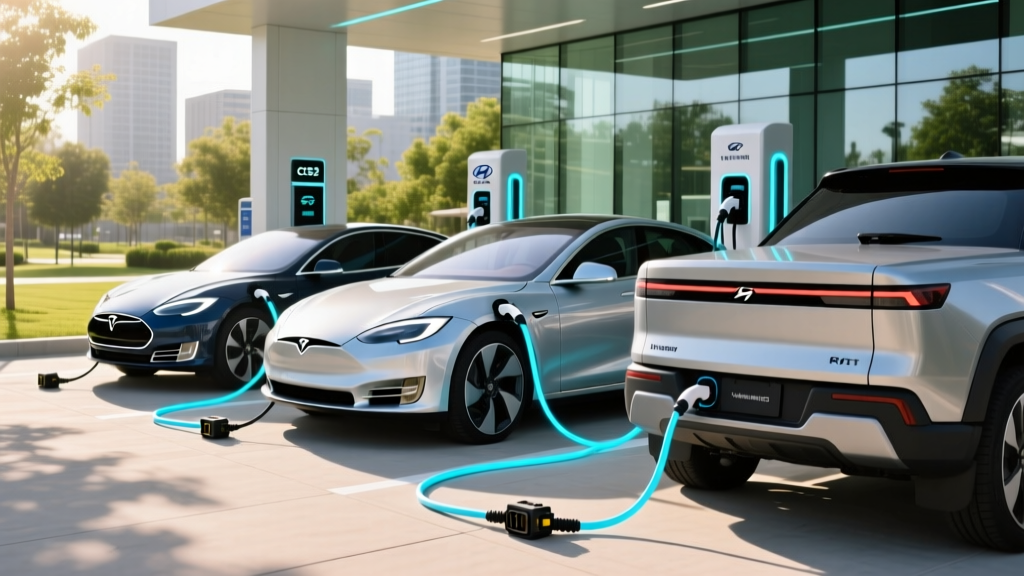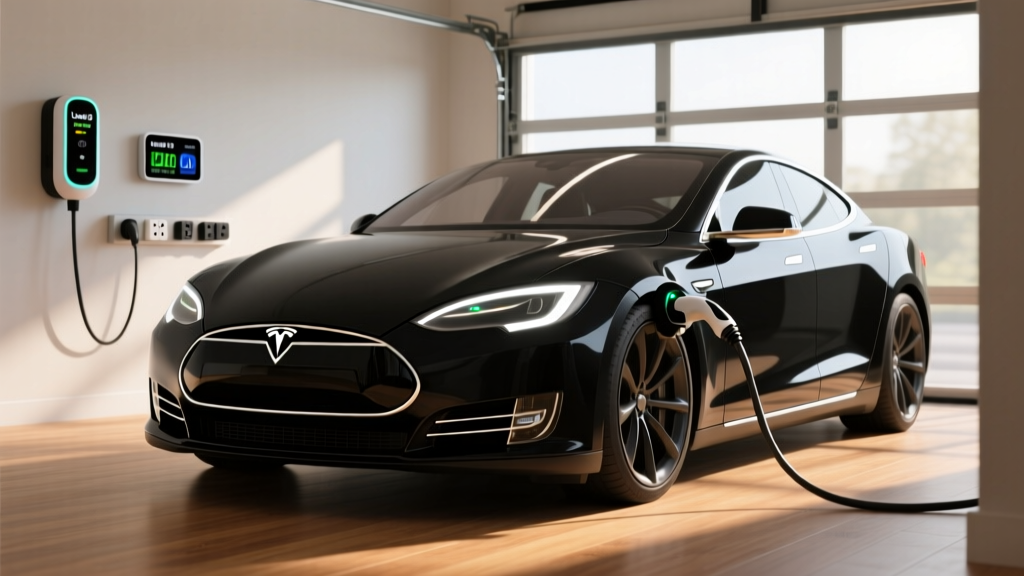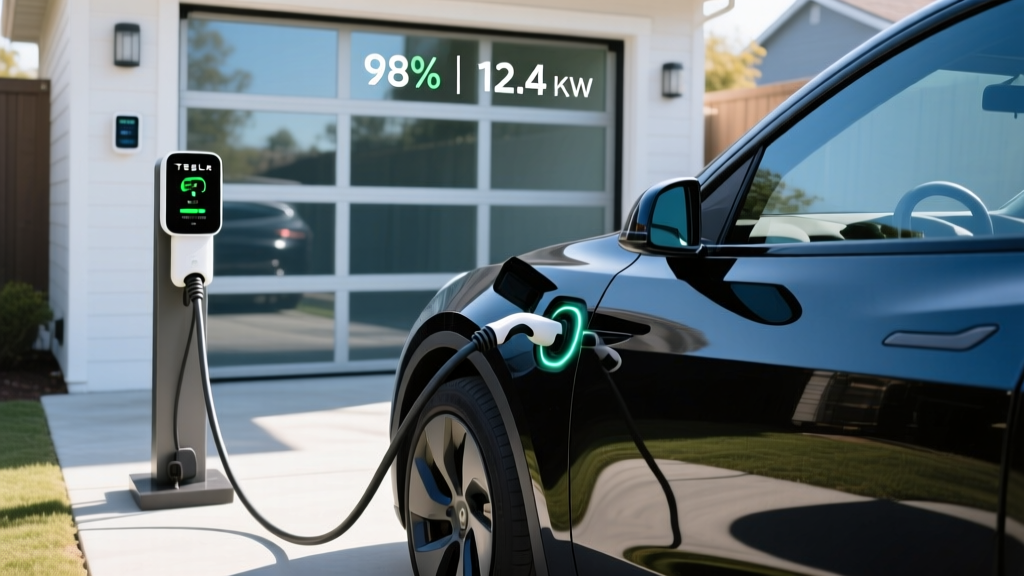
If you've searched for the Tesla fastest charge time, you've likely seen conflicting numbers: 15 minutes, 25 minutes, or even claims of "200 miles in 10 minutes." The reality depends on which Tesla model you drive, which Supercharger generation you plug into, battery temperature, and state of charge (SoC). Below, we break down exact charging speeds across Tesla's network, real-world 10–80% charge times by model, and what you need to replicate fast charging at home — including electrical requirements, installation costs, and equipment picks.
Tesla Supercharger Speeds: V3 vs V4 and Peak kW by Model
Tesla's Supercharger network has evolved through multiple generations, and the peak power (measured in kilowatts, or kW — the rate of energy delivery, not to be confused with kWh, which is the battery's energy capacity) varies significantly:
| Supercharger Gen | Peak Power | Max Miles Added (15 min) | Connector |
|---|---|---|---|
| V2 | 150 kW | ~150 miles | NACS (Tesla proprietary) |
| V3 | 250 kW | ~200 miles | NACS (Tesla proprietary) |
| V4 | 250–350 kW (cabinet-dependent) | ~200–250 miles | NACS (with CCS adapter support) |
As of 2026, V3 stalls remain the most common high-speed option across the US network, while V4 cabinets are being deployed at new and rebuilt stations. The V4 architecture supports up to 350 kW at the cabinet level, but the actual peak delivered to your vehicle depends on the car's onboard charge acceptance. According to Tesla's official Supercharging page, the Model 3 Long Range and Model Y Long Range can accept up to 250 kW at V3 and V4 stalls, while the Cybertruck and refreshed Model S/X can peak slightly higher under optimal conditions.
Tesla 10–80% Charge Times by Model (Real-World Data)
Here are observed and manufacturer-reported 10–80% DC fast charge times at V3/V4 Superchargers with a preconditioned battery (battery pre-warmed via navigation to a Supercharger):
| Model (2025–2026) | Battery (kWh usable) | Peak DC kW | 10–80% Time | EPA Range |
|---|---|---|---|---|
| Model 3 Long Range AWD | ~82 kWh (NMC) | 250 kW | ~25–28 min | 363 mi |
| Model 3 Performance | ~82 kWh (NMC) | 250 kW | ~25–28 min | 341 mi |
| Model Y Long Range AWD | ~82 kWh (NMC) | 250 kW | ~27–30 min | 320 mi |
| Model Y Performance | ~82 kWh (NMC) | 250 kW | ~27–30 min | 303 mi |
| Model S Long Range | ~100 kWh (NMC) | 250 kW | ~32–36 min | 402 mi |
| Model X Long Range | ~100 kWh (NMC) | 250 kW | ~34–38 min | 348 mi |
| Cybertruck AWD | ~123 kWh (NMC) | 250–350 kW | ~28–35 min | 340 mi |
The Tesla fastest charge time in the current lineup belongs to the Model 3 Long Range and Model Y Long Range, which can add approximately 200 miles of range in about 15 minutes at a V3 or V4 Supercharger when arriving with a low SoC and a preconditioned battery. The larger-battery Model S and Model X take longer to reach 80% simply because there's more total energy to replenish, even though their peak charge rate is similar.
Charging Levels Explained: How Fast Will Each Level Add Range?
Whether you own a Tesla or any other EV, understanding the three charging levels is essential for planning both daily driving and road trips:
| Level | Voltage / Amperage | Power (kW) | Miles of Range per Hour | Best For |
|---|---|---|---|---|
| Level 1 | 120V / 12–16A | 1.4–1.9 kW | 3–5 mi/hr | Overnight top-ups, PHEVs, emergencies |
| Level 2 | 240V / 32–48A | 7.7–11.5 kW | 25–44 mi/hr | Daily home charging, workplace |
| DC Fast (V3/V4 Supercharger) | 400–800V DC | 150–350 kW | 500–1,000+ mi/hr (peak) | Road trips, rapid replenishment |
For Tesla owners, Level 2 at home is where 90%+ of all charging happens. A Wall Connector on a 60A circuit (48A continuous) delivers up to 11.5 kW — enough to fully recharge a Model 3 Long Range from 20% to 100% overnight in roughly 7 hours. Level 1 is included via the Mobile Connector but is impractical as a primary strategy for BEVs with 80+ kWh batteries.
Home Charger Installation: Electrical Requirements and Costs
Installing a Level 2 home charger for your Tesla (or any NACS-equipped EV) requires a dedicated 240V circuit. Here's what's involved and what it costs:
Electrical Requirements
- Circuit: Dedicated 240V, 60A breaker (for 48A continuous charging) or 50A breaker (for 40A continuous)
- Wire: 6 AWG copper (for 60A) or 8 AWG copper (for 50A), run in conduit
- Outlet vs. hardwired: Tesla Wall Connector is hardwired (no outlet required); universal chargers may use a NEMA 14-50 receptacle
- Panel capacity: Your electrical panel must have spare capacity — typically 200A service is sufficient, but older homes with 100A panels may need an upgrade
- Permit: Required in most jurisdictions; electrical permit typically $50–$200
Installation Cost Breakdown
| Item | Simple Install (near panel) | Complex Install (long run, conduit) | Panel Upgrade + Install |
|---|---|---|---|
| Charger equipment | $400–$500 | $400–$500 | $400–$500 |
| Electrician labor | $300–$600 | $800–$2,000 | $1,500–$3,000 |
| Permit & inspection | $50–$150 | $100–$200 | $150–$300 |
| Panel upgrade (if needed) | — | — | $1,500–$3,500 |
| Total range | $750–$1,250 | $1,300–$2,700 | $3,550–$7,300 |
The single biggest variable is whether your electrical panel can support a new 60A circuit. Homes built after 2000 with 200A service usually have enough headroom. Homes with 100A panels, older wiring, or panels already near capacity (electric range, dryer, HVAC) may require a service upgrade — which can add $1,500–$3,500. Always get a licensed electrician to perform a load calculation before committing to equipment.
Connector Compatibility: NACS, CCS, and Adapter Needs
As of 2026, the North American Charging Standard (NACS) — originally Tesla's proprietary connector — has become the dominant EV charging connector in the US. Here's the compatibility landscape:
| Connector | Native Vehicles | DC Fast Network Access | Adapter Needed? |
|---|---|---|---|
| NACS (Tesla) | All Tesla models; Ford F-150 Lightning, Mustang Mach-E, Rivian, GM Ultium vehicles (2025+) | Tesla Superchargers + growing NACS third-party (Electrify America, EVgo) | No (native); CCS-to-NACS adapter for legacy CCS stations |
| CCS1 | Hyundai, Kia, BMW, VW, older Ford/GM models | Electrify America, EVgo, ChargePoint, Ionity | NACS-to-CCS adapter needed for Tesla Superchargers (where opened) |
| CHAdeMO | Nissan Leaf (legacy) | Declining network; some Electrify America stations | No direct Tesla adapter available |
For Tesla owners, the NACS connector is native — no adapter needed at Superchargers. However, Tesla sells a CCS Combo 1 Adapter (~$175) that allows access to non-Tesla DC fast chargers with CCS1 cables. This is useful for road trips through areas where Supercharger coverage has gaps. Non-Tesla EVs with NACS ports (2025+ Ford, GM, Rivian) can access Tesla Superchargers that have been opened to other brands via Tesla's Magic Dock or NACS-native stalls.
Cost to Charge: Home vs. Public vs. Gas per Mile
Charging cost varies enormously depending on where and when you plug in. Here's a realistic breakdown for a Tesla Model Y Long Range (82 kWh battery, ~3.5 mi/kWh efficiency):
| Scenario | Rate ($/kWh) | Cost for 80 kWh (10–80%+) | Cost per Mile | Equivalent Gas Price (at 28 MPG) |
|---|---|---|---|---|
| Home (off-peak utility rate) | $0.08–$0.12 | $6.40–$9.60 | $0.023–$0.034 | $0.64–$0.95/gal |
| Home (standard residential) | $0.14–$0.18 | $11.20–$14.40 | $0.040–$0.051 | $1.12–$1.43/gal |
| Tesla Supercharger (avg US) | $0.28–$0.36 | $22.40–$28.80 | $0.080–$0.103 | $2.24–$2.88/gal |
| Third-party DC fast (EA, EVgo) | $0.35–$0.55 | $28.00–$44.00 | $0.100–$0.157 | $2.80–$4.39/gal |
| Gas vehicle (28 MPG combined, $3.50/gal) | — | — | $0.125 | $3.50/gal |
Home charging on an off-peak rate is dramatically cheaper than gas — roughly the equivalent of $0.75/gallon gasoline. Even at public DC fast chargers, Tesla Supercharging undercuts gas per mile in most US markets. The key insight: charging cost is dominated by home vs. public. If you can charge at home on a time-of-use (TOU) plan, your per-mile cost drops to a fraction of any gas car. Data from the EPA's EV technology page confirms that electricity costs for EVs average roughly one-third to one-half the per-mile fuel cost of comparable gasoline vehicles.
Recommended Home Chargers for Tesla and NACS-Equipped EVs
Tesla Wall Connector (Gen 3)
- Power Output: Up to 11.5 kW (48A on 60A circuit)
- Connector: NACS (native Tesla)
- Cable Length: 24 ft
- Smart Features: Wi-Fi, OTA updates, power sharing between two units, load management
- Price: ~$475
- Best For: Tesla-only households; cleanest integration with Tesla app
ChargePoint Home Flex (NACS version)
- Power Output: Up to 12 kW (50A on 60A circuit; adjustable down to 16A)
- Connector: NACS (available 2025+); also CCS1 variant
- Cable Length: 23 ft
- Smart Features: Wi-Fi, Alexa, scheduling, energy tracking, flexible amperage
- Price: ~$550–$600
- Best For: Mixed-fleet households; adjustable circuit sizing
Emporia Level 2 EV Charger
- Power Output: Up to 11.5 kW (48A on 60A circuit)
- Connector: J1772 (NACS adapter included with Tesla bundle)
- Cable Length: 24 ft
- Smart Features: Wi-Fi, solar integration, energy monitoring, scheduling
- Price: ~$400
- Best For: Budget-conscious buyers; solar-panel households
For most Tesla owners, the Tesla Wall Connector is the obvious default — it's purpose-built, supports power sharing if you have two Teslas, and receives over-the-air updates. The ChargePoint Home Flex earns its place for households with both a Tesla and a non-Tesla EV, thanks to adjustable amperage and multiple connector options. All three require a dedicated 240V circuit installed by a licensed electrician.
Safety, Electrical Code, and Panel-Upgrade Considerations
EV charging draws sustained high current for hours — unlike a dryer or oven that cycles on and off. This makes proper installation critical:
- Dedicated circuit: Your EV charger must be on its own breaker — never shared with other appliances. NEC Article 625 governs EV charging equipment.
- Continuous load derating: EV charging is classified as a continuous load (3+ hours). A 48A charger requires a 60A breaker (80% rule: 48A ÷ 0.8 = 60A).
- GFCI protection: The 2020 NEC requires GFCI protection for outdoor receptacles used for EV charging. Hardwired installations (like the Wall Connector) typically do not require a GFCI breaker, but local code may vary.
- Outdoor rating: If mounting outdoors, ensure the charger carries a NEMA 4 (or IP65+) weather rating. The Tesla Wall Connector and ChargePoint Home Flex are both rated for outdoor use.
- Panel load calculation: Before installation, your electrician should perform a NEC Article 220 load calculation. If your panel is at or near capacity, you may need a panel upgrade or a smart load-management device (like the Emporia smart panel or Tesla Powerwall integration) to avoid overloading your service.
Frequently Asked Questions
How much does it cost to install a home EV charger?
A straightforward Tesla Wall Connector installation on an existing 200A panel with a short wire run typically costs $750–$1,250 total (equipment + electrician + permit). Longer runs requiring conduit, or installations on older 100A panels needing upgrades, can push costs to $2,000–$7,000+. Always get a site-specific quote from a licensed electrician.
How fast will each charging level add range to my Tesla?
Level 1 (120V) adds roughly 3–5 miles per hour — enough for PHEVs but impractical for a full BEV overnight. Level 2 (240V, 48A) adds 30–44 miles per hour, fully recharging most Teslas overnight. DC fast charging at a V3 Supercharger can add up to 200 miles in 15 minutes, though this rate tapers significantly above 50% SoC.
Which connector is compatible with my Tesla?
All Tesla vehicles use the NACS connector natively. At home and at Superchargers, no adapter is needed. For non-Tesla DC fast chargers with CCS1 cables, Tesla sells a CCS Combo 1 Adapter (~$175). Starting in 2025, many non-Tesla EVs (Ford, GM, Rivian) also use NACS and can access Tesla Superchargers.
How much does charging cost per mile vs. gas?
Home charging at off-peak rates ($0.10/kWh) costs roughly $0.03/mile — equivalent to $0.80/gallon gasoline. Public Supercharging ($0.32/kWh avg) costs ~$0.09/mile, still cheaper than a 28 MPG gas car at $3.50/gallon ($0.125/mile). The savings are largest when you charge at home. Per fueleconomy.gov, EVs consistently show lower per-mile energy costs than gasoline equivalents.
What electrical upgrades might I need for a home charger?
If your home has a 200A electrical panel with available breaker slots and load headroom, you likely need only a new 60A breaker and wire run. If your panel is 100A, already near capacity, or uses outdated wiring (knob-and-tube, aluminum), you may need a panel upgrade ($1,500–$3,500), a service upgrade from the utility, or a smart load-management system. A licensed electrician's load calculation will determine this.
Does the Tesla fastest charge time require battery preconditioning?
Yes. Tesla's battery management system must pre-warm the battery to its optimal charging temperature (roughly 95–110°F) for peak charge rates. Navigate to a Supercharger using the car's built-in navigation, and the vehicle will automatically begin preconditioning. Arriving at a Supercharger without preconditioning — especially in cold weather — can add 5–15 minutes to your 10–80% time and reduce peak kW significantly.