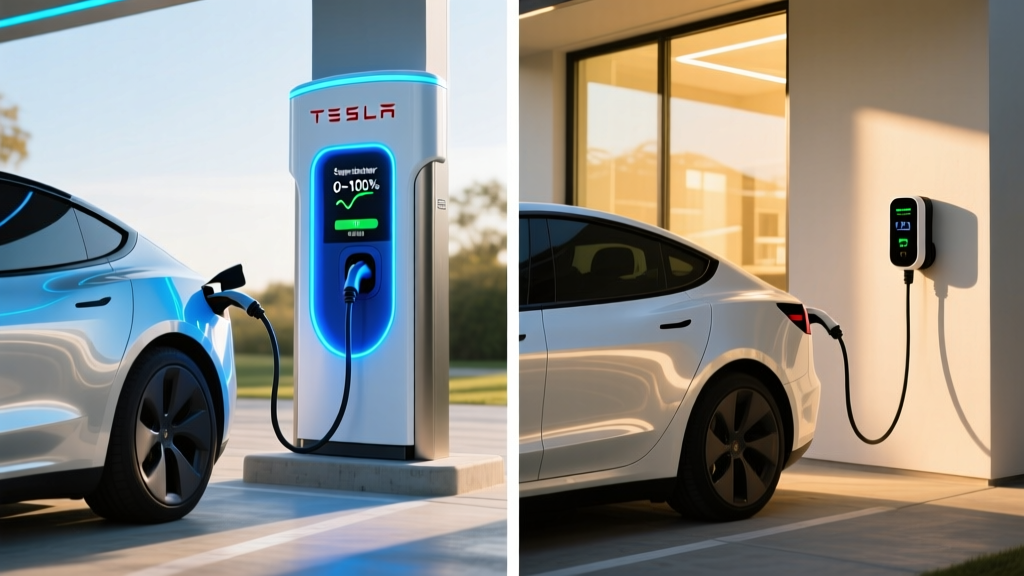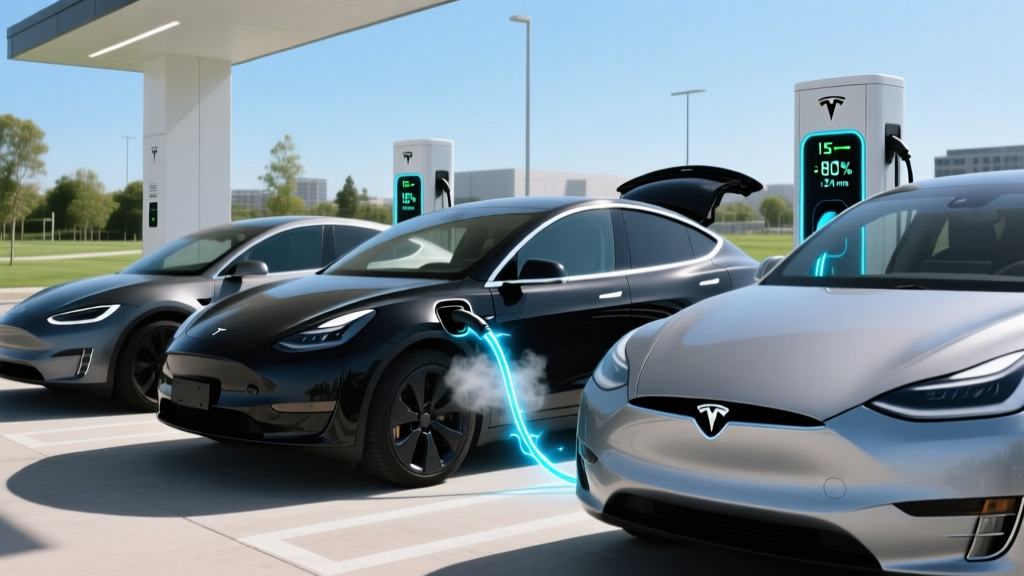
If you own or are shopping for a Tesla, understanding actual charging speeds — not just the marketing peak — is essential for road-trip planning and daily ownership. Tesla fast charge time varies significantly by model, battery chemistry, Supercharger generation, and ambient temperature. This guide breaks down real DC fast-charging performance across the 2026 Tesla lineup, then covers home Level 2 setup, costs, and equipment.
Tesla DC Fast-Charge Times by Model (2026)
Tesla's Supercharger network currently spans V2 (150 kW peak), V3 (250 kW peak), and the newer V4 cabinet architecture (up to 325 kW peak for compatible vehicles). But peak kW is only part of the story. Charging follows a taper curve: the battery accepts maximum power at low state of charge (SoC), then progressively slows to protect cell health, especially above 80%. What matters for trip planning is the 10–80% time.
| Model (2026) | Battery (kWh usable) | Chemistry | Peak DC kW | 10–80% Time | EPA Range |
|---|---|---|---|---|---|
| Model 3 RWD | ~60 | LFP | 170 kW | ~30 min | 272 mi |
| Model 3 Long Range AWD | ~79 | NMC | 250 kW | ~27 min | 363 mi |
| Model Y Long Range AWD | ~79 | NMC | 250 kW | ~27 min | 320 mi |
| Model S Long Range | ~100 | NMC | 250 kW | ~34 min | 402 mi |
| Model X Long Range | ~100 | NMC | 250 kW | ~36 min | 348 mi |
A few real-world caveats: LFP (lithium iron phosphate) packs in the Model 3 RWD tolerate frequent 100% charging better than NMC, but their charge curve tapers earlier, yielding longer 10–80% sessions despite a smaller battery. Cold weather (below 40°F) can add 5–10 minutes to any session unless you precondition the battery by navigating to a Supercharger in the Tesla app or in-car nav, which activates the thermal management system. On V2 stalls (150 kW peak), expect 10–80% times to roughly double.
Charging Levels Explained: kW, Speeds, and Miles Per Hour
The single most common EV confusion is mixing up kW (kilowatts — the rate of power delivery, like water pressure) with kWh (kilowatt-hours — the energy stored, like gallons in a tank). A 250 kW Supercharger delivers energy at that rate; a 75 kWh battery stores that much total energy.
| Level | Voltage / Amps | Max Power (kW) | Miles of Range Added per Hour | Typical Use |
|---|---|---|---|---|
| Level 1 | 120V / 12–16A | 1.4–1.9 kW | 3–5 mi/hr | Emergency / overnight trickle |
| Level 2 (home) | 240V / 32–48A | 7.7–11.5 kW | 25–44 mi/hr | Daily home charging |
| Level 2 (public/destination) | 208–240V / 32–80A | 7.7–19.2 kW | 25–60 mi/hr | Hotels, workplaces, malls |
| DC Fast (V2 Supercharger) | 400V DC | 150 kW | ~300–450 mi/hr* | Road trips (older stalls) |
| DC Fast (V3/V4 Supercharger) | 400V DC | 250–325 kW | ~500–800 mi/hr* | Road trips (current network) |
*Miles-per-hour rates are peak estimates; actual rates taper as SoC rises. You'll never sustain peak rate for a full session.
Tesla Supercharger Network: V2, V3, and V4 Differences
Not all Superchargers are equal. Here's what you'll encounter on the road:
- V2 (150 kW): Older stalls, still widespread. Shared power between paired stalls (A/B). A Model Y LR will do 10–80% in roughly 45–55 minutes here.
- V3 (250 kW): No stall sharing. Supports peak 250 kW for Model 3/Y/S/X on NMC packs. This is the backbone of the current network.
- V4 (up to 325 kW): Newer cabinet design with CCS-compatible connectors built in alongside NACS. Currently optimized for Cybertruck and future 800V architectures; existing Model 3/Y peak at 250 kW even on V4 hardware.
The Tesla in-car navigation automatically routes you through Superchargers and preconditions the battery when a Supercharger is set as your destination, which is critical for achieving advertised charge speeds. Arriving at a V3 stall with a cold battery can cut your peak kW in half.
Home Level 2 Charging: Installation Costs and Electrical Requirements
For daily use, home Level 2 charging is the standard. Tesla's onboard charger accepts up to 11.5 kW (48A) on Model S/X and 11.5 kW on newer Model 3/Y Long Range, while the RWD Model 3 accepts up to 7.7 kW (32A). To get the most from your car, you need a 240V circuit rated at 125% of the continuous draw — so a 48A charger requires a 60A breaker.
Electrical Requirements
- Voltage: 240V (standard for Level 2, same as a dryer outlet)
- Amperage: 40A circuit (for 32A charging) or 60A circuit (for 48A charging)
- Dedicated circuit: Required by NEC — no sharing with other appliances
- GFCI protection: Required for outdoor installations per NEC 2020/2023 code
- Panel capacity: Most 200A home panels can support a 60A EV circuit; older 100A panels often require an upgrade
How much does it cost to install a home EV charger?
Installation costs vary enormously based on your panel's distance from the garage, whether a panel upgrade is needed, and local permit fees. Here's a realistic breakdown based on 2026 national averages:
| Component | Simple Install (panel near garage) | Complex Install (long run, subpanel) | With Panel Upgrade (100A → 200A) |
|---|---|---|---|
| EVSE equipment (charger) | $400–$650 | $400–$650 | $400–$650 |
| Electrician labor | $300–$600 | $800–$1,800 | $1,200–$2,500 |
| Permit & inspection | $50–$200 | $100–$350 | $150–$400 |
| Panel upgrade (if needed) | — | — | $1,500–$3,500 |
| Total | $750–$1,450 | $1,300–$2,800 | $3,250–$7,050 |
If your home was built before 1990 and has a 100A panel, budget for a panel upgrade. Some utilities offer rebates of $200–$500 for EV charger installations — check with your local provider. The IRS residential clean energy credit (30% of equipment and installation, up to $1,000) was available through 2032 for qualifying home charging equipment under §25C; confirm current-year eligibility with a tax professional.
Connector Compatibility: NACS, CCS, and Adapters
Tesla uses the North American Charging Standard (NACS) connector natively. Since 2024, most non-Tesla automakers (Ford, GM, Rivian, Volvo, Hyundai, and others) have adopted NACS as well, and Tesla opened its Supercharger network to non-Tesla EVs via the Magic Dock adapter at select stations.
| Connector | Native Vehicles | At Tesla Superchargers? | Adapter Needed? |
|---|---|---|---|
| NACS (Tesla) | Tesla (all), Ford, GM, Rivian, Volvo, Hyundai (2025+) | Yes — native | None for Teslas |
| CCS1 | Older Hyundai/Kia, VW, BMW, Mercedes (pre-2025) | Only at Magic Dock stations | Tesla CCS adapter (~$175) or Magic Dock built-in |
| CHAdeMO | Nissan Leaf (legacy) | No | No adapter available — use EA/EVgo networks |
If you own a Tesla and want to charge on Electrify America or other CCS networks, Tesla sells a CCS adapter for approximately $175. For destination charging at hotels with J1772 connectors, Tesla includes a J1772 adapter with every vehicle.
Cost to Charge: Home vs. Public vs. Gas
Charging economics depend heavily on where and when you plug in. Here's a comparison using a Model Y Long Range (79 kWh battery, ~3.5 mi/kWh real-world efficiency) and a comparable gas SUV at 25 MPG combined:
| Scenario | $/kWh | Cost for Full Charge (79 kWh) | Cost per Mile | Equiv. Gas Price (at 25 MPG) |
|---|---|---|---|---|
| Home (off-peak utility rate) | $0.10 | $7.90 | $0.028 | $0.71/gal |
| Home (average US rate) | $0.16 | $12.64 | $0.045 | $1.13/gal |
| Tesla Supercharger (avg 2026) | $0.30 | $23.70 | $0.085 | $2.13/gal |
| Public DC fast (EA, EVgo) | $0.40–$0.55 | $31.60–$43.45 | $0.11–$0.15 | $2.75–$3.75/gal |
| Gasoline (US avg, early 2026) | — | — | $0.13 (at $3.25/gal) | $3.25/gal |
The takeaway: home charging on an off-peak rate is dramatically cheaper than gas. Supercharging on road trips is roughly equivalent to $2.13/gallon gas — still a savings. But public DC fast chargers outside the Tesla network can approach or exceed gas costs, making home charging access the single biggest economic factor in EV ownership.
Best Home Chargers for Tesla Owners (2026)
Tesla's own Wall Connector is the default choice, but several third-party options offer competitive features. All chargers below use the NACS connector natively.
Tesla Wall Connector (Gen 3)
- Power: Up to 11.5 kW (48A)
- Connector: NACS (native)
- Cable length: 24 ft
- Smart features: Wi-Fi, OTA updates, load sharing between multiple units, Power-Share with Tesla Powerwall
- Price: ~$475
- Best for: Tesla-only households wanting seamless integration
ChargePoint Home Flex (NACS version)
- Power: Up to 12 kW (50A), configurable down to 16A for panel-constrained homes
- Connector: NACS (2025+ models) or J1772 with adapter
- Cable length: 24 ft
- Smart features: Wi-Fi, app scheduling, utility demand-response integration, Alexa
- Price: ~$550–$650
- Best for: Mixed-fleet households (Tesla + non-Tesla with adapter)
Emporia Vue Level 2 Charger
- Power: Up to 11.5 kW (48A)
- Connector: NACS or J1772 (select at purchase)
- Cable length: 24 ft
- Smart features: Integration with Emporia home energy monitor, solar-aware scheduling
- Price: ~$399
- Best for: Budget-conscious buyers with solar panels
Safety, Code, and Panel Considerations
EV charging is a continuous high-draw load — your charger will pull maximum current for 6–10 hours straight. This is fundamentally different from a dryer or oven, which cycles on and off. Key safety requirements:
- Dedicated circuit: NEC requires a dedicated breaker for EVSE — no shared circuits.
- 125% rule: A 48A continuous load requires a 60A breaker (48 × 1.25 = 60).
- GFCI: Required for outdoor installations; indoor garage outlets may also require it depending on local code.
- Outdoor rating: If mounting outside, the EVSE must carry a NEMA 4 or IP65 weather rating. The Tesla Wall Connector and ChargePoint Home Flex both qualify.
- Wire gauge: 6 AWG copper for 48A/60A circuits; 8 AWG for 32A/40A circuits. Your electrician will size this based on run length.
Before committing to a charger purchase, have an electrician assess your panel's remaining capacity. If you're already running electric heat, an electric dryer, and an electric range on a 100A panel, a 60A EV circuit will likely exceed capacity. A panel upgrade to 200A or adding a secondary subpanel solves this but adds $1,500–$3,500 to the project.
Frequently Asked Questions
How much does it cost to install a home EV charger?
A straightforward installation with the panel near the garage runs $750–$1,450 including equipment, labor, and permit. Complex runs or homes needing a panel upgrade can cost $3,000–$7,000. Always get 2–3 electrician quotes.
How fast will each charging level add range to my Tesla?
Level 1 (120V) adds 3–5 miles per hour — essentially overnight trickle. Level 2 (240V, 48A) adds 35–44 miles per hour, easily replenishing a full day's driving in 2–3 hours. DC fast charging at a V3 Supercharger adds range at roughly 500–800 miles per hour at peak, but tapers significantly above 80% SoC.
Which connector is compatible with my Tesla?
All Teslas use NACS natively. For non-Tesla public chargers (Electrify America, EVgo), you need Tesla's CCS adapter (~$175). For J1772 destination chargers, Tesla includes a J1772 adapter in the vehicle. CHAdeMO is not compatible with any Tesla.
How much does charging cost per mile vs. gas?
Home charging on an average US electricity rate ($0.16/kWh) costs about $0.045/mile in a Model Y — roughly one-third the per-mile cost of a 25 MPG gas SUV at $3.25/gallon ($0.13/mile). Supercharging on road trips costs about $0.085/mile, still cheaper than gas.
What electrical upgrades might I need for a home charger?
If your home has a 200A panel with available headroom, you likely need only a new dedicated 60A breaker and wire run. Homes with 100A panels, especially those with electric heat and appliances, typically need a panel upgrade ($1,500–$3,500). Older homes may also need a grounding upgrade or service lateral replacement.
Does preconditioning actually matter for Tesla fast charge time?
Yes. The battery must be in its optimal temperature window (roughly 95–110°F at the cell level) to accept peak kW. Navigating to a Supercharger in the Tesla nav triggers preconditioning automatically. In cold weather, skipping preconditioning can reduce your peak charge rate by 40–50%, adding 10–15 minutes to a 10–80% session.
Can I charge a non-Tesla EV at a Supercharger?
Yes, at select Supercharger stations equipped with Tesla's Magic Dock (a built-in CCS adapter). As of 2026, Ford, GM, Rivian, and Volvo EVs with NACS ports can also access the full Supercharger network natively. Check the Tesla app for station-level compatibility.
For official EPA range and efficiency data, consult fueleconomy.gov. For current federal tax credit rules on EV purchases and home charging equipment, see the IRS residential clean energy credit page. Tesla's current Supercharger map and pricing are available at tesla.com/supercharger.