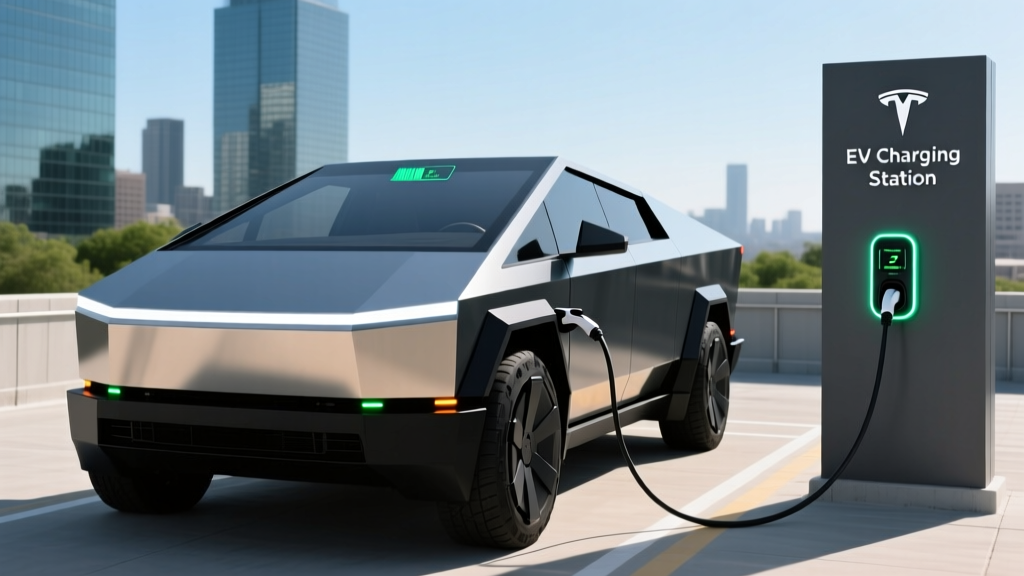
The Tesla Cybertruck's angular design and stainless-steel exoskeleton dominate headlines, but for owners and prospective buyers, the more pressing question is practical: how far does it really go, and how do you keep it charged efficiently? Searches for a "Tesla Cybertruck range extender" have surged as owners look for ways to squeeze more miles out of the truck's massive battery pack. The reality is that no bolt-on range-extender module exists for the Cybertruck's pure BEV powertrain — but the right charging strategy, equipment, and battery management can functionally extend your usable range and eliminate the downtime that makes range anxiety feel real.
This guide covers the Cybertruck's actual range in real-world conditions, the charging hardware you need at home and on the road, installation costs, and the specific equipment that pairs best with the truck's NACS connector and large battery. Whether you own the AWD or the Cyberbeast, the physics of moving 6,600+ pounds of electric truck remain the same — and your charging setup is the single biggest variable you control.
Cybertruck Range: EPA Sticker vs. Real-World Reality
Before optimizing your charging setup, you need honest range expectations. Tesla offers the Cybertruck in two main configurations with different battery and range profiles:
| Specification | Cybertruck AWD | Cyberbeast |
|---|---|---|
| Usable Battery (est.) | ~123 kWh (NMC) | ~123 kWh (NMC) |
| EPA Range | 340 miles | 320 miles |
| Real-World Highway (70 mph) | ~265–285 miles | ~245–265 miles |
| Cold Weather (20°F, highway) | ~220–250 miles | ~200–230 miles |
| Peak DC Fast Charge | ~250 kW | ~250 kW |
| 10–80% DCFC Time | ~28 minutes | ~28 minutes |
| Level 2 Max Acceptance | ~17 kW (48A) | ~17 kW (48A) |
| 0–60 mph | 3.9 sec | 2.6 sec |
| Base MSRP (2025/2026) | $79,990 | $99,990 |
Why There Is No Tesla Cybertruck Range Extender (And What Works Instead)
Unlike a plug-in hybrid or a range-extended EV (EREV) like the older BMW i3 REx, the Cybertruck is a pure battery-electric vehicle with no internal combustion engine and no auxiliary generator port. Tesla has not announced, patented, or hinted at a bolt-on range-extender accessory for the Cybertruck as of early 2026. Any aftermarket product claiming to be a "Cybertruck range extender" is either a software optimization tool, a portable power station that cannot interface with the traction battery, or outright misleading.
What actually extends your functional range is a combination of factors:
- Optimized home charging: A properly spec'd Level 2 charger ensures you start every day at your target state of charge (SoC) without relying on slow Level 1 trickle charging.
- Preconditioning for DC fast charging: Using the Cybertruck's navigation to route to a Supercharger automatically warms the battery, enabling peak charge rates and reducing stop time by 10–15 minutes.
- Efficiency driving habits: Speed reduction from 75 to 65 mph can recover 30–40 miles of range on the Cybertruck due to its large frontal area and aerodynamic drag.
- The announced Cybertruck Range Extender battery pack: Tesla has mentioned a future auxiliary battery pack that would sit in the bed, targeting 470+ miles of range. As of 2026, this remains announced but not available for purchase. No pricing, release date, or installation details have been confirmed.
Charging Levels Explained: Speeds, kW, and Miles Per Hour
Understanding the three charging levels is essential for any Cybertruck owner. Note: kW (kilowatts) measures power — how fast energy flows into the battery. kWh (kilowatt-hours) measures energy — the total capacity of the battery. These are not interchangeable.
| Charging Level | Voltage / Amperage | Max Power (kW) | Miles Added Per Hour | Best Use Case |
|---|---|---|---|---|
| Level 1 | 120V / 12A | ~1.4 kW | ~3–4 miles | Emergency top-up, overnight trickle |
| Level 2 (Home) | 240V / 40–48A | 9.6–11.5 kW | ~28–38 miles | Daily home charging, full overnight refill |
| Level 2 (48A max) | 240V / 48A | ~11.5 kW | ~38 miles | Optimal for Cybertruck's 17 kW onboard charger |
| DC Fast Charge | 400V+ / 300A+ | Up to 250 kW | ~600+ miles (peak rate) | Road trips, Supercharger network |
For the Cybertruck's ~123 kWh battery, a full Level 1 charge from 10% to 100% would take over 72 hours — entirely impractical. A 48-amp Level 2 charger reduces that to roughly 11–12 hours, making overnight charging viable even after a near-full depletion. On a DC fast charger, the 10–80% charge takes approximately 28 minutes at a Supercharger V3 or V4 stall, though the charge curve tapers significantly above 80% SoC to protect battery health.
Home Charger Installation: Electrical Requirements and Costs
The Cybertruck's large battery makes a high-amperage Level 2 home charger nearly mandatory. Here's what a proper installation involves:
Electrical Requirements
- Circuit: Dedicated 60-amp breaker (supports continuous 48-amp charging per NEC 80% rule)
- Voltage: 240V split-phase (standard US residential)
- Wire gauge: 6 AWG copper (THHN in conduit) or 4 AWG aluminum for runs over 50 feet
- Connector: NACS (North American Charging Standard) — native on all Cybertrucks
- GFCI protection: Required by NEC 2020+ for outdoor receptacles; hardwired chargers may not require a GFCI breaker depending on local code
Panel Upgrade Considerations
Most homes built after 2000 have a 200-amp main panel, which typically supports a 60-amp EV circuit if existing load allows. Older homes with 100-amp service will almost certainly need a panel upgrade before adding a 48-amp charger. Even some 200-amp panels are near capacity if you have electric HVAC, an electric dryer, and an electric range. A licensed electrician will perform a load calculation (NEC Article 220) before recommending a circuit size.
| Cost Component | Low Estimate | High Estimate | Notes |
|---|---|---|---|
| Level 2 Charger (Equipment) | $400 | $750 | 48A smart charger, NACS connector |
| Electrician Labor (standard install) | $600 | $1,500 | Panel to garage, <30 ft run |
| Permit & Inspection | $50 | $250 | Varies by municipality |
| Panel Upgrade (if needed) | $1,500 | $3,500 | 100A to 200A service upgrade |
| Conduit & Materials | $100 | $400 | Longer runs, outdoor routing |
| Total (no panel upgrade) | $1,050 | $2,900 | Typical garage installation |
| Total (with panel upgrade) | $2,550 | $6,400 | Older homes with 100A service |
Always get at least two quotes from licensed electricians and confirm they pull a permit. Unpermitted electrical work can void home insurance and create fire risk. Refer to the National Electrical Code (NFPA 70) for baseline safety standards.
Connector Compatibility: NACS, CCS, and Adapter Needs
The Cybertruck ships with a native NACS (Tesla) charge port. This is the simplest connector situation in the EV market because Tesla's Supercharger network — the most reliable public DC fast-charging network in North America — uses the same connector natively.
| Connector Type | Compatibility with Cybertruck | Network Access | Adapter Needed? |
|---|---|---|---|
| NACS (Tesla) | Native — built-in | Tesla Superchargers, Destination Chargers | None |
| CCS1 | Requires NACS-to-CCS adapter | Electrify America, EVgo, ChargePoint DCFC | Yes — Tesla CCS adapter (~$250) |
| CHAdeMO | Not supported | Legacy Nissan/Mitsubishi stations | No adapter available |
| J1772 (Level 2) | Requires J1772-to-NACS adapter | Public Level 2, hotels, workplaces | Yes — included with Cybertruck |
Tesla includes a J1772 adapter with every Cybertruck, allowing you to use the thousands of non-Tesla Level 2 public chargers. For DC fast charging on non-Tesla networks, the Tesla CCS adapter is a worthwhile $250 investment, especially for road trips through areas with sparse Supercharger coverage. As of 2026, many non-Tesla networks are adding NACS connectors, but CCS remains dominant at Electrify America and most ChargePoint DCFC stations.
Recommended Home Chargers for the Cybertruck
Because the Cybertruck can accept up to ~17 kW (48 amps at 240V) on Level 2, you want a charger that delivers the full 48 amps to minimize overnight charge time. Here are three proven options:
Tesla Wall Connector (Gen 3)
- Power Output: Up to 11.5 kW (48A)
- Connector: NACS native
- Cable Length: 24 feet
- Smart Features: Wi-Fi, OTA updates, load sharing with second unit, Tesla app integration
- Price: ~$475
- Verdict: Best integration with Cybertruck. Schedules charging, tracks energy use, and supports power-sharing if you add a second EV. The default choice for Tesla owners.
ChargePoint Home Flex
- Power Output: Up to 12 kW (50A circuit, configurable to 48A)
- Connector: NACS or J1772 (select at purchase)
- Cable Length: 23 feet
- Smart Features: Wi-Fi, Alexa, app scheduling, energy dashboard
- Price: ~$550–$650
- Verdict: Excellent if you have non-Tesla EVs alongside the Cybertruck. The adjustable amperage lets you match your circuit without swapping hardware.
Emporia Vue Level 2 Charger
- Power Output: Up to 11.5 kW (48A)
- Connector: NACS or J1772
- Cable Length: 24 feet
- Smart Features: Wi-Fi, app scheduling, energy monitoring, solar integration
- Price: ~$400–$450
- Verdict: Best budget smart charger. Less polished app than Tesla or ChargePoint, but solid hardware at the lowest price in this category.
Charging Cost Per Mile: Cybertruck vs. Gas Truck
The Cybertruck's efficiency is rated at approximately 56 MPGe combined (per fueleconomy.gov), which translates to roughly 60 kWh per 100 miles driven. Here's what that costs in real charging scenarios compared to a comparable gas truck getting 19 MPG combined:
| Scenario | Cost per kWh | Cost per 100 Miles | Cost per Mile |
|---|---|---|---|
| Home Level 2 (national avg. residential) | $0.16/kWh | $9.60 | $0.096 |
| Home Level 2 (off-peak TOU rate) | $0.09/kWh | $5.40 | $0.054 |
| Tesla Supercharger (avg. 2026) | $0.30/kWh | $18.00 | $0.18 |
| Electrify America (avg.) | $0.36/kWh | $21.60 | $0.216 |
| Gas Truck (19 MPG, $3.50/gal) | — | $18.42 | $0.184 |
At home on an off-peak rate, the Cybertruck costs roughly 5.4 cents per mile — nearly one-third the cost of a comparable gas truck. Even at public DC fast chargers, costs are competitive with gasoline, though frequent Supercharger use erodes the EV cost advantage. The sweet spot is clear: charge at home overnight on a time-of-use plan, and reserve DC fast charging for road trips.
Safety, Code, and Best Practices
EV charging involves sustained high-current draw that stresses residential electrical systems. Follow these non-negotiable safety principles:
- Dedicated circuit: Your Level 2 charger must be on its own dedicated breaker — never shared with outlets, lighting, or appliances.
- Continuous load derating: The NEC requires that continuous loads (defined as 3+ hours, which EV charging always is) use only 80% of the breaker rating. A 60-amp breaker supports 48 amps continuous. A 50-amp breaker supports 40 amps.
- Outdoor rating: If your charger is mounted outside, it must carry a NEMA 4 or NEMA 4X rating for weather resistance. All three chargers recommended above meet this standard.
- GFCI considerations: NEC 2020 requires GFCI protection for outdoor receptacles. For hardwired chargers, GFCI requirements vary by jurisdiction — ask your electrician and local inspector.
- Cable management: Use a holster or cable organizer to keep the charging cable off the ground, preventing abrasion and trip hazards.
For the Cybertruck specifically, always enable scheduled charging in the Tesla app to take advantage of off-peak electricity rates. Set your daily charge limit to 80% for routine use to minimize battery degradation — the NMC chemistry in the Cybertruck's pack degrades faster when held at 100% SoC for extended periods. Charge to 100% only before long road trips, and begin driving shortly after reaching full charge.
Frequently Asked Questions
How much does it cost to install a home EV charger for the Cybertruck?
A typical installation with a 60-amp dedicated circuit, no panel upgrade, and a Tesla Wall Connector runs $1,050–$2,900 total (equipment + electrician + permit). If your home needs a panel upgrade from 100A to 200A service, add $1,500–$3,500. Always get a load calculation from a licensed electrician before committing to a circuit size.
How fast will each charging level add range to the Cybertruck?
Level 1 (120V) adds roughly 3–4 miles per hour — impractical for a 123 kWh battery. Level 2 at 48 amps (240V) adds approximately 38 miles per hour, fully replenishing the battery overnight in 11–12 hours. DC fast charging at 250 kW adds range at over 600 miles per hour at peak rate, taking the battery from 10–80% in about 28 minutes.
Which connector is compatible with the Cybertruck?
The Cybertruck uses NACS natively, giving it direct access to all Tesla Superchargers and Destination Chargers. For CCS-based public DC fast chargers (Electrify America, EVgo), you need the Tesla CCS adapter (~$250). A J1772 adapter for public Level 2 chargers is included with the truck. CHAdeMO is not supported.
How much does charging the Cybertruck cost per mile vs. a gas truck?
Home charging at off-peak rates costs approximately $0.054 per mile. A comparable gas truck at 19 MPG and $3.50/gallon costs $0.184 per mile. Even at Tesla Supercharger rates (~$0.30/kWh), the Cybertruck costs about $0.18 per mile — roughly on par with gasoline. The real savings come from consistent home charging.
What electrical upgrades might I need for a Cybertruck home charger?
Homes with 200-amp panels and available capacity typically need only a new 60-amp breaker and wiring run. Homes with 100-amp service, or 200-amp panels already near capacity, may need a full panel upgrade ($1,500–$3,500). Some utilities offer load-management devices that allow EV charging without a panel upgrade by temporarily reducing charger amperage when other large loads activate.
Is the announced Tesla Cybertruck bed-mounted range extender battery available?
As of early 2026, no. Tesla has referenced a future auxiliary battery pack that would mount in the truck bed and push total range past 470 miles, but it is not available for purchase, pre-order, or retrofit. No official pricing, release date, or technical specifications have been published. Monitor Tesla's Cybertruck page for updates.
Should I charge my Cybertruck to 100% every night?
No. The NMC battery chemistry in the Cybertruck degrades faster when routinely held at 100% SoC. Set your daily charge limit to 80% in the Tesla app. Reserve 100% charges for road-trip departures, and try to begin driving within an hour or two of reaching full charge. This practice significantly extends long-term battery health and aligns with Tesla's own guidance.