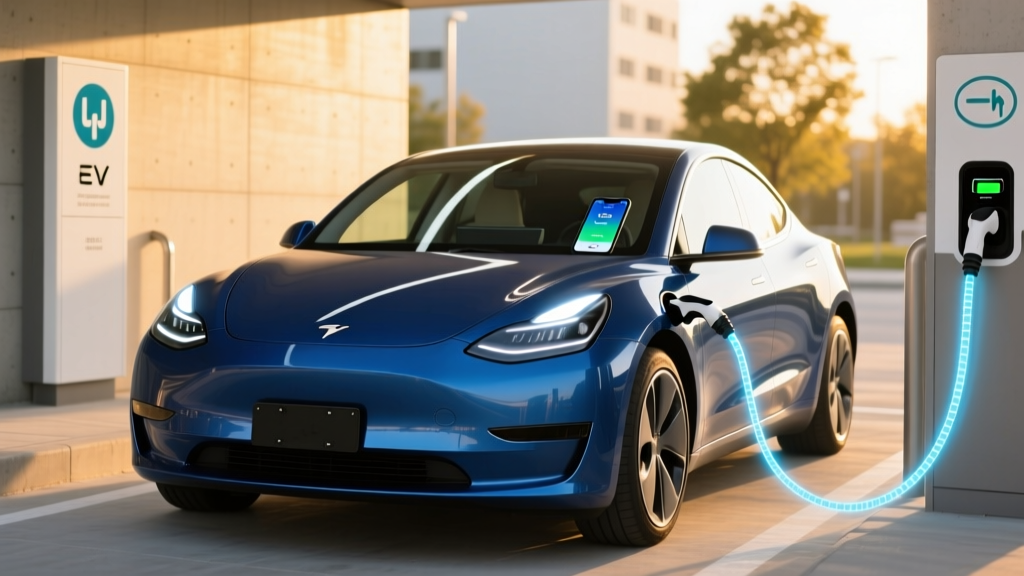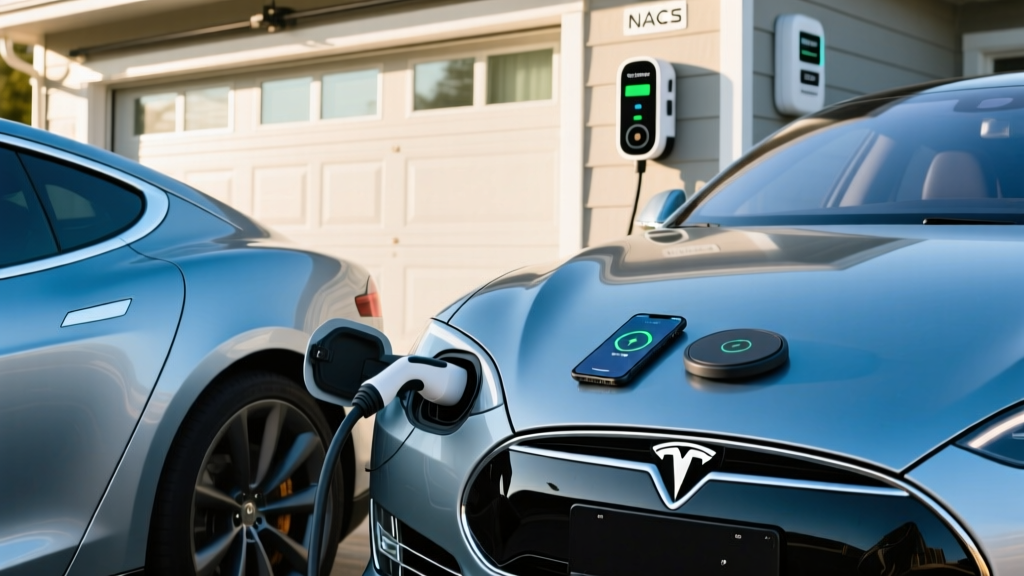
If you've searched "tesla charging type" while researching an EV purchase, you've likely hit a wall of connector acronyms: NACS, CCS1, CHAdeMO, J1772. The confusion is understandable. For over a decade, Tesla used a proprietary connector that no other automaker adopted. Then, starting in late 2022, nearly every major manufacturer committed to adopting Tesla's North American Charging Standard (NACS) for their future EVs. By 2026, NACS has become the de facto charging connector in North America — but the transition is still playing out across different model years, adapters, and public networks.
This guide breaks down exactly what the Tesla charging type is, how it compares to competing standards, what you need for home installation, and what charging actually costs per mile in real-world driving. We'll cover the physics (kW vs kWh), the economics (install costs, electricity rates), and the practical realities (panel upgrades, charge-curve taper) that most buying guides gloss over.
Understanding the Tesla Charging Type: NACS vs CCS1 vs CHAdeMO
The Tesla charging connector — officially called the North American Charging Standard (NACS) since Tesla open-sourced its design in November 2022 — is a compact, single-connector system that handles both AC Level 2 charging and DC fast charging through the same port. This is its key advantage over the Combined Charging System (CCS1), which uses a larger, two-part connector with separate pins for AC and DC.
Here's how the three North American connector types break down for the 2026 model year:
| Connector | Used By | AC + DC in One Port? | Adapter Needed? |
|---|---|---|---|
| NACS (Tesla) | Tesla (all models), Ford (2025+), GM (2025+), Rivian (2025+), Volvo/Polestar (2025+), Hyundai/Kia (2026+), BMW (2026+) | Yes | CCS1→NACS adapter for older non-Tesla EVs at Superchargers |
| CCS1 | Most pre-2025 non-Tesla EVs (VW ID.4, older Mustang Mach-E, Hyundai Ioniq 5 pre-2026) | No (combo connector) | NACS→CCS1 adapter ($150–$250) for Supercharger access |
| CHAdeMO | Nissan Leaf (legacy only, discontinued) | No | Limited adapter options; network shrinking |
Key takeaway for 2026: If you're buying a new EV this year, NACS is the connector you want. Most 2025-and-newer models from Ford, GM, Rivian, and Volvo ship with native NACS ports. Hyundai and Kia transitioned to NACS for 2026 models. If you own an older CCS1-equipped EV, you'll need a Tesla CCS adapter (roughly $190) to access the Supercharger network, which now welcomes non-Tesla vehicles at many locations.
kW (kilowatts) = power, or the rate of charging. Think of it as water flow rate from a hose. A 250 kW DC fast charger delivers energy faster than a 50 kW charger.
kWh (kilowatt-hours) = energy, or battery capacity. Think of it as the size of the water tank. A Tesla Model Y Long Range has a ~75 kWh usable battery.
Charging at 11.5 kW (Level 2) for 8 hours adds ~92 kWh — more than enough to fully refill most EV batteries overnight.
Charging Levels Explained: Speeds, kW, and Miles Per Hour
Every EV charges at one of three levels. The Tesla charging type (NACS) supports all three, which is part of why the standard gained such rapid industry adoption.
| Level | Voltage | Power (kW) | Miles of Range Per Hour | Best For | 10–80% Time (75 kWh battery) |
|---|---|---|---|---|---|
| Level 1 | 120V AC | 1.0–1.4 kW | 3–5 mi/hr | Overnight trickle, PHEVs, emergency | ~45–50 hours |
| Level 2 | 240V AC | 7.2–19.2 kW | 25–75 mi/hr | Daily home charging, workplaces | 4–8 hours |
| DC Fast | 400–800V DC | 50–350 kW | 150–1,000+ mi/hr | Road trips, highway corridors | 15–40 minutes |
Real-world nuance on DC fast charging: That "350 kW peak" number is not sustained. EV charging follows a curve — the battery charges fastest between roughly 10% and 50% State of Charge (SoC), then tapers significantly above 80% to protect battery health. A Tesla Model 3 Long Range at a V3 Supercharger (250 kW peak) might sustain 200+ kW from 10–40% SoC, drop to ~100 kW by 60%, and trickle to under 40 kW past 85%. This is why manufacturers quote "10–80%" times rather than 0–100%.
Level 2 is where most EV owners live. Over 80% of EV charging happens at home, and a properly installed Level 2 charger refills virtually any EV overnight. A Tesla Wall Connector at 48 amps (11.5 kW on a 60-amp circuit) adds roughly 44 miles of range per hour — meaning an 8-hour session restores about 350 miles, exceeding the EPA range of most EVs on the market.
Home Charger Installation: Electrical Requirements, Costs, and Panel Upgrades
Installing a Level 2 home charger isn't plug-and-play for most homes. The electrical requirements are significant, and costs vary enormously depending on your home's age, panel capacity, and the distance from your electrical panel to the charging location.
Electrical Requirements for Level 2 Charging
A typical Level 2 home charger runs on 240V AC (the same voltage as your electric dryer or oven) and draws between 16 and 48 amps. Here's what that means for your electrical system:
- 16-amp charger (3.8 kW): Requires a dedicated 20-amp circuit. Works on most existing panels. Adds ~15 miles of range per hour.
- 32-amp charger (7.7 kW): Requires a dedicated 40-amp circuit. Common for older homes with 100-amp service. Adds ~30 miles per hour.
- 48-amp charger (11.5 kW): Requires a dedicated 60-amp circuit. Ideal for most EVs. Adds ~44 miles per hour. May require panel upgrade in older homes.
- 80-amp charger (19.2 kW): Requires a dedicated 100-amp circuit. Maximum Level 2 speed (supported by Tesla Model S/X and some 2026 trucks). Almost certainly requires a panel upgrade and possibly a service upgrade from the utility.
NEC code requirement: Under the National Electrical Code (NEC 2023/2026), EV chargers are considered continuous loads, meaning the circuit must be rated at 125% of the charger's maximum draw. A 48-amp charger needs a 60-amp breaker — not a 50-amp breaker.
Installation Cost Breakdown
| Component | Simple Install (panel nearby) | Standard Install (50–80 ft run) | Complex Install (panel upgrade needed) |
|---|---|---|---|
| Level 2 charger hardware | $400–$600 | $400–$600 | $400–$600 |
| Electrician labor | $300–$500 | $600–$1,200 | $1,500–$3,000 |
| Electrical permit | $50–$150 | $50–$200 | $100–$300 |
| Panel upgrade (if needed) | — | — | $1,500–$4,000 |
| Conduit, wiring, misc. | $50–$100 | $200–$500 | $300–$800 |
| Total | $800–$1,350 | $1,250–$2,500 | $3,800–$8,700 |
Panel upgrade reality check: Homes built before 1990 often have 100-amp or even 60-amp electrical service. Adding a 60-amp EV circuit to a maxed-out 100-amp panel isn't safe or code-compliant. You'll need a panel upgrade to 200 amps — and in some cases, your utility may need to upgrade the service drop to your home. This is the single biggest variable in installation cost, and it's why you should get a licensed electrician's assessment before purchasing a charger. Some utilities offer free or discounted panel assessments.
- Dedicated circuit: Your EV charger must have its own dedicated breaker — it cannot share a circuit with other appliances.
- GFCI protection: NEC 2023/2026 requires GFCI (Ground Fault Circuit Interrupter) protection for all EV charging outlets. Hardwired chargers with built-in GFCI may satisfy this requirement.
- Outdoor rating: If installing outdoors, use a NEMA 4-rated (weatherproof) enclosure or a hardwired charger rated for outdoor use. The Tesla Wall Connector is rated for indoor and outdoor installation.
- Permit required: Virtually all jurisdictions require an electrical permit for EV charger installation. Unpermitted work can void home insurance and cause issues at sale time.
Charging Cost Per Mile: Home vs Public vs Gas
The economics of EV charging depend heavily on where you charge. Home charging on a residential rate is dramatically cheaper than public DC fast charging — and both are typically cheaper than gasoline on a per-mile basis.
| Scenario | Rate | Cost to Add 200 Miles* | Cost Per Mile |
|---|---|---|---|
| Home (off-peak, utility rate) | $0.09/kWh | $5.40 | $0.027 |
| Home (average residential) | $0.16/kWh | $9.60 | $0.048 |
| Public Level 2 (ChargePoint, EVgo) | $0.30–$0.45/kWh | $18–$27 | $0.09–$0.135 |
| DC Fast (Tesla Supercharger) | $0.28–$0.40/kWh | $17–$24 | $0.085–$0.12 |
| DC Fast (Electrify America) | $0.35–$0.55/kWh | $21–$33 | $0.105–$0.165 |
| Gas car (28 MPG avg, $3.40/gal) | $3.40/gallon | $24.29 | $0.121 |
*Based on 3.0 miles per kWh (typical for a mid-size EV like Tesla Model Y or Ford Mustang Mach-E). Actual efficiency varies by model, temperature, and driving style. Source: fueleconomy.gov
The bottom line: If you charge at home on an off-peak utility rate, you'll pay roughly 3–5 cents per mile — about one-quarter the cost of gasoline. Even public DC fast charging at $0.35/kWh undercuts gas on a per-mile basis for most vehicles. The savings are largest for high-mileage drivers and those with access to cheap home electricity.
However, if you rely exclusively on public DC fast charging at premium rates ($0.50+/kWh), your per-mile cost can actually exceed that of a fuel-efficient hybrid. This is why home charging access remains the single most important factor in EV ownership economics.
Equipment Recommendations: Best Level 2 Chargers for Tesla and NACS-Equipped EVs
With NACS now the dominant standard, charger manufacturers have released native NACS hardware. Here are our top picks for 2026, based on power output, build quality, smart features, and real-world reliability:
🏆 Best Overall: Tesla Wall Connector
- Power: Up to 11.5 kW (48A)
- Connector: Native NACS
- Cable length: 24 ft
- Smart features: Wi-Fi, OTA updates, load sharing (pair two units on one circuit), power-sharing between vehicles
- Price: ~$475
- Best for: Tesla owners and NACS-equipped EVs; cleanest integration with Tesla app
🔧 Best Universal: ChargePoint Home Flex
- Power: Up to 12 kW (50A), adjustable from 16A–50A
- Connector: Available in NACS or J1772 (with NACS adapter)
- Cable length: 23 ft
- Smart features: Wi-Fi, scheduling, Alexa/Google integration, detailed energy tracking in app
- Price: ~$550–$650 (NACS version)
- Best for: Multi-EV households, renters who may move (amperage adjustable to fit available circuits)
💰 Best Budget: Emporia Level 2 Charger
- Power: Up to 11.5 kW (48A)
- Connector: J1772 (NACS adapter required for Tesla) or native NACS (new 2025/2026 model)
- Cable length: 24 ft
- Smart features: Wi-Fi, solar integration (pairs with Emporia Vue energy monitor), scheduling
- Price: ~$350–$400
- Best for: Budget-conscious installers, solar-panel owners wanting charge-on-excess-solar features
🔌 Best Portable: Tesla Mobile Connector
- Power: Up to 7.7 kW (32A) with NEMA 14-50 adapter; 1.4 kW (12A) with standard 120V adapter
- Connector: Native NACS
- Cable length: 20 ft
- Smart features: None (no Wi-Fi or scheduling)
- Price: ~$300 (included with some Tesla models)
- Best for: Backup charger, travel, renters who can't hardwire a unit; pair with a NEMA 14-50 outlet for Level 2 speeds
Hardwired vs plug-in: Chargers rated above 40 amps should be hardwired (directly connected to your panel wiring) rather than plugged into a NEMA 14-50 outlet, which is rated for 50 amps continuous but can overheat with sustained 48-amp draws. The Tesla Wall Connector and ChargePoint Home Flex both support hardwired installation. A NEMA 14-50 outlet is fine for 32-amp portable chargers and gives you flexibility to unplug and travel.
Public Charging Networks: Where the Tesla Charging Type Works in 2026
The Tesla Supercharger network — long the gold standard for reliability and coverage — now serves non-Tesla EVs at thousands of stations across North America. As of early 2026, Tesla operates over 6,500 Supercharger stations with roughly 65,000 individual stalls in North America, with a growing share equipped with the Magic Dock (a built-in CCS1 adapter) or designated as "Open to Non-Tesla EVs" in the Tesla app.
Here's how the public charging landscape looks for each connector type:
- NACS-equipped EVs (Tesla, 2025+ Ford/GM/Rivian/Volvo, 2026+ Hyundai/Kia/BMW): Full access to the Supercharger network natively. Also compatible with Electrify America, EVgo, and ChargePoint stations that have added NACS cables (increasingly common in 2025–2026).
- CCS1-equipped EVs (pre-2025 models): Access Superchargers via Tesla's CCS adapter (~$190) at participating stations. Full access to Electrify America, EVgo, ChargePoint, and other CCS networks.
- CHAdeMO (Nissan Leaf legacy): Network coverage is shrinking rapidly. Electrify America has phased out CHAdeMO connectors at most new stations. Plan road trips carefully.
Charging-curve reality on road trips: When planning a Supercharger stop, don't plan around peak kW — plan around the 10–80% time. A Tesla Model Y Long Range (75 kWh battery) at a V3 Supercharger (250 kW peak) typically charges from 10% to 80% in about 25–28 minutes. A Model 3 Long Range with the newer architecture can do it in roughly 18–22 minutes at a V4 Supercharger stall. Always precondition your battery (the car does this automatically when you navigate to a Supercharger) to hit peak charge rates.
Federal Tax Credit for Home Charging Equipment (2026)
The IRS §30C Alternative Fuel Vehicle Refueling Property Credit can offset 30% of home EV charger equipment and installation costs, up to $1,000. However, eligibility depends on several factors:
- The charger must be installed at your primary residence.
- Your home must be located in an eligible census tract (low-income or non-urban area — check the IRS eligibility tool or Argonne National Lab's mapping tool).
- The credit covers both the charger hardware and installation labor/electrical work.
- Maximum credit is $1,000 for residential installations.
- This is a non-refundable credit — it reduces your tax liability but won't generate a refund beyond what you owe.
Consult a tax professional to confirm eligibility, as census-tract rules and IRS guidance can change year to year.
Frequently Asked Questions
How much does it cost to install a home EV charger?
A straightforward Level 2 installation (panel nearby, no upgrade needed) typically costs $800–$1,350 including the charger, electrician labor, and permit. A standard install with a 50–80 foot wire run costs $1,250–$2,500. If your home needs a 200-amp panel upgrade, expect $3,800–$8,700 total. Always get a site assessment from a licensed electrician before purchasing equipment.
How fast will each charging level add range?
Level 1 (120V) adds 3–5 miles per hour — suitable only for PHEVs or emergency top-offs. Level 2 (240V, 48A) adds roughly 44 miles per hour, fully recharging most EVs overnight. DC fast charging (150–350 kW) can add 150–250+ miles in 15–25 minutes, depending on the vehicle's charge curve and battery size.
Which connector and charger is compatible with my EV?
Check your vehicle's charge port. If it's a Tesla or a 2025+ model from Ford, GM, Rivian, Volvo, or Polestar, you have NACS and can use any NACS charger natively. If your EV has CCS1 (most pre-2025 non-Tesla models), you'll need a CCS-to-NACS adapter (~$150–$250) for Supercharger access. CHAdeMO vehicles (legacy Nissan Leaf) have limited and shrinking public charging options.
How much does charging cost per mile vs gas?
Home charging at average residential rates ($0.16/kWh) costs roughly $0.048 per mile for a typical EV — about 60% less than a 28 MPG gas car at $3.40/gallon ($0.121/mile). Off-peak home rates ($0.09/kWh) drop that to under 3 cents per mile. Public DC fast charging at $0.35–$0.45/kWh costs roughly $0.09–$0.14 per mile, still competitive with gasoline for most vehicles.
What electrical upgrades might I need?
Homes with 200-amp service and available breaker slots typically need no upgrade for a 48-amp Level 2 charger. Homes with 100-amp service — common in pre-1990 construction — may need a panel upgrade ($1,500–$4,000) to safely add a 60-amp EV circuit. In rare cases, the utility service drop itself must be upgraded, adding $1,000–$3,000. A load calculation by a licensed electrician is the only way to know for certain.
Can I use a Tesla Supercharger with a non-Tesla EV?
Yes — if your EV has a native NACS port (2025+ Ford, GM, Rivian, Volvo, Polestar; 2026+ Hyundai, Kia, BMW) or if you use a Tesla CCS adapter at participating Supercharger stations. Not all Supercharger stalls are open to non-Tesla vehicles yet, but coverage is expanding. Use the Tesla app (available to non-Tesla owners) to check station availability and initiate charging sessions.