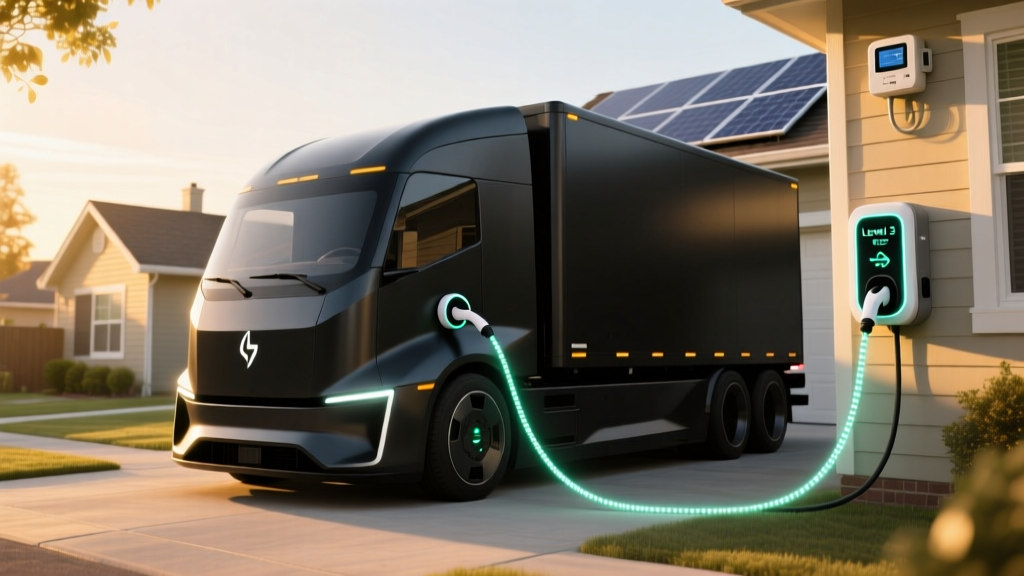
Electric pickup trucks like the Ford F-150 Lightning, Rivian R1T, and Chevrolet Silverado EV have pushed battery capacities well past 130 kWh, making charging speed and infrastructure a make-or-break ownership factor. Meanwhile, Purdue University researchers have been developing dynamic wireless charging systems designed to power electric trucks and heavy-duty vehicles while they drive. That research could reshape how commercial fleets charge, but for today's EV truck owner, the practical reality still comes down to home Level 2 installations, public DC fast charging networks, and understanding exactly what your electrical panel can handle.
This guide bridges the gap between Purdue's forward-looking electric truck charging research and the concrete numbers you need right now: kW charge rates, installation costs, connector compatibility, and per-mile charging costs compared to gas.
Purdue's Dynamic Wireless Charging: What the Research Shows
Purdue's Center for Roadway Energy Sustainability and Resilience has been testing in-roadway wireless charging — embedding transmitter coils into highway segments that transfer energy to receiver coils mounted on electric vehicles as they pass overhead. The target application is Class 8 semi-trucks and heavy-duty commercial EVs that carry enormous battery packs (often 300-600 kWh) and cannot afford extended downtime at static chargers.
In laboratory testing, Purdue's system has demonstrated wireless power transfer at rates up to 200 kW across an air gap, with efficiency exceeding 90%. The long-term vision: electrified highway corridors where trucks charge continuously at highway speed, reducing the battery capacity each truck needs and eliminating depot charging bottlenecks.
For consumer electric truck owners, this research matters as a signal of where high-power charging infrastructure is heading. But until dynamic wireless charging reaches public roads — a timeline measured in decades, not years — your charging strategy depends on the three established levels available today.
Charging Levels Explained: Speeds in kW and Miles Per Hour
The single most important distinction in EV charging is between kW (kilowatts — the rate of power delivery, like water pressure) and kWh (kilowatt-hours — the total energy transferred, like gallons in a tank). A 19.2 kW Level 2 charger delivers 19.2 kWh of energy in one hour of charging. Confusing these two will lead to wildly wrong expectations.
| Level | Voltage | Max Power (kW) | Miles of Range Per Hour | Typical Use Case |
|---|---|---|---|---|
| Level 1 | 120V AC | 1.2–1.9 kW | 3–5 mi/hr | Overnight trickle; PHEVs |
| Level 2 | 240V AC | 7.2–19.2 kW | 20–55 mi/hr | Home daily charging; workplace |
| DC Fast Charge | 400–800V DC | 50–350 kW | 150–700+ mi/hr | Road trips; rapid top-ups |
For a large-battery electric truck like the F-150 Lightning Extended Range (131 kWh usable), Level 1 charging is effectively useless — a full charge from empty would take over 100 hours. Level 2 at 11.5 kW (the most common home setup on a 48-amp circuit) adds roughly 30 miles per hour, meaning a 10-80% charge takes about 9-10 hours overnight. DC fast charging at the Lightning's peak rate of 150 kW can push from 10-80% in approximately 41 minutes on a compatible station.
The Chevrolet Silverado EV 4WT, with its 200+ kWh Ultium battery pack and 350 kW max DC fast charge capability, can achieve 10-80% in roughly 35-40 minutes at a 350 kW Electrify America or EVgo station — though sustained charging power tapers significantly above 80% State of Charge as the battery management system protects cell health.
Home Charger Installation: Electrical Requirements and Cost Breakdown
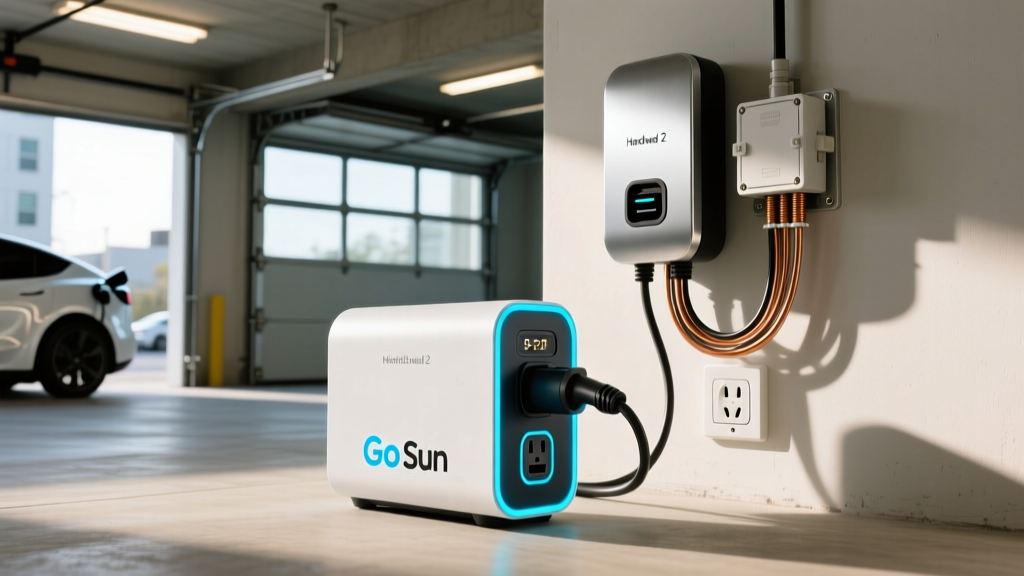
Installing a Level 2 home charger for an electric truck is not a simple plug-and-play project. Most electric trucks have batteries large enough that you want a 48-amp or higher circuit to achieve meaningful overnight charging speeds. That requires a 240V dedicated circuit — typically a NEMA 14-50 outlet or a hardwired connection — and sufficient spare capacity in your electrical panel.
Electrical Requirements
- Voltage: 240V (split-phase residential)
- Amperage: 40A circuit for a 32A charger, or 60A circuit for a 48A charger (NEC requires circuits rated 125% of continuous load)
- Dedicated circuit: Required — you cannot share this circuit with other appliances
- GFCI protection: NEC 2020/2023 requires GFCI breakers for EV outlets in garages; hardwired chargers may bypass this requirement depending on local code
- Outdoor rating: If your charger is installed outside, both the unit and the conduit/wiring must be rated for wet locations (NEMA 4 or IP55 minimum)
Panel Upgrade Considerations
This is the cost factor most guides gloss over. If your home has a 100-amp electrical panel — common in homes built before the 1990s — you likely do not have enough spare capacity to add a 60-amp dedicated circuit for EV charging. A panel upgrade to 200 amps typically costs $1,500-$3,000 before the charger circuit itself is even run. Some older homes with 60-amp service may need a full service upgrade at $3,000-$5,000+.
Even with a 200-amp panel, a licensed electrician must perform a load calculation (NEC Article 220) to verify you can safely add a 40-60 amp circuit without overloading the service. Running electric heat, a dryer, and an electric range simultaneously while charging an EV truck can push a 200-amp panel to its limit.
| Cost Component | Typical Range | Notes |
|---|---|---|
| Level 2 Charger Equipment | $350–$750 | 32A–48A smart Wi-Fi chargers |
| Electrician Labor (standard install) | $500–$1,500 | Varies by run length, conduit, panel proximity |
| Electrical Permit | $50–$250 | Required in most jurisdictions |
| Panel Upgrade (if needed) | $1,500–$3,500 | 100A → 200A service upgrade |
| Total (no panel upgrade) | $900–$2,500 | Most modern 200A-panel homes |
| Total (with panel upgrade) | $2,400–$6,250 | Older homes with 100A service |
Always hire a licensed electrician and pull the required permit. Unpermitted electrical work can void your homeowner's insurance and create fire risk — particularly important with the sustained high-current draw of nightly EV truck charging.
Connector Compatibility: NACS, CCS, and CHAdeMO for Electric Trucks
The connector landscape shifted dramatically in 2024-2025 when Ford, GM, Rivian, and most other automakers adopted Tesla's North American Charging Standard (NACS) for new vehicles. By 2026, the situation for electric truck buyers is as follows:
| Electric Truck | Native Connector | DC Fast Network Access | Adapter Needed? |
|---|---|---|---|
| Ford F-150 Lightning (2025+) | NACS | Tesla Supercharger + third-party | CCS adapter included for legacy stations |
| Ford F-150 Lightning (2022–2024) | CCS1 | Electrify America, EVgo, etc. | NACS adapter needed for Superchargers |
| Rivian R1T (2025+) | NACS | Tesla Supercharger + third-party | CCS adapter for legacy stations |
| Rivian R1T (2022–2024) | CCS1 | Electrify America, EVgo, etc. | NACS adapter needed for Superchargers |
| Chevrolet Silverado EV | NACS | Tesla Supercharger + third-party | CCS adapter for legacy stations |
| Tesla Cybertruck | NACS | Tesla Supercharger (full access) | None |
If you own a 2022-2024 CCS-equipped truck, Ford and Rivian both sell or provide NACS adapters that grant access to Tesla's Supercharger network — the largest and most reliable DC fast charging network in North America with over 25,000 stalls. For home Level 2 charging, the connector difference is less critical: all Level 2 chargers sold today either come with a NACS plug or a J1772 plug (which works with CCS vehicles natively and NACS vehicles via a simple adapter).
Charging Cost Per Mile: Electric Trucks vs. Gas Trucks
Electric trucks carry massive batteries, which means charging costs are higher than a compact EV — but still typically lower than fueling a comparable gas truck. Here's how the math works with real 2026 electricity and fuel prices.
| Scenario | Rate | Cost to Add 200 mi (F-150 Lightning) | Cost Per Mile |
|---|---|---|---|
| Home Level 2 (off-peak utility rate) | $0.09/kWh | $6.30 | $0.032/mi |
| Home Level 2 (national avg residential) | $0.17/kWh | $11.90 | $0.060/mi |
| Public Level 2 (ChargePoint, etc.) | $0.25–$0.35/kWh | $17.50–$24.50 | $0.088–$0.123/mi |
| DC Fast Charge (EA, EVgo) | $0.35–$0.55/kWh | $24.50–$38.50 | $0.123–$0.193/mi |
| Gas Truck (F-150 3.5L EcoBoost, 20 MPG) | $3.40/gal | $34.00 | $0.170/mi |
The F-150 Lightning achieves approximately 2.0 kWh/mile in mixed driving (per EPA data), which is the figure used above. For home charging on an off-peak utility rate, you'll spend roughly $0.03/mile — about one-fifth the fuel cost of a gas F-150. Even at national average residential rates, home charging runs about $0.06/mile, still roughly a third of gas costs.
The advantage narrows on public DC fast chargers. At $0.48/kWh (common at Electrify America without a subscription plan), charging an electric truck can actually exceed the per-mile cost of a gas truck. This is why home charging access is economically essential for electric truck ownership — public DC fast charging should be reserved for road trips, not daily use.
Also factor in that some utilities offer dedicated EV time-of-use (TOU) rates with off-peak pricing as low as $0.05-$0.08/kWh between 10 PM and 6 AM. Setting your charger's schedule to charge during these windows maximizes savings.
Equipment Recommendations: Best Home Chargers for Electric Trucks in 2026
For electric trucks with 100+ kWh batteries, prioritize chargers that deliver at least 11.5 kW (48 amps on a 60-amp circuit). Faster Level 2 charging means you can fully replenish a depleted truck battery overnight instead of needing two nights. Here are three proven options:
ChargePoint Home Flex (NACS or J1772)
- Power Output: Up to 12 kW (50A circuit, 40A continuous) — configurable down to 16A
- Cable Length: 23 feet
- Smart Features: Wi-Fi, Alexa, scheduled charging, energy tracking via app
- Connector: Available in NACS or J1772 at purchase
- Price: ~$599 (NACS) / ~$549 (J1772)
- Best For: Flexible amperage adjustment for older panels; UL-listed for indoor/outdoor
Grizzl-E Smart (NACS or J1772)
- Power Output: Up to 11.5 kW (60A circuit, 48A continuous)
- Cable Length: 24 feet
- Smart Features: Wi-Fi, OCPP-compatible, works with multiple energy management apps
- Connector: NACS or J1772 options
- Price: ~$499
- Best For: Cold-climate durability (tested to -40°F); IP67 waterproof; Canadian-built
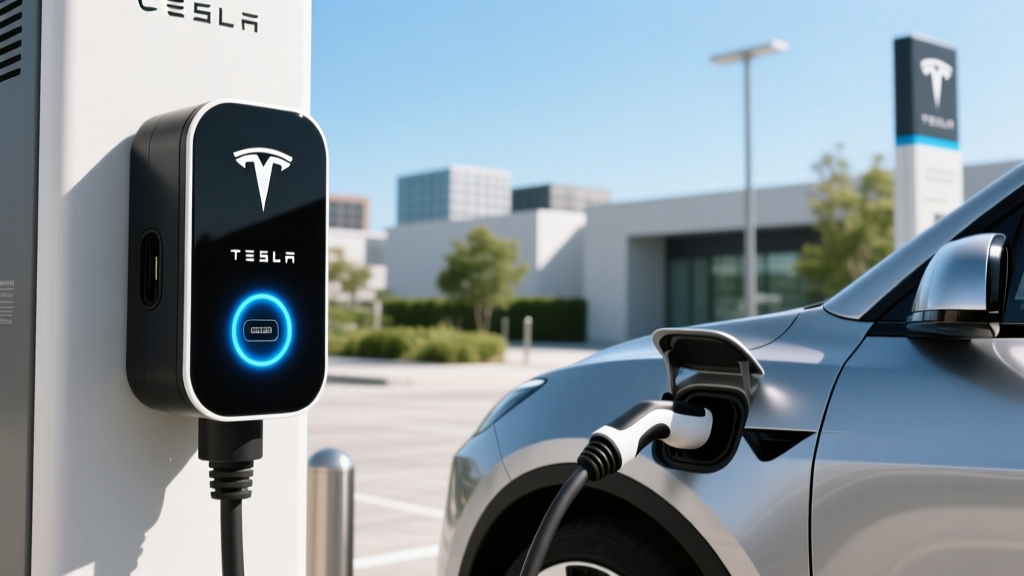
Tesla Wall Connector (NACS native)
- Power Output: Up to 11.5 kW (60A circuit, 48A continuous)
- Cable Length: 24 feet
- Smart Features: Wi-Fi, over-the-air updates, power sharing (multiple units on one circuit), Tesla app integration
- Connector: NACS native; J1772 adapter available
- Price: ~$450
- Best For: Tesla Cybertruck and NACS-native trucks; power-sharing feature for two-vehicle garages
For homes with limited panel capacity, the ChargePoint Home Flex's ability to dial down to 16A (3.8 kW) on a 20-amp circuit is genuinely useful — you still add roughly 12 miles per hour, which covers most daily driving with overnight charging.
Charging Time Examples for Common Electric Truck Batteries
Real-world charging times depend on the charge curve: DC fast chargers deliver peak kW only at low State of Charge (typically 10-40%), then taper progressively to protect the battery. Here are realistic 10-80% times for popular electric trucks at various charger types:
| Vehicle (Battery kWh) | 120V Level 1 (1.4 kW) | 240V Level 2 (11.5 kW) | 150 kW DCFC | 350 kW DCFC |
|---|---|---|---|---|
| Ford F-150 Lightning Std (98 kWh) | ~65 hrs | ~7 hrs | ~38 min | N/A (150 kW peak) |
| Ford F-150 Lightning Ext (131 kWh) | ~88 hrs | ~9.5 hrs | ~41 min | N/A (150 kW peak) |
| Rivian R1T Dual Max (149 kWh) | ~100 hrs | ~11 hrs | ~45 min | ~35 min (220 kW peak) |
| Silverado EV 4WT (~200 kWh) | ~135 hrs | ~15 hrs | ~65 min | ~38 min (350 kW peak) |
| Tesla Cybertruck AWD (123 kWh) | ~83 hrs | ~9 hrs | ~35 min | N/A (250 kW peak) |
A critical takeaway: none of these trucks can accept the full 350 kW that the fastest Electrify America or EVgo stations can deliver — except the Silverado EV. The F-150 Lightning, for example, peaks at 150 kW on DC fast charge regardless of the station's capability. You won't damage anything plugging into a 350 kW stall, but you'll only receive the truck's maximum accepted rate.
Safety and Electrical Code Considerations
EV charging draws sustained high current for hours — a duty cycle unlike anything else in a typical home. Key safety requirements include:
- Dedicated circuit: NEC Article 625 requires EV charging equipment to be on its own dedicated branch circuit. No sharing with outlets, lighting, or other appliances.
- GFCI protection: NEC 2020 added GFCI requirements for 125V and 250V receptacles used for EV charging in garages. This can cause nuisance tripping with some chargers — a hardwired installation avoids this issue.
- Outdoor installations: Chargers mounted outside must carry a NEMA 4 or IP55+ rating. All outdoor conduit and junction boxes must be rated for wet locations.
- Wire gauge: A 48-amp continuous load on a 60-amp circuit requires minimum 4 AWG copper wire (THHN in conduit) or 3 AWG for NM-B cable. Undersized wiring creates fire risk under sustained load.
- Load management: If your panel is near capacity, consider an energy management system (like the Emporia VUE or Span smart panel) that dynamically limits charger draw based on real-time household consumption.
The NHTSA notes that properly installed EV charging equipment carries minimal fire risk, but emphasizes following manufacturer installation instructions and local electrical codes without exception.
How Purdue's Research Connects to Consumer Charging Today
Purdue's dynamic wireless charging research targets a specific problem: heavy-duty electric trucks with enormous batteries (200-600 kWh) that face prohibitively long static charging times. A 500 kWh semi-truck battery charging at 350 kW still needs over an hour for a 10-80% fill. Embedding charging into roadway infrastructure would let these trucks charge while moving, shrinking the battery each truck needs and keeping freight flowing.
For consumer electric truck owners, the near-term implications are indirect but real. The high-power charging infrastructure being developed to support Purdue's vision — megawatt-scale chargers, advanced grid integration, smart load management — will eventually trickle down to consumer-facing charging networks. The 350 kW DC fast chargers now appearing along interstates are early beneficiaries of this broader push toward high-power electric truck charging.
In the meantime, your best strategy as an electric truck owner or buyer is straightforward: invest in a quality Level 2 home installation (48 amps minimum), leverage off-peak utility rates, and use DC fast charging for road trips rather than daily top-ups.
Frequently Asked Questions
How much does it cost to install a home EV charger?
A typical Level 2 home charger installation costs $900-$2,500 when your electrical panel has sufficient capacity. This includes the charger ($350-$750), electrician labor ($500-$1,500), and permit fees ($50-$250). If your home needs a panel upgrade from 100A to 200A service, add $1,500-$3,500, bringing the total to $2,400-$6,250.
How fast will each charging level add range to my electric truck?
Level 1 (120V) adds 3-5 miles per hour — essentially useless for a 130+ kWh truck battery. Level 2 (240V, 48A) adds approximately 25-35 miles per hour depending on truck efficiency. DC fast charging at 150 kW can add 200+ miles in 30-40 minutes, though charge speed tapers above 80% SoC.
Which connector and charger is compatible with my EV truck?
2025+ Ford F-150 Lightning, Rivian R1T, Chevrolet Silverado EV, and Tesla Cybertruck all use the NACS connector. Model years 2022-2024 of the Lightning and R1T use CCS1. For home Level 2 charging, purchase a charger matching your vehicle's connector — or use the widely available NACS-to-J1772 or CCS-to-NACS adapters.
How much does charging an electric truck cost per mile vs. gas?
At home on the national average electricity rate ($0.17/kWh), an F-150 Lightning costs approximately $0.06/mile to charge — roughly one-third the $0.17/mile fuel cost of a gas F-150 at $3.40/gallon and 20 MPG. Off-peak utility rates can push home charging below $0.04/mile.
What electrical upgrades might I need for a home EV charger?
The most common upgrade is a panel capacity increase from 100A to 200A service ($1,500-$3,500). You may also need a new dedicated 60-amp circuit with appropriately sized wiring (4 AWG copper minimum for 48A continuous load), a GFCI breaker if using a receptacle, and potentially an energy management system if your panel is near its load limit. Always have a licensed electrician perform a load calculation before installation.