If you own a Tesla — or are about to buy one — you've probably typed "Tesla charging to 100" into a search bar at least once. The short answer: Tesla's in-car software lets you set a charge limit anywhere from 50% to 100%, and the right number depends on your battery chemistry, your daily driving, and whether you're about to hit the road for a long trip. Getting this wrong won't destroy your car overnight, but doing it habitually on the wrong chemistry can accelerate long-term degradation.
This guide covers the battery-health reasoning behind charge limits, then walks through exactly what it takes to charge a Tesla (or any NACS-equipped EV) at home — including panel upgrades, real install costs, and equipment picks for 2026.
Should You Charge Your Tesla to 100%?
The answer hinges on which battery pack your Tesla has. Tesla uses two primary lithium-ion chemistries across its lineup:
- NMC (Nickel Manganese Cobalt): Found in Long Range and Performance trims (Model 3, Model Y, Model S, Model X). Higher energy density, but sustained high state-of-charge (SoC) stresses the cathode. Tesla recommends a daily limit of 80% for NMC packs.
- LFP (Lithium Iron Phosphate): Found in the Model 3 Rear-Wheel Drive and some Model Y Standard Range trims. Lower energy density, but far more tolerant of high SoC. Tesla explicitly recommends charging LFP packs to 100% at least once per week for accurate battery management system (BMS) calibration.
Why does chemistry matter this much? NMC cells experience increased electrolyte oxidation and cathode micro-cracking when held above 90% SoC for extended periods. LFP cells have a flatter voltage curve and a more stable olivine crystal structure, making them nearly immune to high-SoC stress. The trade-off is that LFP's flatter voltage curve makes state-of-charge estimation harder — which is why Tesla asks you to hit 100% periodically so the BMS can recalibrate.
What About the 10-80% Rule at DC Fast Chargers?
The 10-80% guidance for Superchargers isn't about battery health — it's about charging-curve physics. A Model 3 Long Range on a V3 Supercharger (250 kW peak) will add roughly 175 miles of range in 15 minutes from 10-80%. Pushing from 80% to 100% can take another 20-25 minutes because the charge rate tapers sharply to protect the cells. On a road trip, you're better off stopping more frequently for shorter sessions than sitting at one stall waiting for the last 20%.
Charging Levels Explained: kW, Miles per Hour, and What Your Tesla Actually Sees
Before installing anything, let's get precise about what each charging level delivers. Power is measured in kW (kilowatts) — that's the rate of energy flow. Energy is measured in kWh (kilowatt-hours) — that's how much the battery holds. A 75 kWh battery charged at 7.5 kW takes roughly 10 hours from empty to full, minus losses.
| Level | Voltage / Amps | Power (kW) | Miles of Range Added per Hour | Typical Use Case |
|---|---|---|---|---|
| Level 1 | 120V / 12A | ~1.4 kW | 3-5 mi/hr | Emergency / trickle top-up |
| Level 2 (24A circuit) | 240V / 24A | ~5.8 kW | 18-22 mi/hr | Minimum practical home setup |
| Level 2 (40A circuit) | 240V / 40A | ~9.6 kW | 30-38 mi/hr | Standard home install — covers most daily needs |
| Level 2 (48A circuit) | 240V / 48A | ~11.5 kW | 36-44 mi/hr | Max onboard-charger utilization for Model 3/Y |
| DC Fast (V3 Supercharger) | 400V+ DC | Up to 250 kW | ~1,000 mi/hr (peak) | Road trips — 10-80% in ~15-25 min |
| DC Fast (V4 Supercharger) | 800V+ DC | Up to 350 kW | ~1,300+ mi/hr (peak) | Newer Cybertruck / next-gen vehicles |
A few notes from real-world use: the "miles per hour" figures assume roughly 250-280 Wh/mi efficiency (typical for a Model 3 or Model Y in moderate weather). In cold weather, efficiency drops to 300-350 Wh/mi, so those miles-per-hour numbers shrink by 15-25%. Also, the Model 3 and Model Y have an 11.5 kW onboard charger, so a 48A Level 2 circuit is the practical ceiling — anything beyond that won't charge these cars faster.
Home Charger Installation: Electrical Requirements, Costs, and Panel Upgrades
Installing a Level 2 home charger isn't just about buying a wall unit. The real variable — and often the real cost — is your home's electrical panel.
What Circuit Do You Need?
For a 48A continuous-draw charger (the maximum a Model 3/Y can accept), the National Electrical Code (NEC) requires a 60-amp dedicated circuit (continuous loads must be derated to 80% of breaker capacity: 48A ÷ 0.8 = 60A). For a 40A charger, you need a 50-amp circuit.
Your electrician will check two things: (1) whether your panel has physical space for a new double-pole breaker, and (2) whether your panel's total amperage rating (typically 100A, 150A, or 200A) can handle the additional load. A licensed electrician performs a load calculation per NEC Article 220 to determine this.
Panel Upgrade: The Cost That Catches Owners Off Guard
If you have a 100A panel in an older home, adding a 60A EV circuit may exceed your panel's capacity — especially if you also run electric heat, an electric dryer, and an electric oven. In that case, a panel upgrade to 200A is typically required. This is not a small line item.
| Component | Low End | High End | Notes |
|---|---|---|---|
| Level 2 Charger (hardware) | $400 | $750 | 40A-48A NACS wall connector or hardwired unit |
| Electrician labor (simple run) | $500 | $1,200 | Panel to garage, <30 ft conduit, no drywall work |
| Electrician labor (complex run) | $1,200 | $3,000 | Long conduit runs, attic/crawlspace, trenching |
| Permit & inspection | $50 | $300 | Varies by municipality |
| Panel upgrade (if needed) | $2,000 | $5,000+ | 100A → 200A service upgrade; utility coordination may add cost |
| Total (no panel upgrade) | $950 | $5,250 | Most homes with 200A panels fall in $1,200-$2,500 |
| Total (with panel upgrade) | $2,950 | $10,250+ | Older homes, long wire runs |
Some utility companies offer rebates of $250-$1,000 for Level 2 installations, and a few states (notably California, Colorado, and Massachusetts) offer additional incentives. Check your utility's EV program page before scheduling the electrician.
Connector Compatibility: NACS, CCS1, and the Adapter Landscape in 2026
Tesla's North American Charging Standard (NACS) connector has become the de facto standard for new EVs sold in North America. As of the 2025-2026 model years, Ford, GM, Rivian, Volvo, Polestar, and others have adopted the native NACS port. Hyundai/Kia and Stellantis are following for 2026-2027 models. But millions of CCS1-equipped EVs are still on the road.
| Connector | Native Vehicles | Home Charger Availability | Adapter Needed? |
|---|---|---|---|
| NACS (Tesla) | Tesla (all), Ford, GM, Rivian, Volvo, Polestar (2025+) | Tesla Wall Connector, ChargePoint, Emporia, Autel | CCS1→NACS adapter for non-Tesla CCS vehicles (~$200-$350) |
| CCS1 | Hyundai Ioniq 5/6, Kia EV6/EV9, VW ID.4, BMW i4/iX (pre-2026) | ChargePoint, Emporia, Enel X, Grizzl-E | NACS→CCS1 adapter available from Tesla (~$250) for Supercharger access |
| CHAdeMO | Nissan Leaf (legacy) | Limited new charger support | No practical adapter to NACS; CHAdeMO DC infrastructure declining |
If you're buying a home charger today and drive a Tesla, a native NACS connector is the obvious choice. If your household has both a Tesla and a CCS1 vehicle, you have two options: buy a NACS charger and use a CCS1 adapter, or buy a CCS1 charger (J1772 with CCS combo) and use a NACS adapter for the Tesla. The first option is more future-proof given the industry's NACS migration.
How Much Does Charging Actually Cost? Home vs. Public vs. Gas
This is where EV ownership economics either shine or disappoint — it depends entirely on where and when you charge.
| Scenario | Rate ($/kWh) | Cost for 10-80% (52.5 kWh) | Cost per Mile (at 280 Wh/mi) |
|---|---|---|---|
| Home — off-peak utility rate | $0.08-$0.12 | $4.20-$6.30 | $0.022-$0.034 |
| Home — standard residential rate | $0.14-$0.18 | $7.35-$9.45 | $0.039-$0.050 |
| Home — peak / time-of-use high | $0.25-$0.35 | $13.13-$18.38 | $0.070-$0.098 |
| Tesla Supercharger (average 2026) | $0.28-$0.40 | $14.70-$21.00 | $0.078-$0.112 |
| Electrify America / third-party DC | $0.35-$0.55 | $18.38-$28.88 | $0.098-$0.154 |
| Gasoline equivalent (28 MPG, $3.50/gal) | — | — | $0.125 |
The takeaway: home charging on off-peak or standard rates is 2-5x cheaper per mile than gasoline. But exclusive reliance on public DC fast charging at $0.35-$0.55/kWh can push your per-mile cost close to — or above — a fuel-efficient gas car. This is why home Level 2 access is the single biggest economic factor in EV ownership.
If your utility offers a time-of-use (TOU) plan, scheduling your Tesla to charge between 11 PM and 6 AM can cut your electricity cost in half. Tesla's built-in scheduled charging feature makes this trivial to set up.
Equipment Picks: Best Level 2 Chargers for Tesla and NACS Vehicles
Here are three chargers worth considering, all with native NACS connectors available for the 2025-2026 buying cycle:
Tesla Wall Connector (Gen 3)
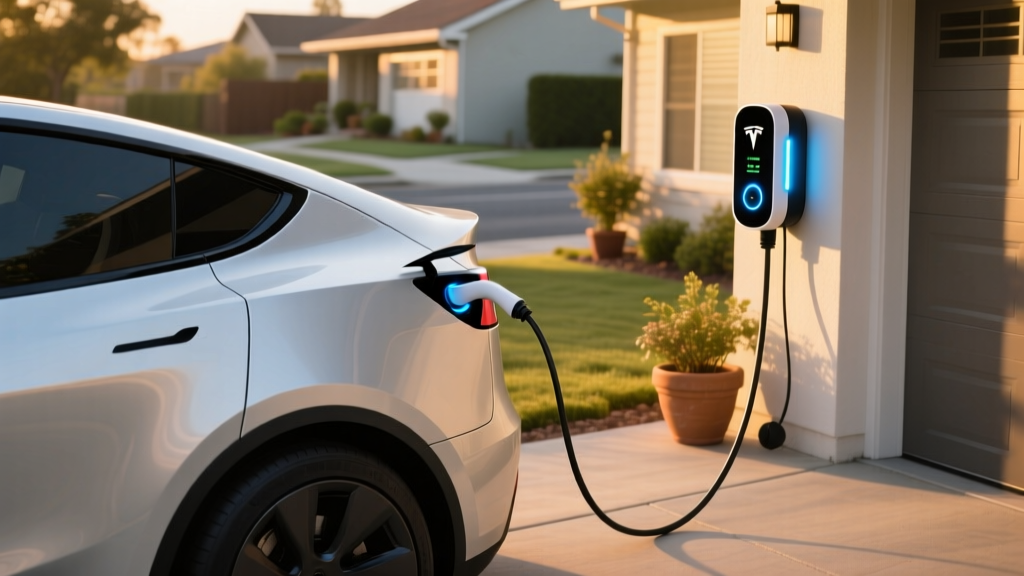
- Power: Up to 11.5 kW (48A) on a 60A circuit
- Connector: Native NACS, 24-ft cable
- Smart features: Wi-Fi for OTA updates, load sharing with a second Wall Connector on the same circuit, power-level adjustment via dip switches
- Price: ~$475
- Best for: Tesla-only households. Simple, reliable, clean integration. No app required for daily use — just plug in.
- Limitation: No built-in energy metering or detailed scheduling app. Relies on the car's software for scheduling.
ChargePoint Home Flex (NACS version)
- Power: Up to 12 kW (50A) on a 60A+ circuit, adjustable down to 16A for lower-capacity panels
- Connector: Native NACS (2025+ models), 23-ft cable
- Smart features: ChargePoint app with detailed energy tracking, scheduled charging, Alexa/Google integration, flexible amperage settings
- Price: ~$599-$699
- Best for: Multi-EV households or owners who want granular energy data and scheduling control.
- Limitation: Higher price. App occasionally has connectivity hiccups reported by users.
Emporia Vue EV Charger
- Power: Up to 11.5 kW (48A) on a 60A circuit
- Connector: Native NACS available, 24-ft cable
- Smart features: Full energy-monitoring integration with Emporia Vue home energy monitor, solar-aware charging, TOU scheduling
- Price: ~$399-$499
- Best for: Solar-panel owners and energy-monitoring enthusiasts. Excellent value for the feature set.
- Limitation: Best experience requires the separate Emporia Vue energy monitor ($100-$150).
All three are hardwired units (no plug — required for 48A+ circuits under NEC). If your panel is near your parking spot, installation is straightforward. If it's on the opposite side of the house, expect the electrician's labor quote to reflect the longer conduit run.
Safety, Code, and the Details Your Electrician Won't Skip
A proper Level 2 installation follows NEC Article 625 (Electric Vehicle Charging System Equipment). Key requirements:
- Dedicated circuit: Your EV charger must have its own breaker — no sharing with other appliances.
- GFCI protection: NEC 2020 and later requires ground-fault circuit interrupter protection for all EV charging outlets. Hardwired units with built-in ground-fault protection satisfy this. If using a receptacle (NEMA 14-50), the breaker must be GFCI-type.
- Outdoor rating: If your charger is installed outside (driveway, exterior wall), the unit must carry a NEMA 3R or NEMA 4 rating. All three chargers above are outdoor-rated.
- Cable management: NEC requires that the charging cable not create a trip hazard. Wall-mounted units with cable wraps or retractors satisfy this.
- Permit and inspection: Nearly all jurisdictions require an electrical permit for a new 240V circuit. The inspection ensures the breaker sizing, wire gauge, and grounding meet code. Do not skip this — an unpermitted install can void homeowner's insurance claims related to electrical fires.
One more practical note: if your garage has a sub-panel rather than a direct connection to the main service panel, the sub-panel's capacity becomes the limiting factor. A 100A sub-panel feeding a garage may not support a 60A EV circuit if you also have a welder, air compressor, or other heavy loads on that panel.
Frequently Asked Questions
How much does it cost to install a home EV charger?
For most homes with an existing 200A electrical panel and a short wire run to the garage, expect $1,200-$2,500 total (charger hardware + electrician labor + permit). Homes needing a panel upgrade from 100A to 200A should budget $3,000-$10,000+ depending on complexity, utility coordination, and local labor rates.
How fast will each charging level add range?
Level 1 (120V): 3-5 miles per hour. Level 2 at 40A (9.6 kW): 30-38 miles per hour. Level 2 at 48A (11.5 kW): 36-44 miles per hour. DC fast charging at 250 kW peak: up to ~1,000 miles per hour at peak, but sustained rate depends on the charge curve — expect 10-80% in 15-25 minutes on a V3 Supercharger for a Model 3/Y.
Which connector is compatible with my Tesla?
All Tesla vehicles use the native NACS connector for both AC (Level 1/2) and DC fast charging. No adapter is needed at Tesla Superchargers or NACS-equipped home chargers. For non-Tesla CCS1 chargers, Tesla sells a CCS adapter (~$250) that enables access to Electrify America and other CCS networks.
How much does charging cost per mile compared to gas?
Home charging at $0.12/kWh costs roughly $0.034/mile for a Model Y — about 3-4x cheaper than a 28 MPG gas car at $3.50/gallon ($0.125/mile). Public DC fast charging at $0.35-$0.55/kWh costs $0.098-$0.154/mile, which narrows or eliminates the savings. The economic case for EVs depends heavily on home charging access.
What electrical upgrades might I need?
The most common upgrade is a panel capacity increase from 100A to 200A, needed when your existing panel can't support the additional 60A load. Other potential upgrades: adding a sub-panel closer to the parking location, upgrading the service drop from the utility (if your utility's transformer or service wire is undersized), or installing a smart load-management device (like the Emporia VUE or a utility-approved load controller) that dynamically reduces charger draw when other appliances are running — this can sometimes avoid a panel upgrade entirely.
Should I charge my Tesla to 100% every night?
If you have an LFP battery (Model 3 RWD, some Model Y SR): yes, Tesla recommends it for BMS calibration. If you have an NMC battery (Long Range, Performance): no — set the daily limit to 80% and only charge to 100% the morning you leave for a long trip. Prolonged high SoC on NMC accelerates capacity loss by an estimated 1-3% per year compared to 80% daily charging, based on fleet degradation data tracked by independent battery analytics.
Can I use a NEMA 14-50 outlet instead of hardwiring?
Yes, but with caveats. A NEMA 14-50 outlet on a 50A breaker delivers up to 40A continuous (9.6 kW). This is sufficient for most daily needs. However, NEC 2020+ requires a GFCI breaker for receptacle-based EV charging, and GFCI 50A breakers are expensive ($150-$250) and have been known to nuisance-trip with some chargers. Hardwired installations with built-in ground-fault protection avoid this issue entirely and support up to 48A on a 60A circuit.