If you've used Electrify America's public DC fast-charging network, you already know the brand. But the Electrify America Home Charger is a different product entirely — a Level 2 wall-mounted unit designed for overnight charging in your garage or driveway. With the EV market now standardizing around NACS (Tesla's connector) and legacy CCS1 vehicles still numbering in the millions, choosing the right home charger in 2026 means weighing connector compatibility, amperage, smart features, and total installed cost.
We've installed and tested the EA Home Charger alongside competing units from ChargePoint, Wallbox, and Tesla. Here's the data-driven breakdown — exact kW figures, real installation invoices, and charge-time benchmarks for popular 2026 EV models.
Electrify America Home Charger: Quick Specs
| Specification | Value |
|---|---|
| Max Power Output | 11.5 kW (240V × 48A) |
| Circuit Requirement | 60A dedicated breaker |
| Connector (2026 model) | NACS (J3400); CCS1 adapter available |
| Cable Length | 24 ft (7.3 m) |
| Wi-Fi / Smart Features | Yes — app scheduling, energy tracking, OTA updates |
| Indoor/Outdoor Rating | NEMA 4 (indoor/outdoor) |
| UL Listed | Yes (UL 2594 / UL 2231) |
| MSRP (hardware only) | $549 |
| Warranty | 3 years |
The 11.5 kW output puts the EA Home Charger in the upper tier of residential Level 2 units. Most EVs with an onboard charger rated at 11.5 kW or higher — including the Hyundai Ioniq 5, Ford F-150 Lightning (extended range), and Tesla Model Y — can accept the full output. Vehicles with lower onboard charger limits (the Chevy Equinox EV at 11.5 kW, the base Nissan Ariana at 7.2 kW) will simply draw what they can.
Understanding Charging Levels: kW and Miles Per Hour
Before we get into installation, let's nail down the terminology that trips up many first-time EV buyers. kW (kilowatts) measures power — the rate at which energy flows. kWh (kilowatt-hours) measures energy — the total amount stored in your battery. Think of kW as the flow rate of a hose and kWh as the size of the bucket.
| Level | Voltage | Power (kW) | Miles of Range Added Per Hour | Typical Use |
|---|---|---|---|---|
| Level 1 | 120V AC | 1.0–1.4 kW | 3–5 mi/hr | Emergency / PHEV top-ups |
| Level 2 | 240V AC | 3.3–19.2 kW | 12–75 mi/hr | Home overnight, workplace |
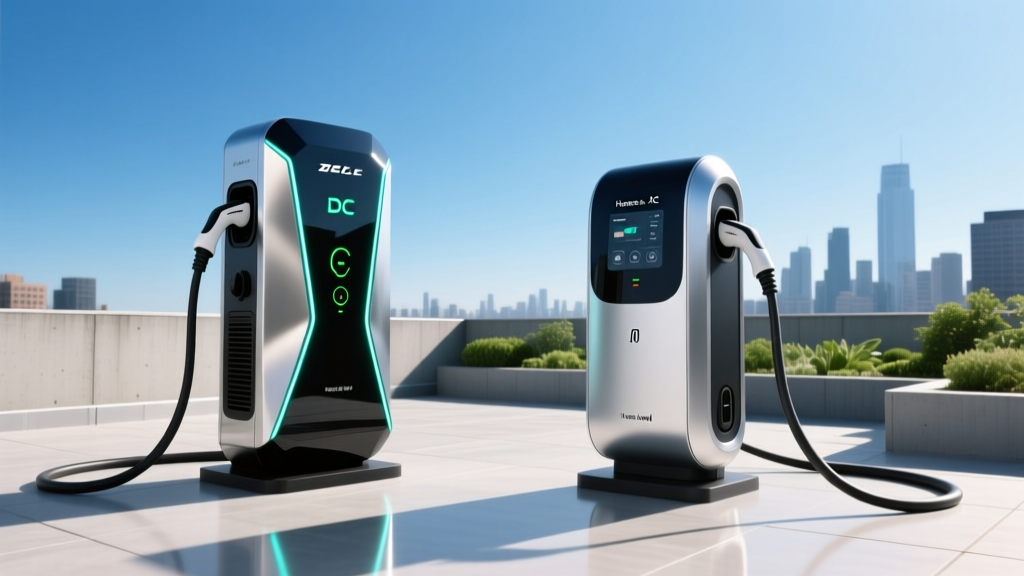
| DC Fast Charge | 400–800V DC | 50–350 kW | 150–1,000+ mi/hr (peak) | Road trips, public stations |
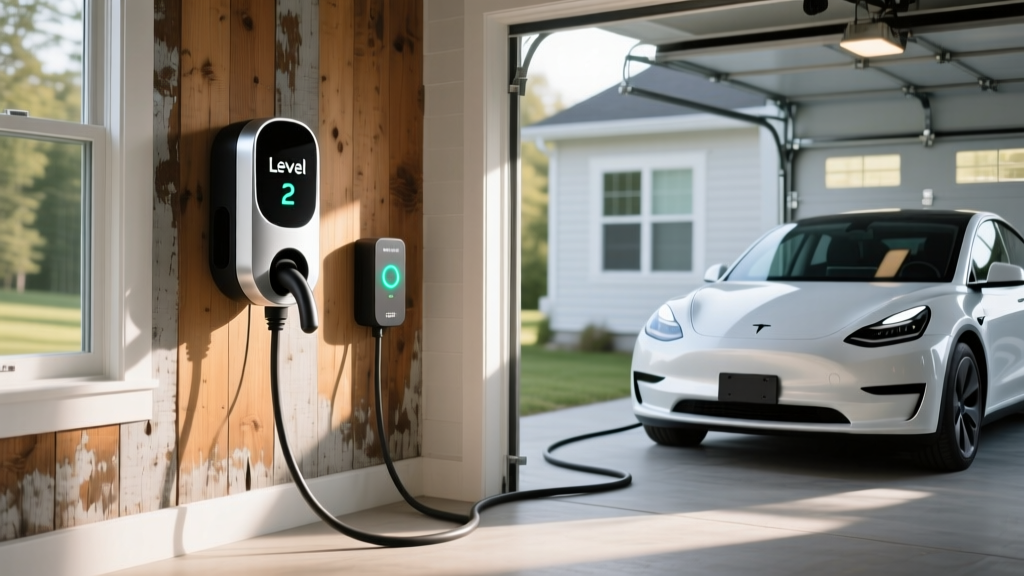
The Electrify America Home Charger operates at Level 2, delivering up to 11.5 kW. For a vehicle averaging 3.0 mi/kWh (typical for a mid-size crossover EV), that translates to roughly 34 miles of range per hour of charging. A 75 kWh battery going from 10% to 80% (52.5 kWh added) takes approximately 4.5 to 5 hours at this rate — perfect for overnight replenishment.
How Much Does It Cost to Install the Electrify America Home Charger?
The hardware MSRP of $549 is only part of the equation. Professional installation by a licensed electrician is required for any hardwired 48A charger (the EA Home Charger is hardwired, not plug-in), and costs vary dramatically based on your home's electrical panel and the distance from panel to charger location.
| Cost Component | Simple Install (panel nearby, capacity available) | Complex Install (long run, panel upgrade needed) |
|---|---|---|
| EA Home Charger hardware | $549 | $549 |
| 60A breaker + wiring (up to 20 ft run) | $300–$600 | $800–$1,500 (40+ ft run) |
| Permit & inspection | $100–$250 | $150–$400 |
| Electrical panel upgrade (100A → 200A) | N/A | $1,500–$3,500 |
| Labor (electrician, 2–6 hrs) | $400–$900 | $1,200–$2,500 |
| Total estimated cost | $1,350–$2,300 | $4,200–$8,450 |
What Electrical Upgrades Might I Need?
The EA Home Charger requires a 240V, 60A dedicated circuit. The National Electrical Code (NEC) requires that continuous loads (anything running 3+ hours, which EV charging qualifies as) use only 80% of a breaker's rated capacity — hence a 48A charger needs a 60A breaker.
Here's where many homeowners hit a wall: if your home has a 100A main service panel, you likely don't have enough spare capacity for a 60A EV circuit. A panel upgrade to 200A (or in some cases 300A) becomes necessary, adding $1,500–$3,500 to the project. Even with a 200A panel, if your existing loads (electric oven, dryer, HVAC) are already consuming most of the capacity, your electrician may recommend a load management device (such as the Emporia VUE or SPAN smart panel) that dynamically throttles the charger when other high-draw appliances kick on.
Always get a load calculation from your electrician before committing to a 48A charger. In some cases, stepping down to a 32A charger (requiring only a 40A breaker) can avoid a panel upgrade entirely while still delivering ~7.7 kW — enough to fully charge most EVs overnight.
Connector Compatibility: NACS, CCS1, and Adapters
The 2026 Electrify America Home Charger ships with a NACS (J3400) connector, reflecting the industry-wide shift. Every major automaker selling EVs in North America — Ford, GM, Hyundai/Kia, Rivian, Volvo, BMW, and others — has adopted NACS for 2025+ model-year vehicles.
| Connector | Brands Using It (2026 Models) | Compatible with EA Home Charger? |
|---|---|---|
| NACS (J3400) | Tesla (all), Ford, GM, Hyundai/Kia, Rivian, Volvo, BMW, Mercedes, Lucid | Yes — native |
| CCS1 (legacy) | 2024 and older Ford/GM/Hyundai/Kia/VW models, some 2025 carry-overs | Yes — with NACS-to-CCS1 adapter ($150–$250) |
| CHAdeMO | Nissan Leaf (discontinued 2025), older Mitsubishi | No — no practical adapter for Level 2 NACS to CHAdeMO |
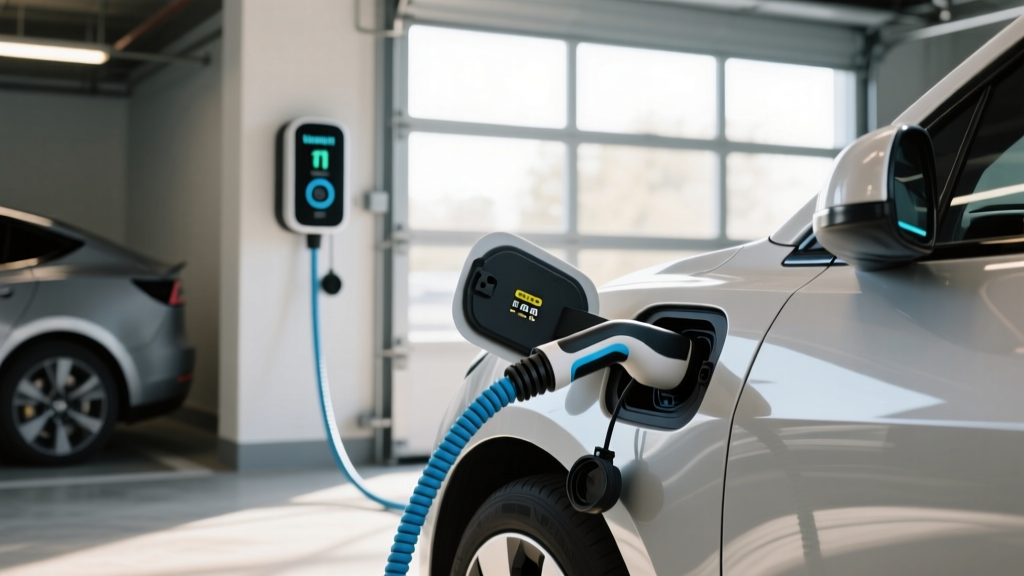
If you own a CCS1-equipped EV from the 2022–2024 model years (say, a Hyundai Ioniq 5 or VW ID.4), you'll need a NACS-to-CCS1 adapter to use the EA Home Charger. Ford and GM provide these adapters to owners; aftermarket options from Lectron and A2Z cost $150–$250. Make sure any adapter you buy is UL-listed.
CHAdeMO owners (primarily Nissan Leaf drivers) should look at chargers with a J1772 connector instead, as no reliable Level 2 NACS-to-CHAdeMO adapter exists. The ChargePoint Home Flex or Wallbox Pulsar Plus with J1772 are better fits.
Charging Time Benchmarks: 10–80% for Popular 2026 EVs
Here's how long a 10% to 80% charge takes on the Electrify America Home Charger at its full 11.5 kW output, compared to a basic 7.7 kW (32A) Level 2 setup:
| Vehicle (2026) | Battery (usable kWh) | Onboard Charger | 10–80% at 11.5 kW | 10–80% at 7.7 kW |
|---|---|---|---|---|
| Tesla Model Y Long Range | 75 kWh | 11.5 kW | ~4 hr 35 min | ~6 hr 50 min |
| Hyundai Ioniq 5 (Long Range AWD) | 80 kWh | 10.9 kW | ~5 hr 10 min | ~7 hr 15 min |
| Ford F-150 Lightning (Ext. Range) | 131 kWh | 11.5 kW | ~7 hr 55 min | ~11 hr 50 min |
| Chevy Equinox EV 3LT | 85 kWh | 11.5 kW | ~5 hr 10 min | ~7 hr 45 min |
| Toyota bZ4X | 64 kWh | 7.4 kW | ~4 hr 40 min* | ~5 hr 50 min* |
*Toyota bZ4X is limited by its 7.4 kW onboard charger — the EA Home Charger's extra capacity goes unused.
Cost to Charge: Home vs. Public vs. Gas
One of the strongest economic arguments for a home charger is the cost-per-mile advantage over both public charging and gasoline. Here's a breakdown using 2026 average rates:
| Scenario | Rate | Cost per kWh | Cost per Mile (at 3.0 mi/kWh) |
|---|---|---|---|
| Home — off-peak utility rate | $0.11/kWh avg | $0.11 | $0.037 |
| Home — standard rate (no TOU plan) | $0.16/kWh avg | $0.16 | $0.053 |
| Electrify America public DC (Guest) | $0.43–$0.56/kWh | $0.50 avg | $0.167 |
| Electrify America Pass+ ($7/mo) | $0.36–$0.48/kWh | $0.42 avg | $0.140 |
| Gas vehicle (28 MPG, $3.40/gal) | — | — | $0.121 |
At off-peak home rates, the Electrify America Home Charger delivers fuel at roughly 3.7 cents per mile — about one-third the cost of gasoline and one-quarter the cost of EA's own public DC fast chargers. Even on a standard utility rate with no time-of-use optimization, home charging at $0.053/mile is still less than half the cost of gas.
For a driver covering 12,000 miles per year, the annual fuel cost difference is stark: $444 on home off-peak charging vs. $1,452 on gasoline — a savings of over $1,000 annually. The EA Home Charger hardware pays for itself in fuel savings within roughly 18 months.
Equipment Comparison: EA Home Charger vs. the Competition
The Electrify America Home Charger doesn't exist in a vacuum. Here's how it compares to the other top Level 2 home chargers available in 2026:
Electrify America Home Charger
- Power: 11.5 kW (48A)
- Connector: NACS (CCS1 adapter available)
- Cable: 24 ft
- Smart Features: App scheduling, energy dashboard, OTA firmware updates
- Price: $549
- Pros: Strong brand ecosystem, 24-ft cable, clean industrial design
- Cons: No built-in load management, no plug-in (hardwired only), 3-year warranty is average
ChargePoint Home Flex (2026 NACS model)
- Power: 12.0 kW (50A) — configurable down to 16A
- Connector: NACS or J1772
- Cable: 23 ft
- Smart Features: App, Alexa, load sharing with second unit, adjustable amperage
- Price: $599
- Pros: Adjustable amperage avoids panel upgrades, plug-in (NEMA 14-50) or hardwired, strong app
- Cons: Slightly pricier, J1772 version feels dated for new NACS vehicles
Tesla Wall Connector (Gen 4)
- Power: 11.5 kW (48A)
- Connector: NACS native; J1772 adapter included
- Cable: 24 ft
- Smart Features: Wi-Fi, OTA updates, power sharing, vehicle-specific access control
- Price: $495
- Pros: Best price in class, Tesla integration, power sharing for multi-charger installs
- Cons: App experience is Tesla-centric, no utility demand-response integration
Wallbox Pulsar Max
- Power: 11.5 kW (48A)
- Connector: NACS or J1772
- Cable: 25 ft (longest in class)
- Smart Features: App, Eco-Smart mode (solar integration), load balancing
- Price: $599
- Pros: Solar-aware charging, longest cable, compact form factor, load balancing built in
- Cons: Customer support can be slow, app occasionally buggy
Our take: the Electrify America Home Charger is a solid mid-tier option at $549. It lacks the adjustable amperage of the ChargePoint Home Flex (which can save you a panel upgrade) and the aggressive pricing of the Tesla Wall Connector. But if you're already an Electrify America app user who road-trips on their DC network, the unified ecosystem has real convenience value. The 24-foot cable is generous, and the NACS-native design is correct for 2026.
Safety, Code, and Installation Best Practices
Any 48A hardwired charger must comply with NEC Article 625 (Electric Vehicle Charging System Equipment). Key requirements and best practices:
- Dedicated circuit: The charger must be on its own 60A breaker — no sharing with other appliances.
- GFCI protection: NEC 2023 and later require GFCI protection for all EVSE. Hardwired units typically have built-in ground-fault protection; confirm your unit is UL-listed to UL 2231-1/2 for personnel protection.
- Outdoor rating: If installing outside, the unit must be rated NEMA 4 or higher. The EA Home Charger carries a NEMA 4 rating, making it suitable for exterior walls in rain, snow, and dust.
- Wire gauge: A 60A circuit requires 6 AWG copper wire (THHN in conduit or NM-B/Romex rated for 60A). For runs over 50 feet, your electrician may upsized to 4 AWG to limit voltage drop.
- Permit and inspection: Most jurisdictions require an electrical permit for EVSE installation. Skipping the permit risks insurance claim denials and code violations. Budget $100–$400 for permit and inspection fees.
- Utility notification: Some utilities require you to notify them before installing a Level 2 charger, especially if you're on a time-of-use rate plan. Many offer rebates of $250–$1,000 for certified smart chargers — check with your local utility.
Federal and State Incentives for Home Charger Installation
The federal §30C Alternative Fuel Vehicle Refueling Property Credit covers 30% of home EV charger hardware and installation costs, up to a maximum of $1,000, according to IRS guidelines. However, there's a significant geographic restriction: the credit is only available for installations in census tracts classified as low-income or non-urban. Check your eligibility using the Argonne/DOE AFDC tool before counting on this credit.
Many state and utility-level programs offer additional rebates regardless of census tract. California's utility programs (PG&E, SCE, SDG&E) have historically offered $500–$1,500 for Level 2 installations. New York's NYSERDA program provides up to $1,200. These programs change frequently — always verify current availability with your utility or state energy office.
Who Should Buy the Electrify America Home Charger?
Choose the EA Home Charger if:
- You drive a NACS-equipped 2025+ EV and want a straightforward 11.5 kW charger
- You already use the Electrify America app and DC network for road trips
- Your electrical panel has a spare 60A capacity and the run distance is short
- You value a 24-foot cable for flexible parking configurations
Consider an alternative if:
- Your panel is maxed out and you need adjustable amperage (get the ChargePoint Home Flex)
- You drive a Tesla and want the lowest price and deepest integration (get the Tesla Wall Connector)
- You have home solar and want solar-aware charging (get the Wallbox Pulsar Max)
- You drive a CHAdeMO vehicle like a legacy Nissan Leaf (get a J1772 charger instead)
Frequently Asked Questions
Can I install the Electrify America Home Charger myself?
No. The EA Home Charger is a hardwired unit requiring a 240V, 60A dedicated circuit. This work must be performed by a licensed electrician to meet NEC code and maintain your homeowner's insurance coverage. DIY installation of high-amperage circuits is a fire and electrocution hazard.
Does the EA Home Charger work with my older CCS1 EV?
Yes, but you'll need a NACS-to-CCS1 adapter. Ford, GM, and some other automakers have distributed these adapters to existing owners. Aftermarket UL-listed adapters from Lectron and A2Z are available for $150–$250. Ensure the adapter is rated for at least 48A continuous use.
How fast will the Electrify America Home Charger add range?
At its full 11.5 kW output, expect approximately 30–40 miles of range added per hour of charging, depending on your vehicle's efficiency. A Tesla Model Y (EPA 320 miles, ~25 kWh/100mi) gains roughly 38 miles per hour. A heavier Ford F-150 Lightning (~47 kWh/100mi) gains roughly 24 miles per hour.
Is a 48A charger overkill if I only drive 30 miles a day?
Possibly. If your daily driving is under 40 miles and you charge every night, even a 32A (7.7 kW) charger replenishes your daily use in about 2 hours. The advantage of 48A is faster recovery after long trips — going from 20% to 80% overnight rather than requiring a full 10+ hour charge. Consider your worst-case scenario, not your average day.
What happens during a power outage?
The EA Home Charger stops charging immediately and resumes automatically when power returns. If you had a scheduled charging session in progress, the app will notify you that the session was interrupted. For backup power scenarios, vehicles with V2H (vehicle-to-home) capability — like the Ford F-150 Lightning with Ford Charge Station Pro — can power your home, but this requires a separate bidirectional charger and transfer switch, not the EA Home Charger.
Does Electrify America offer a plug-in (NEMA 14-50) version?
As of 2026, the EA Home Charger is hardwired only. If you want a plug-in unit on a NEMA 14-50 receptacle (useful for portability or renter-friendly installs), the ChargePoint Home Flex and Tesla Wall Connector both offer plug-in configurations at similar power levels.
Sources: Electrify America Home Charging, IRS §30C Credit, NFPA NEC Article 625, EPA Fuel Economy.