Quick Verdict: What Tesla Charging Speed Can You Actually Expect?
If you're shopping for a Tesla or evaluating home charging, the headline number — 250 kW peak at a Supercharger — only tells part of the story. Real-world Tesla charging speed depends on which level you're using, your battery's state of charge (SoC), ambient temperature, and whether the car has preconditioned its pack. A Model 3 Long Range (79 kWh usable, NMC chemistry) can add roughly 200 miles in 15 minutes at a V3 Supercharger under ideal conditions, but that same session stretches past 45 minutes on a cold day without preconditioning.
This guide breaks down every charging tier, what it costs to install at home, what you'll pay per mile, and which equipment actually delivers on its promises.
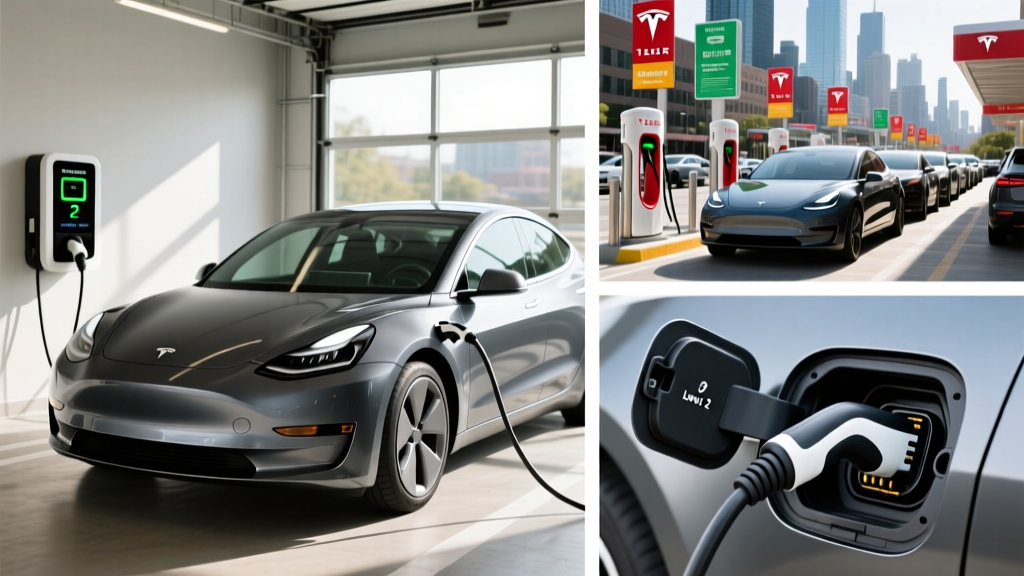
Tesla Charging Speed by Level: kW, Miles Per Hour, and 10-80% Times
Before we get into hardware, let's nail the terminology. kW (kilowatts) measures power — how fast energy flows into the battery. kWh (kilowatt-hours) measures energy capacity — how much the battery holds. Think of kW as the flow rate of a hose and kWh as the size of the bucket.
| Level | Voltage / Amps | Power (kW) | Miles of Range / Hour | Typical Use Case |
|---|---|---|---|---|
| Level 1 | 120V / 12A | ~1.4 kW | 3–5 mi/hr | Overnight trickle, emergency |
| Level 2 (Mobile Connector) | 240V / 32A | ~7.7 kW | 25–30 mi/hr | Home daily charging |
| Level 2 (Wall Connector) | 240V / 48A | ~11.5 kW | 35–44 mi/hr | Home daily, faster turnaround |
| Level 2 (Wall Connector max) | 240V / 60A circuit | ~11.5 kW (car-limited on Model 3/Y) | 35–44 mi/hr | Model S/X can accept up to 17 kW |
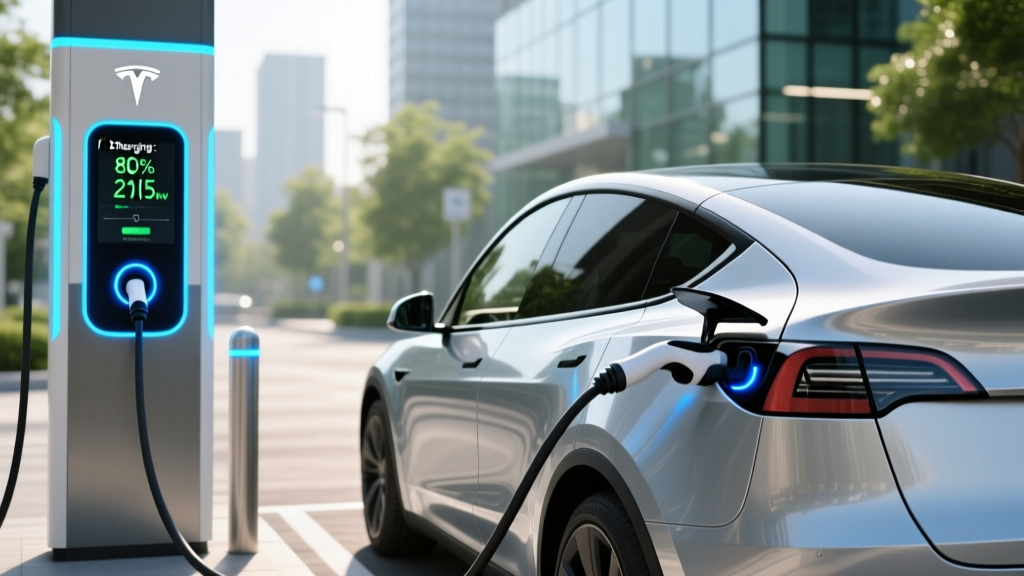
| DC Fast (V3 Supercharger) | 400V architecture | Up to 250 kW peak | ~1,000 mi/hr (at peak) | Road trips, rapid top-ups |
| DC Fast (V4 Supercharger) | Up to 800V capable | Up to 350 kW (announced) | ~1,200+ mi/hr (at peak) | Next-gen Supercharger stalls |
Real-World Charging Time: 10-80% SoC
Peak kW is never sustained across the full session. The charge curve tapers significantly above ~50% SoC and drops sharply past 80%. Here are realistic 10-80% times for common Tesla models at a V3 Supercharger (250 kW peak) with a preconditioned battery in moderate temperatures:
- Model 3 Long Range (79 kWh): ~25–28 minutes
- Model Y Long Range (81 kWh): ~27–30 minutes
- Model S (100 kWh): ~30–35 minutes
- Cybertruck (123 kWh): ~35–40 minutes
In cold weather (below 32°F / 0°C) without preconditioning, add 30–50% to these times. Always navigate to a Supercharger using the car's built-in routing to trigger automatic battery preconditioning.
Home Charger Installation: Electrical Requirements and Costs
Most Tesla owners do 80%+ of their charging at home. The Tesla Wall Connector is the default choice, but installation complexity varies enormously depending on your home's electrical panel.
Electrical Requirements
The Tesla Wall Connector can be configured for circuits from 15A to 60A. The most common residential setup is a 240V / 60A dedicated circuit (which delivers up to 48A continuous to the car, per NEC 80% derating rules). This requires:
- A double-pole 60A breaker in your main or sub-panel
- 6 AWG copper wire (or 4 AWG aluminum) run from panel to charger location
- A NEMA 14-50 outlet (if using a plug-in configuration) or hardwired connection
- GFCI protection (required by NEC 2020 and later for EV outlets in garages)
When You Need a Panel Upgrade
If your home has a 100A main panel (common in homes built before 1990), adding a 60A EV circuit may exceed your panel's capacity — especially if you already run electric range, dryer, and HVAC. An electrician will perform a load calculation (NEC Article 220) to determine if you need a panel upgrade to 200A. This is one of the most underestimated costs in EV ownership.
| Component | Low End | High End | Notes |
|---|---|---|---|
| Tesla Wall Connector (hardware) | $400 | $475 | Gen 3, 24' cable, Wi-Fi enabled |
| Electrician labor (standard install) | $600 | $1,800 | Depends on wire run distance, wall type |
| Permit and inspection | $100 | $350 | Varies by municipality |
| Electrical panel upgrade (if needed) | $1,500 | $3,500 | 100A → 200A service upgrade |
| Total (no panel upgrade) | $1,100 | $2,625 | Typical suburban home with 200A panel |
| Total (with panel upgrade) | $2,600 | $6,125 | Older home needing service upgrade |
Some utilities offer rebates of $250–$750 for Level 2 charger installation. Check with your local utility before scheduling work. The federal Alternative Fuel Vehicle Refueling Property Credit (IRC §30C) covers up to 30% of home charger hardware and installation costs (capped at $1,000) for eligible taxpayers in qualifying census tracts — confirm eligibility with a tax professional.
Connector Compatibility: NACS, CCS, and Adapter Reality
Tesla's North American Charging Standard (NACS) connector has become the de facto industry standard. As of 2025-2026, nearly every major automaker — Ford, GM, Rivian, Volvo, BMW, Hyundai, and others — has adopted NACS or committed to offering NACS-equipped vehicles. This means Tesla owners have the simplest connector situation in the market.
| Connector | Tesla Vehicles | Non-Tesla EVs (2026) | Adapter Needed? |
|---|---|---|---|
| NACS (Tesla native) | All Tesla models (native) | Ford, GM, Rivian, Volvo, BMW, Hyundai (new models) | None for Tesla |
| CCS1 | Not native | Older VW ID.4, Hyundai Ioniq 5 (pre-2025), legacy models | Tesla sells CCS adapter (~$175) |
| CHAdeMO | Not native | Nissan Leaf (legacy, being phased out) | Third-party adapter required; not recommended |
| J1772 (Level 2 AC) | Adapter included with Tesla | All non-Tesla EVs | Tesla includes J1772-to-NACS adapter |
Key takeaway: Tesla owners can use any Supercharger natively, and can access Electrify America, EVgo, and other CCS networks using the optional CCS adapter. For Level 2 public charging (J1772 stations), the included adapter handles it. Tesla owners face the fewest compatibility headaches of any EV buyer.
Cost to Charge a Tesla: Home vs. Public vs. Gas
Charging cost is where EVs typically win decisively — but the gap narrows or disappears depending on where and when you charge.
| Scenario | Rate / Price | Cost Per Mile (Model 3 LR, ~4 mi/kWh) | Cost Per Mile (Gas Sedan, 30 MPG) |
|---|---|---|---|
| Home charging (off-peak utility rate) | $0.10/kWh | $0.025 | — |
| Home charging (national avg. residential) | $0.16/kWh | $0.040 | — |
| Tesla Supercharger (national avg.) | $0.32/kWh | $0.080 | — |
| Third-party DC fast (Electrify America, etc.) | $0.45/kWh | $0.113 | — |
| Gasoline (national avg. $3.50/gal) | $3.50/gal | — | $0.117 |
| Gasoline (California avg. $4.80/gal) | $4.80/gal | — | $0.160 |
What this means in practice: A Tesla owner who charges 80% at home (national average rate) and 20% on Superchargers pays roughly $0.048/mile — less than half the cost of a 30 MPG gas sedan at national fuel prices. Over 15,000 miles/year, that's approximately $720 in electricity vs. $1,750 in gasoline, a savings of ~$1,030 annually.
However, if you rely exclusively on public DC fast charging at $0.40–$0.50/kWh, your per-mile cost can approach or exceed gasoline. Home charging access is the single biggest economic factor in EV ownership.
Best Home Chargers for Tesla Owners: Equipment Picks
The Tesla Wall Connector is the obvious default, but it's worth understanding the landscape — especially if you have a non-Tesla EV alongside your Tesla, or want specific smart features.
Tesla Wall Connector (Gen 3)
- Power output: Up to 11.5 kW (48A on a 60A circuit)
- Connector: NACS (native Tesla)
- Cable length: 24 feet
- Smart features: Wi-Fi, OTA updates, power-sharing between two units on one circuit, access control
- Price: ~$400–$475
- Best for: Tesla-only households; cleanest integration
ChargePoint Home Flex
- Power output: Up to 12 kW (50A on a 60A circuit), configurable down to 16A
- Connector: NACS or J1772 (select at purchase)
- Cable length: 23 feet
- Smart features: Wi-Fi, app scheduling, utility demand-response integration, Alexa
- Price: ~$550–$650
- Best for: Mixed-EV households; utility rate optimization
Emporia Vue Level 2 Charger
- Power output: Up to 11.5 kW (48A)
- Connector: NACS or J1772
- Cable length: 24 feet
- Smart features: Integrated energy monitoring (pairs with Emporia Vue panel monitor), solar-aware scheduling
- Price: ~$400–$500
- Best for: Solar-equipped homes; energy-usage tracking
For Tesla-only homes, the Wall Connector's seamless integration and power-sharing capability (two chargers on one 60A circuit) make it hard to beat. If you own or plan to own a non-Tesla EV, the ChargePoint Home Flex with a NACS plug offers flexibility and robust app controls.
Safety and Electrical Code Considerations
EV charging draws sustained high current for hours — more like a continuous-duty appliance than a typical household load. Proper installation is non-negotiable.
- Dedicated circuit: Your Level 2 charger must be on its own dedicated circuit — never shared with other outlets or appliances.
- NEC 80% rule: Continuous loads (defined as 3+ hours, which EV charging always is) can only use 80% of a circuit's rated capacity. A 60A circuit delivers 48A continuous; a 50A circuit delivers 40A continuous.
- GFCI protection: NEC 2020+ requires GFCI protection for EV charging outlets in garages. Hardwired installations may not require a separate GFCI breaker depending on your local AHJ (Authority Having Jurisdiction) — ask your electrician.
- Outdoor rating: If installing outdoors, ensure the charger carries a NEMA 4 (weatherproof) rating. The Tesla Wall Connector is rated for indoor and outdoor use.
- Permit and inspection: Virtually all jurisdictions require an electrical permit for a new 240V circuit. Skipping the permit risks insurance claim denial in the event of an electrical fire.
- Wire gauge: Your electrician must size wire correctly for the circuit amperage and run length. Long runs (over 100 feet) may require upsized wire to prevent voltage drop.
Frequently Asked Questions
How much does it cost to install a home EV charger for a Tesla?
A standard Tesla Wall Connector installation on an existing 200A panel typically costs $1,100–$2,625 total (hardware, electrician labor, and permit). If your home needs a panel upgrade from 100A to 200A, add $1,500–$3,500, bringing the total to $2,600–$6,125. Always get 2-3 quotes from licensed electricians.
How fast will each charging level add range to my Tesla?
Level 1 (120V) adds 3–5 miles per hour. Level 2 on a 48A circuit adds 35–44 miles per hour — enough to fully replenish a Model 3 Long Range overnight in about 8–9 hours. DC fast charging at a V3 Supercharger adds up to 200 miles in 15 minutes at peak rate, though the curve tapers significantly above 50% SoC.
Which connector and charger is compatible with my Tesla?
All Tesla vehicles use the NACS connector natively. The Tesla Wall Connector and Mobile Connector both use NACS. For non-Tesla J1772 Level 2 public chargers, Tesla includes a J1772-to-NACS adapter. For CCS DC fast chargers (Electrify America, EVgo), Tesla sells an optional CCS-to-NACS adapter for approximately $175.
How much does charging a Tesla cost per mile compared to gas?
At the national average residential electricity rate ($0.16/kWh), a Model 3 Long Range costs about $0.04/mile to charge at home. A comparable 30 MPG gas sedan at $3.50/gallon costs $0.12/mile. Home charging is roughly one-third the cost of gasoline per mile. Public DC fast charging at $0.32–$0.48/kWh narrows the gap to $0.08–$0.12/mile.
What electrical upgrades might I need for a home charger?
The most common upgrade is a panel capacity increase from 100A to 200A if your existing panel can't accommodate a new 60A circuit alongside your other loads. Your electrician will perform a NEC Article 220 load calculation. Other potential needs: a sub-panel if the charger is far from the main panel (e.g., detached garage), or a whole-home energy management system to avoid a panel upgrade by intelligently shedding loads.
Does the Tesla Mobile Connector work as a permanent home charger?
It can, but it's limited. The Mobile Connector with a NEMA 14-50 plug delivers up to 32A (~7.7 kW, ~25–30 mi/hr) on a 240V outlet. For most daily driving (30–50 miles), this is sufficient. However, the Wall Connector delivers up to 48A (~44 mi/hr), which matters if you regularly drive 200+ miles and need faster turnaround. Tesla also recommends against leaving the Mobile Connector plugged in permanently as a primary charger — it's designed for portability.
Why does my Tesla charge slower than the posted Supercharger kW rating?
Several factors reduce actual charging speed below the posted maximum: (1) State of charge — the car accepts peak power only between roughly 10-50% SoC, then tapers. (2) Battery temperature — cold batteries charge much slower; always navigate to the Supercharger via the car's routing to trigger preconditioning. (3) Supercharger sharing — at V3 stalls, sharing a paired stall with another vehicle no longer splits power, but at older V2 stalls it does. (4) Battery health — heavily degraded or very high-mileage batteries may accept slightly lower peak power. See Tesla's Supercharger support page for stall-specific details.
Sources: EPA efficiency data from fueleconomy.gov; Tesla Wall Connector specs from tesla.com/home-charging; federal charger tax credit rules from irs.gov.